Here is something that has been bugging me lately: brands keep plastering "sustainable" and "supports small farmers" on their jars, but does anyone actually believe them? I ran a study with six American consumers to find out what really makes them grab one jar of coconut oil over another, and whether all that feel-good messaging translates into sales.
The answer was pretty unanimous: not really. At least, not without receipts.
The Participants
Six participants from across the United States: a volunteer caregiver in rural Indiana, a construction manager in San Antonio, a facilities manager in Philadelphia, a chauffeur in Cleveland, a corporate counsel in rural Hawaii, and a stay-at-home parent in rural South Carolina. Ages ranged from 30 to 55, household incomes from SNAP-dependent to six figures. What united them? They all buy coconut oil regularly and they all have finely tuned nonsense detectors when it comes to food marketing.
Does "Rooted in Healthy Food" Move the Needle?
I asked participants if seeing a brand claim they are "rooted in healthy food" and support sustainable agriculture would influence their purchase decision. The consensus was swift and brutal.
"Not much. That sounds like marketing talk to me," said Dana from Indiana. "I buy on price per ounce, taste, and if the jar is glass so I can reuse it."
Roque from Cleveland put it more bluntly: "That rooted in healthy food talk sounds like a bumper sticker. I am buying on price per ounce, clean smell, and a jar that does not make a greasy mess."
The pattern was clear: sustainability messaging without proof is just noise. Participants wanted to see real certifications they recognised, traceable sourcing with country and farm names, and third-party audits they could verify.
Sandie from Hawaii, a corporate counsel who knows her way around contracts, was particularly rigorous: "That reads like copy. I need hard details or I pass. I care about stewardship, but I do not buy slogans."
Key insight: Sustainability messaging only earns shelf space when paired with specific, verifiable proof. Vague claims about "healthy food" and "sustainable agriculture" register as marketing noise to budget-conscious consumers.
What Actually Drives the Purchase?
When I asked participants to walk me through their actual purchase criteria, the priorities became crystal clear:
Price per ounce rules everything. Every single participant mentioned this first.
Packaging matters: wide-mouth glass jars for coconut oil (it gets solid in cold weather), tight seals, no leaks.
Type clarity: refined for neutral cooking, virgin/unrefined for coconut flavour.
Sensory signals: clean white colour, mild coconut smell (not plasticky or funky).
Ingredient simplicity: should just say "coconut oil" with nothing else.
James from Philadelphia summed it up: "I keep it simple. I do not chase fancy labels. Price per ounce, type, jar, look, ingredients, date and seal, smell after opening."
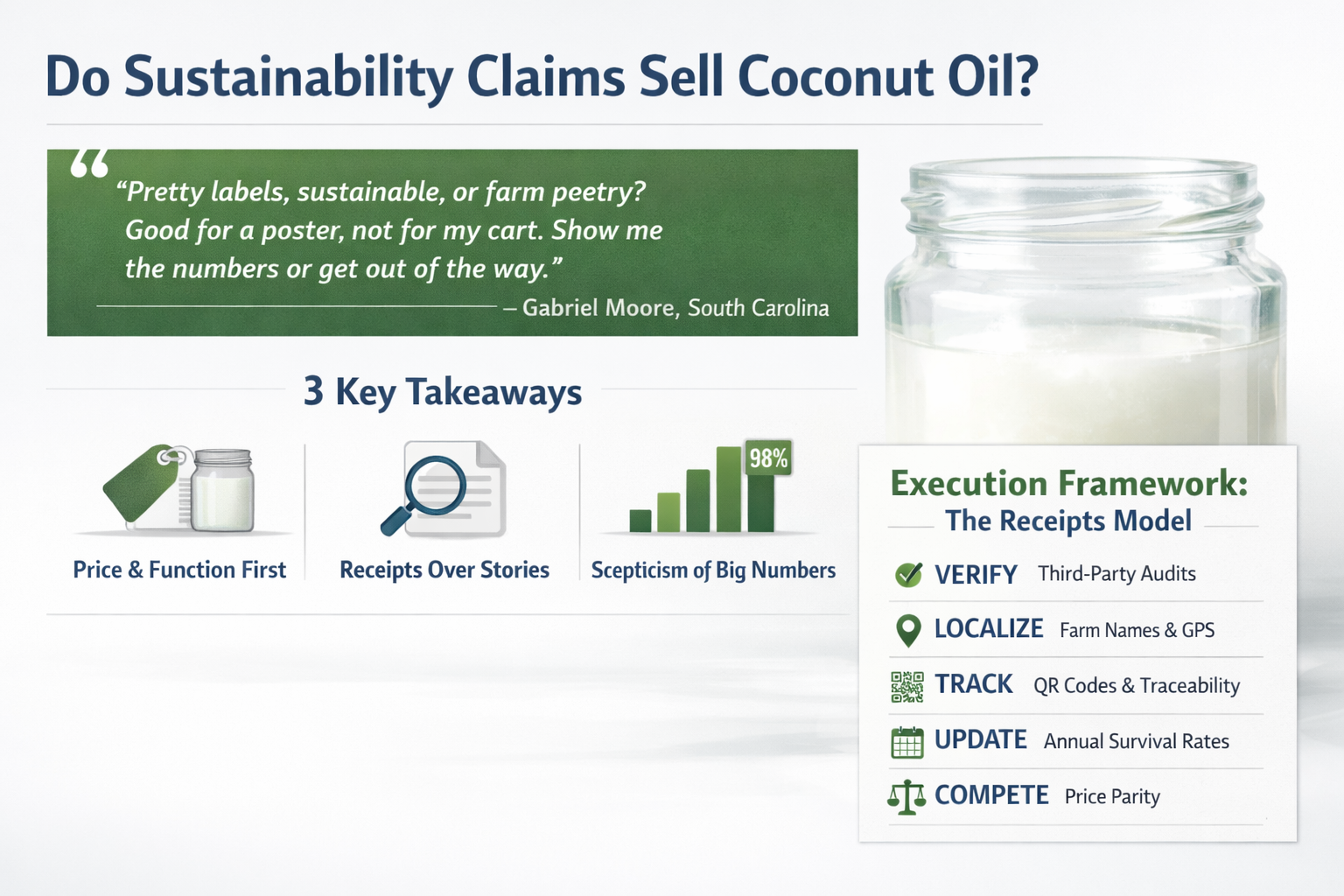
Gabriel from South Carolina, managing a household on SNAP, was even more direct: "Pretty labels, sustainable, or farm poetry? Good for a poster, not for my cart. Show me the numbers or get out of the way."
Key insight: Functional criteria trump aspirational messaging. Consumers make decisions based on price, packaging practicality, and sensory quality, not brand storytelling.
The "100,000 Seedlings" Test
Here is where it got really interesting. I asked participants: if a brand told you they planted 100,000 coconut seedlings to support small farmers, would that make you more likely to buy?
The answer was a resounding "not really" unless backed by serious proof.
Roque from Cleveland nailed it: "Seedlings are like New Year goals. Looks good day one, most do not last without follow-through."
Participants demanded:
Survival rates, not just planting counts ("How many are still alive after 1-2 years?")
Specific farm and co-op names with GPS locations, not "somewhere in Southeast Asia"
Third-party audits from independent verifiers, not the company's own blog
Farmer economics (long-term purchase agreements, fair prices, training)
Real photos with dates, geotagged, showing the same farmers over time
Batch traceability via QR codes linking to origin data
Efren from San Antonio summed up the Latino consumer perspective: "Show me it is not just a press release. What percent of my purchase funds this, even if it is small. Keep it simple and clear. And a WhatsApp contact and Spanish info would help."
Key insight: Big round numbers trigger scepticism, not trust. Consumers want survival rates, not planting totals. They want "boring PDFs and trend lines," not glossy marketing materials.
What This Means for Coconut Oil Brands
If you are marketing organic coconut oil or superfood products, here is what actually moves the needle:
Lead with price competitiveness. Sustainability claims only matter "if the price is the same." No one is paying a premium for slogans.
Invest in packaging that works. Wide-mouth glass jars with tight seals beat fancy labels every time. "If your jar greases my pantry, I do not care how many seedlings you planted."
Show receipts, not stories. Name specific farms, survival rates, audit dates, and farmer economics. Make it accessible via QR codes without data harvesting.
Localise your proof. Spanish translations, WhatsApp contacts for Latino markets, clear shipping policies for Hawaii and other island markets.
Update annually and admit failures. "Next year, update the number and admit what died. I respect honest numbers more than puffed-up totals."
The Bottom Line
American consumers are not opposed to sustainability claims. They are opposed to empty ones. The market opportunity is real for brands willing to do the work: build traceable supply chains, publish verifiable data, and compete on price. The brands that figure this out will convert sceptical shoppers into loyal repeat buyers.
As Gabriel from South Carolina put it: "If two jars cost the same and yours shows real receipts and real people, sure, I will grab yours. If you expect me to pay extra for a slogan, nope. Show me the numbers or move along."
Want to test your own coconut oil positioning? Ditto lets you run studies like this in hours, not weeks. Book a demo at askditto.io.
What the Research Revealed
We asked real consumers to share their thoughts. Here is what they told us:
When you see an organic coconut oil brand claim they are "rooted in healthy food" and support sustainable agriculture, does that influence your purchase decision?
Roque Franks, 39, Chauffeur/Driver, Parma city, OH, USA:
Not really. That rooted in healthy food talk sounds like a bumper sticker, so I am buying on price per ounce, clean smell, and a jar that does not make a greasy mess. Sustainable is cool, but I need proof I recognise and no upcharge for the same coconut oil.
Dana Driscoll, 32, Volunteer Caregiver, Rural, IN, USA:
Not much. That sounds like marketing talk to me. I buy on price per ounce, taste, and if the jar is glass so I can reuse it. I want the label to just say coconut oil. A real seal helps a little if the price is close. I will not pay extra for buzzwords when the Aldi one works fine.
Sandie Winegar, 55, Corporate Counsel, Rural, HI, USA:
No, not by itself. That reads like copy. I need hard details or I pass. I care about stewardship, but I do not buy slogans. Real certifications I recognise, traceable sourcing with country and co-op name, labor assurance with third-party audit, packaging that survives Hawaii shipping.
What makes you pick one coconut oil or MCT oil brand over another?
James Rodriguez, 36, Facilities Manager, Philadelphia city, PA, USA:
I keep it simple. I do not chase fancy labels. For coconut oil: price per ounce, type (refined for no coconut taste, virgin if I want the smell), jar (wide mouth, easy lid), look (white, clean, not yellow), ingredients (just 100% coconut oil), date and seal (no loose cap), smell after opening (real coconut or neutral).
Efren Hernandez, 41, Construction Manager, San Antonio city, TX, USA:
I am cheap but picky. I do not care about hype. I care about how it cooks, how it smells, and whether the jar is gonna make a mess in my pantry. Price per ounce first, one ingredient only, use-case (refined for neutral, unrefined for baking), smell and texture (clean, not plasticky).
Gabriel Moore, 30, Stay-at-Home Parent, Rural, SC, USA:
I grab the cheapest decent jar that will not make a mess. Unit price first, refined for cooking so it does not make everything taste like a coconut cookie, wide-mouth jar with tight lid. Pretty labels, sustainable, or farm poetry? Good for a poster, not for my cart. Show me the numbers or get out of the way.
If a brand told you they planted 100,000 coconut seedlings to support small farmers, would that make you more likely to buy?
Roque Franks, 39, Chauffeur/Driver, Parma city, OH, USA:
Only a little. Cool story, but I still buy on price per ounce. Seedlings are like New Year goals - looks good day one, most do not last without follow-through. Show me specifics: where, when, who, third-party check, survival rate (planted vs alive after 12-24 months), money trail, real proof with time-stamped pics.
Efren Hernandez, 41, Construction Manager, San Antonio city, TX, USA:
A little, but only if they prove it and the price stays sane. Planting 100,000 seedlings sounds big, but seedlings die. Show me where and when (exact regions, co-ops, dates), third-party receipts, survival rate, farmer benefit (long-term agreements at fair price), money trail, batch traceability. Spanish info and WhatsApp contact would help.
Sandie Winegar, 55, Corporate Counsel, Rural, HI, USA:
No, not by itself. Big round numbers do not feed into my cart. What would make it credible: independent verification (name the auditor, publish audited count with survival rates at 12 and 24 months), where and with whom (country, districts, GPS map, co-op names), farmer terms (who owns trees, price floor, purchase contracts), traceability to the jar.