"Your favourite childhood snacks made better." It is the kind of tagline that either makes you reach for your wallet or roll your eyes. I ran a study with six American consumers to find out which reaction is more common, and what it would take for an heirloom snack brand to convert sceptics into buyers.
The verdict? Mostly eye rolls. But with a clear path to winning them over.
The Participants
Six participants from across the United States: a logistics coordinator in Fort Worth, an operations manager in Tampa, an investment banker in rural New Jersey, a former beverage sales rep in Brooklyn Park, a sales representative in Philadelphia, and a stay-at-home parent in rural Ohio. Ages ranged from 28 to 46, incomes from tight SNAP budgets to $200k+ households. What united them? They all buy snacks regularly, and they all have seen enough "heirloom" marketing to be deeply sceptical.
Does "Heirloom" Build Trust?
I asked participants: when you see a snack brand claim "heirloom" or "heritage" ingredients, what is your first reaction? Does it make you trust the product more?
The answer was swift and nearly unanimous: side-eye.
Natalie from Fort Worth captured the sentiment: "My first reaction is a little eye-roll. In my garden, heirloom means a specific variety with quirks and real flavour. On a bag of chips or crackers, it usually reads like marketing fluff slapped on to charge extra."
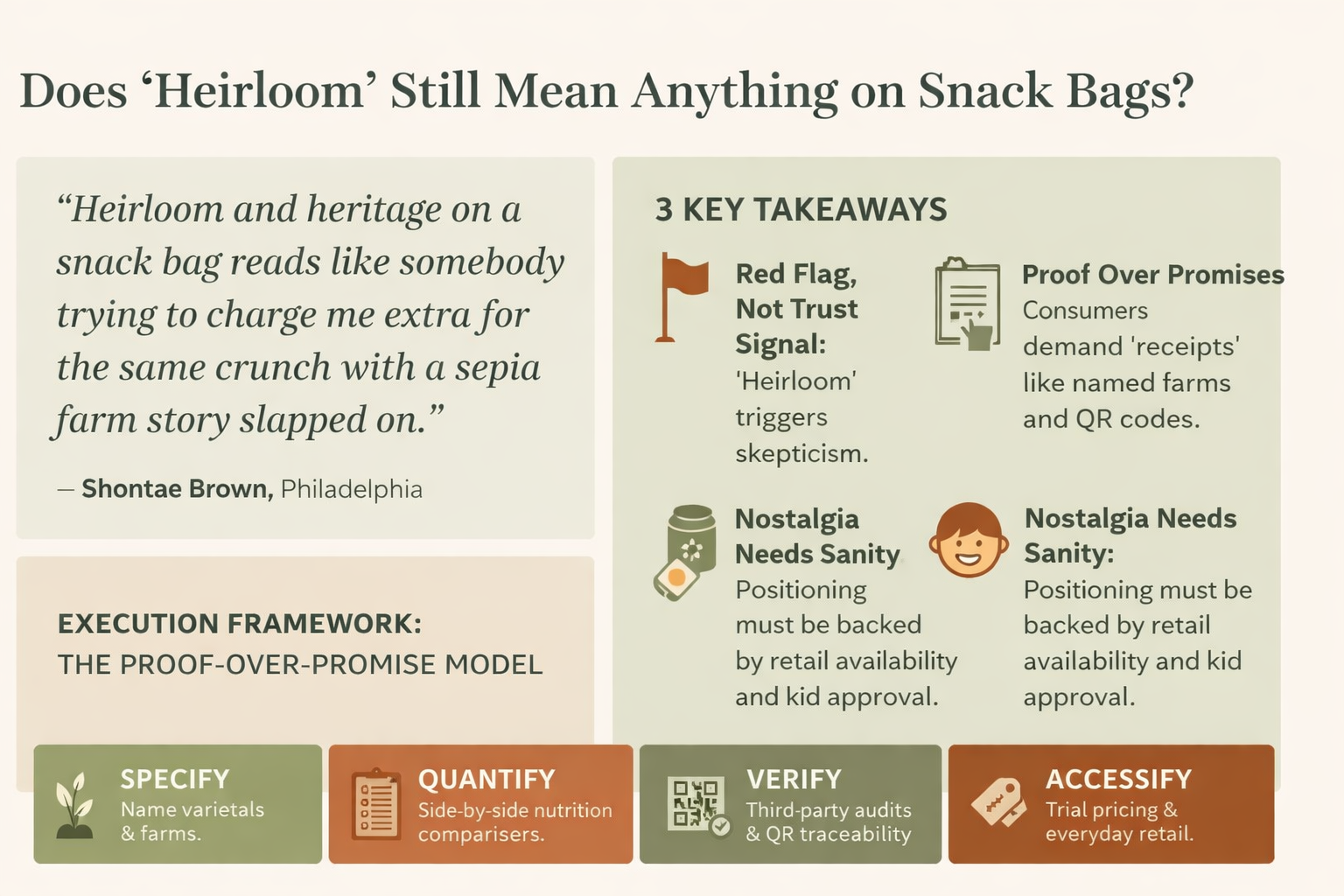
Shontae from Philadelphia was even more direct: "Side-eye. Heirloom and heritage on a snack bag reads like somebody trying to charge me extra for the same crunch with a sepia farm story slapped on."
The pattern was clear: "heirloom" has become a devalued term. Consumers have seen it used so loosely that it triggers scepticism rather than trust.
Kathryn from rural Ohio put it perfectly: "Nine times out of ten it feels like somebody slapped a storybook font on a bag and added two bucks to the price."
Key insight: "Heirloom" alone is not a trust signal. It is a red flag that requires proof to overcome. Brands using this positioning need to show, not just claim, what makes their ingredients different.
What Would Make Them Believe It?
Despite the scepticism, participants were not closed off. They had clear criteria for what would convert them from eye-roll to purchase:
Name the variety and origin - "Not just heirloom corn, which farms, which varietal, which harvest"
Explain what is actually better - fewer junk ingredients, cleaner oil, lower salt without tasting like cardboard
Side-by-side transparency - "A simple panel that compares your bag to the classic version on crunch, ingredients, and salt"
Price sanity - "If it is boutique-priced for a toddler-sized portion, I am out"
Traceable batches - QR codes linking to farm info, harvest window, processing date
Real reviews - "Reviews from normal folks, not influencers"
David from New Jersey summarised the standard: "Heirloom is a fuzzy word unless you tell me what, where, and how it improves anything I can taste or measure."
Key insight: Proof is the pathway to trust. Specific varietals, named farms, clear comparisons to mainstream alternatives, and batch-level traceability can convert sceptics. Vague heritage stories cannot.
Would They Pay the Premium?
I asked participants directly: would you pay 25-30% more for snacks from a brand that sources from small family farms and practices regenerative agriculture?
The answer split into three camps: "no" (for weekly snacks), "sometimes" (for special occasions), and "maybe" (if they prove it).
Shontae from Philadelphia, managing a tight budget with two kids, was direct about the economics: "25-30% is real money. For snacks, I shop Aldi and ShopRite on Sundays. If you want me to pay that premium, it has to either replace another spend or keep my kids full longer so I am not buying a second jawn midweek."
Even David, with a $200k+ household income, was cautious: "For weekly snacks, no. I am not paying a 25-30% greenwash tax. I would pay that premium only if taste beats our current go-tos, the nutrition is clearly better, and the proof on farming is tight and auditable."
What they would need to believe the claims:
Third-party verification - "A real third-party scheme with audits I can read"
Farm-level data - soil organic matter, reduced inputs, cover crop acreage
Farmer economics - "Percent of retail price reaching the farm, contract length, price floors"
Price transparency - "Where the extra 25-30% goes. Show farm pay vs packaging vs marketing."
Nutrition that justifies it - lower sodium, better protein/fiber, cleaner ingredients
Annual impact reports - "With baselines, goals, misses, and course corrections. No cherry-picking."
Key insight: Premium pricing requires premium proof. Consumers will consider paying 25-30% more, but only with third-party verification, transparent farmer economics, and nutrition that justifies the premium. "Regenerative" without receipts is just greenwashing.
The "Childhood Snacks Made Better" Positioning
Finally, I tested Pipcorn's specific positioning: "Your favourite childhood snacks made better" using heirloom corn from family farms. Does that message resonate?
The response was lukewarm at best.
Natalie from Fort Worth did not mince words: "Your favourite childhood snacks made better hits my eye-roll button. It sounds like a food-marketing Mad Libs. And heirloom gets tossed around so much it is basically a sticker until someone shows receipts."
Alyson from Tampa agreed: "It half works on me, half makes my eye twitch. Childhood snacks made better feels like nostalgia with a price hike unless they show receipts."
But participants also offered a roadmap for making the positioning work:
Specificity over sentiment - Name the farms, the varietal, the harvest timing
Define "better" - "Fewer junk ingredients, cleaner oil, lower salt without tasting like cardboard. Spell it out, not lifestyle vibes."
Comparison transparency - Side-by-side panel showing improvements over the classic version
Trial pricing - "A small trial bag that does not feel like a tax"
Everyday availability - "On a regular shelf at Walmart or Kroger, not only online"
Kid approval - "If my kids do not ask for it twice and the unit price is wild, it is a no from me"
Key insight: Nostalgia is not enough. "Childhood snacks made better" needs to answer: better how? With proof, comparison, and price sanity, the positioning can work. Without them, it is "nostalgia cosplay."
What This Means for Heirloom Snack Brands
If you are positioning a snack brand around heirloom or heritage ingredients, here is what actually converts sceptical shoppers:
Name everything. Varietal, farm names, locations, harvest timing. "Not family farms, real ones I can look up."
Quantify "better". Side-by-side ingredient panels, sodium comparisons, specific improvements over mainstream alternatives.
Make proof accessible. QR codes to batch-level data, third-party audits, annual impact reports with misses included.
Price for trial. Sample sizes, BOGO offers, trial packs under $5. "Do not make me pay boutique money to gamble."
Be where they shop. Walmart, Kroger, Target shelves. "If it only lives in the bougie aisle, I assume it is a costume."
Earn kid approval. "If Mason eats it without complaining and Lila does not spit it into her sparkly boots, we are cooking."
The Bottom Line
"Heirloom" has become a devalued marketing term, but the underlying appeal is real: consumers want cleaner ingredients, better taste, and food that supports small farms. The opportunity exists for brands willing to back up the story with data.
As Kathryn from rural Ohio put it: "I grow tomatoes, and an August Cherokee Purple is a whole different thing than those hard red grocery orbs. Same with certain cornmeal. You can taste it. But on a Tuesday with a grocery envelope that is already tight, heritage is not a free pass."
The path forward is clear: specificity, transparency, and price sanity. Prove it, and you convert sceptics into advocates. Rely on the story alone, and you stay in "nostalgia cosplay" territory.
Want to test your own heirloom positioning? Ditto lets you run studies like this in hours, not weeks. Book a demo at askditto.io.
What the Research Revealed
We asked real consumers to share their thoughts. Here is what they told us:
When you see a snack brand claim "heirloom" or "heritage" ingredients, what is your first reaction?
Natalie Ramos, 43, Logistics Coordinator, Fort Worth, TX, USA:
Honestly, my first reaction is a little eye-roll. In my garden, heirloom means a specific variety with quirks and real flavour. On a bag of chips, it usually reads like marketing fluff slapped on to charge extra. I will give it a chance if they actually back it up: name the varietal and where it is grown, explain what it changes in texture or flavour, keep the ingredient list clean.
Shontae Brown, 38, Sales Representative, Philadelphia city, PA, USA:
Side-eye. Heirloom and heritage on a snack bag reads like somebody trying to charge me extra for the same crunch with a sepia farm story slapped on. I do not trust it by default. It only means anything if the flavour is cleaner, the crunch is tighter, and the price hike is small. Small meaning like 50 cents to a buck, not that 5.49-for-a-tiny-bag foolishness.
Kathryn Tighe, 28, Stay-at-Home Parent, Rural, OH, USA:
Eye roll. Nine times out of ten it feels like somebody slapped a storybook font on a bag and added two bucks to the price. Sometimes it is real. I grow tomatoes, and an August Cherokee Purple is a whole different thing than those hard red grocery orbs. But on a Tuesday with a grocery envelope that is already tight, heritage is not a free pass.
Would you pay 25-30% more for snacks from a brand that sources from small family farms and practices regenerative agriculture?
David Fairbanks, 46, Investment Banker, Rural, NJ, USA:
For weekly snacks, no. I am not paying a 25-30% greenwash tax. I would pay that premium only if taste beats our current go-tos, the nutrition is clearly better, and the proof on farming is tight and auditable. Third-party verification, farm-level data (soil organic matter, reduced inputs), farmer economics (percent of retail reaching the farm), annual impact report with baselines and misses.
Alyson Velasquez, 39, Operations Manager, Tampa, FL, USA:
Sometimes. I will pay 25-30% more if the snack actually tastes better, the bag is not shrinkflated, and the brand gives me real receipts on the farm and soil claims. Third-party verification, named farm partners, concrete practices spelled out, price transparency showing farmer premium vs commodity, batch-level traceability, annual impact report with misses and course corrections.
Shontae Brown, 38, Sales Representative, Philadelphia city, PA, USA:
Maybe, but mostly no. 25-30% is real money. For snacks, I shop Aldi and ShopRite. If you want me to pay that premium, it has to either replace another spend or keep my kids full longer. Unit price and satiety, kid approval via sample size, receipts not vibes (QR code that pulls batch page with farm names, percent of sale to farmers, third-party audit).
Does Pipcorn's positioning as "your favourite childhood snacks made better" using heirloom corn from family farms resonate with you?
Natalie Ramos, 43, Logistics Coordinator, Fort Worth, TX, USA:
Not really. Your favourite childhood snacks made better hits my eye-roll button. It sounds like food-marketing Mad Libs. And heirloom gets tossed around so much it is basically a sticker until someone shows receipts. Show me specific farms, what is actually better (fewer junk ingredients, cleaner oil, lower salt), side-by-side transparency, price sanity, traceable batches.
Alyson Velasquez, 39, Operations Manager, Tampa, FL, USA:
It half works on me, half makes my eye twitch. Childhood snacks made better feels like nostalgia with a price hike unless they show receipts. The heirloom corn angle could be legit, but my Maintenance Phase brain is allergic to health halos. Name the corn (varietal, where grown, which farms), traceability (QR to lot, farm info, harvest window), ingredients and label math, taste proof.
Deondre Lewis, 46, Job Seeker, Brooklyn Park city, MN, USA:
Kind of. The heirloom angle and family farms hits the right notes, but I have seen enough crafted snack copy to last me. If it tastes like regular popcorn, costs double, and leans on a cute story, I am out. Real sourcing not vibes (farm names, crop year, simple map), short clean ingredients, taste and texture I can feel, honest sizing and price, local receipts.