Here's what happens when you tell consumers your laundry pods are 'biobased' with 'clean chemistry': they roll their eyes and ask for receipts. Not leafy marketing receipts. Real receipts. Third-party testing. Ingredient lists in plain English. And proof that 'recyclable' doesn't mean 'recyclable where facilities exist' (translation: the trash).
I ran a study with 6 American consumers to understand how eco-friendly cleaning product claims land in real purchase decisions. These were people who actually buy laundry detergent, not sustainability evangelists. Their answers were brutally practical.
The Participants
Six consumers from Florida, California, Illinois, and Maryland. Ages 25-50. Mix of blue-collar workers (lineman, barber, construction manager) and working parents. Household incomes ranging from under $50k to over $200k. What united them: they all do laundry regularly and they've all seen the green marketing parade. They had opinions.
Do Green Claims Actually Influence Purchases?
The first question asked how much environmental claims influence their detergent decisions. The answer was remarkably consistent: tie-breaker, not driver.
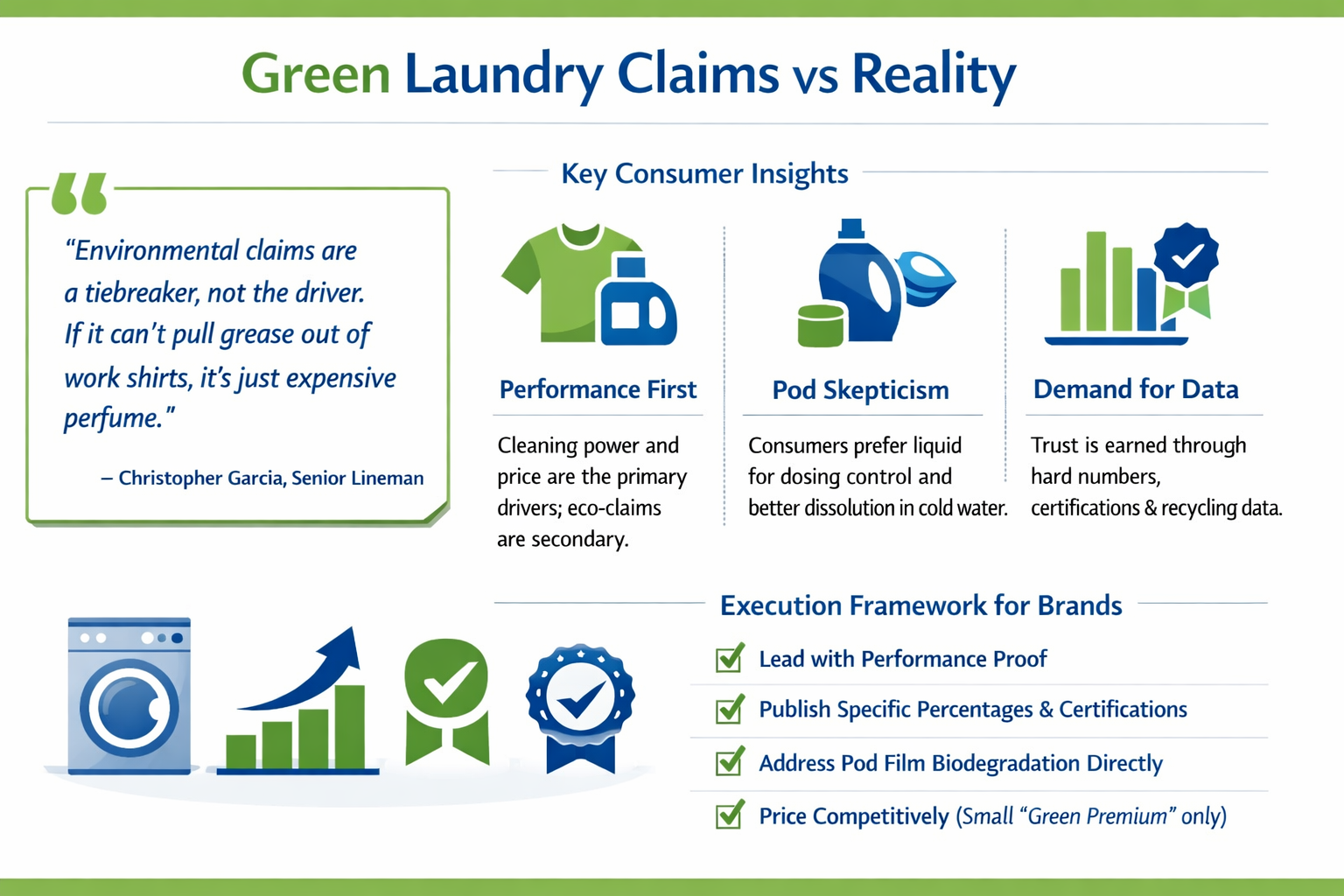
"Environmental claims are a tiebreaker, not the driver. If two options clean the same and the price per load is close, I'll pick the one that's concentrated, low-residue, and has a legit third-party badge. But if it can't pull sweat, grease, and pole gunk out of work shirts, it's just expensive perfume."
The decision hierarchy was crystal clear:
Cleaning power first: Can it handle kid stains, work clothes, sweat?
Price per load second: Mental math happens at the shelf
Format and convenience third: HE-safe, cap that doesn't drip, reasonable size
Environmental claims fourth: A nice bonus when everything else is equal
One participant put a number on it: environmental stuff is 20-40% of the decision, but only when it lines up with cleaning power and price.
Key insight: Eco claims sway consumers at the margin, not at the core. Performance and price have to be right first. The green leaf is dessert, not the main course.
Pods vs Liquid vs Powder: The Format Wars
The second question explored attitudes toward detergent pods versus traditional formats. Pods took more criticism than I expected.
The pod problem:
Fixed dosing feels restrictive: "I want control, not a one-size-fits-all scented surprise"
Price per load is higher: "You're paying for the wrapper"
Dissolution issues in cold water: "I've had the film half-melt and streak a hoodie"
Safety concerns with kids: "They look like candy, and I don't need that drama"
"Pods are great for Airbnbs or when I don't want to think. Day to day, I want control and consistency, not a scented surprise glued to a sleeve."
Liquid wins on flexibility: consumers like being able to adjust the dose for heavily soiled loads and pre-treat specific stains.
Powder has humidity issues: clumping in Florida garages and humid basements was a consistent complaint.
Key insight: Pods solve a convenience problem that many consumers don't actually have. They'd rather have control over their dosing than pre-portioned simplicity.
What Would Make Them Believe 'Biobased' Claims?
The final question tested eco-friendly messaging directly: if a brand says their pods are 'biobased' with 'clean chemistry' and recyclable packaging, what would you need to believe those claims?
The skepticism was intense. These consumers have seen too many green leaves and fuzzy buzzwords to take anything at face value.
What earns trust:
Numbers on the label: "% biobased by weight, not vibes"
Full ingredient lists in plain English, plus SDS access
Third-party certification they can look up, not a badge the brand invented
Specific recycling instructions for their actual location
Pod film end-of-life data: "Tell me exactly what the film is and what happens after it dissolves"
Performance proof against regular detergent
Price per load that's comparable, not a "green tax"
"Talk to me like an adult, print the numbers on the box, and back it with third-party proof. If you can't put the percentage on the label, you don't have it."
What triggers skepticism:
"Clean" with zero data
Nature imagery and tiny asterisks
"Recyclable where facilities exist" (translation: it's trash)
Offset talk instead of fixing the product
Influencer-only testimonials
Subscription-only purchasing
Key insight: Consumers want specs, not slogans. They've developed sophisticated greenwashing radar and they're looking for boring PDFs with specifics, not pretty marketing pages.
What This Means for Eco-Friendly Cleaning Brands
If you're marketing sustainable cleaning products, this research points to a clear strategy:
Lead with performance: Prove it cleans work clothes, kid stains, and daily grime before talking about the planet
Publish the numbers: Exact percentages, full ingredient lists, third-party certifications with links
Be specific about recycling: "Curbside recyclable in your county: yes/no" beats "recyclable where facilities exist"
Address the pod film question directly: Wastewater data on biodegradation, not cartoons of smiling droplets
Price to compete: Eco premiums are acceptable only when small (1-2 dollars) and justified
Admit limitations: "The film is petroleum-based, here's why we use it, here's the end-of-life data" builds more trust than vague claims
Skip the subscription trap: Consumers see forced subscriptions as a red flag
The Bottom Line
Consumers want to make environmentally responsible choices. But they've been burned by greenwashing too many times to take claims at face value. They want receipts, not poetry.
The winning formula? Show your work. Put the numbers on the label. Match conventional products on performance and come close on price. Then, and only then, will the eco claims land as a genuine differentiator.
Want to test your own cleaning product positioning? Ditto lets you run studies like this in hours, not weeks. Book a demo at askditto.io.
What the Research Revealed
We asked real consumers to share their thoughts. Here's what they told us:
How much do environmental claims influence your detergent decision?
Christopher Garcia, 32, Senior Lineman, Tampa, FL, USA:
Environmental claims are a tiebreaker, not the driver. If two options clean the same and the price per load is close, I'll pick the one that's concentrated, low-residue, and has a legit third-party badge. But if it can't pull sweat, grease, and pole gunk out of work shirts, it's just expensive perfume.
Shawn Heath, 50, Barber, Rural, FL, USA:
Not much. If the green leaf on the bottle costs me extra or cleans worse, I skip it. If two options are the same price per load and one uses less plastic or works in cold water, fine, I'll grab that. I want clean towels and shirts, not a lecture.
Jamie Ordonez, 29, Project Coordinator, San Jose, CA, USA:
Environmental claims matter, but they're a tiebreaker, not the opening pitch. If the bottle screams 'green' and then costs a small fortune or leaves grass stains laughing at me, I'm out. If I had to put a number on it, environmental stuff is like 30 to 40 percent of my decision.
How do you feel about detergent pods versus liquid or powder?
Christopher Garcia, 32, Senior Lineman, Tampa, FL, USA:
Pods look clean on a shelf, but they bug me in practice. The dosing is fixed, the scent is usually loud, and in cold or quick cycles I've had the film half-melt and streak a hoodie. Pods are great for Airbnbs or when I don't want to think. Day to day, I want control and consistency.
Stephen Kennedy, 25, Construction Manager, Rural, MD, USA:
Pods are convenient, but I mostly stick with liquid. On my work gear with mud, grease, and that end-of-week funk, I want control. With liquid I can glug a little extra and hit collars and knees. I've had pods half-dissolve on quick or cold cycles and leave a gummy spot.
Natalie Alvarado, 27, Retail Lead, Largo, FL, USA:
Pods are convenient but pricey and a little bossy. I stick with liquid for control and value, and powder is a Florida humidity headache. Pods cost more, the scent is usually loud, and sometimes they don't dissolve right on my cold cycles.
What would you need to believe 'biobased' and 'clean chemistry' claims?
Christopher Garcia, 32, Senior Lineman, Tampa, FL, USA:
I don't buy buzzwords. If a brand says biobased, clean chemistry, and recyclable, I want them to show their work or I pass. Numbers: % biobased by weight, not vibes. Third-party proof: a real certification I can look up, not a cute leaf badge you invented. Specs beat slogans.
Natalie Alvarado, 27, Retail Lead, Largo, FL, USA:
I'm not buying it just because you slapped a leaf on the box. Clear definitions with numbers on the front, not buried on a QR page. Third-party verification with real labels I recognize. Full ingredient list. Local reality: tell me if Pinellas County curbside takes it. Impress me with data, not sea turtle clip art.
Page Bazan, 45, Homemaker, Aurora city, IL, USA:
It's very cold today and I feel cranky. So I need straight talk, not pretty words. Clean chemistry sounds like marketing to me. Say it plain or I don't buy it. Show me numbers, real sello from outside, recycling that works here, and what is inside in simple words I know.