
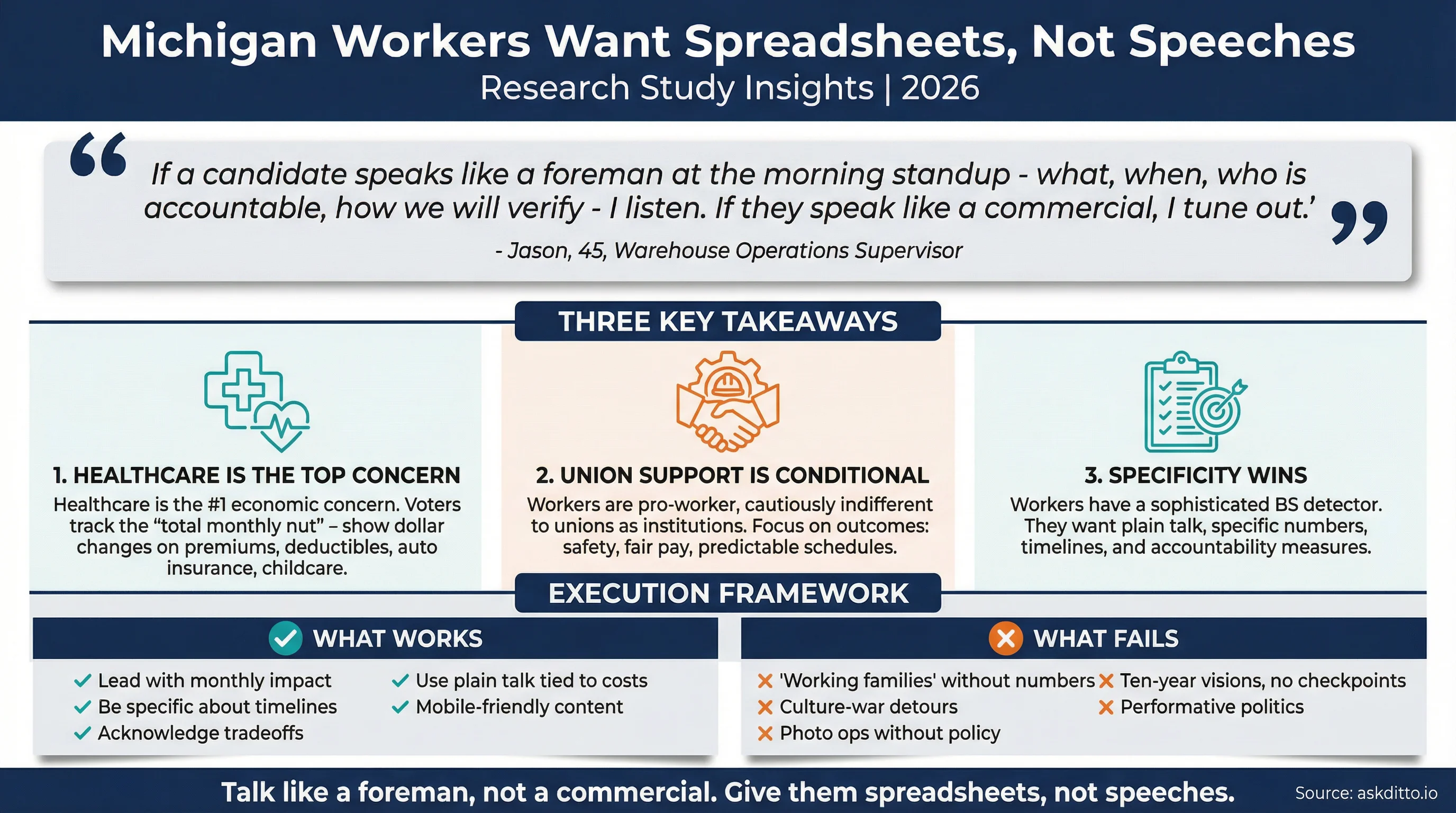
"If a candidate speaks like a foreman at the morning standup - what, when, who is accountable, how we will verify - I listen. If they speak like a commercial, I tune out."
That is Jason, a 45-year-old warehouse operations supervisor in rural Michigan. I ran a voter research study with Michigan working families heading into 2026, and his comment captures everything the study revealed: these voters want spreadsheets, not speeches.
This matters for anyone trying to reach working class voters in a state that will help decide 2026.
The Participants
I recruited 6 Michigan voters from Ditto's synthetic voter model. They include a product manager in Grand Rapids, an office manager in Ann Arbor, a warehouse operations supervisor in rural MI, an unemployed young professional in Farmington Hills, an entrepreneur running a mobile diagnostics firm, and a stay-at-home parent in Grand Rapids. They span union and non-union households, different income levels, and different political leanings.
What Keeps Them Up at Night
When asked about their biggest economic concerns, Michigan working families zeroed in on specific pain points:
It is cost of living whiplash. The rest is details.
The top concerns across all six participants:
Healthcare costs: premiums, deductibles, surprise billing, narrow networks
Auto insurance: "Stupid high" in Michigan, no clear value for the price
Childcare: availability and affordability, especially for shift workers
Wages vs everything else: raises are not keeping pace with groceries, utilities, insurance
Job security: auto industry transition creating anxiety across sectors
Roads and infrastructure: potholes, winter operations, grid reliability
Brian, 41, a product manager in Grand Rapids, explains: "Premiums, deductibles, narrow networks that randomly change, surprise billing risk. We buy our plan on the Marketplace, and it feels like playing roulette every open enrollment."
Key insight: Healthcare is the top economic concern, but the pain is felt across multiple monthly bills. Voters are tracking the "total monthly nut," not individual line items.
The Nuanced View on Unions
Union support among Michigan workers is real but conditional. The pattern: pro-worker, cautiously indifferent to unions as institutions.
I see unions like brakes on a car. You do not think about them when the road is smooth, but when management gets cute with safety or squeezes schedules, you need real stopping power.
What they like about unions:
Safety, staffing ratios, and training pipelines
Collective bargaining as a necessary counterweight
Protection against wage theft and abusive scheduling
What gives them pause:
"Calcified rules that kill common sense"
Political spending that feels disconnected from shop floor concerns
Protecting underperformers at the expense of high performers
Jason captures the conditional support: "If leadership listens, pays fair, and keeps people safe, organizing pressure usually cools off. When leadership ignores safety or nickels-and-dimes folks, unions start looking like a necessary counterweight."
Key insight: Union support is earned, not assumed. Candidates should focus on worker outcomes (safety, fair pay, predictable schedules) rather than union-as-identity.
What Messaging Actually Lands
When asked what political messaging resonates with Michigan working families, the answers were remarkably consistent:
What works:
"Plain talk tied to my monthly costs"
Specific numbers, timelines, and accountability measures
Local faces and real people, not actors or influencers
Admitting tradeoffs: "Say what gets cut to pay for something"
Mobile-friendly, short, captioned content
What fails:
"Working families" used as a costume without numbers
Culture-war detours that do not lower a bill or fill a pothole
Hard-hat photo ops with no policy specifics
Ten-year visions with no checkpoints
"AI will create new jobs" without training plans
Talk in dollars, dates, and drive-times. Cut friction I can feel this month. Everything else is yard signs.
Nicholas, 26, who runs a mobile diagnostics firm, offers a practical test: "Show me how your plan keeps patients covered at 6 a.m. in February when a driver calls off and the roads are ice. If your answer is a press release, I am out."
Key insight: Michigan workers have a sophisticated BS detector. They want campaigns that respect their intelligence and their time.
What This Means for Candidates
The implications for anyone running on working class issues in Michigan:
Lead with monthly impact: show the dollar change on premiums, deductibles, auto insurance, childcare
Be specific about timelines: "By summer" not "eventually"
Acknowledge tradeoffs: voters respect honesty about costs
Skip the cosplay: flannel and factory tours without numbers are counterproductive
Union messaging should focus on outcomes, not identity
Address AI anxiety with concrete training-with-pay plans
Show up when cameras are not rolling
As Shavone, 45, a Grand Rapids mom put it: "Respect our time, our bills, and our brains. Everything else is background noise."
The Bottom Line
Michigan working families are not waiting to be inspired. They are doing the math. They vote their monthly budget, not their feelings, and they can smell performative politics from across the factory floor.
The winning formula is not complicated: talk like a foreman, not a commercial. Give them spreadsheets, not speeches. And if you cannot explain how your plan shows up in their Google Sheet this month, do not expect their vote.
Want to test your own working class messaging with real voters? Ditto lets you run studies like this in hours, not weeks. Book a demo at askditto.io.