'Ethically sourced' means nothing to me without proof—that's a direct quote from a pet parent in this study. Ask pet parents about 'ethically sourced' ingredients and they'll: ask pet parents about 'ethically sourced' ingredients and they'll tell you it's nice. But ask what would actually make them switch to a premium brand, and the answer is brutally practical. Show me the receipts, prove it works on my dog, and don't make me hunt for it.
I ran a study with 6 American pet owners to understand what really drives premium pet food purchases. These weren't casual pet people. They were devoted owners who think carefully about what goes in their pets' bowls. And their answers cut through a lot of marketing noise.
The Participants
Six pet parents from across the United States: Kentucky, Indiana, Maryland, California. Ages 44-55. Mix of dogs and cats. Household incomes ranging from under $50k to over $100k. What united them: they all buy pet food regularly and they've all been targeted by premium brands with ethical messaging. They were ready to share what actually moves them.
Does 'Ethically Sourced' Actually Matter?
The first question cut straight to the heart of premium pet food marketing: how do you feel about 'ethically sourced' or 'humanely raised' ingredients?
The consensus was unanimous and surprisingly blunt: nice-to-have, not the deal-maker.
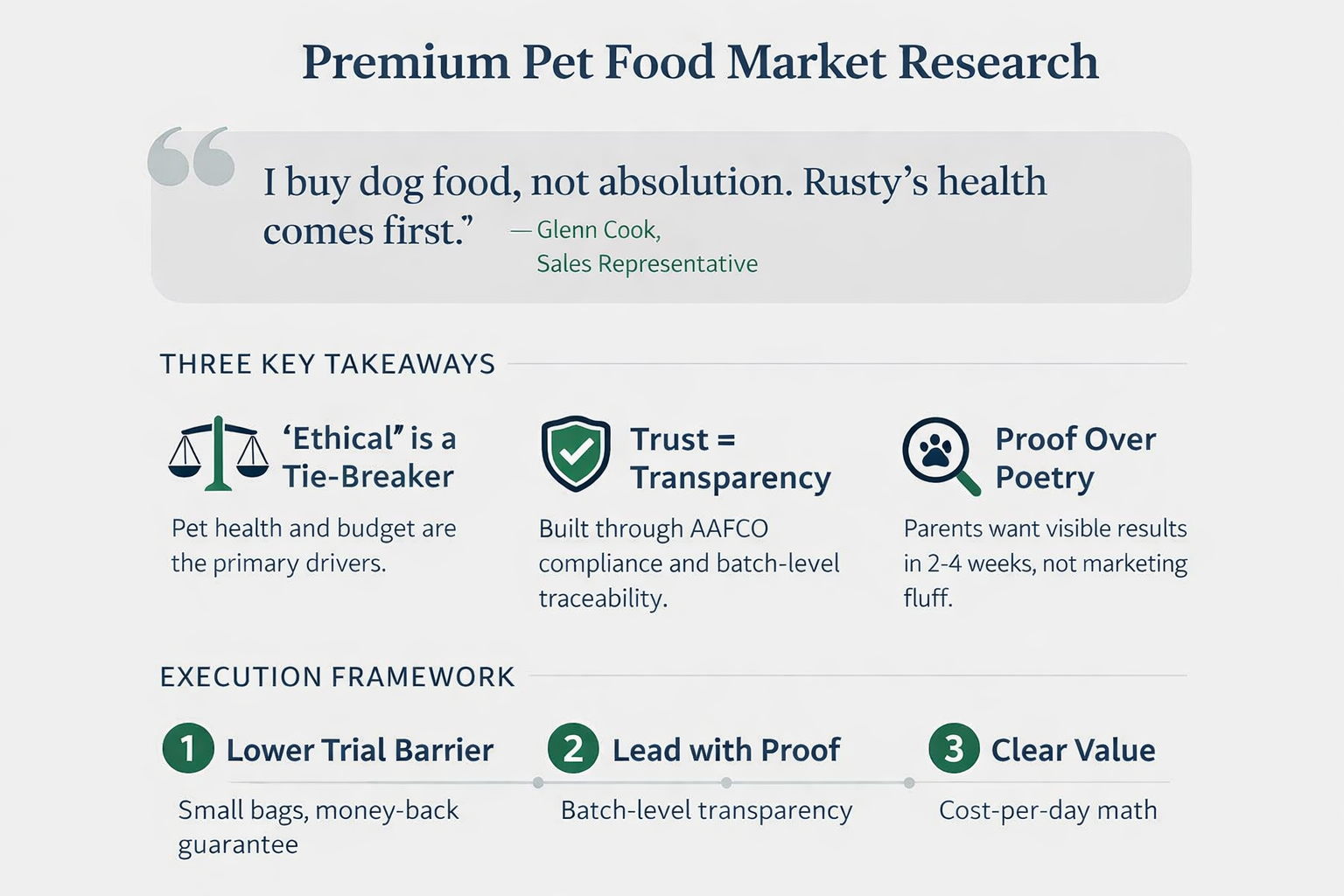
"I buy dog food, not absolution. Rusty's health comes first. The whole 'ethically sourced' thing is a nice tie-breaker if the price gap is small and the company shows real proof instead of a leafy logo and a sermon."
One participant from Maryland summed up the hierarchy perfectly:
Pet's tummy first: if it messes with digestion, it's out, no matter how virtuous the label
Consistency and access: can I grab it at my local store or set up reliable delivery
Price sanity: not paying a 40% markup for a halo and a burlap bag
Key insight: Ethical claims land as a tie-breaker, not a driver. Pet parents will choose the ethical option when two products are otherwise equal, but they won't sacrifice price, convenience, or their pet's health for a feel-good label.
What Actually Builds Trust?
The second question asked what actually convinces pet parents that a brand is trustworthy. The answers revealed a stark divide between what brands emphasise and what consumers care about.
What earns trust:
AAFCO 'complete and balanced' statement clearly printed
Named proteins at the top of the ingredient list (chicken, beef, salmon, not 'meat meal')
Batch codes and lot numbers you can actually read
A phone number where a human answers
Consistent kibble size and smell bag to bag
Clean recall history, or if they messed up, they owned it fast
"Show me your receipts, not your poetry. If a brand can be specific, reachable, and consistent, I'll trust it. If it leans on vibes and buzzwords, I keep walking."
What feels like marketing fluff:
'Grain-free' as a magic fix
'Holistic', 'ancestral', 'superfood', 'biologically appropriate'
'Veterinarian recommended' with no names or data
'Human grade' splashed on kibble
Influencer coupons and glossy farm-field photos
One participant nailed it: "Loud bags with wolves on them and breathless promises make me roll my eyes. I trust the quiet brands that publish the basics and answer the phone."
Key insight: Trust is built through transparency and accessibility, not storytelling. Pet parents want batch-level proof, clear labelling, and a company that's reachable when things go wrong.
What Would Actually Make Them Switch?
The final question got tactical: what would make you switch from your current brand to a premium option?
The answers revealed a clear formula for conversion:
Visible payoff in 2-4 weeks: shinier coat, less itching, better digestion, smaller and less smelly poop
Low-risk trial: small bag (3-5 lbs) with no-hassle money-back guarantee
Price that pencils out per day, not per bag
Easy availability at local stores or reliable delivery
Real traceability: QR codes to batch results, not pretty videos
"I'd only switch if it actually helps Rusty, not because the bag has a leaf on it. If a small trial bag makes his coat less itchy, his breath less nasty, and he eats it without giving me that sad beagle stare, I'm listening."
The barriers were equally clear:
Sticker shock without visible payoff
Risk of upsetting their pet's stomach ('I'm not signing up for 3 a.m. carpet drama')
Availability issues or forced subscriptions
Marketing claims with no receipts
Key insight: The path to premium is proof-first, not promise-first. Remove the risk with small trials and money-back guarantees, then let the product prove itself on the pet.
What This Means for Premium Pet Food Brands
If you're marketing premium pet food, this research points to a clear strategic shift:
Lead with proof, not poetry: Batch-level traceability, third-party testing, and clear AAFCO compliance beat aspirational storytelling
Lower the trial barrier: Small bags (3-5 lbs) at accessible price points with no-questions-asked refunds remove the biggest objection
Make availability boring: Stock at mainstream retailers (grocery, Tractor Supply, pet stores) and offer reliable, pausable subscriptions
Show cost-per-day math: Premium pricing is acceptable if the value equation is clear
Answer the phone: Responsive human customer service builds more trust than any certification
Skip the buzzwords: 'Holistic', 'ancestral', and 'superfood' register as marketing noise. Clear ingredient sourcing and plain language win.
The Bottom Line
Pet parents want to do right by their animals. They'll pay more for quality. But they've been burned by marketing fluff before, and they're not buying another pretty bag with a wolf on it.
The winning formula? Prove it works on my pet, show me the receipts, make it easy to buy and return, and don't make me pay double for buzzwords. Do that, and you've got a customer for life.
Want to test your own pet food positioning? Ditto lets you run studies like this in hours, not weeks. Book a demo at askditto.io.
What the Research Revealed
We asked real consumers to share their thoughts. Here's what they told us:
How do you feel about 'ethically sourced' or 'humanely raised' ingredients in pet food?
Glenn Cook, 51, Sales Representative, Rural, IN, USA:
Short answer: I buy dog food, not absolution. Rusty's health comes first. If the kibble keeps his coat decent, stools steady, and he actually eats it, that's the driver. The whole 'ethically sourced' and 'humanely raised' thing is a nice tie-breaker if the price gap is small and the company shows real proof instead of a leafy logo and a sermon. I'll pay a couple bucks more if I trust the folks behind it, but I ain't burning an extra 30 percent for a halo on the bag.
Marie Granberry, 53, Nonprofit Program Manager, Germantown CDP, MD, USA:
Short answer: I care, but I am not paying a 40% markup for a halo and a burlap bag. In principle, I like the idea. I do worry about factory farming and waste. But with Lila's food, my hierarchy is pretty clear: Lila's tummy first, consistency and access second, price sanity third. Where 'ethically sourced' lands for me: tie-breaker.
Marna Major, 50, School Principal, Rural, KY, USA:
Short version: it's a nice-to-have, not my north star. I care about stewardship and not being cruel to God's creatures, but a glossy barn on the bag with a halo word doesn't move me if it's just marketing fluff. If the claim comes with real specifics and the price is close, fine, I'll pick it. If it's a big upcharge for a vague promise, I roll my cart right past it at the feed store.
What actually convinces you that a brand is trustworthy?
Scott Astorga, 44, Sales Operations Manager, South Bend, IN, USA:
For Juniper I keep it boring and proven. If a food keeps her coat shiny, energy steady, and her stomach quiet, it earns a spot. The rest is just noise most days. What actually convinces me: Clean recall record you can actually find, plus batch codes and a phone number on the bag. AAFCO 'complete and balanced' right on the label. Named proteins up top. Transparent sourcing and who makes it.
Matthew Parra, 54, Sales Manager, Owensboro, KY, USA:
Short answer: I trust what I can verify, and I trust what Chico's stomach tells me. Everything else is just pretty bags and wolf cartoons. What actually convinces me: AAFCO 'complete and balanced' line on the bag, named meat up front and a short ingredient list I can pronounce, plant and lot info printed clear as day, plus a phone number where a human actually picks up.
Bonny Rayas, 55, Unemployed Adult, San Jose, CA, USA:
Short version: I trust what I can see at home, not shiny badges on the bag. If Luna's fine and my gut says ok, then ok. If it smells weird or the story feels cute-but-empty, no gracias. What makes me trust a brand: Consistent results at home, 'Complete and balanced' printed clearly, simple label in English and Spanish, predictable price and availability.
What would make you switch to a premium option?
Matthew Parra, 54, Sales Manager, Owensboro, KY, USA:
I'd switch if Chico eats it and does well in 2 weeks with solid stools, no itching, steady energy. That's the only real proof. There's real transparency. A QR code that shows batch, where the protein came from, and past recalls. Not a pretty video. Price-per-day is clear and not silly. I'll pay a bit more if the math makes sense.
Marie Granberry, 53, Nonprofit Program Manager, Germantown CDP, MD, USA:
Short answer: I'll switch if it's boringly reliable, proves it helps Lila, and doesn't gouge my budget. If it's vibes and a price hike, no thanks. What would make me switch: Lila-first proof with a small trial bag that won't wreck her stomach, plus a no-hassle refund if it does. Receipts, not poetry. Price sanity within 10-15% of what I pay now.
Glenn Cook, 51, Sales Representative, Rural, IN, USA:
Short version: I'd only switch if it actually helps Rusty, not because the bag has a leaf on it. If a small trial bag makes his coat less itchy, his breath less nasty, and he eats it without giving me that sad beagle stare, I'm listening. If you can show me clear, no-BS sourcing I can verify, that matters more than the word 'sustainable' in a pretty font.