Here's something that keeps coming up in political strategy conversations: Democrats run healthcare ads warning about Republican cuts, and the response from persuadable voters is... mostly indifferent. The ads get tuned out. The warnings feel like noise. But when you ask those same voters if they're worried about losing coverage, they absolutely are. So what's going wrong?
I ran a study with 6 American voters across California, Washington, Oregon, New York, and Massachusetts to understand this disconnect. These weren't partisan activists. They were working-class and middle-income voters who use or know people who use Medicaid, SNAP, and other safety net programmes. I asked them point-blank: when Democrats warn about cuts, do you believe them? And if you saw a campaign ad saying Republicans want to take your healthcare, would that motivate you to vote?
The answers reveal a fundamental messaging problem that campaigns are getting wrong.
The Participants
The six participants ranged from ages 26 to 63, spanning urban and rural communities. They included a 26-year-old farmworker in Pasco, Washington; a 30-year-old admin assistant in Fresno expecting her first child; a 37-year-old CFO in rural Massachusetts who runs a food pantry; a 50-year-old office worker in Albany, New York on a tight budget; a 59-year-old fabricator in rural Oregon; and a 63-year-old bilingual auto-parts sales rep in Downey, California.
What unites them: all have direct exposure to healthcare and food assistance programmes, either personally or through family and community. Several attend churches that run food pantries. Several have watched clinic hours get cut or paperwork requirements knock people off coverage. These aren't voters consuming political news from a distance. They live with the policy outcomes.
Do Voters Believe the Warnings About Cuts?
The first question cut straight to credibility: when Democrats warn about Republican cuts to Medicaid and food assistance, what's your honest first reaction?
The consensus was remarkably consistent across all six participants: they believe there's real risk, but they're exhausted by the presentation. Not one person dismissed the warnings outright. But not one person accepted them at face value either.
"I roll my eyes first. The ads and the tone are always turned up to 11. But I don't dismiss it. When politicians say 'efficiencies' or 'work requirements,' it usually means people get dropped in the paperwork."
That was Lisa, 30, in Fresno. She's watched her church's food pantry lines spike after recertification periods. A friend lost CalFresh benefits for missing one form. "That's half our grocery month," she said.
Brenda, 59, in rural Oregon put it more bluntly: "The folks who get pinched are not headlines. They're the single mom from choir, the laid-off millhand with a busted knee, the grandparent raising grandkids. If Republicans are pushing a bill that trims eligibility or adds hoops, I assume people will fall through. That's not fear-mongering to me. That's Tuesday."
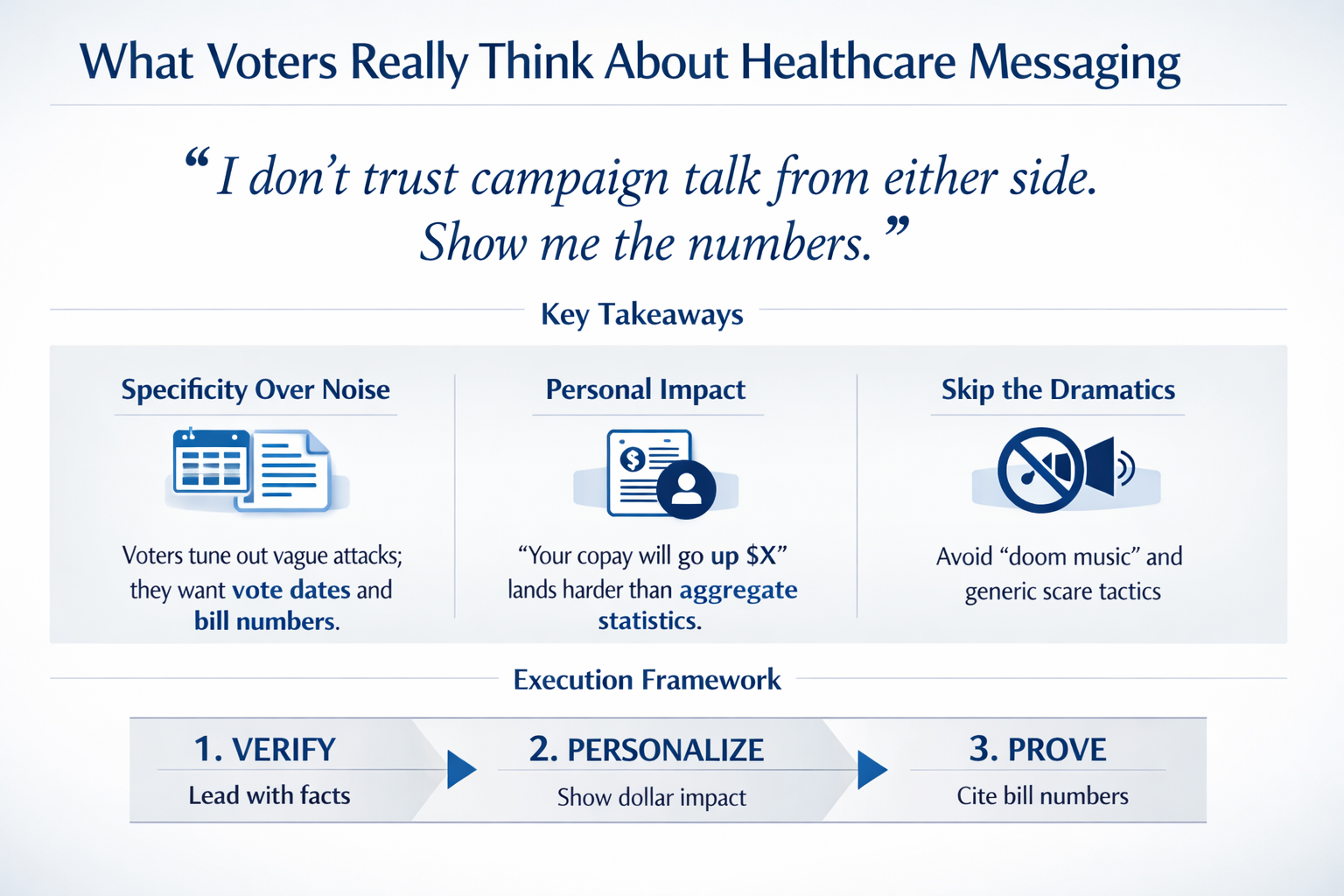
Key insight: Voters don't reject the substance of healthcare warnings. They reject the format. Scare music, red sirens, and vague doom don't work on people who've already seen how "tightening" plays out in real life. They want receipts, not vibes.
What Would Voters Actually Respond To?
The second question explored what a candidate would need to earn their vote, using the New Hampshire Senate race as a frame. But the answers revealed something broader: a detailed checklist of what persuadable voters need to hear on healthcare.
The phrase "show me the numbers" appeared in almost every response. Voters want:
Bill numbers and section references, not vague warnings
Dollar amounts for their specific situation (co-pays, premiums, prescription costs)
Local impact (their county, their clinic, their wait times)
Dates and timelines, not "soon" or "could happen"
Plain-English summaries they can verify themselves
A credible messenger (local nurse, pharmacist, small employer) instead of actors or celebrities
Glen, 63, in Downey was explicit: "Talk to me like a shop owner: clear, no drama, no fine print. If you cannot put it on one page, I don't trust it."
Angelica, the CFO in rural Massachusetts, wanted even more detail: "Name the bill and the section. Bill number, page, and the exact line that changes eligibility or funding. Link to the text... If you can hand me that, I'll listen. If it's just a 30-second doom ad, I assume it's noise and go back to my spreadsheet."
Key insight: Working-class and middle-income voters are policy-literate. They don't need simplification. They need specificity. Generic warnings about "taking away healthcare" fail because they sound like every other political ad. Concrete, verifiable details cut through.
Would a Healthcare Ad Motivate Them to Vote?
The third question tested the ultimate effectiveness: if you saw a campaign ad from Democrats saying Republicans want to take away your healthcare, would that motivate you to vote?
The answer, almost universally: "I'd tune it out unless they show receipts."
"Short answer: I mostly tune it out. 'They want to take your healthcare' trips my prove-it reflex. I already vote. A scare-line won't move me. Sigh. Show your work or I change the channel."
That was Angelica's response. But she wasn't dismissing the concern. She went on to list exactly what would get her attention: the bill number, local impact by county, the mechanics of eligibility changes, the total cost to employers, and a messenger who looks like a neighbour, not a campaign spokesperson.
Bria, 50, in Albany had similar requirements: "Real numbers on screen. Premium up how much. Copay up how much. Drug price up how much. Keep it simple... A nurse or pharmacist from around here talking like a normal person. No script. No buzzwords."
Brenda in Oregon summed up what all six wanted: "Show me receipts, show me our town, and tell me exactly how you'll keep the doctor's door open and the bill sane. Do that, I'm listening. Turn the sirens up and pass the hat, I'm out."
Key insight: The problem isn't voter apathy or disbelief. The problem is format. These voters already worry about healthcare. They've already seen the consequences of cuts. Standard political advertising fails them because it treats them like they need to be scared into caring. What they actually need is proof they can verify.
What This Means for Democratic Campaigns
The findings point to a clear strategic shift that healthcare messaging needs:
Lead with bill numbers and vote records, not warnings. Name the legislation. Show the section. Link to the text.
Localise everything. Replace "millions of Americans" with "4,200 people in your county." Name the clinic at risk. Show the wait-time increase.
Use dollars, not drama. "Your copay goes from $20 to $45" is more effective than "they want to destroy your healthcare."
Feature credible local voices. A pharmacist from the next town over beats a celebrity. A small employer beats a party spokesperson.
Provide verification. Include a link or phone number where voters can check their own coverage.
Lower the production values. "No scary music" came up repeatedly. Quiet, straightforward delivery signals honesty.
Offer a counter-plan. Don't just warn about cuts. Show what you'll protect and how you'll pay for it.
The deeper lesson: these voters aren't cynical. They're exhausted. They've been through cycles of political promises and seen how little changes. The way to break through isn't volume or alarm. It's specificity, verification, and respect for their ability to evaluate evidence.
The Bottom Line
American voters believe healthcare is at risk. They've watched the consequences of benefit cuts in their own communities. But they've also been conditioned to tune out political advertising that relies on fear and vague warnings.
The voters in this study weren't asking campaigns to stop talking about healthcare. They were asking campaigns to talk about it differently: with receipts, with local specificity, with dates and dollars, and with messengers who sound like neighbours, not talking heads.
As one participant put it: "Talk to me like that. Show me the receipt, not the drama."
Want to test healthcare messaging with your target voters before launching your campaign? Ditto lets you run studies like this in hours, not weeks. Book a demo at askditto.io.
What the Research Revealed
We asked real consumers to share their thoughts. Here's what they told us:
When Democrats warn about cuts to Medicaid and food assistance, what is your honest first reaction?
Angelica Mendez, 37, Chief Financial Officer, Rural MA:
Gut reaction: I don't trust anyone's talking points until I see the bill text and the CBO table. That said, I don't shrug it off either. When benefits get tightened, our pantry traffic jumps. I've watched it. So my guard goes up. Dem warnings: They can overstate scope, but they're usually directionally right on who feels it first - seniors on fixed incomes, single parents, folks with unreliable transport.
Tyler Fernandez, 26, Field Service Technician, Pasco WA:
Honestly, I kind of believe it. Not all the noise, but enough to worry. Here in Pasco a lot of folks use Apple Health and EBT, so if they cut that, it hits fast. I do not trust Congress, so I wait for the letter, but it is not just fear talk to me.
Brenda Chandler, 59, Fabricator, Rural OR:
I mostly believe them, with a squint. When I hear Democrats yelling about cuts to Medicaid and food help, my gut tightens first, then my brain kicks in. I've watched D.C. use the safety net like a bargaining chip, and out here the folks who get pinched are not headlines - they're the single mom from choir, the laid-off millhand with a busted knee, the grandparent raising grandkids.
What would make you consider voting for a Republican candidate like Chris Sununu, and what would a Democrat need to focus on to win your vote?
Bria Velasquez, 50, Administrative Assistant, Albany NY:
What could make me consider Sununu: He acts steady. No drama. Shows numbers. Takes town hall questions. He keeps health care and food help in place. No games with Medicaid or SNAP. He says clear he will not push new abortion limits. He respects privacy. He talks cost of living. Lower drug costs. Winter heat help. No shutdowns.
Glen Gurrola, 63, Sales Representative, Downey CA:
I would consider Sununu if he puts in writing a clear plan for small businesses - faster permits, predictable taxes, no hidden fees, and real help on insurance costs for shops. He keeps basic healthcare stable - no cute talk that ends in fewer clinic slots or tighter Medicaid rules - and he shows line items, not slogans.
Lisa Ocana, 30, Administrative Assistant, Fresno CA:
I'd consider Sununu if he stays boring-practical: keep costs down for working families and small businesses, protect Social Security and Medicare, be serious on fentanyl and border security without cruelty, and skip the culture-war circus. For a Democrat to get my attention, hit the wallet stuff hard and specific: insurance premiums, childcare, housing supply, energy bills.
If you saw a campaign ad saying Republicans want to take away your healthcare, would that motivate you to vote?
Angelica Mendez, 37, Chief Financial Officer, Rural MA:
Short answer: I'd mostly tune it out. 'They want to take your healthcare' trips my prove-it reflex. I already vote. A scare-line won't move me. Sigh. Show your work or I change the channel. What would make me pay attention: Name the bill and the section. Bill number, page, and the exact line that changes eligibility or funding. Link to the text.
Bria Velasquez, 50, Administrative Assistant, Albany NY:
I mostly tune it out unless they show proof. I hear that line and I sigh. It sounds like noise. I will watch if they put up the vote, the date, and the dollar change for real people. If it is just scary music and big words, I mute it. Real numbers on screen. Premium up how much. Copay up how much. Drug price up how much. Keep it simple.
Brenda Chandler, 59, Fabricator, Rural OR:
I mostly believe it, with a squint, but the ad better show receipts or I tune it out. If it's just doom music, red sirens, and 'they'll take your healthcare,' I roll my eyes and go feed the chickens. But I've seen what 'tightening' and paperwork tricks do to real people, so I don't dismiss the warning. I just need something sturdier than slogans.