Six Canadian consumers. Three questions about online insurance shopping. One genuinely surprising consensus that challenges everything insurers think they know about pricing: I ran a study with 6 Canadian consumers about online insurance, and every single one of them said the same thing about the "25% cheaper" pitch. Not enough. Unanimous. Zero exceptions.
This wasn't the split I expected. I figured at least one or two budget-conscious renters would jump at a 25% discount. But no. The consensus was clear: when it comes to insurance, Canadians are measuring twice before they cut. And honestly? Their reasoning is really compelling.
The Participants
I used Ditto to recruit 6 synthetic personas from across Canada: a retired homeowner in Saguenay (88, speaks French), a young data analyst in Markham (21, condo owner), a logistics coordinator in Gatineau (42, French-speaking mom), a senior account manager in Hamilton (42, condo owner), a part-time tailor in Longueuil (88, fiscally cautious), plus one delightfully honest 4-year-old whose response was "Papa buys things. I trust Papa not the website." Fair enough, Olivier.
What united them: they're all property owners or renters with existing insurance. They've been through the process. They know what matters when a pipe bursts at 2 a.m. in February.
First Impressions: Speed as a Red Flag
I showed participants a pitch for an online insurance provider: "quotes in under a minute, 25% cheaper than traditional providers." The response was fascinating. Instead of excitement, I got suspicion.
George, an 88-year-old tailor from Longueuil, put it perfectly:
"A quote in under a minute sounds like hemming pants without measuring twice. Looks tidy at first, then the seam pops when you sit down."
That metaphor stuck with me. For consumers who've actually dealt with insurance claims, speed isn't a feature, it's a warning sign. They're thinking: "What did you skip to go that fast?"
Marie-Eve from Gatineau was blunt: "Insurance only matters when you have a claim, not when you get a quote. Right now at -14C and cranky, I have zero patience for fluff."
Key insight: The speed pitch that works in other categories (food delivery, ride-hailing) backfires in insurance. Canadians want to see you've done the measuring, not skipped it.
Trust Is Earned With Receipts, Not Slogans
I asked what would make participants actually trust an online-only insurance provider over a traditional broker. The answers were detailed and demanding. Jakub, a 21-year-old data analyst in Markham, delivered my favourite quote of the entire study:
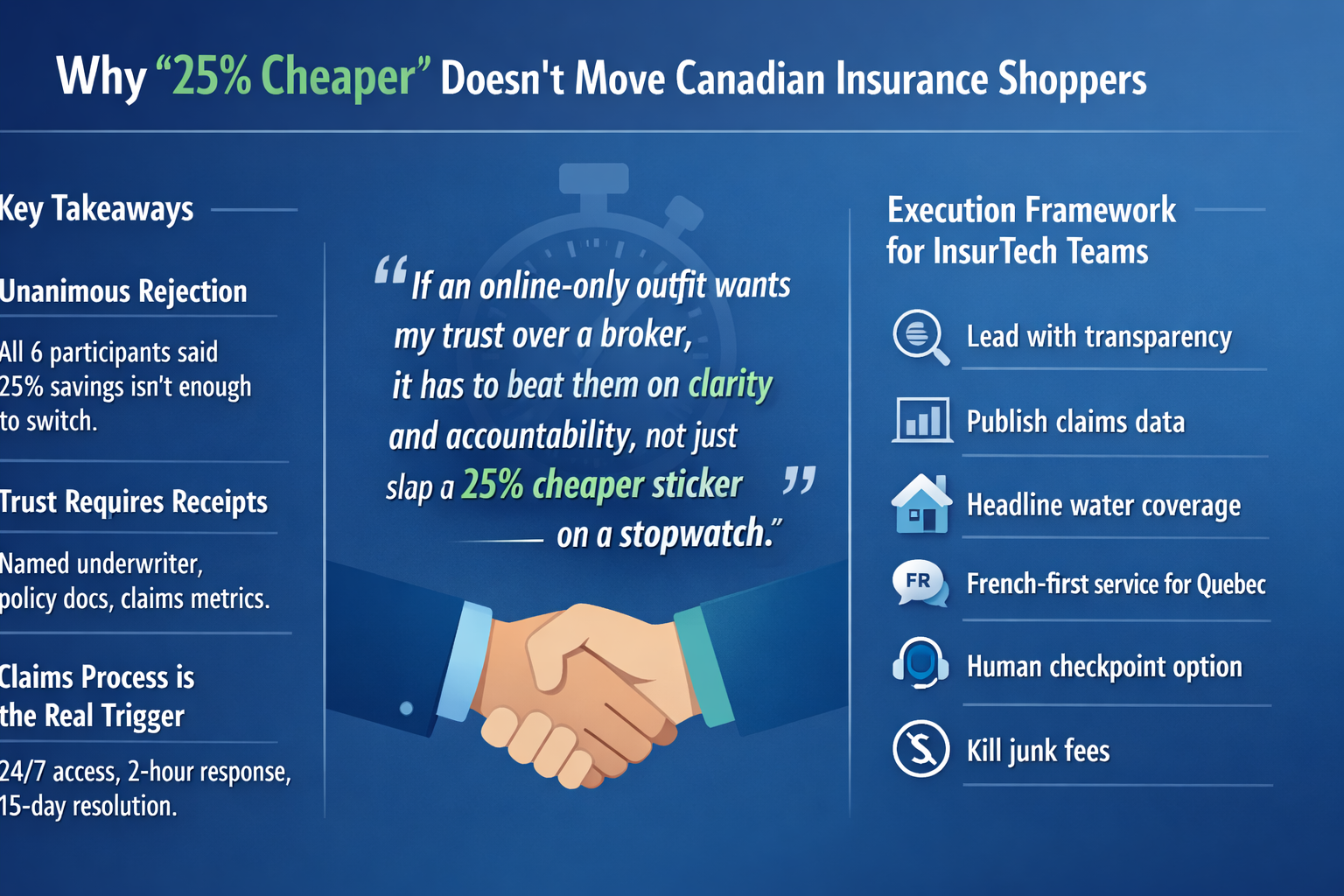
"If an online-only outfit wants my trust over a broker, it has to beat them on clarity and accountability, not just slap a 25% cheaper sticker on a stopwatch."
So what would actually build trust? Participants gave remarkably consistent answers:
Named underwriter visible up front (who actually holds the risk and handles claims)
Full policy wording downloadable before payment, not after
Water coverage spelled out clearly: sewer backup, overland, frozen pipes, deductible options
24/7 claims phone line with humans, not chat-only
Published claims metrics (response times, resolution timelines)
No hidden fees: monthly, admin, broker, or cancel fees
Privacy stance that doesn't sell data or require invasive app permissions
Michael from Hamilton made a point about data privacy that felt very 2026: "Canadian data residency, no selling data to marketing lists, and no training AI models on my personal info. After this week's AI nonsense in the news, that's a hard line."
Key insight: Trust requires proof. Every participant wanted to see the receipts: named underwriter, policy docs, claims data, fee transparency. Slogans and testimonials aren't enough.
What Would Actually Make Canadians Switch?
This is where it gets really interesting. When I asked about switching from their current provider, the 25% discount was universally dismissed as insufficient. But that doesn't mean they won't switch. They just need different triggers.
Jean-Guy, an 88-year-old retiree in Saguenay, explained his calculus:
"Just 25% savings makes me raise an eyebrow... but not change insurers tomorrow morning. Switching is hassle, paperwork, deductibles to compare. At my age I want to sleep well when the thaw comes and water finds the basement."
What would actually move Jean-Guy?
Price frozen for 24 months, written in black and white, no hidden renewal fees
Better water protection for Quebec: backup, ice dams, infiltration, with lower deductibles
24/7 claims in French with a human who answers and a guaranteed response time
Simple paperwork: paper policy by mail if wanted, Interac accepted, no complicated web accounts
Marie-Eve crystallized the economic reality: "On a $1,500 policy, 25% is about $375. Nice, but not worth a hollow policy or a year-2 price jump." She'd switch for even 10-15% if it came with stronger water coverage and better sub-limits.
Key insight: The switching trigger isn't discount size. It's coverage improvement + claims confidence + renewal predictability. Better coverage at a smaller discount beats bigger discount with coverage gaps.
The Quebec Factor: French Service is Non-Negotiable
Three of my six participants were Quebecois, and they were unanimous on one point: French-language service isn't a nice-to-have, it's a dealbreaker.
Jean-Guy's requirements included: "Claims line in French with a human who answers and an assigned name, plus guaranteed response time for a dryer in Saguenay." Marie-Eve demanded: "Named underwriter I can verify, with Quebec licensing visible. Show me the AMF info and a real Quebec address, not a PO box in Neverland."
The specificity here matters. Quebec consumers aren't asking for translation. They're asking for genuine French-first service: full policy wording in clear French, local adjusters who know Quebec winters, and visible provincial licensing.
Key insight: For Quebec market penetration, French isn't a checkbox, it's foundational. Service hours should match Quebec time, not California time.
Claims Process: The Real Switching Trigger
Every single participant focused heavily on claims, not quotes. Michael from Hamilton was explicit about what he'd need to see:
24/7 phone line ("I'd call once at 10pm to test hold time")
Time to first contact under 2 hours
Typical non-catastrophic water claim closed under 15 business days
Local adjusters available on weekends
Chat-only claims is an instant dealbreaker
George's rule stuck with me: "Read twice, buy once. Fast is fine when the stitching holds."
Key insight: Insurance is judged at claim time, not purchase time. Consumers will test your claims line before buying. If you can't prove claims performance with real metrics, they won't trust the discount.
What This Means for InsurTech Product Teams
If you're building or marketing online insurance in Canada, this research suggests some clear pivots:
Lead with transparency, not speed. The "under a minute" pitch triggers skepticism. Instead, highlight what you show upfront: full policy wording, named underwriter, clear coverage breakdowns.
Reframe the discount. Instead of "25% cheaper," try "same coverage, verified savings." Show the apples-to-apples comparison. Explain what's included, not what's excluded.
Publish claims data. Response times, resolution timelines, customer satisfaction scores. Real numbers, not star ratings. Participants said they'd call your claims line to test it before buying.
Make water coverage a headline. In Canadian winters, water is the real risk. Sewer backup, overland flood, frozen pipes, ice dams. If these are included and configurable, say so loudly.
Quebec requires Quebec-first thinking. Not translation. French-first service, AMF licensing visible, local adjusters, Quebec case studies. Service hours should match Eastern time.
Offer a human checkpoint. Even online-comfortable buyers want one phone call option to confirm condo deductibles or building assessments. A 10-minute licensed agent call reduces friction.
Kill the junk fees. Monthly fees, admin fees, cancel fees. Participants specifically called these out. Pro-rata refunds and simple cancellation build trust.
The Bottom Line
Canadian insurance shoppers aren't price-insensitive. They're proof-insensitive. Show them the receipts and they'll consider switching. Lead with discounts and they'll assume you're hiding something.
The most telling finding? Several participants said they'd switch for smaller discounts (10-15%) if the coverage was demonstrably better. That's the insight InsurTech PMs should be building around: trust compounds, discounts don't.
Want to test your own insurance positioning with Canadian consumers? Ditto lets you run studies like this in hours, not weeks. Book a demo at askditto.io.
What the Research Revealed
We asked real consumers to share their thoughts. Here's what they told us:
What is your first impression of online insurance with quotes in under a minute?
Jakub Lewandowski, 21, Data Analyst, Markham, ON, Canada:
First impression: speed-first pitch, light on substance. The 25% cheaper line means nothing without the basket they compared to. Compared to who, for what limits, and with which exclusions? If they lead with a percent-off instead of showing the underwriter and sample wording up front, that's a red flag for me. Would I buy entirely online without a broker? Yes. I already do for my condo. Zero interest in phone tag. But I only click pay after I can reconcile details.
George Nguyen, 88, Tailor, Longueuil, QC, Canada:
Gut reaction? Fast and cheap makes me squint. A quote in under a minute sounds like hemming pants without measuring twice. The 25% cheaper line... maybe, but usually it hides a higher deductible or missing bits. Would I buy fully online without a broker? For tenant insurance, maybe, if the basics are clear. For a home policy, I want a human voice before money moves.
Marie-Eve Lefebvre, 42, Logistics Coordinator, Gatineau, QC, Canada:
First impression: slick, fast, all the right buzz to make you click. 25% cheaper and under a minute smells like marketing to me. Insurance only matters when you have a claim, not when you get a quote, and right now at -14C and cranky, I have zero patience for fluff.
What would make you trust an online-only insurance provider?
Jakub Lewandowski, 21, Data Analyst, Markham, ON, Canada:
Trust is earned with receipts, not slogans. If an online-only wants me to ditch a broker or bank, I need hard proof, not a shiny landing page. Underwriter named up front, plus financial strength. Policy docs before pay: full wording plus sample declarations. Water coverage visible and configurable. Claims proof: 24-7 phone with humans, not email-only. Published SLA targets and recent metrics.
Michael Carter, 42, Senior Account Manager, Hamilton, ON, Canada:
I do not trust slogans. If an online outfit wants my business, show me receipts, not emojis. Data privacy I can live with: Canadian data residency, PIPEDA compliance, no selling data to marketing lists, and no training AI models on my personal info. Given this week's AI garbage in the news, this matters.
Jean-Guy Gagnon, 88, Retiree, Saguenay, QC, Canada:
If an online-only outfit wants me to trust them more than the lady at the local counter, they have to win on clarity and service, not glossy speed. On a day like this at -24, I do like the idea of doing it from the kitchen table, no boots, no slush. But if it's only flashy numbers and tiny text, I close the tab. I need a real phone line in French that answers fast, plus a 24/7 emergency number I can try myself.
What would make you actually switch to a new provider?
Marie-Eve Lefebvre, 42, Logistics Coordinator, Gatineau, QC, Canada:
25% alone is not enough. I am not chasing coupons on my house. On a $1,500 policy, 25% is about $375 - nice, but not worth a hollow policy or a year-2 price jump. If they deliver coverage upgrade that matters and keep the coverage equal or better, then 25% tips me over fast. If they also add stronger water coverage and better sub-limits, I would move even for 10-15%.
Michael Carter, 42, Senior Account Manager, Hamilton, ON, Canada:
25% alone is not enough. I switch when it is apples-to-apples on coverage, the claims operation is proven with real numbers, and renewal behavior is predictable. Show me proof or I stick with my broker. Net: I switch maybe once every 3-4 years. Give me equal or better coverage, proven claims, sane renewals, and real savings. If it is just a flashy 25% banner with holes in the policy, keep it.
George Nguyen, 88, Tailor, Longueuil, QC, Canada:
25% alone isn't enough. Maybe for a basic tenant policy, but for my house, a big discount usually means a thin seam somewhere - higher deductibles, weaker water coverage, slow claims. I'd only switch at renewal, after an apples-to-apples check, and only if they prove they're sturdier, not just cheaper. My rule: read twice, buy once - fast is nice, but only when the stitching holds.