
I have a bottle of vitamin D in my kitchen cupboard. I bought it in January. It's March. The bottle is still about three-quarters full. I take it maybe twice a week, when I happen to see it while reaching for the coffee. Some weeks I take it every day. Most weeks I forget entirely. And yet, when I see it sitting there, I feel a tiny bit better about my health. As if owning the vitamins counts for something.
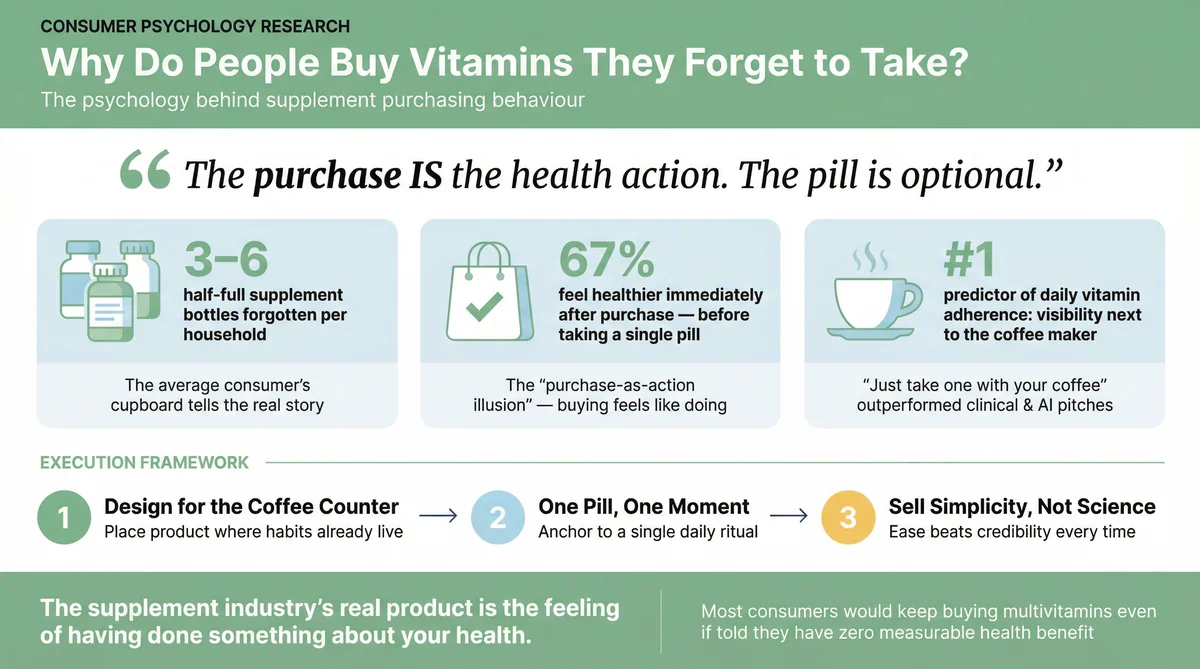
This, it turns out, is not a personal failing. It's the most common relationship people have with their supplements. I ran a Ditto study with 10 American consumers about why people buy vitamins and then forget to take them, and the results revealed something the supplement industry probably doesn't want to hear: for many consumers, the purchase IS the health action. The pill is optional.
Who I Asked
Ten US consumers aged 25 to 55, from rural Idaho to suburban Texas to urban New York. Credit analysts, civil engineers, retail managers, climbers, teachers, and caregivers. Incomes ranged from working class to upper-middle. All had bought supplements at some point. Most had abandoned at least one bottle.
What Triggers the Purchase?
I wanted to start at the beginning: what makes someone walk into a shop or click "add to cart" on a vitamin bottle? The triggers fell into four clear categories:
Clinical flag: A doctor's recommendation or lab result showing a deficiency. This was the most powerful trigger, and crucially, the most durable. Participants who bought because of a doctor's order were far more likely to actually take the vitamins consistently.
Health anxiety: The vague feeling that you "should be taking something." A cold season, a friend's cancer diagnosis, a birthday that ends in zero. This triggered purchases but almost never sustained use.
Social influence: Podcast ads, influencer recommendations, a gym partner who swears by creatine. Effective at getting the product home, terrible at keeping it in the routine.
Promotions: BOGO deals, end-of-aisle displays, Costco-sized bottles at seemingly impossible prices. Great at filling cupboards. Useless at building habits.
And then the honest follow-up: how many half-full bottles are sitting in your cupboard right now?
The average? Between 3 and 6. A supplement graveyard. Vitamins bought with genuine intent, used for a week or three, then quietly pushed to the back of the shelf. One participant described it as "a museum of all the times I tried to be healthier."
Key insight: The trigger determines the trajectory. Clinical flags create durable habits; everything else creates cupboard archaeology.
The Morning Rush: Where Vitamin Habits Die
When I asked participants to walk me through a typical week with their vitamins, the pattern was depressingly consistent. The first week is great: every morning, with coffee, like clockwork. The second week, you skip Tuesday. No big deal. The third week, you skip three days. By week four, the bottle has migrated from the counter to the cupboard, and out of sight means out of mind.
The failure points were specific and physical:
The morning rush: Getting out the door with kids, coffee in hand, bag packed. Adding a vitamin to that chaos is one step too many.
Pill size and taste: Multiple participants mentioned chalky tablets, fish oil burps, and horse-pill-sized capsules as immediate deal-breakers.
Storage location: The single biggest predictor of daily use. Vitamins next to the coffee maker get taken. Vitamins in a cupboard get forgotten.
No feedback loop: Unlike medication, vitamins rarely produce a noticeable effect. When you can't feel the difference, the motivation to continue evaporates.
"If it was next to the coffee, I took it. If it was in the cupboard, I forgot. That's literally the whole story of my supplement history." - Jaylan, 30, Suburb, TX
Key insight: Supplement adherence is a visibility problem, not a motivation problem. The ritual is the product. If your vitamin isn't physically present in an existing daily routine, it doesn't exist.
The Purchase-as-Action Illusion
This was the finding that stopped me in my tracks. I asked: does buying vitamins make you feel healthier, even if you don't take them?
The answer, from nearly every participant, was yes. Not a confident yes. A sheepish, slightly embarrassed yes. The kind of yes that comes with a self-aware laugh.
Participants described the bottle in the cupboard as a kind of health insurance. A symbolic action. A placeholder for a better version of themselves. "I know it's irrational," one said, "but having the bottle there feels like I'm at least trying."
"It's like having gym clothes in your drawer. You feel slightly more athletic just by owning them."
"The purchase IS the health action. The pill is just a bonus."
"I feel guilty when I see the bottle. But a productive kind of guilty, like it's reminding me to do better."
The supplement industry has, perhaps inadvertently, built a $60 billion business partly on this psychological mechanism. The transaction feels like progress. The bottle in the cupboard feels like health insurance. Whether the pills are actually consumed is, for many consumers, a secondary consideration.
Key insight: For a significant portion of consumers, supplement purchases function as psychological tokens of health intent. The industry's real product isn't vitamins. It's the feeling of having done something about your health.
The 8-Supplement Morning: Health or Anxiety?
I asked participants to react to someone who takes 8 supplements every morning. The reactions were revealing:
Impressed... briefly: Some admired the discipline. But the admiration curdled quickly into scepticism. "That's not health, that's a hobby."
Suspicious: Most questioned the necessity. "Do they actually know what each one does? Or are they just throwing pills at a problem they can't name?"
Anxious: Several participants said the number itself signalled health anxiety rather than health consciousness. "Eight supplements says 'I'm scared,' not 'I'm healthy.'"
Key insight: There's a perceived ceiling for supplement use. Beyond 2-3 products, consumers start reading the behaviour as anxious rather than aspirational. More supplements ≠ more credibility. In fact, it signals the opposite.
Three Pitches: Clinical, Simple, or Personalised?
I tested three brand positionings:
Brand A: Clinical-grade. Doctor-formulated. Third-party tested. 14 peer-reviewed studies.
Brand B: "Just take one. Every morning. With your coffee. That's it."
Brand C: Personalised nutrition powered by AI. Take our quiz, get your custom blend.
Brand B won. And it won specifically because it addressed the actual problem: not "which nutrients do I need?" but "how do I remember to take the damn thing?" The pitch built the habit into the product. One pill. With your coffee. Done.
Brand A was respected but felt intimidating. "14 peer-reviewed studies" impressed the evidence-focused minority but overwhelmed everyone else. "I don't want to read a medical journal to buy vitamins."
Brand C triggered immediate resistance. The AI quiz felt like a data grab disguised as personalisation. Multiple participants explicitly distrusted the "your body is unique" framing: "My body isn't that unique. Neither is my vitamin D deficiency." The subscription model was an additional barrier: "Auto-ship is just a word for 'hard to cancel.'"
"Just tell me what to take, make it small, and put it where I'll see it. I don't need AI for that. I need a bottle that lives next to my kettle." - Ashley, 36, Suburban, TX
Key insight: The supplement industry's biggest competitor isn't another brand. It's forgetting. The brand that solves the habit wins, regardless of what's in the capsule.
What If Multivitamins Don't Actually Work?
I asked the uncomfortable question: if research shows multivitamins have essentially zero benefit for people who eat a reasonably balanced diet, would you stop buying them?
The honest answer? Most people would keep buying. The reasons were fascinating:
"My diet isn't perfectly balanced, so I'm probably in the group that benefits."
"Even if the average person doesn't benefit, maybe I'm the exception."
"It's $15 a month. That's cheap enough to not be worth the risk of stopping."
"I'd feel like I was giving up on myself."
Only the most evidence-focused participants said they'd stop. Everyone else found a reason to continue. The sunk cost, the self-image, the "what if" insurance policy. Supplement purchasing is resistant to evidence because the product serves an emotional need, not just a nutritional one.
Key insight: Vitamins occupy a unique position: cheap enough that the rational cost of stopping outweighs the emotional cost of admitting they might not work. The $15/month insurance premium against health anxiety is one of the most resilient business models in CPG.
What This Means for Supplement Brands
You're not selling nutrition. You're selling a morning ritual. The brands that win long-term are the ones that integrate into an existing habit. Design for the coffee counter, not the medicine cabinet.
Visibility is your retention strategy. Packaging that lives next to the kettle, on the bathroom counter, by the toothbrush. Out of sight is out of supplement. Invest in counter-worthy design.
One pill. One moment. That's the ceiling. Multi-pill regimens fail for the same reason multi-step skincare routines fail: too many steps, too little motivation. Simplify or lose.
Stop selling science. Start selling simplicity. "14 peer-reviewed studies" impresses a small minority. "Take one with your coffee" converts everyone. The barrier isn't knowledge. It's friction.
Personalisation is a trap. AI quizzes and custom blends trigger data anxiety, not excitement. Most people don't want a bespoke supplement. They want a single bottle that works and is easy to remember.
The Bottom Line
The supplement intention gap is the health industry's version of the gym membership: people pay for the idea of being healthier as much as the reality. The bottle in the cupboard is doing psychological work even when it's not doing nutritional work. And the brands that understand this aren't trying to educate consumers about bioavailability or synergistic nutrient blends. They're designing for the only moment that matters: the 15 seconds each morning when someone either reaches for the bottle or reaches for the door.
Want to test how your product fits into consumers' real daily routines? Ditto lets you run studies like this in hours, not weeks.
What the Research Revealed
We asked 10 American consumers to share their honest thoughts about supplement purchasing, abandonment, and the gap between buying vitamins and actually taking them. Here's what they told us:
What triggered your last vitamin purchase? And how many half-full bottles are in your cupboard right now?
Ashley Young, 34, Administrative Assistant, Rural, NC, USA:
County clinic told me my vitamin D was low, so I grabbed D3 like they said. I also picked up magnesium after a deputy swore it helped his sleep and headaches. In my cupboard right now: a half-full multivitamin from a New Year podcast ad, a dusty bottle of elderberry from last winter, and turmeric caps I quit because they smelled awful. I take the D3 most days and the rest just sit there staring at me... bless it.
Jaylan Sherman, 25, Civil Engineer, Columbus, OH, USA:
Short answer: not big on supplements. The last time I bought anything was vitamin D3 in January after my annual physical came back low-normal and my doc said the gray Ohio winter is brutal. I also picked up creatine because my climbing plateaued and it’s cheap and simple. Not from a podcast ad. I mute those and roll my eyes at the “optimize your life” spiel. What’s actually in my cupboard right now: - D3 - in active use, about half gone. I take it with breakfast. - Creatine - about a third left. I use it most training days. - Fish oil - 70% full and basically abandoned because the burps are awful. - Magnesium glycinate - half-full, I use it on random rough-sleep weeks. So two are half-full and basically forgotten, and two I actually use. Not proud of the fish oil. It was a dumb buy.
Evan Gallagher, 32, F&i Manager, Chandler, AZ, USA:
Last one I bought was creatine, magnesium glycinate, and vitamin D at Costco after my annual physical showed D a bit low and my sleep was trash. Podcast ad? Hard pass; a gym buddy pushed the creatine, and the Arizona heat sold me on electrolyte packets after a calf cramp on the canal path. What I actually take most days: creatine and magnesium; D a few times a week when I remember. Honest count on the graveyard shelf right now: three half-fulls. - Fish oil I quit because of the burps - A multivitamin that messes with my stomach - A greens tub that tastes like lawn clippings
Stephen Washington, 40, Logistics Coordinator, Moreno Valley, CA, USA:
Last time was in January when a cold blew through the house. I grabbed vitamin C gummies for the kids and vitamin D for me at Target because it was buy-one-get-one and I had an Ibotta thing. Not a doctor thing. More like I thought I should be taking something, and a coworker said magnesium helped him sleep. I don’t buy off podcast ads. That stuff feels like hype. How many are sitting half-used? Yeah... a few. - Adult multi - half-full, been there since last summer. - Vitamin D - about half, I forget it a lot. - Magnesium - like 75% left, tasted chalky. - Fish oil - quarter gone, burps were nasty, I quit. - Kids’ gummies - almost empty, they remember those like candy. It is what it is. I’ll probably finish the D... when I remember.
Arlin Peoples, 39, Credit Analyst, Nashville-Davidson metropolitan government (balance), TN, USA:
I’ll be real: the last supplement I actually bought was vitamin D3 after my annual labs flagged me as low. My doctor told me 2000 IU daily, so I grabbed the big store-brand bottle at Sam’s and I’ve been steady with that. Podcast ads and influencer stuff don’t move me, and I’m not paying premium prices for wishful thinking. What’s quietly aging in the cupboard right now: - Magnesium glycinate - a church friend swore by it for sleep; it made me feel off the next morning. Half-full. - Fish oil - I tried, but those fishy burps are a hard no. About three-quarters full. - Probiotic - bought during a family tummy-bug moment; I forget to take it. Half-full. - Elderberry gummies - winter impulse. One bottle with a few stragglers. So net-net, I’m a one-bottle-on-purpose person with three-and-a-half bottles of regret. That what you were after?
Amber Magana, 32, Forklift Operator, Springfield, IL, USA:
I don’t mess with supplements much. Last time I bought any was this past winter - cheap vitamin D and magnesium from Aldi after too many gray mornings. The clinic nurse said D wouldn’t hurt, and a coworker swore magnesium helped his back, so I grabbed the lowest-price bottles to test. No podcast hype, no fancy label; if I don’t feel something in a couple weeks, I’m not paying for guesswork. What’s rotting in the cupboard right now? Three bottles: half-full fish oil from a sale, a multivitamin I forget, and the magnesium that’s basically new. Vitamin D is the only one I touch, and even that I skip like every other day. La neta, most of it feels like paying for marketing.
Andrew Pacini, 37, Unemployed Adult, Enterprise CDP, NV, USA:
Short version: not a "should be taking something" guy. I buy this stuff when something specific nudges me, not because a podcast bro yelled at me. Last time was a three-part mess: - My lower back was cranky and sleep was garbage, so a gym buddy pushed magnesium glycinate at night. I caved. - At my annual, the doc offhand said D3 wouldn’t hurt since I’m indoors midday a lot. Fine. Tossed it in the cart. - Costco had fish oil on sale, and I got sucked in thinking joints, heart, all that dad-life jazz. - Separately, a YouTube lifting dude reminded me creatine is boring but solid, so I grabbed a tub. What’s actually getting used: - Creatine - steady. Easy win. I don’t overthink it. - Protein powder - basically food. I go through it. - D3 - sometimes. I forget. Then I remember. Then I forget again. Graveyard in the cupboard, half-full and giving me side-eye: - Fish oil - 3/4 full. Burps like a dockworker. Regret buy. - Magnesium - half a bottle. Helps a bit, but I’m spotty with it. - Turmeric caps - 90% full. Impulse Costco science-in-a-bottle moment. Meh. - Old pre-workout - neon dust, maybe two scoops left. Makes me jittery and weird. Hard pass. So yeah, there’s a small shelf of expensive pee in the pantry. No podcast ads, no miracle powders. If it doesn’t actually help me lift better, sleep better, or hike Sloan without cramping, it just sits there until Lauren gives me the look and I quietly retire it.
Iesha Wilcox, 31, Retail Store Manager, Rural, IN, USA:
Short answer: doctor and a yellow clearance tag. Not a podcast. Not some influencer. I hit skip on that junk. Last time I bought anything, my doctor said my vitamin D was low after winter labs. So I grabbed store-brand D3. Same week I was sleeping like trash and the rain had me stiff, so I tossed a magnesium bottle in the cart because it was marked down at work. That was me trying to feel in control, I guess. Dumb, but there it is. What’s actually in my cupboard right now: - D3 - I take it most mornings with coffee. This one gets used. - Generic multi - I remember it maybe 3 days a week. Fine, not exciting. - Half-full and forgotten: collagen tub from a coworker rave - still gritty, still gross. - Half-full and forgotten: turmeric from my plantar flare month - stomach didn’t love it. - Half-full and forgotten: apple cider gummies - tasted like stale candy, I quit. - Half-full and forgotten: zinc I panic-bought after a long week - sits there, judging me. So yeah, I keep two in rotation, and I’ve got four sad bottles collecting dust. I manage a grocery store and I still fall for BOGO when my head’s noisy. I hate that. But I do it, probably.
Shannon Schichtel, 33, Sales, Rural, MA, USA:
Short answer: no, I’m not running a supplement graveyard. The last time I bought anything was triggered by actual data and winter reality, not a podcast voice promising me vitality. My annual physical had me a bit low on vitamin D - rural Massachusetts in February is basically a cave - so I grabbed D3. Around the same time, my sleep went sideways after a brutal travel week, and a trainer friend nudged me toward magnesium glycinate. That was it. Not sexy. Just practical. As for the cupboard: - Actively taking: D3 and magnesium. I actually finish these. - Half-full and forgotten: one sad turmeric bottle from a “wellness” gift box that tasted like peppered sawdust. I should just toss it. Podcast ads? Hard pass. Friend anecdotes are fine as a nudge, but if it can’t earn its keep, it doesn’t get renewal space on my shelf.
Justin Bishop, 46, Hospitality Manager, Austin, TX, USA:
Short answer: doctor’s nudge plus a run of lousy sleep during these stormy nights pushed me. After my last physical flagged borderline BP and winter blahs, my doc said D3 was fine and magnesium might help with sleep and leg twinges, so I grabbed both at H‑E‑B on the way home. I like things I can track - if it doesn’t move a metric like my Apple Watch sleep score or those at-home BP readings, it’s on probation. Magnesium glycinate stuck. D3 I remember in spurts. Everything else that came from hype-y ads or a friend’s “dude, life-changing” pitch turned into clutter in the pantry next to the mezcal. What’s half-full and basically forgotten right now: - Turmeric-ginger caps - tasted like curry burps, hard pass. - Ashwagandha - friend swore by it; I felt nada, shelfed it. - Probiotic - made me puffy and annoyed. Out. - Collagen tub from a podcast code - chalk city, never finished. - Fish oil - buried in the garage cabinet during a pantry clean, probably rancid by now. - Melatonin gummies - travel-only, half a bottle lives in my dopp kit. So yeah, the graveyard is real - maybe five half-used bottles, one keeper. If a label screams “detox,” I roll my eyes and walk. I’d rather cook my nutrients - frijoles, greens, citrus - and let the supplements earn their keep with actual results. Lupa also thinks every crinkly bottle is her toy, which is its own deterrent.
Walk me through a typical week with your vitamins. Do you take them every day, most days, or when you remember? What's the exact moment you forget?
Amber Magana, 32, Forklift Operator, Springfield, IL, USA:
Not daily. I take vitamin D some weekdays when I remember, more in winter or on gray weeks like this rain. I started strong for two weeks, then it slid to 2-3 times a week, then nada for stretches. The fish oil and multi basically live in the cupboard, collecting dust. La neta, if I don’t feel it, I forget it. - Forget moment: 4:45 a.m. rush - coffee, pack lunch, walk Koa, grab keys, out the door. Pills are out of sight, so bye. - Texture-taste: Multi is a horse pill. Fish oil gives those nasty burps. That kills any momentum. - Where it breaks: María tidies the counter, bottles go back in the cupboard, and my brain goes Si no lo veo, no existe. - Weekend: I might take D after breakfast when it’s calmer. If I skip a week, I just shrug, pop one right then, and move on. - Headspace when I notice: Mild guilt for wasting like $6, then I remind myself most of this stuff feels like marketing and I’m fine.
Justin Bishop, 46, Hospitality Manager, Austin, TX, USA:
Short version: I’m a most days guy who runs hot for a few weeks, then trips over my own routine and has to reset. Typical week looks like this: morning cafecito, quick patio sweep, Lupa stare-down, then I take D in the kitchen because the bottle lives by the grinder; at night, magnesium on the nightstand. If I’m traveling to a property or we’ve got a messy Monday, the vitamins lose every time to Slack pings and a Zoom that should’ve been an email. Gummies feel like dessert-for-breakfast, chalky multis make me gag, and fish oil burps are a war crime, so those are on probation at best. I don’t miss because I “forgot vitamins” exactly - I miss because the mise en place fell apart. - Exact moments I forget: when Lupa needs a longer walk and I’m already late to a coaching call; when I move the bottle off the counter for a tidy kitchen photo and never bring it back; site-visit days when my backpack becomes a black hole; nights I fall asleep to the thunder and never see the magnesium glaring at me. When I notice I’ve skipped a week, first thought is a little eye-roll and a muttered “órale, genius.” Then I do what I do at work: fix the system, not the blame. I slide the bottle back next to the grinder, pre-fill a tiny pill case in my bag, and let the Apple Watch nag me at 9:30. No spiral, just mild annoyance and a reset - like burning the first tortilla and knowing the next round will hit that perfect puff.
Jaylan Sherman, 25, Civil Engineer, Columbus, OH, USA:
Week to week is pretty boring, which is the point. D3 rides with breakfast 5-6 days. If my normal flow holds - pour-over, oats, inbox check - I don’t miss it. Creatine only on training days, so Mon and Thu after climbing, Sat after soccer, sometimes Tue post-run. Magnesium is a swing player on rough-sleep weeks. Fish oil is benched for good because the burps are vile. The exact failure modes: - Morning scramble - early site visit or Teams pings before coffee, I grab oats to go and the D3 just sits there by the kettle. - Not at my place - if I crash at my partner’s, no pills on hand, out of sight out of mind. - Weekend drift - breakfast out at Fox in the Snow or North Market, routine breaks, I don’t circle back. - Travel - bottle stays on the counter because I packed in a rush. When I realize I blew a week, I roll my eyes for 10 seconds, then move on. It’s D3 and creatine, not a prescription. I shove the D3 bottle in front of the grinder as a visual tripwire, log the next dose, and keep going. No guilt, no “make-up” megadose nonsense. Supplements aren’t a religion.
Stephen Washington, 40, Logistics Coordinator, Moreno Valley, CA, USA:
Short answer: not daily. More like when I remember, then I fall off. Typical week: - Mon-Fri mornings: no shot. I’m packing lunches, chasing shoes, keys, traffic. Bottles stay up high so Aaliyah can’t reach, so I don’t see them and I forget. - Evenings: I’ll grab vitamin D maybe 2-3 nights when I’m setting the coffee. If I sit down on the couch first, it’s over. - Weekends: Better after church or after soccer if I remember. Half the time I don’t. How it goes, honestly: I start strong for a week, miss a day, then three, then it turns into dust collectors till the next cold hits. Exact stuff that makes me skip: - Morning rush is the killer. - Pill size and taste. Fish oil burps were nasty. Magnesium was chalky. I’m not fighting that every night. - Out of sight because of the kids. If it’s not on the counter, I forget. If it’s on the counter, little hands get curious. When I realize I skipped a week: I roll my eyes, feel dumb about wasting money, take one, drink some water, and move on. It is what it is.
Ashley Young, 34, Administrative Assistant, Rural, NC, USA:
Most weeks I take D3 on workdays and then it falls apart on the weekend. - Mon-Fri: I take D3 right after coffee while I pack my lunch. The bottle sits by the coffee pot so I see it. If the morning goes sideways at the office, I’ll take it with lunch. If I forget by then, it’s gone for the day. - Nights: Magnesium happens 2-3 nights when my neck is tight or a headache’s poking. I forget when I crash early or if it’s past 9, because it makes me groggy the next morning. It’s a big chalky thing and I don’t love it. - Multivitamin: I started strong for two weeks then stopped. It’s a horse pill, made me queasy, and I got annoyed at myself for buying it off a podcast ad. - Elderberry: Only when folks at work start coughing. I remember for three days, then it gathers dust again. - Exact forget moment: Leash the dog, grab helmet and keys, and I’m out the door. Different weekend rhythm - yard sales, church, no lunch bag - so I don’t see the bottle and I skip. - When I notice I skipped a week: Usually Sunday night wiping the counter. I roll my eyes, mutter “bless it,” move the bottle back by the coffee maker, and start over Monday. I don’t double up. If a pill feels like a stunt or stinks like turmeric, I’m out.
Iesha Wilcox, 31, Retail Store Manager, Rural, IN, USA:
Short version: most days for D3. Spotty for the multi. Everything else sits and judges me. How a week goes, for real: - Monday: opener. 4:30 coffee, D3 goes down easy. Multi stares at me. It’s a horse pill. I skip it because my throat’s dry. - Tuesday: same deal. D3 with coffee. Think about magnesium at night if my calves bark from running the floor. Sometimes take it. Sometimes fall asleep on the couch. - Wednesday: mid-shift wrecks my rhythm. I let the dog out, check the weather alert, get a schedule text, forget everything. Realize in the car and I’m not turning around. - Thursday: gray and rainy like today, joints feel creaky, so I remember D3 again. Multi maybe, if I already started drinking water. - Friday: close shift. I tell myself I’ll take them after dinner. Then I snack, scroll, crash. Nothing happens. - Saturday: farmers market, errands. I toss two pills in my hoodie pocket so I’ll “take them later.” They do a full lap in the washer. Great. - Sunday: church morning. D3 with coffee before I head out. Multi if I’m not rushing. Collagen tub glares at me from the cupboard. No. Exact moment I forget: - When I set the mug down to let Copper out and a work text pops. Brain swaps tasks. Pills lose. - When I cleaned the counters for company and shoved the bottles in a cabinet. Out of sight, gone a whole week, easy. - When I pick up the multi, feel that big chalky edge, and think “nope, not choking today.” I put it back. When I notice I’ve skipped a week: - I look at the bottle and the line hasn’t moved. I get mad at myself. Do the dumb math on money wasted. - I don’t double up because last time it made my stomach mad. I just restart on Monday. Fresh week, fine. - I drag the bottles back next to the coffee maker and slap a sticky note. Works for a bit, then life tilts again. So yeah. D3 most mornings. Multi three-ish days. Everything else is just me falling for a clearance tag and then resenting the clutter. And no, I’m not downloading some reminder app. My internet’s spotty and I keep notifications off on purpose. Should be fine, I hope.
Shannon Schichtel, 33, Sales, Rural, MA, USA:
Short answer: No, I do not take them every day. I go in seasons. Winter in Massachusetts, I’m decent. Summer, I forget and do not care. Here is how it actually plays out: - What I take when I bother: Vitamin D in the dark months. Magnesium at night when my brain is buzzing. Multivitamin sits there like a decorative rock. Fish oil was a fling until the burps ruined it. - Cadence: Winter: 4-ish days a week if I’m home. Summer: 1 or 2, after I spot the bottle and feel mildly judged. A typical week looks like this: - Monday: I nail it. Coffee, inbox, swallow the D with a shrug. Feeling smug for 7 minutes. - Tuesday: Early drive or calls. I see the bottle, think, I’ll take it after breakfast. I do not. - Wednesday: Gym early, then sprint. Vitamin what. - Thursday: Remember at 10 p.m., consider taking it, decide I do not care enough to get out of bed. - Friday: If I am home, I remember. If I am traveling, it is buried in a pouch I forgot I packed. - Weekend: I either reset and take them, or I pretend supplements are a Monday problem. The exact moment I forget: - Bag switch: I move from work tote to backpack and the little pill case does not make the transfer. - Morning rush: One unexpected call during coffee and the vitamin is dead to me. - Pill size: If the multivitamin looks like a horse tranquilizer, I avoid it like a meeting that should have been an email. - Taste: Anything fishy or chalky gets one chance, then exile. When I realize I skipped a week: - I see the untouched line in the pill sorter and think, great, I bought expensive decor. - Zero guilt. Mild irritation at myself, and a tiny eye-roll at the wellness-industrial complex. - Then I take one, mostly to stop the internal nagging, and move on. If I start strong and quietly stop, it is usually because travel blew up my routine or the pills are annoying. I am disciplined where it counts, but vitamins live in that gray zone of nice-to-have. If they require thought, they lose.
Arlin Peoples, 39, Credit Analyst, Nashville-Davidson metropolitan government (balance), TN, USA:
Typical week, I take the D3 most days - usually 5 or 6. The bottle lives by the coffee mugs, so I pop it right after breakfast with my first cup. I forget on carpool mornings and Sundays when church flips the routine, and anything I try to take at lunch is a lost cause because once I’m in emails, it’s gone from my brain. Exact miss moment: a kid yells about a missing sneaker, I set the softgel down by the sink, grab backpacks, and that vitamin is not making the cut. The D3 is easy because it’s tiny and tasteless; the fish oil died because of the burps, and the magnesium and probiotic are basically squatters in the cabinet. When I realize I’ve skipped a week - usually Saturday when I’m resetting the kitchen - I roll my eyes, drag the bottle back to front-and-center, and restart Monday. No guilt spiral, just a reset. So my setup is D3 with coffee, backups in my work bag, and I don’t pretend I’m taking the others. That what you needed?
Andrew Pacini, 37, Unemployed Adult, Enterprise CDP, NV, USA:
Short answer: not daily. I take stuff when it fits the day, not like a Swiss train. More like the local bus that skips stops when the driver needs coffee. Typical week: - Mon-Wed-Fri - Gym mornings. Scoop of creatine is automatic after I lift. Protein shake is just food. The D3 gelcap sits by the coffee maker giving me the stink eye. I grab it maybe twice that week. If I’m rushing Rusty out and checking job boards, it gets ignored. - Tue-Thu - Lighter days. If sleep was trash the night before, I remember the magnesium at bedtime. If I crashed on the couch and stumble to bed, I look at the bottle on the nightstand, sigh, and don’t bother. - Weekends - Chaos. Hike, Costco, hockey, grilling. Vitamins get benched. Creatine still happens if I lift, but D3 and magnesium go dark. Where it fails: - Morning choke point - Coffee, dog, email, Lauren out the door. Tiny gelcap disappears in the noise. - Night choke point - I brush teeth half-asleep. I’m not walking back to the kitchen for a pill. Not a chance. - Taste/feel - Fish oil? Hard no. Burps like a boat motor. Turmeric tastes like dusty curry air. So they just sit. Creatine’s tasteless, so it wins. Pattern, if I’m honest: - I start strong for a week or two, then settle into 2-3 days a week for D3 and magnesium. Creatine stays steady. That’s it. Moment I realize I skipped a week: - I open the pantry and the bottle hasn’t moved in days. Or my sleep is ragged and my lower back is chatty again. Internal dialogue: “Nice job, champ.” Eye roll. I take one and move on. No shame spiral. No gummy subscription nonsense. - If Lauren asks, “You still taking that D3?” I hit her with an “mmhmm,” take it for a few days, then life happens again. Today’s weather is stupid nice - sunny, breezy - so I’m outside more and I forget D3 even faster. Vitamins for me are LTL pickups around town. Creatine gets dock time. The rest miss the window and get rescheduled... indefinitely.
Evan Gallagher, 32, F&i Manager, Chandler, AZ, USA:
Most days, not perfect. Creatine basically daily, magnesium most nights, D like 2-3 times a week, electrolytes only on heavy sweat days. - Morning: Gym at 5:30, cold brew, scoop of creatine in the shaker while the coffee drips. If a 7:30 delivery pops up, I bolt and that shaker sits on the counter like a sad science project. That is the exact forget moment. - Evening: Magnesium with dinner because it helps me wind down. If we do a late sushi date or neighbors pull me into a backyard hang, I skip and do not think twice. - Vitamin D: Tiny pill, zero drama, but the bottle lives in the pantry so I see it maybe Monday and Thursday. Out of sight, out of mind. - Weekends: Saturday is dealership chaos so creatine gets spotty. Sunday after church and a short South Mountain loop, I remember everything like a responsible adult for one day. Taste or pill size is not the blocker. The multivitamin wrecked my stomach and fish oil burps were a war crime, so they are dead to me. It is the rush and where the bottles sit that make or break it. When I realize I skipped a week, I do a quick mental math on the money wasted, roll my eyes, and just restart Monday. No doubling up, no motivational speech, no supplement-bro guilt. I move the bottles next to the coffee, and carry on.
Does buying vitamins make you FEEL healthier, even if you don't take them? Is the purchase itself a form of health action?
Justin Bishop, 46, Hospitality Manager, Austin, TX, USA:
Short answer: no. Buying the bottle gives me a 48-hour halo of “look at me, taking charge,” then it turns into a quiet judge on the shelf. If it lives by the grinder, it’s a nudge; if it’s in a cupboard, it’s health theater. That purchase feels like printing a shiny new SOP but skipping pre-shift - looks organized, changes nothing on the floor. The only “just in case” that actually feels good is the melatonin in my dopp kit for red-eyes; everything else is pantry placebo until it’s tied to a habit and moves a number. Otherwise, it’s clutter Lupa thinks is her toy and I know I’m lying to myself every time I slide the door shut.
Andrew Pacini, 37, Unemployed Adult, Enterprise CDP, NV, USA:
Short answer: no. Buying vitamins I don’t take doesn’t make me feel healthier. It makes me feel like I bought a gym membership and then sat in the parking lot scrolling my phone. There’s a tiny dopamine pop the day I toss the bottle in the cupboard, like I did a grown-up thing. Then it turns into a nag. By week two it’s just visual clutter and a quiet reminder I punted the actual work. If I map the feeling out: - Day 1 - a little proud, like I checked a box. - Days 3 to 30 - mild guilt every time I reach past it for the coffee. Eye roll. Sigh. - Day 45 - Lauren gives me the look, I shove it behind the peanut butter, and it becomes pantry dead stock. Logistics brain talking here: inventory sitting on a shelf is not value. It’s cash tied up and a reminder I didn’t deliver. Same with those bottles. If I’m not swallowing it, it’s an IOU for expensive pee, not health. Only caveat: having magnesium or D3 already in the house makes it easier when I actually decide to fix a bad sleep week. But that’s about the action, not the purchase. The bottle isn’t a habit. It’s a prop. So no - seeing it every morning doesn’t make me feel healthier. It feels like procrastination theater. On a warm, breezy morning like today, taking Rusty for a loop and getting water in me moves the needle. Staring at fish oil I regret buying just pokes the guilt bear.
Amber Magana, 32, Forklift Operator, Springfield, IL, USA:
Short answer: No. Buying the bottle gives me a tiny hit of “I’m doing something,” and then it turns into clutter and mild guilt. Seeing it in the cupboard doesn’t make me feel healthier - it just reminds me I paid six bucks for dust. The only time I feel anything is when I actually take D steady for a week on gray weeks like this rain. La neta, a closed bottle is a feel-good buy, not health.
Stephen Washington, 40, Logistics Coordinator, Moreno Valley, CA, USA:
Short answer: No. Buying the bottle gives me a tiny for a minute buzz like I did something, mostly that first day. After that, it lives up high so Aaliyah can’t grab it and I stop seeing it. When I do notice it, I just feel annoyed I spent money and didn’t stick with it. During a cold, having gummies for the kids feels responsible, but for me, if I’m not swallowing it, it doesn’t count. So nah, the purchase by itself isn’t a real health move to me. It is what it is.
Ashley Young, 34, Administrative Assistant, Rural, NC, USA:
No. Day one I feel a little “okay, I’m trying” when I set the bottle by the coffee pot. By day three, if I haven’t taken any, it feels like clutter and wasted grocery money. Only time a bottle makes me feel steadier is when there’s a real need behind it, like the clinic saying my D was low. Seeing D3 there helps because I actually take it most workdays. The elderberry and that horse-pill multi just sit and make me annoyed at myself. So no, the purchase by itself isn’t health action to me. Swallowing it is. Otherwise it’s just another thing to dust... bless it.
Shannon Schichtel, 33, Sales, Rural, MA, USA:
Short answer: No. Buying vitamins does not make me feel healthier. It’s like unloading a kettlebell from the trunk and calling it a workout. Here’s how it feels in my head: - The bottle is a visual nag, not health. It’s a plastic to-do list. If I’m not swallowing it, it’s just staring at me while I make coffee. - “Just in case” vibes? That lands as preparedness - same bucket as a spare charger in my bag. Useful, sure. Healthier, no. - Purchase as action? Feels like performative self-care. I hate performative anything. The receipt gives a 10-minute glow that evaporates the second I skip a day. - Seeing it every morning: Either I take it, or I shove it behind the olive oil so it stops judging me. - Emotionally: If I’m honest, sometimes buying closes a mental loop - problem spotted, solution acquired - but without the habit, it turns into expensive decor and mild annoyance. If I want to feel healthier, I lift, sleep, or clean the kitchen. A bottle on a shelf is set dressing. The only part that counts is the swallow.
Jaylan Sherman, 25, Civil Engineer, Columbus, OH, USA:
Short answer: no. Buying a bottle doesn’t make me feel healthier. I might get a 10-minute “I did a thing” buzz walking out of Kroger, then it turns into visual clutter and a tiny tax on my attention every morning. How it plays out for me: - Checkout glow - quick hit of virtue, fades by dinner. - Counter stare-down - it sits there, I feel mildly annoyed at myself. - Clutter guilt - if I’m not using it, it’s money and plastic wasting space. The only time a bottle has any positive effect is when it’s a nudge tied to a routine - like my D3 parked by the grinder - but that’s about the action I actually take, not comfort from owning the thing. The half-full fish oil is the opposite of “feels healthy” - it’s a dumb purchase staring back at me. Especially on a gray, rainy Columbus morning like today, the bottle means nothing unless I swallow the pill with breakfast. So yeah, the purchase itself doesn’t count in my book.
Arlin Peoples, 39, Credit Analyst, Nashville-Davidson metropolitan government (balance), TN, USA:
Short answer: no. Buying the bottle gives me a quick hit of “I’m on it,” but that’s just spending money, not health. I’ll get a small rush the first week when the bottle is parked by the coffee mugs - like I’ve set the stage - then it turns into a little guilt totem I scoot around when I’m grabbing cinnamon. The only time it actually feels healthy is when I swallow the thing, preferably after breakfast, and keep doing it long enough that my labs or sleep or something real changes. Having it “just in case” does calm my mom brain a hair, but that’s organization comfort, not wellness. My arc looks like this: - Day 1: Control vibes. “Future me is set.” - Week 1: Aspirational glow if I remember a few days. - Week 3: Clutter-guilt and side-eye at the $18 I basically donated to my cupboard. So for me, the purchase is a promise, not the action. If the promise turns into a daily habit, great. If not, it’s shelf decor with a side of regret. That track with what you’re seeing too?
Iesha Wilcox, 31, Retail Store Manager, Rural, IN, USA:
Short answer: no. Buying the bottle gives me a tiny buzz for like a day, tops. I stick it by the coffee and feel responsible for five minutes. Then real life hits, shifts flip, rain keeps coming, and that bottle turns into clutter that nags me. - The hit: seeing a yellow tag, tossing it in the cart, checking the receipt. Feels like I did something smart. - The crash: three days later, line on the bottle has not moved. I do money math and get irritated. - Just in case does not calm me. It pokes me. If I do not swallow it with coffee, it is not action. - On gray mornings like today, D3 I take. That feels better. The untouched stuff makes me feel worse, not safer. So no, the purchase is not its own health move for me. It is retail therapy in work clothes. A short sugar high, then guilt, probably.
Evan Gallagher, 32, F&i Manager, Chandler, AZ, USA:
So you’re really asking: 1) does the buy make me feel healthier, 2) does seeing the bottle help, 3) is the purchase its own health action. Short answer: no. Buying it gives me a tiny hit for a day or two, then it turns into background noise and mild guilt when I open the cupboard. If it’s on the counter, I might sit up straighter and chug water for a couple mornings, but that vibe fades fast. In the budget app it looks like “health,” but if I am not swallowing it, it’s just sunk cost with a halo. - 1) Feel healthier from the buy: brief buzz, then nothing. - 2) Bottle in sight: a small nudge if I am already in a good routine, worthless if I am not. - 3) Purchase as action: health cosplay. The action is taking it, not owning it. Only exception for me: electrolytes in the summer. I feel the difference same day, so I actually use them. Everything else lives or dies by habit, not the receipt.
Someone takes 8 supplements every morning. What's your honest reaction? Does the number signal health consciousness or health anxiety?
Ashley Young, 34, Administrative Assistant, Rural, NC, USA:
Honestly, I feel exhausted and a little suspicious. Eight bottles every morning sounds like overkill, not healthy balance. I’m not impressed - I wonder who sold them on it and why they think they need all that. To me it reads like health anxiety more than health conscious, unless a doctor laid it out for a real need. Also it’s pricey, rough on the stomach, and turns your counter into clutter... bless it.
Andrew Pacini, 37, Unemployed Adult, Enterprise CDP, NV, USA:
Gut reaction? Exhausted. A little suspicious. Not impressed. Eight bottles before coffee feels like trying to fix a squeaky door by replacing the whole house. My read when someone stacks that many: - Signal I see - more health anxiety than health consciousness. Feels like chasing control with capsules. - Podcast echo - odds are a couple of those are there because some shiny ad said “optimize.” I’ve been suckered. Fish oil burps taught me fast. - No clear scoreboard - with that many, how do you even know what’s pulling weight vs what’s just expensive pee? - Operational headache - eight SKUs every morning is a mini warehouse. Reorders, timing, food interactions, the whole circus. If it’s bloodwork-driven or a doc mapped it out for a real issue, fine. That’s a plan. But the collagen-ashwagandha-probiotic stack screams vibes, not verified. My bias is simple: if it doesn’t help me lift better, sleep better, or hike Sloan without my calves whining, it gets benched. Creatine stays. D3 and magnesium when I remember. Omega burps? Hard no. On a breezy, sunny morning like this, I’d rather walk Rusty and get some actual light than juggle eight bottles. So yeah - eight supplements reads like anxiety in a pill organizer. One or two with a clear job beats a whole roster you can’t score. Just don’t preach it at me while I’m pouring coffee, please.
Justin Bishop, 46, Hospitality Manager, Austin, TX, USA:
Gut reaction? Exhausted with a side of hmm, who sold you all that. Eight every morning sounds like turning breakfast into a part-time job. I respect a dialed-in ritual and I’m not anti-pill - D and magnesium live in my world - but that particular lineup reads like a sampler platter of marketing with a couple of keepers sprinkled in. Collagen still tastes like chalk to me, ashwagandha did zip, probiotics made me puffy, and omega-3 is famous for... let’s call it aromatic feedback. Does the number signal health consciousness or health anxiety? For me it tilts anxiety unless you can point to clear outcomes and you’re not constantly swapping bottles when the next podcast drops. Otherwise it starts to feel like health theater - lots of props, not much plot. - Signals “conscious” to me: consistent routine, minimal lineup, actual metrics moving, zero evangelizing. - Signals “anxious” to me: new bottles every month, pantry multiplying, words like “detox,” and a grimace when you swallow them. If it’s working for you, cool. In my kitchen, eight is clutter. Lupa would assume they’re eight new chew toys and I’d probably let her have the ashwagandha.
Stephen Washington, 40, Logistics Coordinator, Moreno Valley, CA, USA:
Gut reaction? Exhausted, then a little suspicious. Eight every morning feels like a job. I’m not impressed by a big pile of bottles. I’m thinking burps, chalky taste, and a receipt that looks like rent. Does it signal health consciousness or anxiety? For me: - Health conscious: you take 1-3 on purpose, you can skip a day and not freak out, you don’t talk about it much. - Health anxiety: you’re stacking 8+, chasing trends, packing a pill case for a two-day trip, and stressing if you miss one. If a doctor told you to take certain stuff, cool. If it’s influencer-protocol energy, I’m side-eyeing. I can barely remember vitamin D, so eight sounds like a lot of money and a stomach ache. It is what it is.
Jaylan Sherman, 25, Civil Engineer, Columbus, OH, USA:
Gut reaction: exhausted and a little suspicious, not impressed. Eight pills before coffee feels like turning your morning into a chore, and it reads like trying to buy health with bottles. The count alone does not signal “healthy” to me. How it lands for me: - If there is a clear doctor plan or a defined training need, fine, that looks intentional. - Most times, eight looks like health anxiety or marketing creep. - A big pill lineup is visual clutter and an attention tax. My half-full fish oil taught me that, plus the vile burps. - If you cannot say in one sentence why each exists and how you would know to stop it, it reads like noise. On a gray, rainy Columbus morning, I want coffee, oats, and D3, not a daily pharmacy.
Arlin Peoples, 39, Credit Analyst, Nashville-Davidson metropolitan government (balance), TN, USA:
Gut check? Exhausted, a little eyebrow raise, not impressed. Eight bottles before coffee feels like turning health into a part-time job, and my budget brain is already calculating the monthly tab while my stomach remembers those fish-oil burps and that magnesium fog. What runs through my head: - Cost: that lineup looks like a whole extra grocery line. - Clutter: eight bottles on the counter would make me twitch. - Compliance: most folks keep that pace for two weeks, tops, then drift. - Why: what problem are you solving and how would you even know it worked? Does the number signal health consciousness or health anxiety? No by itself, but eight every morning reads more like anxiety or control vibes than calm, dialed-in wellness unless there is a clear reason tied to labs or a doctor. I’m a one-bottle-for-a-real-reason person, so that cart looks like chasing promises, not outcomes. That track with what you were asking?
Shannon Schichtel, 33, Sales, Rural, MA, USA:
Short answer: No - I’m not impressed. I’m tired just hearing the list. My gut read: - Exhausted, with a raised eyebrow. Eight pills before coffee feels like a part-time job. If you need a caddy and a checklist, it reads more like management of anxiety than management of health. - Signal check: Quantity does not equal wisdom. It signals either you’ve got a tight, lab-backed protocol... or you’re collecting amulets. Without a crisp why per bottle, I’m in the health anxiety camp. - What would actually impress me: One sentence per item tied to labs, symptoms, or a clear goal. If you can’t defend it without buzzwords, it’s retail therapy in capsule form. - Vibe audit: Multi + D in a New England winter + magnesium at night? Fine. But when zinc, probiotics, collagen, and ashwagandha all pile on in the morning, I start picturing a jumpy stomach and very expensive pee. - Practical reality: Those pills are horse-sized, fish oil burps are real, and ashwagandha tastes like potting soil. I have actual work to do. Given the week’s doom-scroll headlines, I get the impulse to control something, anything. But eight bottles looks like chasing calm through a ritual. Net-net: more signals health anxiety than health consciousness, unless they can justify each one cleanly. Otherwise, it’s just an organized scramble in a pretty pill sorter.
Amber Magana, 32, Forklift Operator, Springfield, IL, USA:
Gut check: exhausted first, a little suspicious second. Eight bottles on the counter reads more like health anxiety than health-conscious to me, unless a doctor actually dialed it in. La neta, I can barely remember vitamin D on gray mornings like this rain - eight would turn my kitchen into a pill parade. - Signal I read: chasing control and trends, not steady basics. Could be dialed, but 9 times out of 10 it looks jittery. - Practical brain: 8 pills x 30 days = 240 gulps a month. Even at 25 cents each, that’s about $60 to maybe feel nothing. - Vibe: clutter, fishy burps, chalky cups, and a recurring guilt tax when you miss a day. If it truly helps them, cool, do your thing. But I’m not impressed by a tower of bottles. I see work, cost, and a routine that’s trying too hard.
Iesha Wilcox, 31, Retail Store Manager, Rural, IN, USA:
Gut reaction: exhausted, then suspicious. Eight bottles before work on a gray, rainy morning like this? Feels like a part-time job, not health. I’m not impressed. I’m tired just hearing it. What it signals to me: - Health anxiety more than steady habits. Looks like trying to control chaos. - D3 and a multi - fine. The rest feels like pile-on. - Omega-3 burps, collagen is gritty, zinc every day makes me side-eye, ashwagandha screams Instagram trend. - Also I see dollar signs - eight bottles is a chunk of grocery money, probably. So yeah, I read it as worry in pill form. If it works for them, whatever, but it doesn’t scream balanced. It screams panic shopping with a tidy label, I think.
Evan Gallagher, 32, F&i Manager, Chandler, AZ, USA:
Gut reaction: exhausted and suspicious, not impressed. Eight lines on a morning checklist looks like health anxiety or marketing creep unless you can tell me exactly why each one is in the stack and what it fixes. - Reads like you do not trust the basics, so you are trying to insure every system with pills. - Smells like a podcast stack. Seen it a hundred times. - Compliance risk is huge. Eight steps before coffee dies the second your morning goes sideways. - Stomach roulette. Multis wrecked me, fish oil burps are a war crime. Pass. - Cost vs value. Feels like expensive reassurance more than action. Health theater. - If you can tie each to labs or a clear change you feel, fine. If not, it is clutter on the counter. So yeah, I lean health anxiety over health consciousness at that count. Arizona sun makes D make sense to me, magnesium helps my sleep, and I can feel electrolytes on hot days. The rest, for me, is noise until proven otherwise.
Three brands pitch you: clinical-grade with 14 studies, 'just take one with your coffee', or AI-personalised custom blend. Which would you buy?
Amber Magana, 32, Forklift Operator, Springfield, IL, USA:
I’d actually buy: Brand B. It fits my brain - one pill with coffee, no thinking, no pill parade on the counter. If it’s cheap and I can grab it at Aldi or Walmart, listo. I’d ignore: Brand C. AI quiz + monthly delivery screams subscription trap and data grab. Brand A feels like paying a premium tax to read fancy words on a label. Here’s what each gets right and what’s off: Brand A - Right: One capsule, third-party tested talk sounds safe and tidy. Doctor-formulated might calm some folks. - Off: “Clinical-grade” and “14 peer-reviewed studies” reads like hype to me. 17 nutrients = horse pill vibes and probably pricey. I only want D, not a kitchen sink. Brand B - Right: Simple routine hook - coffee is my cue. One-and-done keeps it out of the guilt zone. If it’s like $8-12 for a month, I’d try it. - Off: Vague. What’s actually in it? If it’s a $30 multi with sprinkles, no gracias. Don’t make me chase fine print. Brand C - Right: Personalization sounds nice in theory, like getting the exact wrench you need. - Off: Quiz, AI, monthly delivery - feels fussy and expensive. I’ll forget to cancel, then get mad at myself. Also I don’t hand over data for vitamins, compa. Hard pass. Bottom line: on a gray, rainy week I might grab B to clip to my coffee habit. A smells like premium for bragging rights. C is a subscription headache wearing a lab coat.
Stephen Washington, 40, Logistics Coordinator, Moreno Valley, CA, USA:
Short answer: If I had to pick, I’d try Brand B. I’d ignore Brand C. Brand A is a maybe-on-sale, but I’m side-eyeing it. - Brand A What they get right: doctor-formulated and third-party tested sounds solid. That matters a bit. What feels off: 17 things in one pill sounds like a horse pill and a stomach ache. “Clinical-grade” and “14 studies” reads like pricey hype. I don’t need a science lecture to take a vitamin. - Brand B What they get right: One pill with coffee fits my morning if I set the pot the night before. Simple message. No quiz, no drama. What feels off: If it’s a sneaky subscription or a big pill that tastes funky, I’m out. Show the total cost and keep it easy to cancel, or I’m not buying. - Brand C What they get right: Personal feels nice in theory. What feels off: AI quiz + monthly box screams upsell and hidden fees. I don’t want another plan hitting my card or a 10-minute survey to buy vitamins. That’s a no. So yeah, buy: Brand B if it’s cheap, small, and not a trap. Ignore: Brand C. Brand A only if I catch a deal and the pill isn’t huge. It is what it is.
Arlin Peoples, 39, Credit Analyst, Nashville-Davidson metropolitan government (balance), TN, USA:
Buy: Brand B. Ignore: Brand C. Brand A is a soft pass unless my doctor specifically told me to take a multi. What each gets right vs. off: - Brand A Right: Doctor-formulated and third-party tested speaks my compliance brain. Peer-reviewed mention tells me you at least care about evidence. Off: “Clinical-grade” reads like puffery, and “the only supplement backed by 14 studies” sounds overcooked. 17 nutrients in one capsule feels like paying for the kitchen sink when I usually need one thing. - Brand B Right: One pill with coffee fits my actual routine. Clear, simple, zero drama - that’s how I keep a habit alive. Off: “Simple vitamins” is vague. I still want to see the label, third-party testing, and a normal price with no subscription trap. - Brand C Right: Acknowledging that bodies differ is fair. Off: An AI quiz mining my health info, then locking me into a monthly blend, is a no. I don’t need a data profile and an auto-renew to take vitamin D. So net-net: I’d actually buy B if the label is clean and it’s not a pricey auto-ship. I’d ignore C outright. A has the right words but too much swagger for my wallet. That line up make sense?
Iesha Wilcox, 31, Retail Store Manager, Rural, IN, USA:
Short version: I’d buy B. I’d ignore C. A is a maybe only if there’s a yellow tag and the pill isn’t a brick. Brand A: - Gets right: third-party tested sounds solid. One capsule is nice. - Feels off: “clinical-grade, doctor-formulated, 14 studies” reads like a lecture. Pricey vibe. 17 nutrients in one cap screams horse pill or queasy stomach. I’m not doing homework before coffee. Brand B: - Gets right: take one with coffee fits my D3 habit. Plain talk. No app. No quiz. I can grab it at the store and move on. - Feels off: if it’s just a basic multi with a fancy label and marked up, nope. If the pill is huge, also nope. Brand C: - Gets right: in theory, fewer bottles could be nice. - Feels off: “AI” and a quiz and a subscription - hard pass. My internet is spotty, my porch deliveries get delayed, and I’m not babysitting another monthly charge. Sounds like cancellation games and mystery blends. It’s gray and rainy and I’m tired. I want simple wins. So yeah - B if price lines up with store brand and the pill is small. A only on clearance. C is a no, probably.
Evan Gallagher, 32, F&i Manager, Chandler, AZ, USA:
Quick verdict: I’d ignore C without blinking, I’d probably skip A, and I’d only buy B if the label is short, the dosing makes sense, and it is not a pricey subscription. - Brand A Right: Third-party tested is good. I like seeing numbers on a label. Off: “Clinical-grade” and “doctor-formulated” read like puff. 17 nutrients in one is a multi, and multis wreck my stomach. “Backed by 14 studies” - of what exactly, the blend or the individual ingredients everyone uses anyway? Smells like high price for a kitchen-sink pill I will stop taking. - Brand B Right: One step, with coffee, hits my routine. That’s how compliance happens for me. Simple is the only way this sticks. Off: What’s in it? If it is a stealth multi, hard pass. If it is D, magnesium, maybe K2 at sane doses, I’ll try it. If it’s subscription-only or “founder tax” pricing, I’ll just keep buying Costco singles. - Brand C Right: A nod to individual needs, sure. Off: “Personalised nutrition powered by AI” is quiz theater. Subscription lock-in, overcomplicated, pills tailored to my horoscope. I do not need a bot to tell me to take D in Arizona. Hard no. So, buy: B only if the formula is minimal and priced normal. Ignore: C completely. A feels like health cosplay in a capsule unless my labs say I need that exact stack and the price is reasonable.
Justin Bishop, 46, Hospitality Manager, Austin, TX, USA:
Gut check with this thunder rolling outside? I’m not in the mood for health theater. Here’s how it lands for me: - Brand A: Gets right - “third-party tested” and “doctor-formulated” hit my operations brain. Feels like a clear SOP instead of vibes. Feels off - 17 nutrients in one capsule sounds like a horse pill and a scattershot blend. “Only supplement backed by 14 peer-reviewed studies” reads like a brag I’d want receipts for - show me the PDFs or it’s brochure talk. Also, if everything and the kitchen sink is in there, what am I actually noticing day to day? - Brand B: Gets right - one pill, with coffee, done. That fits my mise en place - bottle by the grinder, habit locks. No guru speak, no glow promises. Feels off - “simple” can be code for generic. If the label is basic and the price is premium, nah. But if it’s clean, no gummy nonsense, and not a subscription trap, I can roll with it. - Brand C: Gets right - acknowledging people aren’t cookie-cutter is fair. I like a tailored menu... at restaurants. Feels off - “AI” plus a quiz plus monthly delivery smells like data grab plus auto-ship. I don’t want to babysit a blend I can’t pronounce or cancel. Also, my track record with hypey add-ons is bad, and I’m not letting a chatbot stock my pantry. Hard pass. What I’d actually buy: Brand B, if the label is sane and there’s no forced subscription. It slots into my coffee routine and either earns its keep or it’s out. What I’d ignore: Brand C. Quiz-me, bill-me, AI-me is not the vibe. Brand A: I’d side-eye it, ask for the actual studies and pill size, maybe trial if they’re transparent. But big blends usually end up as expensive, chalky wallpaper in my cupboard, and Lupa thinks those bottles are her chew toys.
Ashley Young, 34, Administrative Assistant, Rural, NC, USA:
I’d maybe buy Brand B if it’s a small D3-type pill and not a kitchen sink. I’d ignore Brand C outright. Brand A sounds polished but I’d probably skip it too. - Brand A Gets right: doctor and third-party stuff. Sounds like they did the homework. Feels off: 17 nutrients in one capsule sounds like that horse-pill multi that wrecked my stomach. “Only supplement backed by 14 studies” reads like chest-thumping. I am not reading studies before coffee. Also smells pricey. - Brand B Gets right: simple, with coffee, one step. That fits how I take D3 now. Feels off: they don’t say what’s in it. If it’s another one-size-fits-all multi, I’m out. Keep it small, plain, and cheap or no thanks. - Brand C Gets right: tailoring sounds nice in theory. Feels off: AI quiz, monthly box, my spotty internet, and a card charge every month. Feels nosy and high-maintenance. I don’t want a robot picking pills off my data, y’all. So I’d try B if it’s truly simple. I’d pass on A and I’d ignore C without blinking... bless it.
Jaylan Sherman, 25, Civil Engineer, Columbus, OH, USA:
Quick verdict: I’d ignore C outright, pass on A unless the label and claims survive a hard look, and if I had to pick one, I’d try B only if it’s truly lean and fairly priced. Honestly, I’d still just buy D3 at Kroger and call it a day. - Brand A What they get right: - Third-party tested is the only phrase here that earns trust. - Referencing studies signals they at least tried to do homework. What feels off: - “Only supplement backed by 14 studies” screams marketing chest-thump. Red flag. - 17-in-1 reads like scattershot. I do not want a kitchen sink pill I cannot justify line by line. - Doctor-formulated is fluff without names, doses, and a reason to stop. - Probably a horse pill. My morning is already busy. I’m not adding that. - Brand B What they get right: - Frictionless. One pill tied to coffee matches how I actually operate. - Speaks to people who don’t want vitamins as a hobby. That is me. What feels off: - Vague on what’s inside. Simple could still be an overpriced multi. - If it’s a subscription or a $1-per-day tax, hard no. I want clear label, no “blend,” and a sane price. - Brand C What they get right: - Acknowledges people differ. Sure. What feels off: - “AI-personalized” quiz is instant eye-roll. I mute this kind of pitch. - Subscription creep, packaging waste, and data collection on my health. No thanks. - High effort for something that should be low effort. I do not want homework to get vitamins. On a gray, rainy Columbus morning with the news already jacking stress levels, I want fewer decisions, less clutter, and no hype. So yeah: Buy B if it proves it’s clean and cheap. Ignore C completely. A feels like paying for a story, not a need.
Andrew Pacini, 37, Unemployed Adult, Enterprise CDP, NV, USA:
Quick read: I’d actually buy Brand B. I’d ignore Brand C. Brand A gets a skeptical side-eye and a maybe-if-you-prove-it. Brand A: "Clinical-grade... 17 essential nutrients... 14 peer-reviewed studies." - Gets right: Third-party tested and studies speak my language. I like receipts. - Feels off: "Only supplement backed by 14 studies" pings my BS radar. 17-in-1 reads like expensive pee and zero way to tell what’s doing what. Probably a horse pill. "Doctor-formulated" is wallpaper. Likely pricey. I don’t need a full pallet when one box ships fine. Brand B: "Just take one. With your coffee." - Gets right: Simple. Ties to a real habit I already do. One SKU, low friction. Talks like a human, not a brochure. - Feels off: Kinda vague. What’s actually in it, and how much? If it’s a sneaky subscription or gummy sugar-bomb, I’m out. But if it’s a straight, clearly labeled daily that sits by the coffee maker, fine. That fits my life. Brand C: "Personalised nutrition powered by AI... quiz... monthly." - Gets right: Admits not everyone needs the same stack. In theory, fewer random bottles. - Feels off: AI quiz and monthly subscription screams hassle, data grab, and cancellation drama. I don’t want a chatbot mixing my pills. Too many variables, no clean scoreboard. Feels like a vitamin CRM I have to manage. Hard pass. Bottom line, with markets rattled and everyone shouting, I’m not adding another auto-bill to the pile. Buy: Brand B if it’s a clear label, no-subscription, grab-it-at-Costco kind of deal. Maybe: Brand A if they show real dosing, link the studies, and drop the chest-thumping. Ignore: Brand C. Don’t make vitamins a software update. Sigh. Now I’m going outside - it’s stupid nice and that’s my D for the day.
Shannon Schichtel, 33, Sales, Rural, MA, USA:
Short answer: No - none gets an automatic yes. If you made me pick, I’d grudgingly try Brand B for a month. I’d ignore Brand C on sight. Brand A gets a hard side-eye unless they show real receipts. Here’s my read: Brand A - “Clinical-grade, doctor-formulated, 17 nutrients, 14 studies” - Gets right: Third-party tested is the only phrase here that earns oxygen. If they’ve actually got peer-reviewed data on the finished formula, not cherry-picked ingredient studies, that’s something. - Feels off: “Only supplement backed by 14 studies” reads like a dare. Show me DOIs, trial design, who paid, and populations. Also, 17 nutrients in one capsule usually means pixie dust doses or a horse pill I’ll avoid. “Doctor-formulated” is marketing confetti. I want forms and doses I can sanity-check, not a lab coat on the box. Brand B - “Just take one with coffee. That’s it.” - Gets right: Compliance design. Pairing with coffee is smart. Low friction beats aspirational wellness rituals every time. - Feels off: Vague. What’s in it, at what dose, and who verified it. “For people who don’t want to think” low-key insults me. Also one-size-fits-all is how you end up swallowing iron you don’t need or a summer D dose your winter self picked out. Brand C - “Personalised nutrition powered by AI” - Gets right: In theory, personalization matters for things like D or iron if you’ve got labs. In theory. - Feels off: A quiz is not medicine. “AI” here sounds like auto-generated pill piles with a subscription meter running. Data privacy questions, algorithmic black box, price creep, and zero idea if the blend maps to anything but vibes. Stop trying to turn my pantry into SaaS. Buy/ignore call: - Actually buy: None by default. If cornered, I’d test B for the simplicity - but only if they publish a clear label and third-party verification. - Ignore: C immediately. Quiz-to-subscription pipelines are where good intentions go to get auto-billed. - Brand A: Possible, if they hand me full transparency on doses, forms, COAs, and those 14 studies are on the finished product. Otherwise, pass. Net-net: don’t sell me slogans. Sell me specific dosing, real testing, and a pill I won’t resent.
If research showed multivitamins have zero benefit for people with balanced diets, would you stop buying them?
Justin Bishop, 46, Hospitality Manager, Austin, TX, USA:
Short answer: stop. I barely buy multis now, and if the takeaway is “zero measurable benefit” for a decent eater, that’s health theater and I’m not paying for props. I’d stick with targeted stuff that actually moves a number for me - magnesium for sleep, D when my doc says winter - and put the multivitamin money into greens, frijoles, citrus, and sleep like a grown-up. If I have a junk-food travel day, I’d rather grab a yogurt and an orange than swallow a mystery blend. If a lab flags a deficiency, different story, we adjust the SOP. Otherwise the multi gets evicted from the grinder zone and Lupa can chase the empty bottle around the patio.
Ashley Young, 34, Administrative Assistant, Rural, NC, USA:
I’d stop buying them. I already quit that horse-pill multi because it made me queasy and felt like wasted grocery money. If most research says they don’t do much for folks eating decent, that just seals it. I’ll stick with D3 since the clinic flagged it and leave the rest on the shelf at Walmart... bless it.
Amber Magana, 32, Forklift Operator, Springfield, IL, USA:
I’d stop. La neta, I already barely buy multis, and if they do nada for a decent diet, that’s my green light to cut the clutter. Why keep paying 8-12 bucks for a horse pill I forget and a little guilt cloud every time María tucks it back in the cupboard? I’d keep vitamin D for gray stretches like this rainy week because I actually feel that one when I’m steady, but the multi? No gracias. If a doc ever says I’m low on something specific, I’ll buy that, not a kitchen-sink bottle.
Andrew Pacini, 37, Unemployed Adult, Enterprise CDP, NV, USA:
Short answer: I’d stop. Honestly I barely buy them now, so this just nails the lid shut. Why I’m out: - Zero ROI = I’m not paying for placebo. That’s cash tied up in pantry dead stock. - Clutter tax = One more bottle staring at me while I make coffee. Annoying. Lauren gives me the look. I shove it behind the peanut butter. - Pill fatigue = I already fail at routines I actually care about. I’m not adding a horse pill for vibes. - Budget sanity = Single income right now. I’d rather buy decent steak or chalk for deadlifts than fund expensive pee. - Behavior beats bottles = It’s warm and sunny. I’ll walk Rusty and drink water. That moves the needle for me. I’ll keep the creatine because it helps me lift, and grab D3 or magnesium when there’s a specific reason. But a daily multi, knowing it does basically nothing for a decent diet? Hard no. That’s shipping air.
Arlin Peoples, 39, Credit Analyst, Nashville-Davidson metropolitan government (balance), TN, USA:
Short answer: I’d stop. Honestly, I don’t buy multis now, and if the takeaway is “zero measurable benefit” for folks eating decent, that just confirms my gut. I’m not donating $15 a month to my cupboard so I can feel virtuous when I grab the cinnamon. I’ll stick to D3 because my labs said low, and that’s it. Why I’d drop multis: - Budget: I’d rather put that money toward produce or my HSA, not shelf decor. - Outcomes: If it doesn’t move labs or how I feel, it’s noise. - Clutter: Fewer bottles on the counter keeps my routine clean. - Compliance: One targeted pill I actually take beats a catch-all I forget. Only exception would be a doctor’s note for a specific gap. Otherwise, I’m removing “multivitamin” from the Sam’s click-list and calling it good. That track with what you’re testing here?
Shannon Schichtel, 33, Sales, Rural, MA, USA:
Short answer: No - I’d stop buying them. If the research says they do basically nothing for someone eating decently, that’s my cue to quit the charade. I already treat the multi like a decorative rock. I don’t collect bottles for vibes or guilt points. Why I’d cut it: - Zero measurable benefit plus a horse pill I resent equals clutter I’m paying for. - Performative health bugs me. I’d rather lift, sleep, and eat like an adult. - Sunk cost does not move me. The bottle goes in the bin. End scene. What stays, because it actually earns its keep: - D3 in winter in rural Massachusetts. Cave season is real. - Magnesium at night when travel scrambles my sleep. If I hit a truly garbage-food month on the road, I might flirt with a tiny travel multi for a week, but even then I’d probably just buy a salad and call it. Net-net: the multi loses.
Iesha Wilcox, 31, Retail Store Manager, Rural, IN, USA:
Stop. If I knew it did basically nothing for me, I’d quit buying the multi, no question. I eat decent most weeks and that pill is a horse pill that bugs my stomach anyway. Why I’d cut it: - Money - I’d rather put the $8-12 toward eggs or greens. Not guilt in a bottle. - Clutter - I’m tired of stuff staring at me from the counter. - Habit fit - it never stuck. I take D3 with coffee. That’s it. I’d either finish the one I have or pitch it if it makes me queasy again. I’d still keep D3 because my labs were low and it’s been gray and rainy nonstop. Brain’s full enough with the world on fire - I don’t need a fake win on the shelf, probably.
Evan Gallagher, 32, F&i Manager, Chandler, AZ, USA:
No, I wouldn’t keep buying them. I’d stop - I basically already did because multis wreck my stomach and if there’s zero measurable benefit on top of that, it’s just sunk cost. $20-30 a month for nothing is dumb - that’s $240-360 a year I’d rather put toward actual food or a new set of tires. I’ll stick to targeted stuff that fits my labs and routine - D, magnesium, electrolytes when it’s blazing - and skip the kitchen-sink pill and the health theater.
Jaylan Sherman, 25, Civil Engineer, Columbus, OH, USA:
Short answer: I’d stop. I don’t buy multis now, so that would just confirm the call. - Zero measurable benefit = I’m not lighting cash on fire for a vibe. - Clutter tax on the counter. I hate it. My D3 has a job. A multi doesn’t. - Subscription creep is a hard no. I’d cancel same day. - If a bottle was already open, I’d either finish it or pitch it if it bugged my stomach - but no re-buy. On a gray, rainy Columbus morning with the news already twitchy, I want fewer decisions, not a placebo pill.
Stephen Washington, 40, Logistics Coordinator, Moreno Valley, CA, USA:
Short answer: I’d stop buying them for me. If they don’t do much, I’m not wasting tight money on a bottle I already forget to take. I’d rather put that toward groceries or the kids’ stuff. I might keep vitamin D around if I feel run down or I’m inside a lot, but the daily multi would be done. For the kids, I’d still grab gummies during a cold because they actually take those and it feels like I’m doing something in the moment. Day to day though, I’d cut it. It is what it is.
The supplement industry is worth $60 billion and a lot of that is forgotten vitamins. If a brand could solve ONE thing to help you actually take yours, what would it be?
Arlin Peoples, 39, Credit Analyst, Nashville-Davidson metropolitan government (balance), TN, USA:
One thing: make the vitamin live inside my coffee routine with a visible, one-day-at-a-time dispenser I can’t ignore. Think a slim Monday-Sunday tear-off or click-out strip that sticks on the side of the coffee maker or under the mug shelf. Big visual gap if I miss, clean design that doesn’t scream “medicine,” refills slide in quarterly, no app, no subscription trap, normal price. If it’s right where my mug is at 7 a.m., I’ll actually take it. If I have to open a drawer, scan a QR, or remember a new step, it dies by Wednesday. What brands have tried that didn’t work for me: - Gummies: too sweet, kids think they’re candy, and I still forget on carpool mornings. - Subscriptions: price creep and cancellation games - plus boxes pile up and feel wasteful. - Apps/reminders: I swipe them away once emails start; Sunday schedule flips and it’s out of sight, out of mind. - Pill organizers: weekly reset is another chore, they’re ugly on the counter, and they migrate to a drawer. - Single-serve packets: end up loose in my bag or junk bowl, extra trash, not anchored to the coffee zone. - Pep-talk inserts: I don’t need motivation copy - I need the pill right there when I grab my mug. So if you solve placement + a clear “did I take it today?” signal, I’m in. Everything else is noise. That line up with what you’re building?
Justin Bishop, 46, Hospitality Manager, Austin, TX, USA:
One thing? Make the habit ride shotgun with my coffee. Give me a small, countertop-worthy dispenser that lives by the grinder, drops one pill with a twist, looks like a salt cellar not a pharmacy bottle, and refills without a subscription trap. If it belongs in the coffee mise en place, I won’t tidy it into a cupboard and forget it. Keep the pill small, no aftertaste, and toss a slim travel strip in the box so site-visit days don’t break the chain. Like we say in service: fix the system, not the blame. What hasn’t worked for me: - Gummies - feel like dessert-for-breakfast and sticky sugar film, hard pass. - Subscription boxes - pile up, feel like homework, annoying to cancel. - Brand apps/reminders - I already use Apple Watch; I won’t babysit another app. - Pill organizers - big, ugly, scream convalescent; they get banished off-counter, then I miss. - Quiz-personalized packs - data grab vibes, too many sachets, zero impact on my actual routine.
Stephen Washington, 40, Logistics Coordinator, Moreno Valley, CA, USA:
One thing to solve: make it part of my coffee habit on the counter and kid-proof. A small, no-burp pill in a simple, click-open dispenser that sticks next to the coffee maker so I see it when I hit the brew. One step, grab it with the mug, done. No app, no quiz, no subscription trap. What hasn’t worked for me: - Gummies: kids want them like candy so I hide them, then I forget. - Subscriptions: surprise charges, boxes pile up, I cancel and feel annoyed. - Apps/reminders: I swipe them away during the morning mess. - Pill organizers: looks medical, kids can open, I stick it in a drawer and forget. - Big pills or funky aftertaste: fish oil burps or chalky magnesium and I’m out. - Blister packs in the cupboard: out of sight, gone from my brain. If it lives by my coffee, is safe from Aaliyah, and doesn’t taste nasty, I’ll actually take it most days. Anything else is just more stuff in a cabinet. It is what it is.
Amber Magana, 32, Forklift Operator, Springfield, IL, USA:
One thing: lock it to my coffee routine and keep it visible without turning into clutter. If the vitamin lived on my coffee maker - a small, clean dispenser I see at 4:45 a.m., one press, one tiny no-burp pill - I’d actually take it. No app, no subscription, refill pack from Aldi or Walmart, under $12. Big visual cue, tidy so María won’t tuck it away. That’s it. On gray, rainy mornings like this, coffee is the only habit that never slips. What I’ve tried or seen that flops for me: - Gummies: feel like candy at 5 a.m., sticky, cost-per-dose is dumb, they clump when it’s hot. I blow through them, then nothing. - Subscriptions: I forget to cancel, boxes pile up, data grab vibes, shipping delays. I shop local. Fin. - Apps/reminders: Phone is on Do Not Disturb, I ignore pings, I don’t want another app. Privacy, compa. - Pill organizers: look medical, add counter clutter, María tidies them, I never refill the damn slots. - Fancy bottles: horse pills and fishy burps. Two days in and I’m out. - QR codes, challenges, points: homework. I’m making coffee, not doing a scavenger hunt. If you make it tiny, no-burp, and physically live where my coffee lives - sin apps, sin suscripción - I’ll take it. Everything else is noise.
Evan Gallagher, 32, F&i Manager, Chandler, AZ, USA:
Solve one thing: anchor it to coffee. If you make a tiny, no-flavor daily dose that drops into my cold brew without wrecking taste or my gut, and it lives in a slim dispenser that sits on or magnets to the coffee canister, I will actually take it. One motion while I grind beans, done. No app, no quiz, no subscription. If it costs more than my Costco singles per month, I am out. What has not worked for me: - Gummies: candy pricing, sticky teeth, feels like dessert not a habit. - Subscription boxes: lock-in, cardboard pile-up, bottles stack when life gets busy. - Apps/reminders: my notifications are muted - I ignore nags by reflex. - Pill organisers: counter clutter or they get shoved in a drawer and I forget them. - Personalized quizzes: overcomplicated, horoscope vitamins, zero chance I stick with it. - Pretty bottles: if it lives in the pantry, it dies. Out of sight, out of mind. Give me a clean scoop or stick that rides my coffee routine at normal pricing, and I will comply. Everything else is health theater.
Shannon Schichtel, 33, Sales, Rural, MA, USA:
Short answer: No - I don’t need another app or pep talk. Make it hard to forget, not easy to remember. The one thing to solve: Bag-switch friction anchored to my coffee routine. Put the dose exactly where I am at 6:30 a.m. and clone it for travel so switching bags doesn’t nuke the habit. What that looks like, practically: - Two-station setup: a clean little dispenser that lives by the coffee maker, and a slim, silent travel sleeve that lives in my go bag forever. Refill both from the same packet. - Tiny pill, zero aftertaste: no horse pills, no fish-burp, no chalk. If it’s gross, it dies. - One-hand, one-second: flip-top or click-out single dose. No fiddly foil, no crinkle sachets that wake the house. - Simple physical cue: a cap counter or color dot that flips when today’s dose is gone. No pings. I see it, I know. - Seasonal sanity: winter on, summer off. Auto-pause that respects daylight and doesn’t guilt-text me in July. - Refill without drama: quarterly, flat pack, COA in plain English. One click to pause. No price creep, no surprise bottles. What brands have tried that flopped for me: - Gummies: candy vibes, sticky lids, and I’m not chewing vitamins before coffee. - Subscription boxes: too many bottles, pretty landfill, auto-bill creep. Pass. - Apps and reminders: I mute notifications. Nags become wallpaper in a week. - Pill organisers: fine at home, useless the second I swap bags. Also, I never refill them on time. - Daily sachets: crinkly, wastey, annoying to tear in a moving car. - Buzzwords: “Doctor-formulated,” “AI-personalized” - congratulations, you printed a lab coat on the label. Doesn’t move the needle. Net-net: anchor it to coffee, duplicate it for travel, make the pill tiny and tasteless, and don’t make me manage another system. Nail that and I’ll actually take the thing. Everything else is pastel guilt with a monthly charge.
Iesha Wilcox, 31, Retail Store Manager, Rural, IN, USA:
One thing: make it coffee-safe and tiny. If I can swallow it with my first sip at 4:30, on an empty stomach, no chalk, no queasy, no burps, I’ll actually take it most days. If it’s a horse pill or “take with food,” it dies on the counter. It’s gray and wet and I’m tired - I’m not wrestling a tablet before sunrise, probably. What didn’t work for me: - Gummies: tasted like stale candy, stuck to my teeth, felt childish. I quit fast. - Subscriptions: spotty rural delivery, delays, dumb cancellations. Another charge to babysit - nope. - Apps/reminders: I keep notifications off, internet hiccups, battery drain. I ignore pings on purpose. - Pill organisers: ugly on the counter so I stash them, then forget a whole week. Also I pocket doses and they ride the washer. Great. So yeah - solve the swallow and stomach with coffee at dawn, and I’m in. Everything else is noise and clutter, I think. Should be fine, I hope.
Jaylan Sherman, 25, Civil Engineer, Columbus, OH, USA:
One thing: put the dose in my way at coffee time. A small, refillable, mountable dispenser that sticks to my grinder or kettle, single-press gives one pill, with a simple day dial so I can see if I took it. Include two slim 3-day travel sleeves in the box so weekends, site visits, or crashing at my partner’s do not break the chain. No app, no subscription, bulk refill pouch, small pill, no fishy burps. If I pour coffee, I cannot miss it. That is the solve. What has not worked for me: - Gummies - taste like candy, get sticky, overpriced, more plastic. - Subscriptions - boxes show up, clutter the counter, I cancel. Hard no. - Apps/reminders - I mute notifications. Buzzing watch equals instant ignore. - Pill organizers - grandpa vibe, more parts to manage, I forget to pack it. - Big bottles - horse pills, vague “blend” labels, round bottles that roll in a bag. On a gray, rainy Columbus morning with the news already cranked, I want fewer decisions, not another app or box. Give me hardware that lives with my coffee and I will actually take the thing.
Ashley Young, 34, Administrative Assistant, Rural, NC, USA:
One thing: solve my weekend gap. Give me a tiny, no-smell pill in a small counter bottle for weekdays and a free pocket tube in every purchase so I can toss a few in my purse or saddlebag. Keep it plain, cheap, and slap “with coffee” big on the label so it lives by the coffee pot and not in a drawer. If it’s a horse pill or stinks, I’m out. What hasn’t worked for me: - Gummies: too sweet, too pricey, and they clump in summer. I start treating them like candy, then quit. - Subscriptions: auto-billing and little packets pile up. Internet here is spotty and I hate cancel hoops. - Apps/reminders: I mute notifications. My phone already chirps enough, and I don’t want an app in my kitchen routine. - Pill organizers: one more chore to fill and it looks fussy on the counter. Ends up in a drawer. - Big multis: queasy, smells weird, feels like wasted grocery money. So if a brand wants me to stick with it, make it small, make it visible at coffee time, and give me that second little tube for the weekends... bless it.
Andrew Pacini, 37, Unemployed Adult, Enterprise CDP, NV, USA:
Short answer: tie it to my coffee with zero extra steps. If taking it is the same motion as brewing that first cup, I’ll do it. If I have to think, count, open a second lid, or scroll an app, it’s dead on arrival. What that means for me in real life: - One tiny, no-burp, no-taste pill that lives literally on the coffee maker. - Physical trigger - a small magnetic dispenser or tear-off strip stuck to the coffee tin so when I flip the lid, one drops. Muscle memory, not motivation. - Clear label, no subscription shenanigans, nothing to manage. Buy it where I buy coffee, done. What I’ve tried that flopped: - Gummies - candy vibes, sticky film on my teeth, and they melt or clump in Vegas heat. Hard pass. - Subscriptions - shipments pile up, cancellation is a chore, wrong cadence. I do not want a vitamin CRM. - Apps and reminders - I swipe them, or I’m on Do Not Disturb. Nagging makes me dig in. - Pill organisers - counter clutter, looks like I’m 87, and then it migrates behind the peanut butter. Out of sight, dead stock. - Gamified streaks - I am not earning badges for swallowing a gelcap. That’s work dressed as fun. - Horse pills and fish oil - feel stuck in my throat, burp like a boat motor. Instant avoidance. - Nighttime formulas - I brush half-asleep. I am not walking back to the kitchen. Not happening. - Travel packs - crinkle in a pocket, go through the wash, disappear. Cool idea, zero stick. So no, I do not need more flavors, quizzes, or push notifications. Solve placement and friction. Make it piggyback my coffee ritual with one dumb-simple motion, or it turns into pantry inventory and Lauren gives me the look. Sigh. Now I’m grabbing a cup and heading outside - it’s breezy and perfect, which is my kind of D.