
"Eye roll" was the most common reaction when I mentioned AI video editing to content creators. But when I dug deeper, the picture became more nuanced: pragmatic openness to AI for mechanical tasks, fierce protectiveness over creative decisions.
I ran a study with six US-based content creators to understand what blocks AI video tool adoption and when they would actually use (and disclose) AI assistance. The answer? AI as productivity assistant, not creative authority.
The Participants
Six participants from across the United States: an education operations director in Houston, an assembly operator in Lansing, a hospital IT professional in Nevada, a data analyst in Allentown, a job seeker in Lancaster, and an unemployed rural Texas resident. Ages ranged from 25 to 45, incomes from zero (living on savings) to $168k. What united them? They all create video content and have strong opinions about where AI belongs in their workflow.
The One-Prompt Promise Falls Flat
I tested reactions to claims that AI can produce finished videos from a single prompt. The response was uniform scepticism.
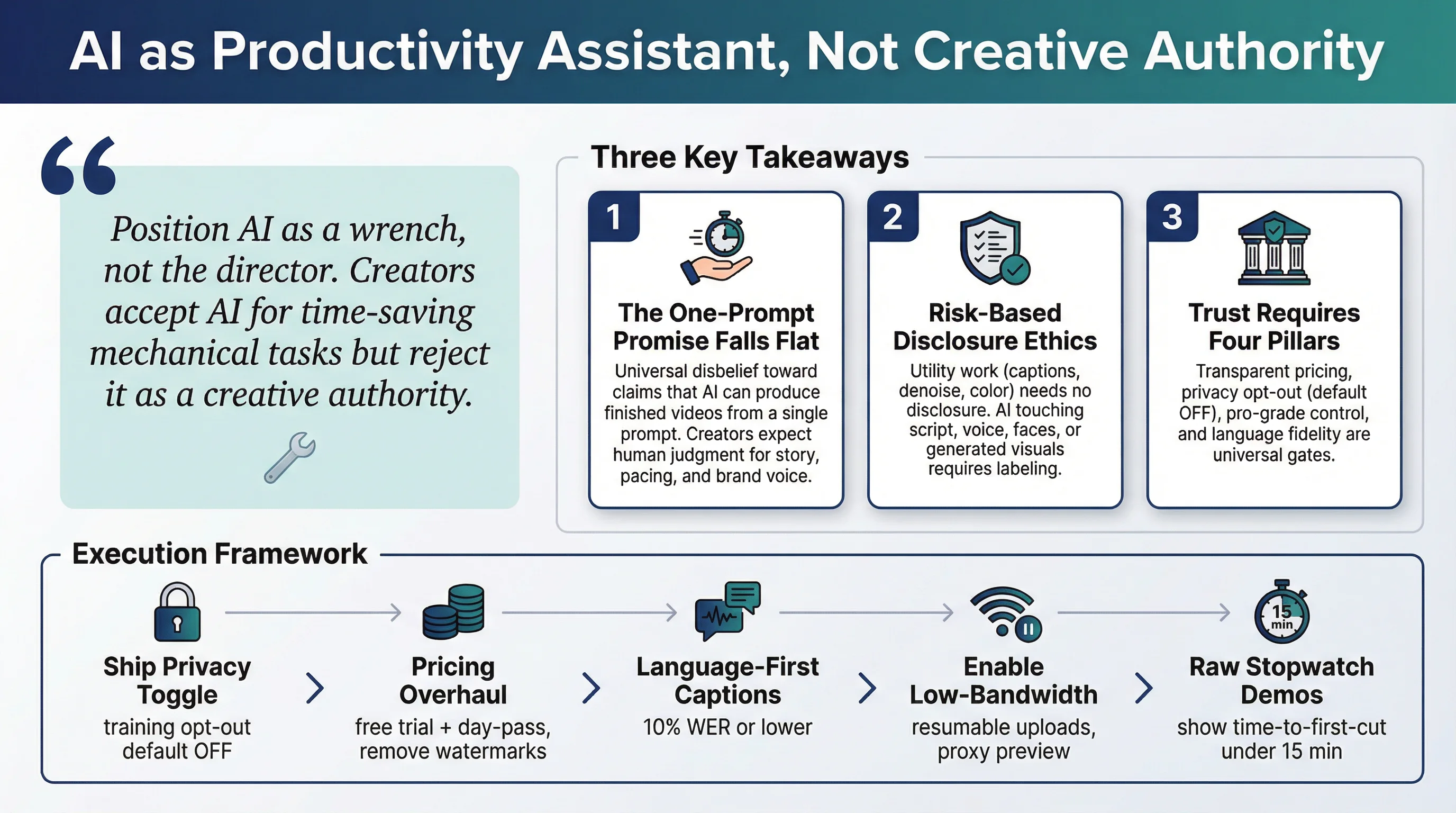
Across all participants, there was "universal disbelief toward claims that a single prompt can produce a finished, creative video." Creators expect human judgment for story, pacing, and brand voice. The one-prompt promise triggers eye rolls, not excitement.
But here is the nuance: participants showed pragmatic willingness to use AI for mechanical drudgery:
Auto-captions and subtitle generation
Silence trimming and rough cuts
Aspect-ratio reframing for different platforms
Basic audio levelling and denoise
B-roll suggestions and placeholder visuals
Key insight: Position AI as a wrench, not the director. Creators accept AI for time-saving mechanical tasks but reject it as a creative authority.
Risk-Based Disclosure Ethics
When would creators disclose AI use? The answer followed a clear ethical framework based on what the AI touched.
The rule: Utility and polish work (captions, denoise, colour) can post without disclosure. AI touching script, voice, faces, or generated visuals requires labelling or non-use.
This was driven by workplace approvals, licensing concerns, and reputational risk. Creators drew a bright line between AI as tool and AI as author.
Key insight: Disclosure anxiety is real but nuanced. Build an export disclosure helper that makes labelling easy when needed.
The Four Pillars of Trust
Trust in AI video tools hinges on four requirements:
Transparent pricing with no watermark ambush. Hidden export restrictions or watermarks are immediate adoption blockers across all income levels. Participants demanded clarity on what the free tier actually delivers.
Privacy and training opt-out (default: OFF). Universal concern that footage will train models. Explicit, plain-language opt-outs are mandatory. Sean from rural Texas demanded "privacy assurances and explicit non-training guarantees."
Pro-grade control and portability. Frame-accurate timeline, ripple/roll/slip editing, remappable shortcuts, 4K exports, and EDL/XML/AAF round-trip capability. Creators want professional tools, not dumbed-down interfaces.
Spanish language fidelity. For Hispanic creators, generic multilingual support is insufficient. High-fidelity Spanish captions with diacritics, culturally correct phrasing, and Spanish UI/support are dealbreakers.
Key insight: Trust requirements vary by segment, but privacy controls and pricing transparency are universal gates.
Segment-Specific Adoption Gates
Different creator segments have distinct barriers:
Spanish-speaking creators need language fidelity: target 10% or lower Word Error Rate for Spanish captions, with diacritics and name accuracy.
Education sector requires institutional procurement terms, student-safety controls, and bilingual brand-first cuts in under 15 minutes.
Compliance/IT professionals demand formal provenance: documented prompts, raw-file retention, version history, and encryption with retention controls.
Lower-resource users need resumable uploads, low-spec performance, day-pass pricing, and no-watermark exports.
Rural/privacy-sensitive users require explicit non-training guarantees and offline capability. Strong preference for local/offline workflows.
Key insight: One-size-fits-all onboarding fails. Each segment has distinct gates that must be cleared before adoption.
What This Means for AI Video Platforms
If you are positioning an AI video editor, here is what actually earns adoption:
Ship privacy toggle with training opt-out (default: OFF). Plain-English policy, visible toggle, clear ownership/indemnity language.
Pricing overhaul: free trial plus day-pass. Remove hidden paywalls and watermarks. Introduce transparent tiers.
Spanish-first captions. Target 10% Word Error Rate or lower, with diacritics, glossary support, and burn-in option.
Resumable uploads and proxy preview. Enable low-bandwidth workflows with ETA visibility.
Publish raw stopwatch demos. Unpolished demos showing time-to-first-cut under 15 minutes defeat scepticism.
The Bottom Line
AI video tools have a real opportunity, but only by positioning AI as productivity assistant, not creative authority. The one-prompt video promise triggers scepticism. Pragmatic automation of mechanical tasks builds trust.
As Jesse Torres from Houston put it: creators are "pragmatically optimistic about AI adoption if institutional safeguards exist." The safeguards matter more than the features.
Want to test your own AI tool positioning? Ditto lets you run studies like this in hours, not weeks. Book a demo at askditto.io.
What the Research Revealed
We asked real consumers to share their thoughts. Here is what they told us:
How do you react to claims that AI can produce finished videos from a single prompt?
Jesse Torres, 39, Education Operations Director, Houston, TX, USA:
Eye roll, then a pause. The promise is alluring but the reality never matches. I would use AI for auto-captions, silence trimming, and rough cuts. Story and pacing stay human.
Abigail Lopez, 45, Assembly Operator, Lansing, MI, USA:
Sceptical. One prompt producing a real video sounds like marketing hype. I would trust AI for mechanical tasks like captions and denoise, not creative decisions.
Derek Tsang, 41, Hospital IT Professional, Enterprise, NV, USA:
Dismissive until proven otherwise. AI can handle mechanical drudgery. Story, pacing, brand voice require human judgment and that is not changing.
When would you disclose that you used AI in creating a video?
Joel Moreno, 25, Data Analyst, Allentown, PA, USA:
Depends what the AI touched. Captions, denoise, colour correction need no disclosure. AI generating script, voice, or faces requires labelling or I do not use it.
Cindy Perkinson, 42, Job Seeker, Lancaster, CA, USA:
Utility work can post clean. If AI touched content that affects trust like voice or generated visuals, I would disclose or not use it at all.
Sean Weinreis, 32, Unemployed, Rural TX, USA:
I would disclose any AI that touches creative substance. Polish and mechanics can be silent. My reputation depends on transparency about authorship.
What would make you trust an AI video tool enough to use it regularly?
Abigail Lopez, 45, Assembly Operator, Lansing, MI, USA:
Spanish captions that actually work. Diacritics, names, cultural phrasing. Plus transparent pricing with no watermark traps and explicit opt-out from training.
Derek Tsang, 41, Hospital IT Professional, Enterprise, NV, USA:
Formal provenance: documented prompts, version history, audit trails. Encryption, retention controls, and a guarantee my footage never trains their model.
Cindy Perkinson, 42, Job Seeker, Lancaster, CA, USA:
Resumable uploads for my slow connection. Day-pass pricing I can afford. No watermarks on exports. Clear privacy policy with training opt-out default to OFF.