
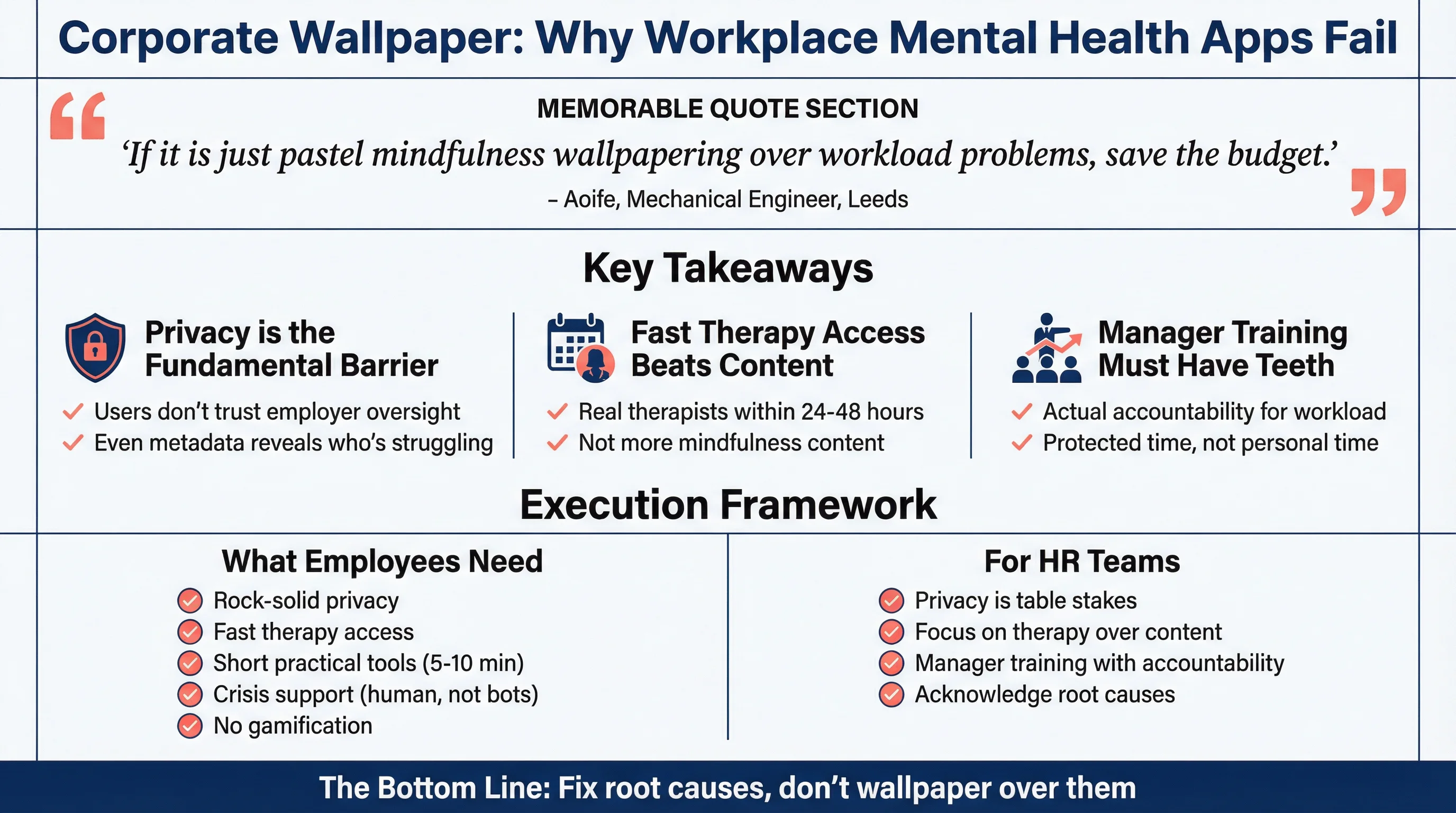
"If it is just pastel mindfulness wallpapering over workload problems, save the budget."
That quote came from Aoife, a 31-year-old mechanical engineer in Leeds. And it captures everything wrong with how companies approach workplace mental health technology.
I ran a study with 6 UK workers to understand what would make a workplace mental health platform actually useful. The findings are a wake-up call for every HR team rolling out wellness apps and every vendor selling them.
The verdict is clear: privacy is the number one barrier. Users want fast therapy access, not mindfulness content. And they can smell corporate wellness theatre from a mile away.
The Participants
Six UK workers: a mechanical engineer in Leeds, a dental nurse in Bristol, an NHS admin in Glasgow, a UX researcher on career break in Bristol, an IT support specialist in Kirklees, and a carpenter in Sheffield. Ages 25-41. A mix of employed, self-employed, and career break.
What unites them: they are all deeply skeptical of employer-sponsored wellness programs, they all worry about privacy, and they all have strong opinions about what would actually help versus what is just "HR box-ticking."
Do You Use Your Employer's Mental Health Programs?
The first question got at the current state: does your employer offer mental health apps or programs, and do you use them?
The pattern was consistent. Most employers offer something. EAP phone lines, mindfulness app codes, resilience webinars. And most employees either ignore them or tried once and stopped.
We have got the usual bits: an EAP with phone counselling, a mindfulness app code floating about, a couple of resilience webinars. It is fine on paper, just feels a bit HR tick-box when the ticket queue is melting.
Daniel, a 34-year-old IT support specialist in Kirklees, captured the gap between offering programs and fixing actual problems. A breathing exercise does not help when you are drowning in service tickets.
The usage patterns reveal the problem. Users tried the app for a week, found the nudges annoying, and deleted it. They attended one counselling session through EAP but found it scripted. The webinars are scheduled during lunch when no one can attend.
I stick to Yoga with Adriene and a jog round the park. Cheaper, no logins, no faff.
Claire, a 41-year-old dental nurse in Bristol, found her own solution. YouTube yoga and park runs beat corporate apps because they are simpler and come without the baggage of employer oversight.
Key insight: The bar for workplace wellness tools is not "exists." It is "better than what employees already do for free."
The Privacy Problem
Every single participant raised privacy as a major concern. This was unprompted and emphatic.
I do not want my employer anywhere near my headspace, even by accident.
Aoife (the Leeds engineer) was direct. Even metadata is concerning: who logs in, when, how often. In a small team, even "anonymous" dashboards can reveal who is struggling.
The concerns fell into clear categories:
Usage tracking: "Even just logins or time of day. Boss sees I am on the app at 2am, suddenly I am 'tired' and 'not for the high ladders' next week." (Liam, Sheffield carpenter)
Manager visibility: Even aggregate dashboards make people twitchy. Small teams can guess who is who from patterns.
Third-party sharing: Insurers, analytics partners, "research." Once data is in the cloud, it spreads.
SSO and work identity: If the app ties to work email or single sign-on, employees assume it is traceable.
Culture consequences: "On site we talk a good game about 'it is ok not to be ok,' but the minute someone thinks you are a wobble risk, your overtime dries up." (Liam again)
I would assume they can see at least something, even if they swear blind they cannot. We have all seen 'mistakes' from big systems hurt real people.
Key insight: Trust is the fundamental barrier. No feature set can overcome suspicion that the employer might see usage data.
What Would Actually Make It Useful?
If employees are skeptical of current offerings, what would change their minds? The answers were specific and practical.
Fast, real therapy - book within 24-48 hours, 6-8 sessions with the same therapist, evenings or early morning, phone or video. UK-accredited. I care about hours, not hype.
Aoife's list became a template that others echoed. The priorities are clear:
1. Fast access to real therapists. Not chatbots. Not wait lists. Actual humans available within 48 hours, with evening and weekend slots. This beats NHS waits, which is the bar.
2. Rock-solid privacy. Totally anonymous to managers. No individual scores or usage ever visible. Clear data policy upfront. Option to use personal email, not work SSO.
3. Short, practical tools. 5-10 minute modules on sleep, burnout, money stress. Not 45-minute webinars. Works offline, low data, works on old phones.
4. Crisis option. 24/7 human to call or text. "If it is a bot, I am out." (Aoife)
5. Manager training that changes work. Capacity planning, protected focus time, no-email windows, sane rota rules. "Training with teeth, not a tick-box slide deck." (Aoife)
6. UK-specific signposting. NHS, local charities, legal rights for carers and parents. Context matters.
7. No gamification. No streaks, no badges, no wellness challenges. "Gamified nonsense rewards the loud." (Aoife)
8. Boundaries respected. Off switch, no nudging outside set hours, silence modes.
If the budget is tight, pick therapy access and proper manager training and drop the fluff. Otherwise it is just corporate wallpaper and everyone knows it.
Key insight: Users want two things above all: fast therapy access and management behavior change. Everything else is secondary.
What This Means for Workplace Wellness
The research points to a fundamental misalignment between what companies buy and what employees need.
Actionable takeaways for HR and wellness vendors:
1. Privacy is not a feature. It is the table stakes. If employees do not trust that their usage is invisible to managers, they will not use the tool. Period. Consider: no SSO, personal email option, clear deletion buttons, UK data residency.
2. Therapy access beats content libraries. Users are drowning in breathing exercises on YouTube. What they cannot get is fast access to qualified therapists. Focus resources here.
3. Manager training must have teeth. Not awareness slides. Actual accountability for workload, meeting hygiene, and after-hours contact. Without this, wellness apps are "mindfulness over mayhem."
4. Protected time matters more than features. If employees cannot actually use the tools during work hours, they will not use them at all. "On the clock, not in my own time. If it matters, pay me to show up." (Liam)
5. Kill the gamification. Badges, streaks, challenges, and leaderboards feel childish to adult employees dealing with real stress. This is not a fitness app.
6. Acknowledge the real problems. High workload, understaffing, unclear priorities. A wellness app that ignores these root causes will always feel like corporate wallpaper.
The Bottom Line
Workplace mental health platforms have a credibility problem. Employees see them as HR box-ticking, management surveillance, or worse: a substitute for actually fixing workload problems.
The path forward is not more features or better meditation content. It is fundamental trust-building: ironclad privacy, fast therapy access, and management training that actually changes how work works.
As Liam the Sheffield carpenter put it: "If it actually saves me time or money, I will use it. If it is another app telling me to breathe while the job is three men short, I will bin it."
The question for every HR team is simple: are you solving real problems, or just decorating them?
Want to understand what your employees actually think? Ditto lets you run studies like this in hours, not weeks. Book a demo at askditto.io.
What the Research Revealed
We asked UK workers to share their thoughts. Here is what they told us:
What privacy concerns would you have about a company mental health app?
Liam Hartley, 40, Carpenter, Sheffield:
Short answer: aye, I would worry. A lot. If the gaffer rolled out a mental health app, I would be side-eyeing it from the off. On site we talk a good game about 'it is ok not to be ok,' but the minute someone thinks you are a wobble risk, your overtime dries up.
Daniel Hargreaves, 34, IT Support, Kirklees:
Yeah, I would worry. A lot. I work in IT, I know how much usage data leaks out of apps even when people swear it is 'anonymised.' If it is tied to work email or SSO, I would assume someone somewhere can join the dots, even if they promise they will not.
Aoife Kearney, 31, Engineer, Leeds:
Short answer: yes, I would worry. I do not want my employer anywhere near my headspace, even by accident. My biggest red flag is metadata - who logs in, when, how often. Even if content is private, patterns can scream burnout.
What features would make a workplace mental health app useful?
Claire Mitchell, 41, Dental Nurse, Bristol:
Short answer: give me stuff that actually helps on a busy shift and no spying. Real humans, fast - book a proper counsellor in a couple of days, evenings or lunch, phone or text if I am wiped. No ten forms before you even start.
Calum McAllister, 25, NHS Admin, Glasgow:
Same-week counselling you can book in-app - real humans, 24-7 call-back, no waiting list chat. Protected time built in - tap to block a 10-15 minute wellbeing slot on the rota. One simple login with my NHS email. That is it. Nae codes, nae portals.