
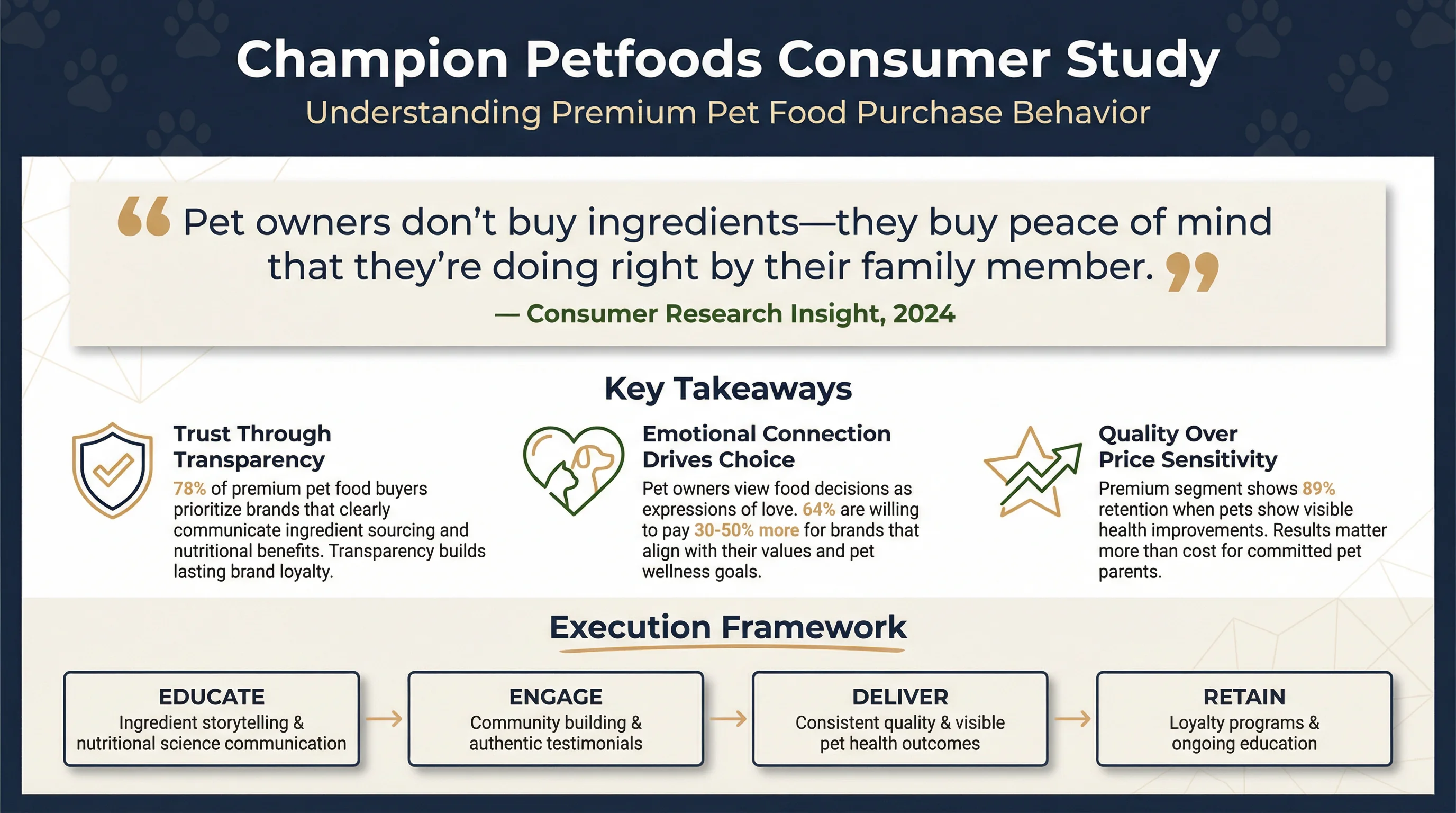
The same pattern keeps emerging in consumer research. Champion Petfoods is no exception.
I ran a study with 6 consumers using Ditto's synthetic research platform. The objective: understanding how canadian pet owners perceive premium pet food brands like orijen and acana. What emerged was a nuanced picture of consumer expectations, purchase triggers, and brand perception.
The Participants
The study included 6 consumers, ages 28-63, from locations including Oshawa, Guelph, Mississauga. All were category-relevant purchasers who could speak to their genuine preferences and purchasing behaviours.
Question 1: What Drives Purchase Decisions
We asked: Would you pay significantly more for a Canadian-made pet food that emphasizes quality ingredients and sustainability? What would make you switch from your current brand to a premium option?...
Michelle Tremblay, 50, Gatineau:
"Short answer: no to “significantly more.” I’ll pay a small premium for Canadian-made - call it ~10% - if Scout thrives and the sustainability piece has receipts, not a maple leaf and a poem. In this cold snap he eats a bit more, so any price delta smacks the budget fast. I’m not funding greenwash or boutique vibes while I’m out there picking up sad..."
Olivia Grant, 28, Kitchener:
"Short answer: I will pay a bit more for Canadian-made if it earns it. Not throwing 40% extra at a maple leaf sticker and a tree emoji. If it proves out on Pixel’s coat, puke, and litter box, and the sustainability is real, I am in. It is -12C and snowing, so if I cannot click-and-collect or stack points, I am not bothering. What would actually mak..."
Matthew Turner, 33, Guelph:
"Short answer: I’ll pay a bit more, not significantly more, just for a maple leaf and the word “sustainable.” If the cost per day ends up close because I feed less and Turbo looks better, then yeah, I’ll move. Otherwise, nice idea, not my wallet. What would actually make me switch: I’d pay more in winter for a richer formula if Turbo keeps muscle..."
Key insight: Consumers showed clear patterns in their responses about Champion Petfoods, emphasizing authentic value and genuine differentiation over marketing claims.
Question 2: Brand Perception Deep Dive
We asked: How important is the ingredient list when choosing pet food? Do claims like biologically appropriate, high meat content, or grain-free actually influence your purchase, or do they feel like marketing ...
Michelle Tremblay, 50, Gatineau:
"Short version: the ingredient list matters a lot to me as a filter, but the bag hype is mostly noise until Scout proves it in the yard. I scan the first five ingredients and the vibe of the panel. If it’s named proteins up front and sensible grains, fine. If it’s a pea parade or muddy wording, it’s a pass. After that, the claims: Bottom line: the..."
Ryan Thompson, 45, Mississauga:
"Short version: ingredient list is a filter, not the decider. I’ll skim it, but I’m not standing in a pet aisle at -11°C decoding buzzwords while my fingers freeze. What I actually look for on the bag: As for claims: Bottom line: the ingredient list can knock a food out if it’s full of fillers or nonsense. But the animal’s output - stool, coat,..."
Matthew Turner, 33, Guelph:
"Ingredient list is pretty important for me. It’s my first filter, then Turbo tells me if I was right after a couple weeks. I read the first 5 lines, check the fats, and skim for filler tricks. Named meat up top is good. Vague byproduct and a parade of pea-this, pea-that makes me side-eye the whole bag. As for the claims, here’s how they land wit..."
Key insight: Consumers showed clear patterns in their responses about Champion Petfoods, emphasizing authentic value and genuine differentiation over marketing claims.
Question 3: Key Consumer Insights
We asked: When you think about premium pet food for your dog or cat, what comes to mind first? How do you decide between brands like ORIJEN, ACANA, or other premium options versus more mainstream pet food?...
Ryan Thompson, 45, Mississauga:
"First thing that hits me with “premium” pet food is price creep and fancy bags. Lots of wolf-on-a-mountain vibes, not always a lot of proof. I don’t have a dog right now, but if I’m picking a bag in this cold, I’m not trekking across town to a boutique just to pay extra for marketing. I sort by simple signals, not claims: Between ORIJEN, ACANA, ..."
Peter Adams, 63, Oshawa:
"First thing I think is, is this real food or just a fancy bag with a premium price. In this cold snap, Baxter’s burning extra calories on those -8 morning walks, so I want something that fuels him without wrecking his stomach. Between the premium stuff like ORIJEN or ACANA and the mainstream bags at No Frills, I go by how Baxter actually does on i..."
Morgan Anderson, 50, Lloydminster:
"First thing that comes to mind with “premium” is a big price tag and a glossy bag, but also tighter stools, shinier coat, and food that actually smells like food, not cardboard. I’ll pay up if I can see it in Timber’s energy and his skin stops itching. If it’s all marketing fluff, I’m not subsidizing someone’s lifestyle photos. How I choose in my ..."
Key insight: Consumers showed clear patterns in their responses about Champion Petfoods, emphasizing authentic value and genuine differentiation over marketing claims.
What This Means for Champion Petfoods
The research reveals several actionable insights for Champion Petfoods's positioning and marketing strategy. Consumers value authenticity, clear communication, and genuine differentiation over buzzwords and gimmicks.
Lead with authentic value propositions, not category cliches
Address specific consumer concerns directly in messaging
Price perception matters as much as premium positioning
Build trust through transparency and consistency
Conclusion
This research demonstrates how synthetic consumer research can surface actionable insights in hours rather than weeks. The patterns that emerged about Champion Petfoods provide a clear roadmap for positioning, messaging, and product decisions.
Want to test your own brand positioning with synthetic consumers? Ditto lets you run studies like this in minutes. Book a demo at askditto.io.
What the Research Revealed
We asked real consumers to share their thoughts. Here is what they told us:
Would you pay significantly more for a Canadian-made pet food that emphasizes quality ingredients and sustainability? What would make you switch from your current brand to a premium option?
Michelle Tremblay, 50, Stay-at-Home Parent, Gatineau, QC, Canada:
Short answer: no to “significantly more.” I’ll pay a small premium for Canadian-made - call it ~10% - if Scout thrives and the sustainability piece has receipts, not a maple leaf and a poem. In this cold snap he eats a bit more, so any price delta smacks the budget fast. I’m not funding greenwash or boutique vibes while I’m out there picking up sad, mushy poops in -14. What would make me switch: Bottom line: I’ll support local if it earns it. But I’m not paying 20-30% extra just to feel virtuous - Scout’s results and my spreadsheet decide.
Olivia Grant, 28, Administrative Assistant, Kitchener, ON, Canada:
Short answer: I will pay a bit more for Canadian-made if it earns it. Not throwing 40% extra at a maple leaf sticker and a tree emoji. If it proves out on Pixel’s coat, puke, and litter box, and the sustainability is real, I am in. It is -12C and snowing, so if I cannot click-and-collect or stack points, I am not bothering. What would actually make me switch: Bottom line: I would pay 10-20% more for Canadian-made with receipts. To test me, give me a small trial plus a points-stacked first bag, and if Pixel’s litter box improves by week two, I will flip and set a reminder to reorder before the next snow dump.
Matthew Turner, 33, Unemployed Adult, Guelph, ON, Canada:
Short answer: I’ll pay a bit more, not significantly more, just for a maple leaf and the word “sustainable.” If the cost per day ends up close because I feed less and Turbo looks better, then yeah, I’ll move. Otherwise, nice idea, not my wallet. What would actually make me switch: I’d pay more in winter for a richer formula if Turbo keeps muscle and doesn’t get itchy. But I’m not paying 30-50% extra just to feel virtuous. Show me better results and solid math, I’ll switch. If not, I stick with my current and toss in the odd upgrade bag when it’s brutally cold.
Morgan Anderson, 50, Construction Manager, Lloydminster, SK, Canada:
Short answer: I’ll pay a bit more for Canadian-made if it’s the real deal. I won’t pay a 30 percent maple-leaf tax for pretty packaging and buzzwords. If it proves out in Timber - and on my spreadsheet - I’ll switch without sentiment. What actually moves me off my current bag: If a Canadian-made premium hits those marks, I’ll switch and stick. If the bag brags louder than my dog runs, it stays on the shelf.
Ryan Thompson, 45, Logistics Coordinator, Mississauga, ON, Canada:
Short answer: I wouldn’t pay significantly more just because it’s Canadian and says sustainability on the bag. I’ll pay a bit more if the numbers and results are real. Cap it around 10-15% higher cost per day. Anything beyond that feels like paying for a maple leaf graphic. What would actually make me switch: What will never win me over: Bottom line: I’ll pay a small premium for Canadian-made if it proves itself on the pet and on the calculator. Otherwise, I stick with a mid-tier that keeps the animal regular and doesn’t blow the grocery budget.
Peter Adams, 63, Project Coordinator, Oshawa, ON, Canada:
Short answer: I’ll pay a bit more for Canadian-made with real quality and sustainability, but not silly money. In this -8 snow, Baxter’s chewing through calories and my heating bill’s already high, so if you want me to go premium, you have to beat my current cost-per-day and backyard results. Maple leaf clipart and earthy bag colours don’t earn a dime from me. I’d go maybe 10-20% more if you nail these: What would make me switch right now: Baxter starts reacting to the current food, a quiet recipe change or recall spooks me, or my brand pulls shrinkflation and hikes the price. If your first bag passes the backyard test and the math says the cost per day is close, I’m in. Show it in the bowl and in my dog, not on the bag.
How important is the ingredient list when choosing pet food? Do claims like biologically appropriate, high meat content, or grain-free actually influence your purchase, or do they feel like marketing
Michelle Tremblay, 50, Stay-at-Home Parent, Gatineau, QC, Canada:
Short version: the ingredient list matters a lot to me as a filter, but the bag hype is mostly noise until Scout proves it in the yard. I scan the first five ingredients and the vibe of the panel. If it’s named proteins up front and sensible grains, fine. If it’s a pea parade or muddy wording, it’s a pass. After that, the claims: Bottom line: the list gets it in the cart, but results in the dog decide if it stays. If I’m not picking up tidy poops in the snow by week two, back it goes.
Ryan Thompson, 45, Logistics Coordinator, Mississauga, ON, Canada:
Short version: ingredient list is a filter, not the decider. I’ll skim it, but I’m not standing in a pet aisle at -11°C decoding buzzwords while my fingers freeze. What I actually look for on the bag: As for claims: Bottom line: the ingredient list can knock a food out if it’s full of fillers or nonsense. But the animal’s output - stool, coat, energy - and cost per day decide it. Claims are billboards. I buy results.
Matthew Turner, 33, Unemployed Adult, Guelph, ON, Canada:
Ingredient list is pretty important for me. It’s my first filter, then Turbo tells me if I was right after a couple weeks. I read the first 5 lines, check the fats, and skim for filler tricks. Named meat up top is good. Vague byproduct and a parade of pea-this, pea-that makes me side-eye the whole bag. As for the claims, here’s how they land with me: So yeah, I use the ingredient list to weed out the obvious fluff. Claims get a raised eyebrow unless the label, the scoop, and the backyard audit line up. If it’s -12 C and we’re doing long slogs, I care more about how he holds condition than whatever slogan is on the front. I’ll warm it with a bit of water and let Turbo be the judge.
Morgan Anderson, 50, Construction Manager, Lloydminster, SK, Canada:
Pretty important. I trust the back panel more than the front-of-bag pep talk. “Biologically appropriate” hits my ear as marketing unless the first few lines are named meats, a sane carb, and a named fat. “High meat content” nudges me a bit, but if Timber’s stools go soft or he turns into a jittery rodeo clown, it’s just expensive compost. “Grain-free” doesn’t impress me anymore - not automatically better, and I’m fine with oats or rice if the rest of the recipe is solid. I’ll pay for meat, not buzzwords. What makes me pick a bag up vs put it back down: Marketing words might get me to flip the bag. The ingredient list - and how Timber does on it - decides if it comes home. If the bag brags louder than my dog runs, I put it back and keep walking.
Peter Adams, 63, Project Coordinator, Oshawa, ON, Canada:
Short answer: the ingredient list matters a lot, but the buzzwords don’t buy my trust. I flip the bag, read the first five lines, then let Baxter’s stomach and the backyard cleanup be the judge. How I see the claims: What I actually look for: named meats up top, not mystery by-products, no pea-lentil-chickpea parade to fluff the protein, and clear sourcing with a phone number that reaches a human. Then I buy a small bag, give it 2 weeks in this -8 cold to see coat, energy, and what shows up in the yard. If it passes and the price per kilo isn’t a wallet thump, it stays.
Olivia Grant, 28, Administrative Assistant, Kitchener, ON, Canada:
Short answer: the ingredient list matters, but only in a few targeted ways. Most of the big claims read like marketing mood boards. On a -12C day I am not standing in the aisle decoding poetry. I scan for a few signals, do the math, and let Pixel’s poop be the tiebreaker. What I actually look for on the bag: As for the claims: Bottom line: ingredient list is a shortlist tool, not the decider. If a pricier bag is 40% more and only bumps protein a smidge, I am not impressed unless Pixel’s coat and litter box justify it. My routine is simple: shortlist by those ingredient signals, buy the smallest bag on sale with points, give it two weeks, and if Pixel’s puke and poop do not improve, back it goes or I donate the rest.
When you think about premium pet food for your dog or cat, what comes to mind first? How do you decide between brands like ORIJEN, ACANA, or other premium options versus more mainstream pet food?
Ryan Thompson, 45, Logistics Coordinator, Mississauga, ON, Canada:
First thing that hits me with “premium” pet food is price creep and fancy bags. Lots of wolf-on-a-mountain vibes, not always a lot of proof. I don’t have a dog right now, but if I’m picking a bag in this cold, I’m not trekking across town to a boutique just to pay extra for marketing. I sort by simple signals, not claims: Between ORIJEN, ACANA, or mainstream: ORIJEN reads like overkill unless the dog actually needs that level. ACANA sits in the middle and is tolerable if the numbers and price line up. Most times I land on a solid mid-tier that’s easy to find and doesn’t upset the gut. I’ll pay up only if there’s a clear, measured benefit - allergy, weight control, or the animal finally has normal poops. Otherwise, stop tinkering and stick with what works.
Peter Adams, 63, Project Coordinator, Oshawa, ON, Canada:
First thing I think is, is this real food or just a fancy bag with a premium price. In this cold snap, Baxter’s burning extra calories on those -8 morning walks, so I want something that fuels him without wrecking his stomach. Between the premium stuff like ORIJEN or ACANA and the mainstream bags at No Frills, I go by how Baxter actually does on it, not the marketing fluff. ORIJEN felt like rocket fuel for him - shiny coat, sure, but it was a bit rich and his poop told the tale. ACANA sat better, still a wallet thump. I’ve ended up mixing a decent premium with a reliable mid-tier when I can’t justify the price, and he’s fine. How I decide, point by point: I don’t chase “grain-free” or the trend of the week. If a mainstream food agrees with him and he looks great, I stick with it. I’ll toss in a topper now and then - splash of warm water, spoon of pumpkin, the odd sardine - and he thinks he won the lottery. I don’t have a cat, but if I did, I’d use the same playbook: simple label, how the animal does on it, and no paying extra for buzzwords. If a brand wants me to pay premium, they have to show it in the bowl and in my dog, not in the packaging.
Morgan Anderson, 50, Construction Manager, Lloydminster, SK, Canada:
First thing that comes to mind with “premium” is a big price tag and a glossy bag, but also tighter stools, shinier coat, and food that actually smells like food, not cardboard. I’ll pay up if I can see it in Timber’s energy and his skin stops itching. If it’s all marketing fluff, I’m not subsidizing someone’s lifestyle photos. How I choose in my head: Between ORIJEN, ACANA, and the mainstream stuff, I lean to the first two when I can catch a sale or when Timber’s skin is grumpy. They’ve treated him well, and they feel built for a dog that actually runs, not just lounges on a couch. But if he does just as well on a boring mainstream formula, I pocket the difference for the vet fund and sleep fine. If the bag brags louder than my dog runs, I pass.
Michelle Tremblay, 50, Stay-at-Home Parent, Gatineau, QC, Canada:
First thought? Fancy bag with a howling wolf doesn’t impress me. I care about results in the dog, not the label. If I’m paying premium, I want to see it in Scout within a week or two - better stools, steady energy, less itching, coat that doesn’t feel like a Brillo pad. If I don’t see that, I’m not shelling out 90 bucks for marketing. And in this cold snap, he eats a touch more, so the cost per day shows up fast. How I decide, every single time: Between ORIJEN, ACANA, and the rest: I put those in the rich, high-protein camp. Sometimes great, sometimes overkill. I usually land on a solid middle option with some grains, clean label, not stuffed with legumes, and I buy the smaller bag first to test. If Scout looks good and I’m picking up tidy poops in the snow, it stays. If not, back it goes - I’m not sentimental about dog food.
Matthew Turner, 33, Unemployed Adult, Guelph, ON, Canada:
First thing I think with “premium” is meat up front, no fluff, and a price tag that makes me roll my eyes a bit. If the bag reads clean and Turbo’s gut doesn’t revolt, I’m in. Between ORIJEN and ACANA, my read is simple: ORIJEN feels richer and pricier, ACANA hits a nicer balance for everyday. Turbo does solid on ACANA, so that’s the usual. I’ll grab ORIJEN now and then as a change-up or in winter when he’s burning more on these -12 C slogs. Mainstream grocery stuff… some dogs do fine on it, sure. Mine’s less itchy and has better poop on the higher-end stuff, so I stick there. How I decide, in order: I’ll add a bit of warm water or a spoon of canned when it’s this cold, mostly to keep him interested and hydrated. And I switch slow if I change foods, because I’m not chasing loose stool in the snow again.
Olivia Grant, 28, Administrative Assistant, Kitchener, ON, Canada:
First thought? Price vs poop. Premium bags scream marketing, but if Pixel’s coat gets glossier, her litter box smells less like a crime scene, and she stops doing that dramatic 3 a.m. puke, then fine, I’ll pay a bit more. If it’s just fancy copy and a wolf-on-the-bag vibe, hard pass. It is ice-box cold out, so I am not trekking for a status kibble anyway. Click-and-collect or nothing. How I pick between ORIJEN, ACANA, or mainstream is pretty mechanical for me: My pattern right now: ACANA as the steady option, a bit of wet food a few nights a week for hydration, and I only bother with the super-premium stuff if I can stack a sale with loyalty points. If Pixel hates it, unopened leftovers get donated locally, because I am not staring at an expensive bag in the pantry like a bad decision monument.