Here's something that's been bugging me about Democratic campaign messaging: we keep talking at voters instead of with them. I ran a study with 6 American voters using Ditto's synthetic research platform to understand what would actually motivate them to not just vote for Democrats in 2026, but to become active advocates who drag their neighbours to the polls.
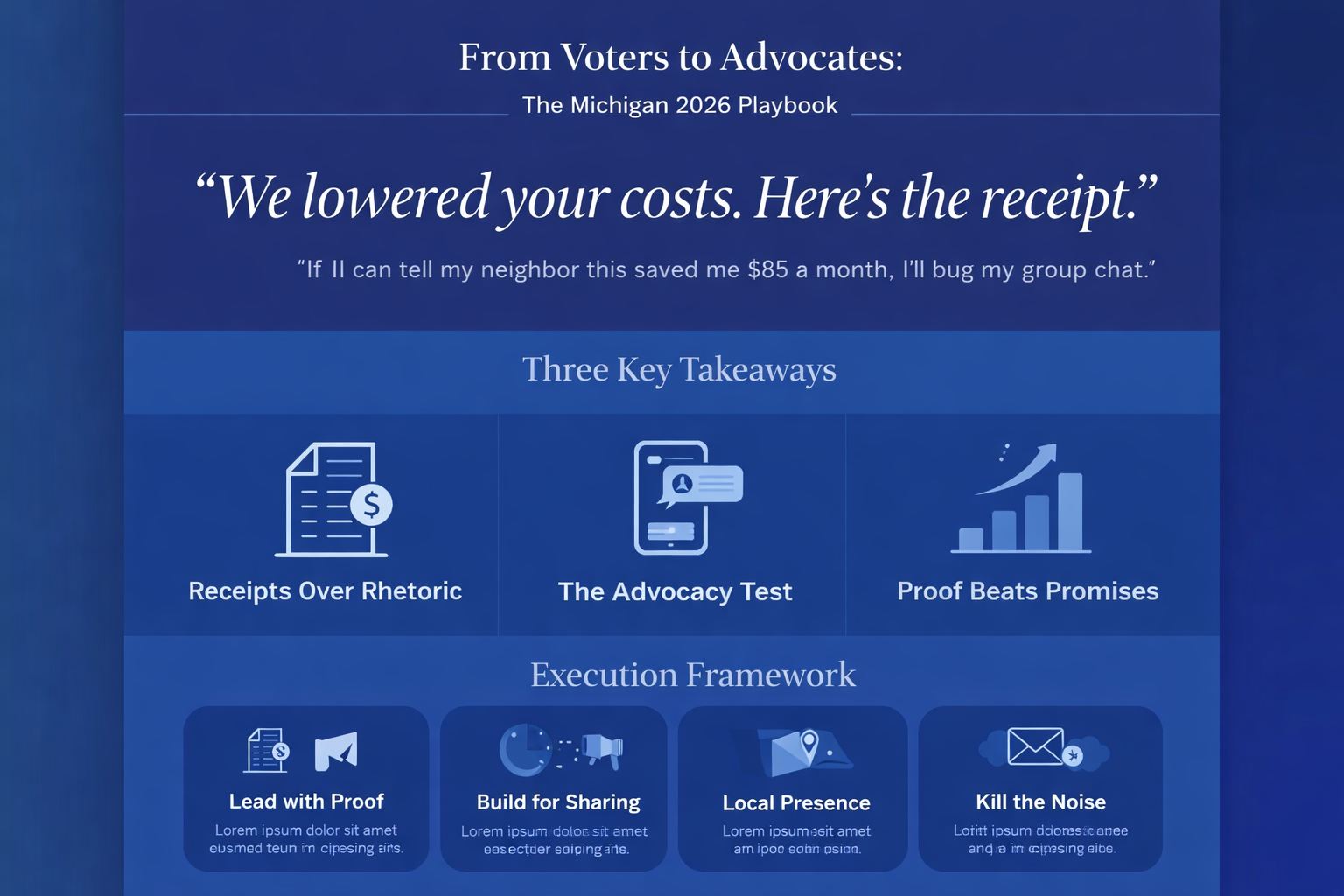
The answer was simpler and more brutal than I expected. One participant put it perfectly: "If I can tell my neighbor this saved me $85 a month, I'll bug my group chat." That's the bar. Not vibes. Not slogans. Receipts.
The Participants
I recruited 6 synthetic personas from Ditto's US model: ages 30-60, spread across different states (Washington, Pennsylvania, Louisiana, Virginia, Florida, Texas), with incomes ranging from working class to high earners. Some were rural, some urban. Some bilingual. What united them? They're all potential Democratic voters who are deeply sceptical of political theatre.
This diversity matters. The Michigan Democratic Party needs to win in places like Erie, PA warehouse floors and rural Louisiana hospitals, not just Ann Arbor coffee shops. These are the people who will decide 2026.
What Would Motivate You to Vote in 2026?
I asked participants what would get them off the couch and to the polls. The consensus was immediate and unified: concrete, verifiable wins that affect their daily lives. Not promises. Not plans. Proof.
Charles, a 43-year-old Seattle renter, summed it up: "If it hits my pocket, my road, or my kid's future, I show up. If it's just noise, I stay home."
The issues that matter most, in order of frequency mentioned:
Healthcare costs - premiums, deductibles, prescription caps, mental health access
Housing - rent caps, renter protections, eviction defence, weatherisation
Infrastructure - roads, broadband, transit frequency, grid reliability
Wages and workplace - wage theft enforcement, paid sick time, predictable schedules, apprenticeships
Safety with accountability - body cams, deescalation training, crisis responders
Kelly, a 60-year-old bilingual warehouse manager in Erie, PA, was blunt: "I do not want to white-knuckle I-90 forever. Fix the damn roads, yes, but prove fewer crashes. Inspections, penalties that bite."
Key insight: Voters want policies they can feel by payday, not policies they have to believe in. The difference between a voter and an advocate is whether they can point to something specific that changed.
Does the Democratic Agenda Energise You?
I asked whether the current Michigan Democratic platform - protecting democracy, reproductive rights, and workers - actually motivates these voters. The response was mixed, leaning towards necessary but insufficient.
Charles called it "table stakes" - important but not exciting. Adam, a 38-year-old rural Louisiana hospital supply chain director, was more direct: "That trio is fine, but it feels like slogans. I get off the couch for concrete fixes with dates and dollar amounts."
The universal request was for receipts over rhetoric. Marc, a Puerto Rico-born security engineer in rural Florida, put it this way: "Democracy with receipts - paper backups, clear audits, fair maps, protect election workers from harassment. Not speeches. Checklists."
What participants wanted more of:
Cost-of-living wins with specific dollar amounts and dates
Rural healthcare survival packages with named facilities and timelines
Broadband and infrastructure with verifiable milestones
Privacy protection - especially opposition to surveillance and encryption backdoors
Disaster preparedness with pre-positioned resources
What they wanted less of:
Culture-war bait and fundraising spam
Task forces and studies that stall action
"Protecting democracy" as a mood instead of specific election fixes
Corporate giveaways without job guarantees and clawbacks
Vague "middle class" talk with no numbers or enforcement
Key insight: The current Democratic platform is a necessary floor, not an inspiring ceiling. Voters don't doubt the values; they doubt the delivery. Proof beats promises.
What Would Make You an Advocate, Not Just a Voter?
This is where the research got genuinely surprising. I asked what would transform these voters into active advocates who recruit others. The answer was unanimous and specific: give them something they can show.
"We lowered your costs, made your street safer, and kept politics out of your doctor's office. Here's the receipt."
That quote from Charles became the thesis of the entire study. Every participant said some version of the same thing: give me a win I can screenshot and text to my group chat.
Adam described exactly what advocacy looks like in practice: "You deliver on two of those with proof and I'll host a boil, print yard signs, and run folks to the polls. If it turns into hashtags and outrage, I stay home and mow."
The advocacy actions participants said they would take if they saw real wins:
Screenshot wins and share on WhatsApp, Facebook, neighbourhood Reddit/Discord
Print one-pagers with specific results and hand out at church, food pantries, feed stores
Organise ballot parties and poll-ride loops after Sunday service
Knock doors with receipts in hand - before/after pharmacy slips, utility bills, repair grants
Host porch Q&As with coffee, walk neighbours through mail-in ballots
Kelly's approach was particularly practical: "One Facebook post in the township group: before-after pharmacy slip, account number covered. 'This is the difference.' That moves people more than ten yard signs."
Key insight: The advocacy test isn't "do I agree with the platform?" It's "can I tell my neighbour this saved me $85 a month?" Give voters screenshots of wins, and they become your field team.
What This Means for Michigan Democratic Campaigns
This research reveals a clear playbook for voter mobilisation that prioritises proof over persuasion:
1. Lead with receipts, not rights. The democratic platform is necessary but not sufficient. Every message should include specific dollar amounts, dates, and locations. "Your premium dropped $X on April 1" beats "We're fighting for healthcare."
2. Build shareable wins. Design policies and communications to be screenshot-able. One-pagers in English and Spanish with phone numbers, dates, and QR codes. Make it easy for supporters to share proof.
3. Publish dashboards, not press releases. Multiple participants mentioned wanting monthly scorecards with red-green status. "Utility complaints down 20 percent by June" with public tracking beats a ribbon-cutting.
4. Show up where they are. Town halls in school cafeterias, not just city centres. Bilingual materials. Local field staff, not fly-ins. The engineer who built the microgrid, not just the politician.
5. Kill the culture-war bait. Every participant mentioned this as a deal-breaker. Focus on "roofs, routes, and routers" (as Marc put it), not Twitter zingers.
6. Create the advocacy toolkit. Give supporters the materials to recruit: before-after comparisons, sample ballots, ride-to-polls checklists, short videos of real people getting help.
The Bottom Line
Michigan voters aren't waiting to be inspired. They're waiting to be shown. The path from voter to advocate runs through one simple test: can they prove it to their neighbour?
As Tyron, a 30-year-old Austin maintenance tech, said: "Give me a one-pager. Simple checklist. In Spanish. With phone numbers. Dates. I'll share it on WhatsApp. If it's just culture war noise, pues no."
The message that works: "We lowered your costs. Here's the receipt." Then literally list it. Dates. Dollars. Addresses. Phone numbers that answer.
Deliver that, and these voters will turn into your most effective organisers. Fail to deliver, and they'll "stay home and mow" - or worse, stay home and not vote at all.
Want to test your own campaign messaging with real voter personas? Ditto lets you run studies like this in hours, not weeks. Book a demo at askditto.io.
What the Research Revealed
We asked real consumers to share their thoughts. Here's what they told us:
What would motivate you to vote in the 2026 midterm elections?
Charles Escamilla, 43, Unemployed Adult, Seattle, WA, USA:
Short answer: I usually vote. In Washington it's mail-in, so it's more "do I fill this out tonight or let it sit a week." I show up faster when it hits my day-to-day life, not slogans. What gets me to vote quickly: Health care costs - Marketplace premiums, out-of-pocket caps, mental health coverage, telehealth. Housing - renter protections, adding more middle housing, supportive housing that's actually funded. Transit and street safety - bus frequency, bus lanes, sidewalks, protected bike lanes. Climate and smoke - heat pump and efficiency rebates that renters can access, urban trees. Consumer stuff - junk fee bans, right to repair, real data privacy. If a candidate can't say what they'll do in plain language, I tune out.
Kelly Ocasio, 60, Warehouse Manager, Erie, PA, USA:
Short version: if it touches my paycheck, my pills, or the road I drive on at 5:30 a.m. in black ice, I show up. If it's just culture-war noise and yard signs, I stay home and fold laundry. I will show up and vote for anyone who puts this in writing with dates and dollars: Workplace safety with teeth. More inspectors, real fines that stick. Protect my time and pay. Overtime rules, predictable schedules, paid sick time. Healthcare that doesn't play gotcha. Lower RX prices, cap insulin, keep preexisting coverage. Basic infrastructure. Plow the roads, fix bridges, reliable rural broadband. Cost of living honesty. Groceries, utilities, insurance. If I can see it, I'll put on my coat in this cold and go vote.
Marc Lopez, 33, Security Engineer, Rural, FL, USA:
Short version: I show up when I see grown-ups on the ballot who respect my time and reality. If it's all noise, I stay home, grill, and keep an eye on the radar. What gets me to the polling place: Hurricane resilience plus insurance sanity - real grid hardening, stronger codes, flood fixes, not press conferences in windbreakers. Rural broadband that actually reaches fence lines. Privacy and security - no backdoors, no warrantless fishing. Veteran care with teeth - staffing, mental health, faster claims. Water and land stewardship. If even one candidate shows real plans on those fronts, I'll drive in, vote, and grab a Publix sub on the way back.
Does the Michigan Democratic agenda energize you?
Charles Escamilla, 43, Unemployed Adult, Seattle, WA, USA:
Short answer: it's a solid baseline. Democracy and reproductive rights are table stakes for me. The workers piece only hits if it's real wages, sick leave, and enforcement, not a ribbon-cutting. So yeah, it nudges me, but I move faster when I see pocketbook fixes I can feel. What I want more of: Health costs, Housing, Transit and street safety, Consumer stuff, Climate that's practical, Public safety that works. What I want less of: Culture-war bait that raises money but fixes nothing. Vague "middle class" talk with no numbers, timelines, or enforcement. Corporate giveaways without job guarantees. Task forces and photo ops that stall real action.
Adam Doubet, 38, Supply Chain Manager, Rural, LA, USA:
Short answer: not really. That trio is fine, but it feels like slogans. I get off the couch for concrete fixes with dates and dollar amounts. I'm already wound tight with the news. I want calm, competent management, not vibes. What would actually energize me: Cost of living you can touch - insurance relief with clear timelines, grid hardening schedules, drug-price transparency. Rural and small-town healthcare - keep ERs open, pay EMS properly. Workforce that feeds real jobs. Public safety that deescalates. If Michigan wants to be a model, post milestones and quarterly scorecards I can skim while waiting at baseball practice.
Marc Lopez, 33, Security Engineer, Rural, FL, USA:
Short take: it mostly energizes me. Protecting democracy and reproductive rights are table stakes in 2026. Workers could light a fire if it comes with nuts-and-bolts, not photo ops. What hits right for me: Democracy with receipts - paper backups, clear audits, fair maps, protect election workers. Reproductive rights as healthcare. Workers with teeth - apprenticeships, skilled trades, wage theft enforcement. What I want more of: Real infrastructure resilience, Rural broadband to the last fence post, Privacy by default, Veteran care with timelines. If they bring a socket set and a torque wrench, not a selfie stick, I'll show up early and vote.
What would make you an advocate, not just a voter?
Charles Escamilla, 43, Unemployed Adult, Seattle, WA, USA:
Short answer: cut my costs in ways I can point to, show receipts, and stop the theater. If I can tell my neighbor "this saved me $85 a month and made the bus come on time," I'll bug my group chat, print flyers, the whole thing. The message that would actually work on me: "We lowered your costs, made your street safer, and kept politics out of your doctor's office. Here's the receipt." Then literally list it. What I'd actually do if they deliver: Text friends and family with screenshots of the wins. Post a straight, no-fluff summary in my neighborhood Reddit and Discord. Ballot party with a one-pager I print at home. Deal-breakers: Culture-war bait and fundraising spam. Task forces that stall action.
Adam Doubet, 38, Supply Chain Manager, Rural, LA, USA:
Short version: prove you can fix the stuff that ruins my sleep - premiums, clinics, power, roads - with dates and receipts. If Democrats did the below, I would not just vote, I'd drag neighbors. Insurance relief with a clock on it: Fortified roof grants live by Q1, reinsurance support signed. Rural health survival package. Drainage and power you can verify. The message I'd actually repeat to friends: We will cut your premium, keep your clinic open, and keep your lights on - here's the schedule and the phone number if we slip. You deliver on two of those with proof and I'll host a boil, print yard signs, and run folks to the polls.
Kelly Ocasio, 60, Warehouse Manager, Erie, PA, USA:
If they put hard wins on the board that I can feel by payday and at 5:30 a.m. on black ice, I'll do more than vote - I'll be a megafono. What flips me from voter to advocate: Receipts, monthly. A one-page scoreboard with dates and dollars - in English and Spanish. Safety with teeth I can point to. Protect my time and pay. Healthcare that shows up at the counter. How I would actually push people: WhatsApp plus pantry - I'll post the scoreboard in my family chat and hand copies at the church food pantry. Rides and reminders after Sunday service. One Facebook post in the township group: before-after pharmacy slip, account number covered. "This is the difference." That moves people more than ten yard signs.
Marc Lopez, 33, Security Engineer, Rural, FL, USA:
Short version: show receipts in places like mine, talk to us like adults, and protect privacy for real. If I can point at a pole with fresh fiber on my dirt road and a roof grant my neighbor actually used, I'll turn into the annoying guy dragging folks to the polls with a cooler of pastelillos in the truck. What would make me a loud advocate: I can point at one local win before Election Day. Clear pledges on privacy in writing. A hotline that works. Do that, and I'll: Host a porch Q&A with cafecito and pastelillos, walk folks through mail-in ballots. Nag the group chat, print sample ballots, and babysit so parents can vote. Put the salsa-red cap on, load Luna in the Tacoma, and knock the dirt road with receipts in hand.