Here's something that's been rattling around in my head for a while: does wearing the uniform actually translate into votes? I see veteran candidates everywhere these days, particularly progressive ones who back VoteVets-style messaging. But I wanted to know what swing state voters actually think when they see "veteran" on a ballot.
So I ran a study with six voters from swing states across the US. Washington, Texas, Ohio, California, Virginia. Ages ranged from 30 to 65, spanning healthcare administrators, a security analyst, a stay-at-home parent, a retiree, and a social worker. All persuadable, all paying attention, and all fierce honest about what moves them.
The findings? Jaysus. They're not what the hero-montage campaign ads might have you believe.
The Participants
I recruited six swing state voters with genuinely diverse profiles:
Sahar Pereira, 44, Security Analyst, Vancouver, WA - Single mum saving for a home, earns $100k-$149k, deeply privacy-conscious
Milton Salas, 65, Retiree, Seattle, WA - Former nonprofit professional, eco-minded, lives frugally on fixed income
Abbe Fenner, 38, Stay-at-Home Parent, Dallas, TX - Nigerian American mum of three, bilingual, manages mortgage on modest income
Barbara Kirk, 61, Healthcare Administrator, Rural Ohio - Hospital quality manager, community-minded, values evidence and clear costs
Mary Magadia, 64, Social Worker, Torrance, CA - Korean American care coordinator, faith-driven, prefers clear terms and bilingual support
Nancy Islas, 30, Healthcare Administrator, Virginia Beach, VA - Bilingual Patient Services Manager, $200k+ household income, values efficiency and evidence
What unites them: all are politically engaged, all vote regularly, and all are tired of theatrics. They want substance over salutes.
Finding One: Military Service Is "A Plus, Not A Pass"
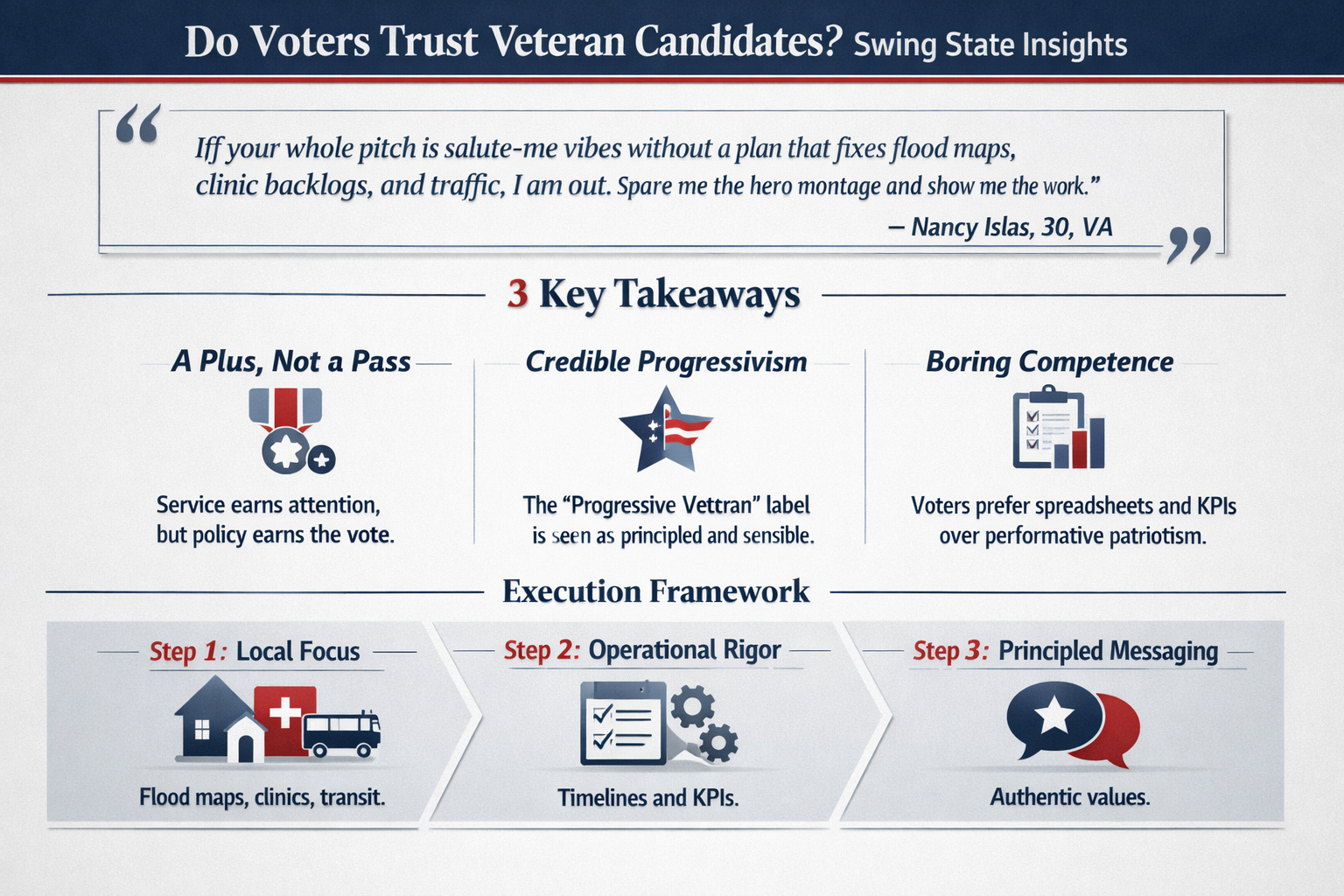
Every single participant said the same thing: veteran status might get them to listen, but it won't automatically get their vote. Milton Salas from Seattle put it bluntly: "Service is a plus, not a pass."
The consensus was fierce clear. Voters respect service, but they've grown allergic to candidates who wave the uniform like a golden ticket. Barbara Kirk from rural Ohio described what she actually wants to see:
"Earn it with boring competence. Not your ribbon rack. Not your B-roll on a Humvee. Show me plans, receipts, and a temperament that can handle messy civilian process without barking orders."
And Nancy Islas from Virginia Beach delivered the quote that sums up the entire study:
"If your whole pitch is salute-me vibes without a plan that fixes flood maps, clinic backlogs, and traffic, I am out. Spare me the hero montage and show me the work."
Key insight: Swing state voters give veteran candidates a "small trust bump" but demand the same policy rigour they'd expect from anyone else. The uniform is a conversation starter, not a substitute for substance.
Finding Two: "Progressive Veteran" Sounds Credible, Not Contradictory
This one genuinely surprised me. I expected some voters to see "progressive" and "veteran" as an odd pairing. Instead, every participant found the combination credible. Some even saw it as particularly sensible.
Sahar Pereira explained the logic:
"Credible, not a contradiction. Service and progressive values can line up just fine if the candidate actually talks about rights, care, and long-term risk, not just ribbons and slogans."
The reasoning that came up repeatedly:
Duty to protect rights - If you swore an oath, defending voting access and civil liberties tracks
Cost-of-war realism - Veterans who've seen the bill are often serious about diplomacy, not chest-thumping
Risk and logistics mindset - Climate as a threat surface, health care as readiness, planning over vibes
Barbara Kirk summed it up: "Plenty of vets come home with a strong streak for voting access, decent healthcare, and not wasting lives or money. That can land you squarely in progressive territory without any cognitive dissonance."
Key insight: Progressive veteran messaging is viable because voters see it as principled, not contradictory. The oath to defend the Constitution maps naturally onto voting rights, climate resilience, and healthcare reform.
Finding Three: Voters Want "Boring Competence Over Hero Montage"
The phrase "boring competence" kept coming up. Again and again. Voters don't want another candidate in a camo hat pointing at problems. They want spreadsheets, timelines, and someone who'll show up to the tedious meeting.
Barbara Kirk laid out what would actually win her over:
"Show me you can stack chairs after the fish fry, sit through a tedious budget meeting without theatrics, and still move the ball. Do that, and yes, your service becomes a plus. Otherwise, it is just biography."
Nancy Islas wants specific KPIs:
"Give me a one-pager with three KPIs you will move in year one and how you will measure them. Example: stormwater permits processed 30% faster by Q3, VA referrals cleared within 7 days, crash hotspots reduced 15% with design fixes."
The hard turn-offs were remarkably consistent across all six voters:
"Uniform cosplay" - Camo hats, flag backdrops, tacticool photos with zero policy
"Service-as-shield" - Using military record to dodge policy questions
"Valor-as-branding" - Constant salutes at the grocery store, war metaphors for potholes
"Metrics-free promises" - No targets, no dates, just vibes
Key insight: The voters who matter most in swing states have developed allergies to performative patriotism. They're screening for operational competence, civilian temperament, and the humility to sit through the boring work.
Finding Four: Specific Local Issues Trump Abstract Messaging
When I asked voters what they actually want to hear veteran candidates address, the answers weren't about military policy or national security. They were fierce local.
Nancy Islas listed what matters in Virginia Beach:
Coastal resilience and insurance sanity - Stormwater fixes that actually move water, not ribbon-cuttings
VA and healthcare operations - Cut appointment delays, show 12-month targets for wait times
Infrastructure and mobility - Fix 264-64 chokepoints, fill sidewalk gaps, safe bike lanes that connect
Abbe Fenner in Dallas wanted candidates to show up in Oak Cliff and talk about:
Better buses and safe sidewalks for kids
Working street lights and steady water bills
Schools and after-school spots that aren't just waitlists
Barbara Kirk in rural Ohio focused on:
Rural hospital stabilisation and EMS
Broadband that works past the town line
Opioid response with treatment on demand
Key insight: Swing state voters want veteran candidates to connect their service to "steady, neighbour-level work." Abstract national security messaging falls flat. Flood maps, clinic backlogs, and buses resonate.
What This Means for Veteran Candidates
If you're a veteran running for office with progressive values, here's how to translate this research into campaign strategy:
Lead with the plan, not the uniform. Open with specific policy, close with how your service informs it. Not the other way around.
Show boring competence. Publish one-pagers with budgets, timelines, and KPIs. Voters crave receipts, not vibes.
Connect service to civilian oversight. Emphasise that you understand chain-of-command AND messy democratic process. Show you can negotiate, not just direct.
Get hyperlocal. Talk about the actual streets, clinics, and bus routes in your district. Show up when the cameras are off.
Kill the cosplay. Lose the camo hat, the flag backdrop, and the tacticool photo ops. Voters find it performative and off-putting.
Translate mission to metrics. "I managed a $2M logistics budget with zero waste" beats "I served my country" every time.
About This Study
This research was conducted using Ditto's synthetic market research platform. I recruited six synthetic personas from Ditto's US model, all representing persuadable swing state voters. They answered three questions about veteran candidates and progressive veteran messaging.
Want to test your own campaign messaging with swing state voters? Ditto lets you run studies like this in hours, not weeks. Book a demo at askditto.io.
What the Research Revealed
We asked real voters to share their thoughts. Here's what they told us:
When you see that a political candidate is a military veteran, does that make you more likely to vote for them?
Abbe Fenner, 38, Stay-at-Home Parent, Dallas, TX:
Short answer: respect, not an automatic vote. Military service tells me they can show up, handle pressure, and stick to a hard job. That matters. But office work is different - you need to listen, deal with budgets, schools, clinics, buses, water bills. If a vet candidate only talks tough and waves a flag, I tune out. So does it make me more likely? A little. Like clean shoes at an interview - nice, but I still check the resume. Abeg, show me your plan for our kids and our streets, not just your rank.
Barbara Kirk, 61, Healthcare Administrator, Rural Ohio:
Short answer: it nudges me, but it is not a golden ticket. I respect service, full stop. But I will not hand someone the keys to a budget and a bureaucracy because they wore a uniform. We have plenty of hero stories and not enough boring competence. If two candidates are dead even and the veteran also shows data sense, patience with process, and concrete plans, it might tip me. But plenty of non-vets have those qualities, and plenty of vets do not. Service is a plus. It is not a pass.
Nancy Islas, 30, Healthcare Administrator, Virginia Beach, VA:
Short answer: slightly more likely, but only as a tiebreaker. Military service can be a green flag, not a golden ticket. If your whole platform is basically "salute me," I check out. What I need to see from a vet candidate: receipts - budgets managed, people developed, results delivered. Specific policy reps - VA, procurement, cybersecurity, disaster response, or infrastructure. And temperament - steady, not performative. I am exhausted by crisis theater. With everything in the news, my nerves do not need more chest-thumping.
Does the combination of military service and progressive politics sound credible?
Sahar Pereira, 44, Security Analyst, Vancouver, WA:
Short answer: credible, not a contradiction. Service and progressive values can line up just fine if the candidate actually talks about rights, care, and long-term risk, not just ribbons and slogans. Why it rings true to me: Duty to protect rights - if you swore an oath, defending voting access and civil liberties tracks. Cost-of-war realism - vets who have seen the bill are often serious about diplomacy and veteran care, not chest-thumping. Would I trust a progressive vet more? Slight edge to the vet if they show humility, back civilian oversight, and bring concrete execution plans.
Milton Salas, 65, Retiree, Seattle, WA:
Not a contradiction. Plenty of vets I've worked with are progressive because they've seen the costs up close - war, VA backlogs, waste - and they treat climate and voting rights as nuts-and-bolts democracy issues, not slogans. I trust a progressive veteran slightly more than a non-vet on execution, crisis handling, and talking to moderates. But I watch for the hierarchy reflex - surveillance creep, puffed-up defense budgets, or waving the service record to dodge scrutiny. Bottom line: it's a small plus if their platform has clear numbers, civil-liberties guardrails, and VA fixes; otherwise it's just biography and I move on.
Mary Magadia, 64, Social Worker, Torrance, CA:
It's credible to me, not a contradiction. Many vets I know say they served to protect the Constitution and their neighbors, so backing voting rights, strong healthcare, and real climate resilience fits that duty mindset. I'd give a progressive veteran a small plus over a progressive who never served because they've handled pressure, logistics, and sacrifices. But it's still not a free pass - I want clear plans, cost realism, and a respectful way of talking. Bottom line, service adds credibility, the follow-through earns my vote.
What would it take for a veteran candidate to earn your vote?
Nancy Islas, 30, Healthcare Administrator, Virginia Beach, VA:
Short version: earn my vote with receipts, restraint, and boring competence. If your whole pitch is salute-me vibes without a plan that fixes flood maps, clinic backlogs, and traffic, I am out. What I need to hear: Coastal resilience plus insurance sanity - stormwater fixes that actually move water, not ribbon-cuttings. VA and healthcare operations - cut appointment delays, show a 12-month target. Infrastructure and mobility - stop worshiping asphalt, fix 264-64 chokepoints. Transparency - publish a public dashboard, office SLAs, and your meeting logs. How you actually win my tiebreaker: Give me a one-pager with three KPIs you will move in year one.
Sahar Pereira, 44, Security Analyst, Vancouver, WA:
Short answer: earn it with sober plans, not a uniform. If you lead like a mission commander - clear objectives, budgets, guardrails, after-action accountability - I listen. If you lead with medals and vibes, I'm out. What I need: Health care I can feel in my bill - lower premiums and deductibles, mental health access, metrics not slogans. Veteran care with teeth - shorter claim times, toxic exposure treatment, community clinics. Name the funding source and timeline. How you earn trust: Publish an operations plan - 1-year and 4-year goals, line-item budgets, milestones.
Barbara Kirk, 61, Healthcare Administrator, Rural Ohio:
Short answer: earn it with boring competence. What would win me over: Rural health care realism. Stabilize rural hospitals and EMS. Stop the prior-auth circus. Veterans care now, not pageantry. Faster claims, suicide prevention with real funding. Budget discipline - if you want to trim fat, show your cut list and the 5-year pay-fors. Infrastructure that actually reaches my road - broadband that works past the town line. What turns me off: Uniform cosplay. Command-and-control swagger. War metaphors for domestic policy. Bottom line: Show me you can stack chairs after the fish fry, sit through a tedious budget meeting without theatrics, and still move the ball.