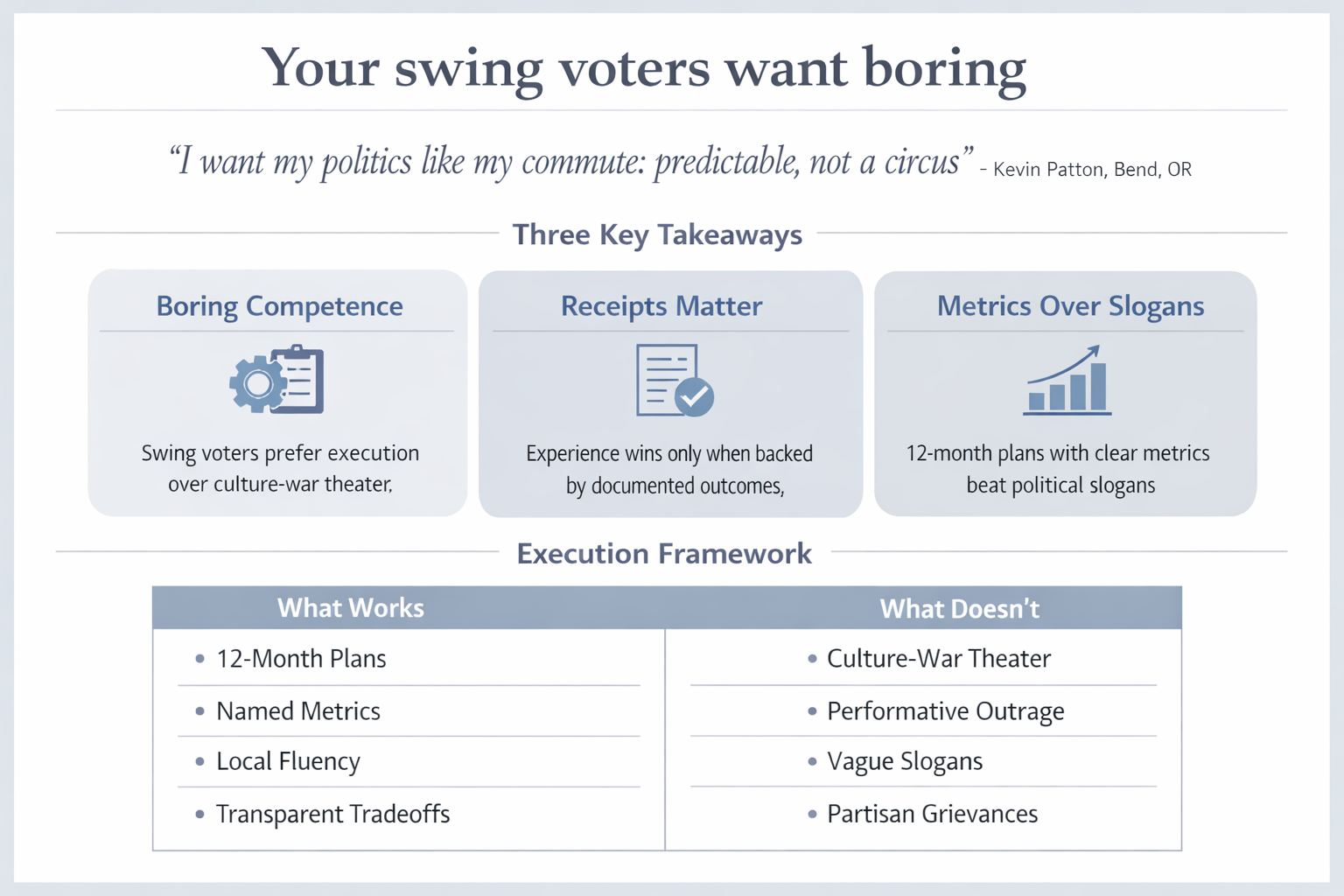
Here's something that surprised me: I asked swing state voters what they want from Republican candidates in 2026, and every single one of them said some version of the same thing. They want boring. Not boring as in dull. Boring as in predictable, competent, and focused on things that actually matter to their daily lives.
One participant, Kevin from Bend, Oregon, put it perfectly: "I want my politics like my commute: predictable, not a circus."
I ran a study with 6 swing state voters from Oregon, California, South Carolina, Texas, North Carolina, and Illinois. Ages 32 to 51. School counselors, operations managers, engineers, project managers. People who have actual jobs and actual bills. And what they told me has some pretty stark implications for anyone running as a Republican in 2026.
The Participants
The group spanned swing states with diverse political cultures:
Kevin Patton, 33, School Counselor, Bend, Oregon
Ryan Maciel, 39, Operations Manager, San Jose, California
Jessica Castellanos, 46, Product Manager, Mount Pleasant, South Carolina
Eduardo Ford, 32, Administrative Assistant, Houston, Texas
Shawn Clavijo, 51, Electrical Engineer, Gastonia, North Carolina
Gloria Villanueva, 45, Project Manager, Naperville, Illinois
What united them: they've all voted for candidates from both parties. They're not partisan loyalists. They're the people campaigns spend millions trying to reach. And they're exhausted.
What Makes Them Even Consider a Republican?
When I asked what would make them more likely to vote Republican, the answers were remarkably consistent. Not a single person mentioned culture-war issues as a draw. Instead, they wanted:
Cost of living with receipts - not slogans, but line-item plans with timelines and tradeoffs
Infrastructure that gets built - flood control, grid hardening, roads, permits that actually move
Public safety with accountability - body cams, training, mental health co-responders
Immigration handled with 'order and decency' - strong but careful, no theatrical raids
Privacy and tech sanity - rein in data brokers, label deepfakes, basic guardrails
Shawn from North Carolina, an electrical engineer who works on grid protection, summed up the vibe: "I want boring competence, not noise."
"Talk like a foreman before a storm - plan the work, work the plan, own the results." - Shawn Clavijo, NC
Key insight: These voters aren't asking for ideological purity. They're asking for competence. They want someone who knows how the budget works, which levers to pull, and how to actually deliver results.
The Outsider Problem
I asked whether they preferred outsider candidates or experienced ones. The answer was overwhelming: experience wins, but only if it comes with proof.
Ryan from San Jose: "Outsiders are fine only if they're builders with a plan, not YouTube warriors. I want boring competence that moves numbers, not another season of cable news."
The group drew a sharp line between two types of candidates:
Authentic: Specific plans with costs and tradeoffs. Ride-alongs without camera crews. Admits 'I don't know' and follows up. Posts votes and meeting attendance. Committee work over TV hits.
Performative: 'I'll fight' rhetoric with no process changes. Photo-ops in borrowed hard hats. Fundraising emails every 48 hours. Blaming 'the establishment' while skipping votes.
Gloria from Illinois, who manages utility field operations, put it bluntly: "Receipts over reels."
"Give me the city-council technocrat energy. If an outsider shows up with spreadsheets, admits constraints, and can survive a 90-minute briefing on wildfire, zoning, and water without flinching, fine. If it's culture-war karaoke, hard pass." - Kevin Patton, OR
Key insight: The 'outsider' brand has been devalued. These voters associate it with performance over substance. Experience signals reliability, but only when backed by documented results.
What Should Republicans Actually Talk About?
When I asked which issues Republicans should prioritise to win swing voters, the consensus was clear: cost of living first, but with specifics. Not 'we'll cut inflation' but 'here's exactly what changes and when.'
The priority stack across all six voters:
1. Cost of living with SPECIFICS - property taxes, utility bills, insurance, grocery prices
2. Infrastructure - flood control, grid hardening, roads, permits
3. Public safety - but smart, with mental health support and accountability
4. Immigration - 'strong but careful', more judges and processing, no theater
5. Housing supply - faster permits, more building, less parking worship
6. Privacy and tech - data brokers, AI guardrails, transparency
What surprised me: privacy and tech concerns ranked alongside traditional Republican issues. These voters are paying attention to data brokers, deepfakes, and AI in ways that most political messaging ignores.
"Show up with a clipboard, not a camera crew." - Eduardo Ford, TX
Eduardo from Houston had a specific request: "A 90-day plan with dollars, dates, and crews for flood work and lighting fixes, then weekly updates." That's the level of specificity these voters are demanding.
Key insight: Generic messaging fails. These voters want 12-month plans with metrics, monthly dashboards, and named tradeoffs. The bar for 'specific enough' is higher than most campaigns realise.
The Instant Disqualifiers
Every single participant had a clear list of immediate turn-offs. These aren't negotiable positions, they're instant exits:
Election denial - 'If you can't accept results, you can't manage a budget'
Culture-war cosplay - book bans, performative hearings, grievance content
Abortion bans without clear limits - medical exceptions must be explicit
Border theater - 'No stunt buses or cosplay at the border'
Tax cuts with no math - 'Don't sell me candy and call it protein'
Outrage-as-platform - 'If your campaign sounds like cable news B-roll, hard pass'
Jessica from South Carolina: "Too many Republican candidates feel like culture-war cosplayers auditioning on cable news. Lots of grievance, not a lot of homework."
Key insight: The culture-war playbook that works in primaries actively repels swing voters. Every minute spent on book bans or election conspiracy is a minute not spent on cost of living.
What This Means for GOP Candidates
If I were advising a Republican candidate trying to win persuadable voters in 2026, here's what this research suggests:
Lead with execution, not ideology - 12-month plans, named metrics, monthly progress reports
Embrace boring - 'City-council technocrat energy' is a compliment, not an insult
Show your work - Votes cast, budgets passed, projects completed. Receipts over vibes.
Name the tradeoffs - What gets cut? What waits? Who loses? Be explicit.
Skip the culture war - Not one of these voters was drawn by social issues. Not one.
Local fluency matters - Know the flood maps, the permit process, the power grid. Speak like someone who's sat through the boring meetings.
Immigration: strong AND careful - Enforcement with accountability, legal pathways that work, no theatrical raids
The winning message template, according to these voters: "Here is my 12-month punch list with dates, budgets, and the metric to judge me by. I will publish a monthly scorecard. I will skip the culture-war TV hits. I will talk like a grown-up."
The Bottom Line
These swing state voters aren't asking for much. They want candidates who treat them like adults, show their work, and focus on things that affect their daily lives. They're allergic to performance politics and hungry for competence.
As Kevin from Bend put it: "If it is housing, water, fires, and the grid, with numbers, timelines, and leaving private life alone, I will listen."
The formula isn't complicated. It's just hard for candidates to execute because it requires actually doing the work instead of farming for clips.
Want to test your own political messaging with real voter personas? Ditto lets you run studies like this in hours, not weeks. Book a demo at askditto.io.
What the Research Revealed
We asked real voter personas to share their thoughts. Here's what they told us:
When you think about Republican candidates running for office in 2026, what comes to mind?
Kevin Patton, 33, School Counselor, Bend city, OR, USA:
Gut reaction? Two buckets. Nationally, I picture culture-war cosplay, grievance fundraising, and performative cruelty dressed up as policy. Locally, there are a few dull-on-purpose, spreadsheet Republicans who actually care about roads, water, wildfire, and permitting. I can work with boring. I prefer boring. It is sunny and cold here and I want my politics like my commute: predictable, not a circus.
Shawn Clavijo, 51, Electrical Engineer, Gastonia city, NC, USA:
First thing I want in 2026 is grown-ups. Reliable power and safe streets, clear plans, no circus. If a Republican talks like a foreman before a storm - plan the work, work the plan, own the results - I'll listen.
Jessica Castellanos, 46, Product Manager, Mount Pleasant, SC, USA:
Gut reaction? Too many Republican candidates feel like culture-war cosplayers auditioning on cable news. Lots of grievance, not a lot of homework. I can handle a boring spreadsheet person who knows stormwater and budgets. I cannot with the performance art.
Gloria Villanueva, 45, Project Manager, Naperville, IL, USA:
When I hear 'Republican candidate in 2026,' I picture two types. One is the county-board, boots-on-ground type who knows snow routes, line clearance, and a budget worksheet. The other is the TV-soundbite type who chases clicks and forgets to show up when the power's out.
Which approach appeals more: outsiders fighting the establishment, or experience and getting things done?
Ryan Maciel, 39, Operations Manager, San Jose, CA, USA:
Short answer: I lean hard toward the experience-get-it-done types. Outsiders are fine only if they're builders with a plan, not YouTube warriors. I want boring competence that moves numbers, not another season of cable news.
Eduardo Ford, 32, Administrative Assistant, Houston city, TX, USA:
I lean toward experienced doers who can show their work. Outsider energy is fine if it actually breaks bottlenecks, but if it's just yelling at 'the establishment,' that's noise. Give me flood crews in ditches, clear dates, and who is paying for what.
Gloria Villanueva, 45, Project Manager, Naperville, IL, USA:
Experience, hands down. In this cold snap, I want the person who knows which plow yard is short on salt, who at IDOT answers their call, and how to unlock emergency funds without turning it into a circus. An outsider only works for me if they are a real working-floor outsider with a plan and a punch list, not a YouTube warrior.
Which issues should Republican candidates prioritize to win swing voters?
Ryan Maciel, 39, Operations Manager, San Jose, CA, USA:
Top priority for swing voters: cost of living, full stop. If a GOP candidate cannot show me how my Bay Area mortgage, energy bill, and grocery run get less painful inside 12 months, I am not listening. The message that makes me take a second look: publish a 12-month plan with 5 metrics, a baseline, and monthly dashboards.
Eduardo Ford, 32, Administrative Assistant, Houston city, TX, USA:
Top line: hit cost of living and neighborhood safety, then prove it with ditch work and receipts. Immigration matters, but folks want it strong and careful, not TV stunts. Bottom line: if a GOP candidate shows up in my neighborhood with a clipboard, not a camera crew, and can prove my rent, flood risk, and safety improve fast, I'll listen.
Kevin Patton, 33, School Counselor, Bend city, OR, USA:
Short answer: housing and cost of living first, then infrastructure, wildfire, and water. Everything else is noise. It is sunny and brisk here, and I want politics like my morning ride: predictable, not a circus. If the 2026 pitch is inflation sound bites plus border cosplay, hard pass. If it is housing, water, fires, and the grid - with numbers, timelines, and leaving private life alone - I will listen.