
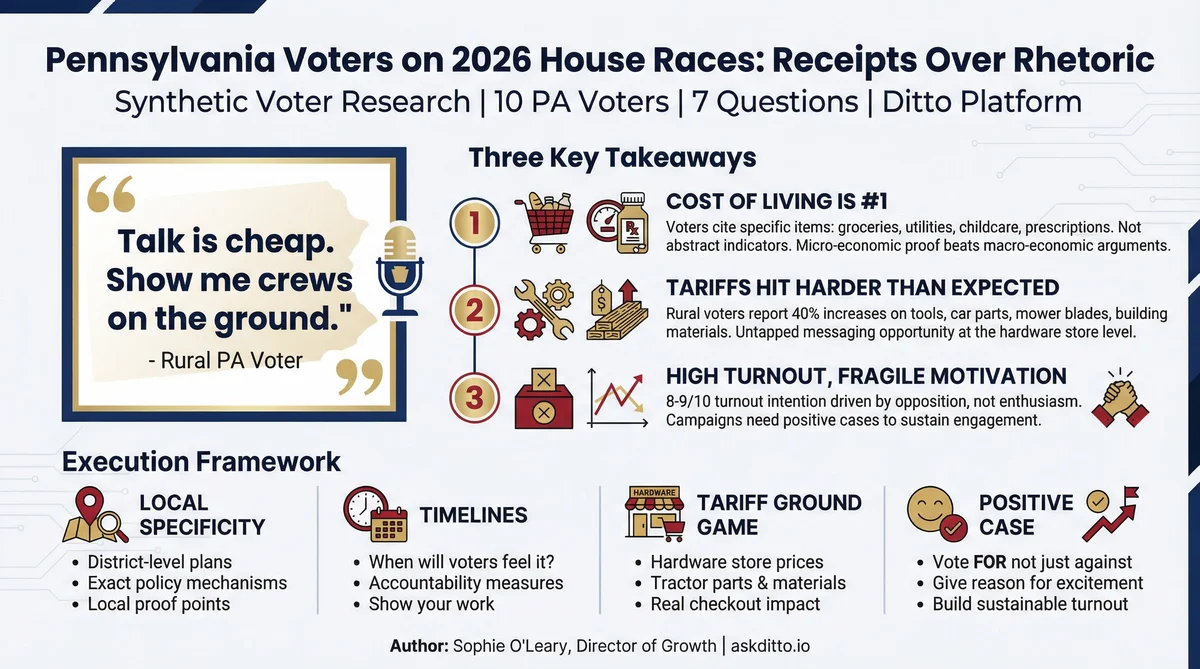
I have a soft spot for Pennsylvania. It is one of those states where politics is not abstract - it is the price of eggs, the cost of heating oil, the question of whether the factory down the road is hiring or shutting. So when we ran a voter research study with 10 synthetic Pennsylvania voters ahead of the 2026 House races, I expected strong opinions. What I got was something sharper: a voter base that is absolutely done with rhetoric and wants receipts.
This study was built using Ditto's synthetic research platform - 10 AI personas modelled on real Pennsylvania voter demographics, each answering 7 questions about what matters most heading into the midterms. The results are blunt, specific, and genuinely useful for anyone running a House campaign in the state.
Cost of Living Is Not a Talking Point. It Is THE Issue.
Every single respondent, regardless of district, age, or lean, put cost of living at the top of their list. Not second. Not tied. First. And the way they talked about it was not vague - it was granular. Grocery bills. Utility costs. Childcare. Prescription drugs. These voters are not reading economic indicators; they are living them.
One respondent from a suburban Philadelphia district summed it up:
"I don't care what the GDP says. My grocery bill is up 30% and my pay is not. Talk to me about that."
This is important for campaigns to hear. Macro-economic arguments - 'the economy is recovering,' 'unemployment is low' - are not landing. Voters want micro-economic proof. Show me your plan for my grocery bill, not the national debt.
The 'Affordability' Message: Resonant but Too Vague
Here is where it gets interesting. When we tested messaging around affordability, voters responded positively to the concept but were deeply sceptical of the execution. They have heard 'I will fight for working families' a thousand times. What they want now is specificity.
Voters told us they want to hear:
Exact policy mechanisms - not 'lower costs' but 'cap insulin co-pays at $35'
Local proof points - what have you already done in this district?
Timelines - when will I feel the difference?
Accountability measures - how will I know you delivered?
The gap between 'affordability messaging' and 'affordability proof' is where most campaigns are losing voters. One rural respondent was particularly pointed:
"Talk is cheap. Show me crews on the ground."
That quote should be printed on every campaign staffer's wall in Pennsylvania right now.
Tariffs Are Hitting Harder Than You Think
This was the surprise finding. We did not ask specifically about tariffs - voters brought them up on their own. And not in the abstract trade-policy sense. They talked about the price of tools, car parts, mower blades, building materials. Real items. Items they buy regularly.
Rural voters in particular flagged this. One respondent from a western PA district said:
"My replacement parts for the tractor cost me 40% more than two years ago. Nobody is talking about that on the campaign trail."
For Democratic House candidates, this is a gift - if they use it correctly. The tariff conversation has been dominated by macro trade narratives. But voters are experiencing tariffs at the hardware store, not on CNBC. Meeting voters where they actually feel the pinch - at the checkout counter - is a messaging opportunity that is wide open.
Turnout Is High, but It Is Fuelled by Opposition
When we asked voters to rate their likelihood of voting on a 1-10 scale, the average came in at 8 to 9 out of 10. That is remarkably high for a midterm. But here is the catch: most of that motivation is against something, not for something.
Voters described their motivation in terms like:
"I am voting to stop things from getting worse"
"I do not love my options but I know which one scares me more"
"Sitting out is not an option when the other side shows up every time"
This is a double-edged sword for campaigns. High turnout driven by opposition is fragile. It depends on the other side remaining scary enough to motivate. If the threat feels less acute by November, that 8-9 could drop to a 5-6 fast. Campaigns need to give voters something to vote FOR, not just against.
What This Means for 2026 House Campaigns
If I were advising a Democratic House campaign in Pennsylvania right now, here is what I would take from this study:
Lead with local, specific cost-of-living plans. Not national messaging. Not party platform. District-level, provable, timeline-attached.
Own the tariff conversation at the ground level. Talk about tractor parts and grocery prices, not trade deficits.
Build a positive case, not just an opposition one. Turnout motivated by fear is unreliable. Give voters a reason to be excited.
Stop saying 'affordability' without a plan attached. Voters have heard the word so many times it has lost all meaning. Specifics or silence.
How We Ran This Study
We used Ditto's synthetic voter research platform to recruit 10 AI personas modelled on real Pennsylvania voter demographics. These are not random chatbots - they are purpose-built synthetic participants calibrated against actual demographic data, voting patterns, and regional economic conditions. Each persona answered 7 open-ended questions about their priorities, concerns, messaging reactions, and turnout intentions. The study was completed in under two hours - a fraction of the time traditional polling would require, and at a fraction of the cost.
The Bottom Line
Pennsylvania voters are not checked out - they are paying extremely close attention. And they are tired of being talked at. They want candidates who show their work, name their timelines, and prove they understand what it actually costs to live in Pennsylvania in 2026.
The full study is available to explore live. If you are working on a Pennsylvania House race, the data is there for you to dig into - real voter language, real priorities, real frustrations. Explore the full study here.
If you want to run a study like this for your own district or state - voter sentiment, message testing, issue prioritisation - drop me a line. We can have results in your hands within hours, not weeks.