
Josh Shapiro has been governor of Pennsylvania for two years and the verdict from voters is: solid B. Not bad. Not transformational. Just... solid. When we ran a voter research study with 10 synthetic Pennsylvania voters, the picture that emerged was a governor who has earned respect through operational wins but faces real vulnerabilities around energy costs, presidential ambition, and the gap between talking points and lived experience.
This study used Ditto's synthetic voter research platform - 10 AI personas modelled on Pennsylvania voter demographics from Harrisburg, Philadelphia, and Pittsburgh to rural communities. Ages 19 to 65, incomes from $2,300 to $345,000. Seven questions each, covering Shapiro's record, campaign accomplishments, Republican challengers, swing state dynamics, economic pressures, 2028 presidential ambitions, and the one fix voters need before November 2026.
The B-Grade Governor
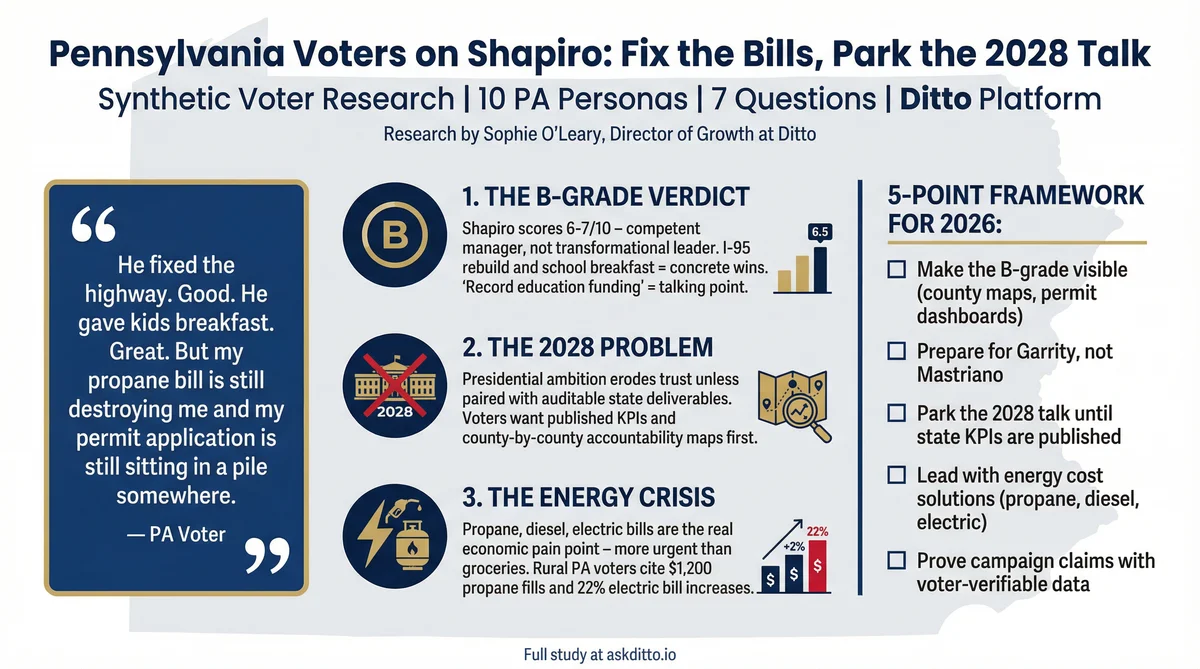
Voters rate Shapiro in the mid-6s to low-7s out of 10. He registers as a steady, competent manager rather than a visionary leader. The I-95 rebuild earned him genuine credit. Universal school breakfast is noticed and appreciated. But beyond those headline wins, voters struggle to name what has changed in their daily lives.
"He fixed the highway. Good. He gave kids breakfast. Great. But my propane bill is still destroying me and my permit application is still sitting in a pile somewhere."
This is the paradox of competent governance: the things Shapiro has done well are visible and acknowledged, but the things voters feel most acutely - energy costs, permitting delays, healthcare confusion - remain stubbornly unresolved. The B-grade is stable, but it is not the kind of grade that generates enthusiasm.
Campaign Accomplishments: Concrete Beats Abstract
We tested Shapiro's campaign talking points directly - record education funding, I-95 rebuild, faster permits, school breakfast for every kid. The response pattern was instructive.
The I-95 rebuild and school breakfast landed. Voters could see them, touch them, experience them. These are tangible wins that exist in the real world, not in a press release.
Record education funding and faster permits did not land. Voters treated these as 'talking points' - claims that may be technically true but do not translate into observable changes in classrooms or construction timelines.
"'Record education funding' - OK, where? My kid's class still has 28 students. The building still needs a new roof. What does 'record' mean if I cannot see it?"
The lesson for Shapiro's re-election campaign is clear: only claim what voters can verify with their own eyes. The I-95 and breakfast wins work because they are physical. Education funding and permitting speed need to be made equally visible - county-by-county maps, classroom-by-classroom data, permit-by-permit timelines.
Mastriano: Unanimous Rejection
We asked voters about the Republican primary matchup - Stacy Garrity versus Doug Mastriano. The response to Mastriano was the most uniform finding in the entire study: voters across every demographic and geography rejected him as a statewide nominee.
"Mastriano is a non-starter. I would vote for a potted plant before I voted for him."
"He had his chance. He lost. Badly. Move on."
"I am a Republican and I cannot support Mastriano. He is not serious."
Garrity, by contrast, was viewed as a credible alternative - not exciting, but competent and not carrying the baggage of January 6th adjacency. A Garrity nomination would make the general election genuinely competitive. A Mastriano nomination would hand Shapiro a comfortable margin. This is the dynamic the Shapiro campaign should be planning for: the harder race, not the easier one.
The 2028 Question: Show Your Work First
There has been persistent talk about Shapiro running for president in 2028. We asked voters directly: does that bother you?
The answer was overwhelmingly yes, unless. Voters want a Pennsylvania-first governor. National ambition is perceived as a distraction from the job they hired him to do.
"I did not vote for him so he could use Pennsylvania as a stepping stone. Finish the job here first. Then we will talk."
But there is a conditional pathway. Higher-income and suburban voters indicated they could tolerate 2028 ambition if and only if it was paired with auditable, local deliverables. Published KPIs. Progress dashboards. County-by-county accountability maps.
The message is clear: prove you can govern before you campaign. Any whiff of 2028 positioning without a visible record of Pennsylvania-specific results will erode the B-grade trust he has built.
Energy Costs: The Sleeping Giant
When asked about their biggest economic pressure, voters did not lead with groceries (though those matter). They led with energy. Propane. Diesel. Electric bills. The cost of heating a rural Pennsylvania home in winter is described with the kind of specificity that should alarm any campaign strategist.
"My propane bill last winter was $1,200 for one fill. I need three fills per season. You do the maths."
"Diesel went up, so everything went up - delivery costs, construction costs, parts costs. It is a chain reaction."
"My electric bill went up 22% and I did nothing different. Nothing."
Energy costs are the connective tissue of Pennsylvania's economic frustration. When propane goes up, heating goes up. When diesel goes up, everything delivered by truck goes up. Voters are drawing this map in their heads, and they want a governor who draws the same map and shows them where the pressure relief valves are.
How We Ran This Study
We used Ditto's synthetic voter research platform to create 10 AI personas calibrated against real Pennsylvania voter demographics - corrections officers, IT support, librarians, engineering directors, retired educators, trade students, and recruiters. Each persona answered 7 open-ended questions covering Shapiro's performance, campaign claims, Republican challengers, swing state dynamics, economic pressures, 2028 ambitions, and the single fix needed before November 2026. The study completed in under two hours with focus-group-level depth.
What This Means for 2026
Make the B-grade visible. The wins Shapiro has are real. Make them physical, local, and verifiable. County maps. Classroom data. Permit timelines.
Prepare for Garrity, not Mastriano. Plan for the harder race. A competent Republican challenger will demand a positive case, not just contrast.
Park the 2028 talk. Every mention of the presidency without a corresponding state-level deliverable erodes trust. Publish KPIs, not trial balloons.
Lead with energy. Propane, diesel, and electric bills are the economic connective tissue. A concrete energy cost reduction plan will cut through noise that grocery talking points cannot.
Prove your claims with their data. 'Record education funding' means nothing without classroom proof. 'Faster permits' means nothing without a public SLA dashboard. Voters want receipts.
The full study is live with every voter response and insight. Explore the full Pennsylvania governor voter study here.
Running a campaign in Pennsylvania? Get in touch and we can build a voter study for your race in hours. Real insights. Real voter language. Real speed.