
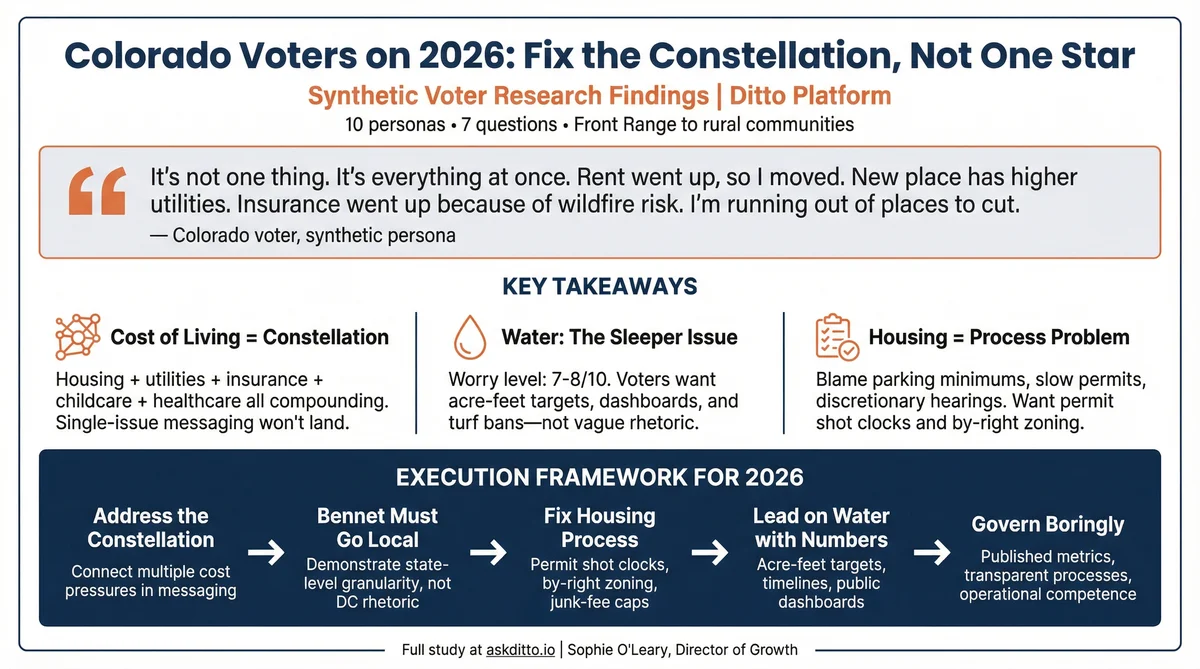
Colorado voters are tired. Not disengaged - tired. When we ran a voter research study with 10 synthetic Colorado voters, the dominant theme was not any single issue. It was the accumulation - rent plus utilities plus insurance plus childcare plus surprise medical bills, all hitting at once, all trending in the wrong direction, all compounding into what voters describe as a constant low-grade financial panic.
This study used Ditto's synthetic voter research platform - 10 AI personas modelled on Colorado voter demographics from Denver, Lakewood, Boulder, Longmont, Highlands Ranch, and rural communities. Ages 18 to 63, incomes from zero to $130,000. Seven questions each, covering daily pressures, the open governor's race, one-party dominance, housing, water scarcity, CO-8 campaign saturation, and what voters need from state government.
Cost of Living as a Constellation
We asked voters to name their single biggest issue. They could not pick just one. That inability is the finding.
Colorado voters describe cost-of-living pressure not as a single problem but as a constellation of interacting shocks. Housing is at the centre, but it is surrounded by utility increases, insurance renewals, childcare costs, healthcare surprises, and income-timing gaps that create what one voter described as 'a constant mental load of financial arithmetic.'
"It is not one thing. It is everything at once. Rent went up, so I moved. New place has higher utilities. Insurance went up because of wildfire risk. Childcare went up because everything went up. I am running out of places to cut."
For campaigns, this means single-issue messaging will not land. Voters do not experience cost of living as 'housing' or 'groceries' or 'energy' - they experience it as an interconnected web. The candidate who acknowledges the web and addresses multiple nodes simultaneously will be more credible than one who picks a single talking point.
Bennet: Competent but DC-Centric
Governor Polis is term-limited and Senator Michael Bennet is the Democratic frontrunner for governor. Voters know him. They respect him. They are not excited.
"Bennet is fine. Competent. But he feels like a DC person who is coming back to Colorado, not a Colorado person who went to DC."
This perception matters. Voters want a governor who speaks from Colorado, not about Colorado. The DC-centric perception is not about Bennet's voting record or policy positions - it is about affect and proximity. Voters want to feel that their governor understands Front Range housing not from a Senate briefing but from having looked at apartment listings in Lakewood.
The path for Bennet is clear: demonstrate state-level granularity. Name specific developments. Cite specific permit delays. Reference specific water rights disputes. Transform the DC brand into a 'I know the federal levers AND the local reality' advantage.
Housing: Local Process Is the Bottleneck
Housing affordability along the Front Range is a crisis, and voters have a surprisingly specific diagnosis of why. They do not blame supply and demand in the abstract. They blame local land-use rules, parking minimums, discretionary hearings, and slow permitting.
"You cannot build anything near transit because of parking requirements that were written in 1985. Kill the parking minimums."
"I applied for a building permit in March. It is now October. Nobody has looked at it."
"Every project needs a neighbourhood hearing where twelve people with nothing else to do kill housing for thousands of people who need it."
Voters are not asking for ideological housing solutions. They are asking for process fixes: permit shot clocks (published timelines), by-right zoning near transit, standardised and capped rental junk fees, and portable tenant screenings. These are operational, not aspirational - and they are exactly the kind of deliverable that a governor can actually execute.
Water: The Issue Nobody Is Talking About Enough
We asked voters how worried they are about water scarcity and drought. The response: 7 to 8 out of 10. That is near-panic levels.
"Water is the thing that keeps me up at night. Not because I am thirsty today, but because I can see the trajectory and nobody with power is talking about it with any specificity."
Colorado voters are frustrated by vague rhetoric about water. They have heard 'we are working on it' from every governor and every legislator for a decade. What they want is:
Acre-feet targets. Not 'more conservation' but 'X acre-feet saved by Y date.'
Reuse and storage timelines. Specific projects with specific completion dates.
Public dashboards. Real-time data on water supply, savings progress, and growth approvals tied to verified water supply.
Nonfunctional turf bans. Voters want ornamental grass eliminated and HOA barriers to xeriscaping preempted by state law.
Water is the sleeper issue of 2026 in Colorado. The candidate who leads with specific, measurable water policy will own a trust-building lane that no competitor is currently occupying.
Blue State Comfort, Not Complacency
Colorado has become a solidly blue state. How do voters feel about one-party dominance?
The answer is comfortable but watchful. Voters welcome the shift for reducing culture-war noise and providing a predictable, humane policy tone on climate and civil rights. But they want guardrails. They want boring competence and measurable delivery, not ideological overreach.
"I am fine with Colorado being blue. But blue does not mean blank cheque. I still want accountability, transparency, and someone who can explain why my rent keeps going up even though we 'solved' the housing crisis three times."
How We Ran This Study
We used Ditto's synthetic voter research platform to create 10 AI personas calibrated against real Colorado voter demographics - leasing consultants, healthcare administrators, engineers, students, MRI technologists, finance analysts, estheticians, and bilingual essential workers. Each persona answered 7 open-ended questions covering daily pressures, the governor's race, one-party dominance, housing, water, campaign saturation, and what they need from state government. The study completed in under two hours with the depth of a traditional multi-week research project.
What This Means for 2026
Address the constellation, not a single star. Cost of living is interconnected. Housing-plus-utilities-plus-insurance-plus-childcare is the real issue. Messaging that picks one and ignores the rest will feel incomplete.
Bennet must go local. The DC-centric perception is fixable but only through visible, granular state-level policy knowledge. Name developments. Cite permits. Reference water disputes by case number.
Fix the process on housing. Permit shot clocks, by-right zoning, junk-fee caps. Voters have diagnosed the bottleneck. Give them the operational fix, not the aspirational speech.
Lead on water with numbers. Acre-feet, timelines, dashboards, turf bans. This is the trust-building lane no competitor is using. Own it.
Govern boringly, govern well. Colorado voters do not want drama. They want dashboards. Published metrics, transparent processes, and the kind of operational competence that makes news boring because everything works.
The full study is live - every voter response, every priority, every insight. Explore the full Colorado voter study here.
Running a campaign in Colorado? Get in touch and we can build a voter study for your race, your district, and your specific questions. Fast turnaround, real insights.