
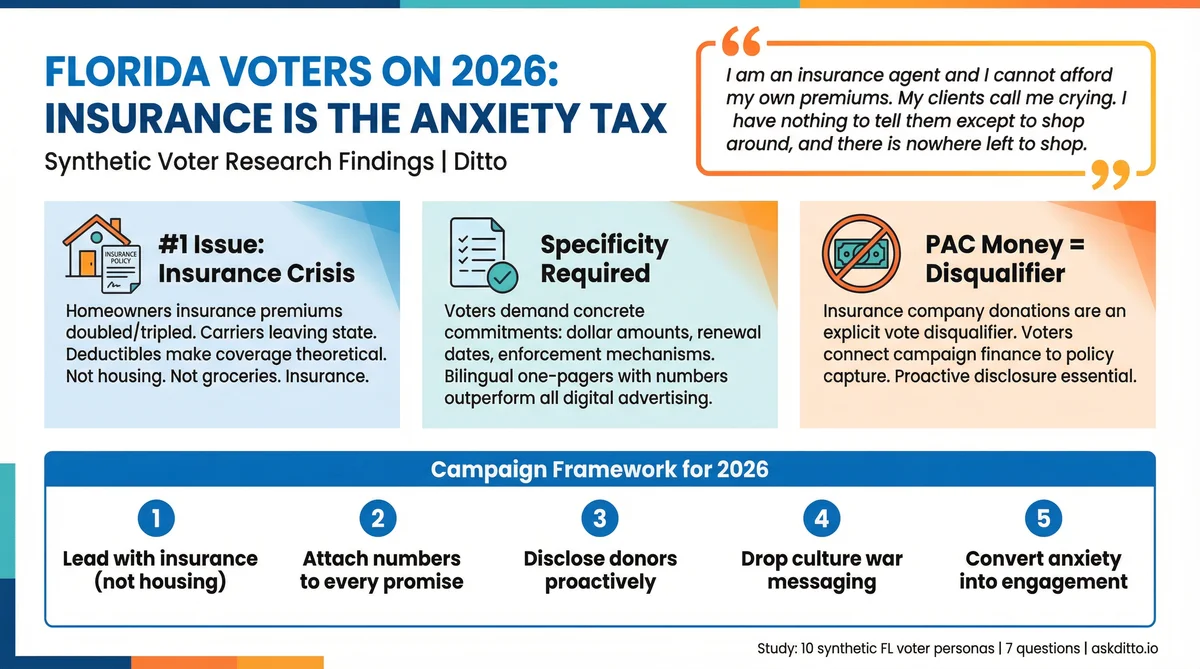
Florida is the state that never stops surprising you. You think you know the story - sunshine, retirees, theme parks - and then you talk to actual Floridians and realise the story is insurance premiums, hurricane deductibles, and the constant anxiety of not knowing whether your carrier will still exist next year. When we ran a voter research study with 10 synthetic Florida voters ahead of the 2026 special Senate election, the findings were immediate, visceral, and deeply practical.
This study used Ditto's synthetic voter research platform - 10 AI personas modelled on Florida voter demographics across Jacksonville, Tampa, St. Petersburg, Lakeland, Tallahassee, and rural communities. Ages 20 to 60, incomes from zero to $140k. Seven questions each, covering daily pressures, the Senate race, affordability messaging, the insurance crisis, candidate deal-breakers, and turnout motivation.
Insurance Is the Anxiety Tax
We asked voters what single issue affects their daily life most. The answer was not housing. It was not groceries. It was not immigration. It was insurance. Specifically, homeowners insurance - the premiums that have doubled or tripled, the carriers that have pulled out of the state, the deductibles that make coverage feel theoretical.
"I am an insurance agent and I cannot afford my own premiums. My clients call me crying. I have nothing to tell them except to shop around, and there is nowhere left to shop."
This is not an abstract policy concern. It is a daily financial anxiety that shapes every other decision - whether to repair a roof, whether to sell a home, whether to stay in the state. One construction manager described it as "paying for insurance that will not cover anything when the storm actually comes." A rural caregiver said her family simply stopped carrying coverage because the cost exceeded what they could lose.
For campaign strategists, this is the entry point. Insurance is not issue number three on a list. It is the lens through which Florida voters evaluate everything else.
Affordability Messaging: Conditional, Not Automatic
The Florida Democratic Party has positioned the 2026 election as being about affordability - housing, insurance, grocery prices. So we asked voters: does that message connect?
The answer is yes, but. Voters broadly accept the affordability frame. They live it every day. But they have heard it before, and they are not going to be moved by the word alone.
"'Affordability' is what politicians say when they want my vote. It means nothing until I see a number on a piece of paper that tells me what changes and when."
Voters want concrete, measurable commitments. Not slogans. Not sentiment. They want to know: what is the first bill you will file? What is the dollar impact? When will I see it on my renewal? Multiple respondents specifically requested bilingual one-pagers with numeric targets - not brochures, not websites, but a single sheet that says here is what I will do, here is the number, here is the date. That level of specificity is what separates a candidate who connects from one who gets filed under 'more of the same.'
PAC Money from Insurers Is a Disqualifier
We asked voters what would make them say absolutely not to a candidate. The answers were varied - corruption, extremism, dishonesty - but one theme cut across demographics with unusual consistency: financial ties to insurance companies.
"If I find out a candidate took money from the same companies that dropped my policy, that is it. Done. I do not care what else they promise."
This is significant. In a state where the insurance crisis is personal and pervasive, voters are connecting the dots between campaign finance and policy outcomes. PAC money from insurers is not just bad optics - it is a disqualifying signal that tells voters the candidate is already captured. Any campaign accepting insurer money in Florida needs to understand: a meaningful segment of voters will reject you on that basis alone, regardless of your platform.
Culture-War Fatigue Is Real
Florida has been at the centre of national culture wars for years. Book bans, immigration rhetoric, identity politics on every channel. So how do voters feel about it in 2026?
They are exhausted.
Respondent after respondent described culture-war messaging as noise that actively suppresses their engagement. A college student in Tallahassee said: "I tune out the second someone starts talking about woke or anti-woke. I need to know about rent and whether I can afford groceries next month." A rural sales manager put it more bluntly: "If your platform is about owning the other side, you have already lost me."
For campaigns, this is a clear signal: lead with pocketbook, not with culture. The voters who are persuadable in 2026 are not looking for a fighter. They are looking for someone who will lower their insurance bill.
Turnout Is High but Conditional
Most respondents rated their likelihood of voting in the 2026 midterms at 8 to 10 out of 10. Florida voters, especially in this study, are habitual voters. But their motivation is conditional.
Several described their turnout as defensive - they vote because they are afraid of what happens if they do not. That is not enthusiasm. That is anxiety translated into civic participation. And anxiety-driven turnout is fragile. It can evaporate if voters feel both sides are equally disconnected from their reality.
"I will vote because I always vote. But I will not knock doors or donate or post on social media unless someone gives me a reason beyond 'the other guy is worse.'"
Campaigns that want to convert high baseline turnout into actual engagement need to provide a positive, concrete, personally relevant reason to care. Not fear. Not outrage. A plan.
How We Ran This Study
We used Ditto's synthetic voter research platform to create 10 AI personas calibrated against real Florida voter demographics - urban professionals, rural homeowners, students, retirees, tradespeople, caregivers. Each persona answered 7 open-ended questions about daily pressures, the Senate race, affordability messaging, insurance, candidate deal-breakers, and turnout. The study completed in under two hours, delivering the kind of qualitative depth that traditional focus groups take weeks and tens of thousands of dollars to produce.
What This Means for 2026
Lead with insurance, not housing. Insurance is the anxiety that shapes every other financial decision in Florida. Make it your opening line, not your third bullet point.
Attach numbers to every promise. Voters want renewal dates, dollar amounts, and enforcement mechanisms. Bilingual one-pagers with specifics will outperform any amount of digital advertising.
Disclose your donors. Proactively. Loudly. If you are not taking insurer money, make that the headline. If you are, expect it to be your biggest vulnerability.
Drop the culture war entirely. Florida voters in 2026 are cost-of-living voters. Culture messaging actively suppresses the engagement you need.
Convert defensive turnout into active engagement. High baseline turnout is not a gift - it is a loan. Pay it back with concrete, locally relevant policy that gives voters a reason to care beyond fear.
The full study is live - every voter response, every priority, every quote. Explore the full Florida voter study here.
Running a campaign in Florida? Get in touch and we can build a study tailored to your race, your district, and your specific voter questions. Real insights, real language, in hours.