
Jon Ossoff won his Senate seat in 2021 by the skin of his teeth during one of the most watched elections in American history. Now he has to do it again. So what do Georgia voters actually think of the man three years into the job? We ran a voter research study with 10 synthetic Georgia voters and the answer is more nuanced than any headline suggests: pragmatic respect, conditional loyalty, and a long list of unfinished business.
This study used Ditto's synthetic voter research platform - 10 AI personas modelled on Georgia voter demographics across Augusta, Columbus, Savannah, and rural communities. Ages 18 to 58, incomes from $2,400 to $165,000. Occupations spanning healthcare administrators, trucking sales, nail technicians, pharma reps, and single fathers. Seven questions each, covering Ossoff's record, the Republican matchup, economic pain, voter laws, and what voters actually need from their senator.
Ossoff Gets a Pragmatic B-Grade
When asked for their gut reaction to Ossoff's name, voters consistently landed on the same word: polished. He is perceived as calm, media-trained, and steady. That is both his strength and his limitation.
"He is fine. Steady. Not embarrassing. But when I try to name something he did that changed my life, I come up short."
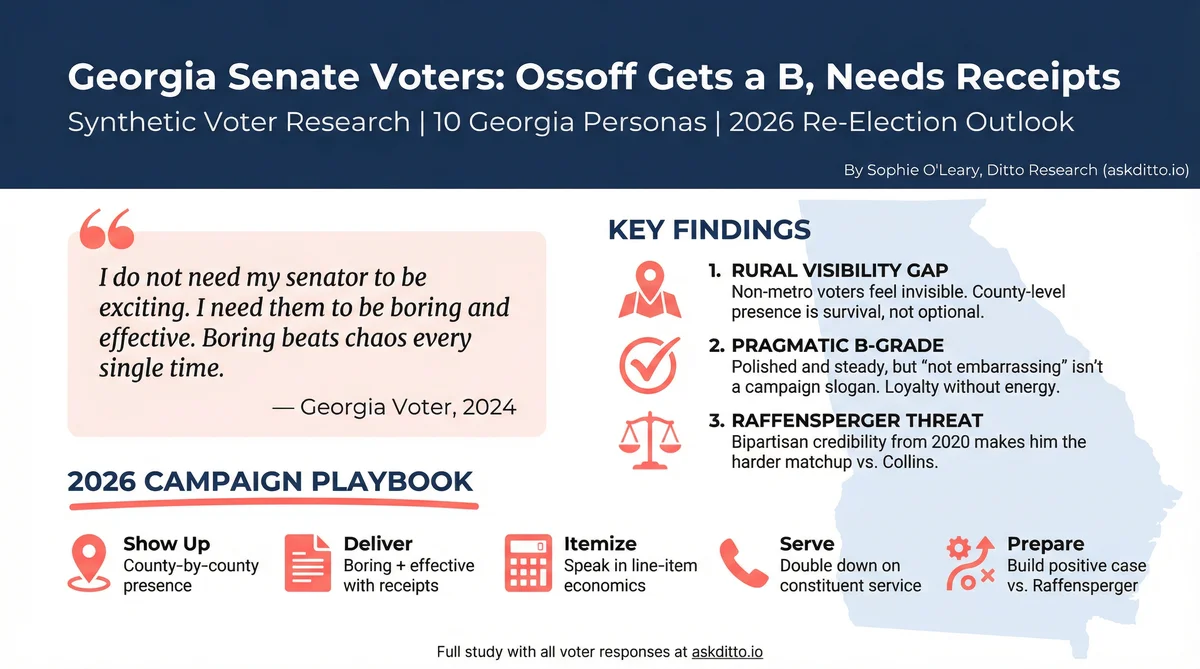
Voters credit Ossoff with not being a chaos agent. In Georgia's recent political history, that counts for something. But 'not embarrassing' is not a campaign slogan, and voters are aware of the gap between competent representation and transformational impact. His B-grade is earned through the absence of negatives rather than the presence of positives.
For the Ossoff campaign, this is a strategic reality: the base is loyal but not energised. Loyalty built on steadiness can be shaken by a challenger who offers both competence and visible results.
Rural Visibility Is the Number One Vulnerability
The most consistent criticism of Ossoff across all voter segments was not ideological. It was geographical. Rural Georgia voters feel invisible.
"I see him on TV talking about Atlanta. Good for Atlanta. When does he come to Augusta? When does he drive through my county and ask what we need?"
This is not a minor complaint. Georgia's political geography means rural voters are essential to any statewide coalition, and Ossoff's perceived absence from non-metro areas is creating a vulnerability that a well-organised Republican challenger could exploit. Voters want broadband in their homes, paved county roads, truck parking, rail-crossing safety, and clinic staffing. These are not glamorous asks. They are the infrastructure of daily life, and voters notice when their senator talks about them in press releases but never shows up to see them.
'Boring Beats Chaos' Is the Strongest Message
When we tested the Ossoff-versus-Republican matchup (Mike Collins or Brad Raffensperger), a fascinating pattern emerged. Voters did not frame the choice as liberal versus conservative. They framed it as calm versus chaotic.
"I do not need my senator to be exciting. I need them to be boring and effective. Boring beats chaos every single time."
This is powerful messaging territory. Voters are signalling that they are exhausted by political theatrics and that Ossoff's perceived blandness is actually a competitive advantage - as long as it is paired with deliverables. 'Boring but effective' is the formula that wins. 'Boring and invisible' is the formula that loses.
One critical caveat: Raffensperger poses a credible crossover threat. His brand as the man who stood up to Trump during the 2020 election count gives him a bipartisan credibility that Collins does not have. Against Raffensperger, Ossoff cannot simply run on 'I am the calm one' - he needs to run on what calm governance delivered.
The Economy: Itemised Pain, Not Abstract Anxiety
Every voter in this study described economic pressure in specific, itemised terms. This is not generalised inflation anxiety. It is a list.
"Groceries are up 30%. I am buying store brand everything and it is still more than name brand was two years ago."
"My utilities went up twice this year. Nobody warned me. Nobody explained why."
"Gas, groceries, insurance, rent. Pick any two - that is your crisis."
The specificity matters. Voters are not responding to 'the economy' as a topic. They are responding to their monthly bills. A senator who talks about GDP growth while voters are staring at a $50 increase on their electric bill is a senator who has lost the thread. The campaign that wins Georgia in 2026 will be the one that speaks in line items, not headlines.
Constituent Service as Loyalty Engine
One of the most striking findings was how much weight voters place on constituent service - the day-to-day responsiveness of the senator's office. This is not about legislation. It is about whether someone picks up the phone.
"I called his office about a VA claim. They called me back the next day and actually helped. That is worth more to me than any speech on the Senate floor."
Voters who had positive interactions with Ossoff's constituent services were dramatically more loyal than those who had not. This suggests a relatively low-cost, high-return strategy: invest heavily in local office responsiveness, bilingual support, and visible problem-solving. It builds loyalty that survives bad news cycles.
How We Ran This Study
We used Ditto's synthetic voter research platform to create 10 AI personas calibrated against real Georgia voter demographics - healthcare workers, trucking professionals, small-business owners, young parents, retired homeowners, students. Each persona answered 7 open-ended questions covering Ossoff's record, Republican matchups, economic pressures, voter laws, national attention fatigue, and what voters actually need. The study completed in under two hours with the depth and nuance of traditional qualitative research at a fraction of the cost.
What This Means for 2026
Show up outside Atlanta. Rural visibility is Ossoff's biggest vulnerability. County-by-county presence is not optional - it is survival.
Run on 'boring but effective.' The message resonates, but only when paired with a deliverables dashboard. Boring plus invisible is a losing formula.
Prepare for Raffensperger. A Collins matchup favours Ossoff's calm brand. A Raffensperger matchup requires a positive case built on tangible results.
Speak in line items. Voters describe their economic pain with spreadsheet precision. Match that precision in your policy proposals.
Double down on constituent service. Every phone call returned, every VA claim resolved, every bilingual interaction builds loyalty that advertising cannot buy.
The full study is live with every voter response and quote. Explore the full Georgia Senate voter study here.
Running a campaign in Georgia? Drop me a line and we can build a study for your specific race and voter questions in hours.