
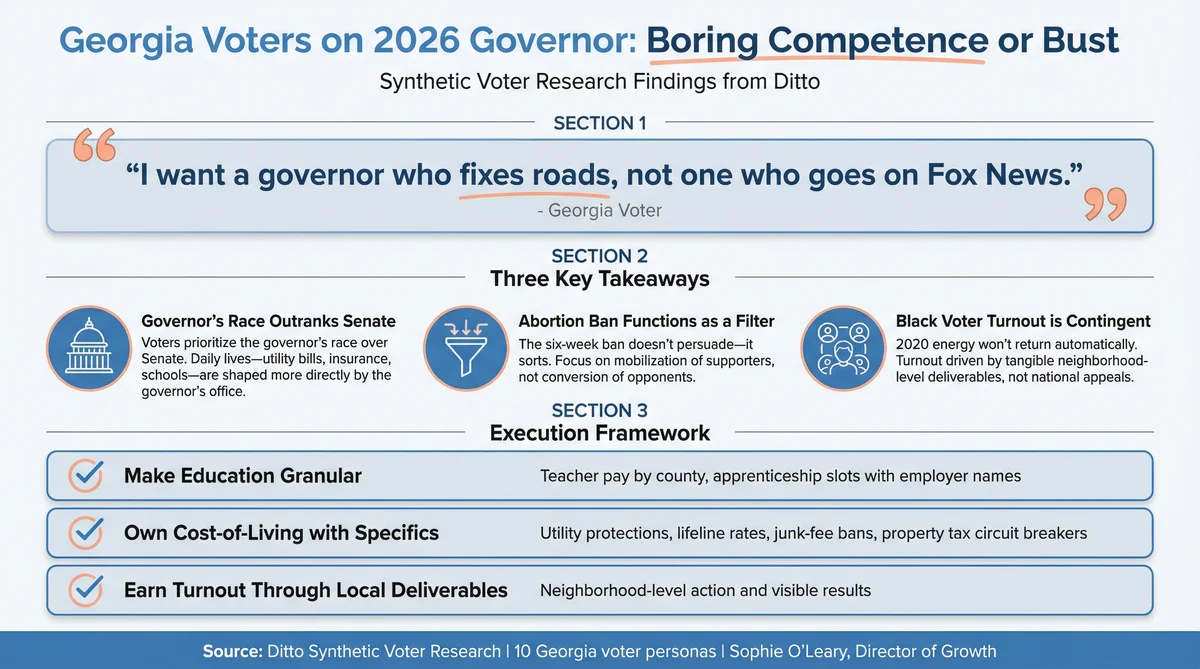
Georgia has an open governor's race in 2026 and voters have very strong opinions about what they want from the next person in the mansion. When we ran a voter research study with 10 synthetic Georgia voters, the headline finding was immediate: the governor's race matters more to voters than the Senate race, and the expectations are brutally specific.
This study used Ditto's synthetic voter research platform - 10 AI personas modelled on Georgia voter demographics from Augusta to rural communities. Ages 18 to 58, incomes from $2,400 to $165,000. Seven questions each, covering the race's importance, Jason Esteves' platform, the Republican primary, the six-week abortion ban, cost of living, Black voter turnout, and the one thing they would tell the next governor.
The Governor's Race Outranks the Senate
This was the first and clearest finding. When asked to compare the governor's race to the Senate race and other elections, voters consistently placed the governor at the top of their priority list.
"The governor signs the bills. The governor runs the hospitals, the roads, the schools. Washington is gridlocked. The governor can actually do things."
This is not anti-federal sentiment. It is pragmatism. Voters understand that their daily lives - utility bills, insurance renewals, school quality, EMS response times - are shaped more directly by the governor's office than by either senator. For donors, campaign strategists, and party operations, this is a clear resource signal: money and attention allocated to the governor's race will have the highest voter engagement return in Georgia 2026.
Esteves: Education Resonates, Abortion Polarises
Jason Esteves is running as a Democrat focused on education funding and repealing Georgia's six-week abortion ban. Voters had strong reactions to both.
On education, the response was positive but conditional. Voters want education funding, but they want it in line items: teacher pay (specific dollar amounts), bus driver pay, literacy programmes, special education, career-technical education, apprenticeship slots. Abstract 'more funding for education' does not move people.
"Tell me how much you will pay a first-year teacher in my county. Tell me where the money comes from. That is what I need to hear."
On the abortion ban repeal, the response was intensely polarising. Some voters see it as a moral imperative and a threshold issue - they will not vote for any candidate who supports the ban. Others want repeal but demand clear medical exceptions and expanded maternal and family supports as conditions. And a smaller segment sees the repeal pledge as disqualifying from the other direction.
The strategic reality: the abortion ban functions as a voting filter. It does not persuade - it sorts. Voters have already decided where they stand, and Esteves needs to plan for mobilisation of supporters rather than conversion of opponents.
The Republican Primary: Competence over Culture War
Burt Jones, Brad Raffensperger, and Chris Carr were all recognised by voters. The framing voters applied to the Republican primary was consistent: who is the most boringly competent?
Jones carries Trump-adjacency baggage that makes some voters nervous. Raffensperger has the bipartisan credibility of his 2020 stand. Carr is viewed as a steady institutional hand. The pattern across respondents was clear:
"I want a governor who fixes roads, not one who goes on Fox News."
"Jones feels like more drama. I am done with drama."
"Raffensperger at least showed he has a spine. That matters."
A Jones nomination would push some voters toward alternatives. The Republican primary outcome will significantly affect how the general election is framed - as competence-versus-competence (Raffensperger or Carr) or as stability-versus-spectacle (Jones).
Cost of Living: Concrete and Immediate
Like every state we have studied, Georgia voters describe cost-of-living pressure with painful specificity: utility bills, insurance renewals, property tax increases driven by appraisals, and childcare costs that consume disproportionate shares of household income.
"My property tax went up because my appraisal went up, but my salary did not. I am being taxed on wealth I cannot access."
Voters are not looking for macro-economic arguments. They want to know what the next governor will do about their specific monthly bills. The candidate who arrives with a county-by-county cost breakdown and a specific plan for utility protections, lifeline rates, and junk-fee elimination will own this conversation.
Black Voter Turnout: Pragmatic Exhaustion
Georgia's Black voter turnout was historically high in 2020 and 2021. We asked: is the same energy there for 2026?
The honest answer is not automatically. Voters described a shift from the urgency of 2020 to what we are calling pragmatic exhaustion. The energy of the Stacey Abrams era was real, but it was driven by a specific moment and a specific threat. That moment has passed, and what remains is a voter base that is engaged but tired.
"I voted in 2020 because I felt like the world was on fire. Now the world is still on fire but I am also paying 40% more for groceries. The motivation is different."
Black voter turnout in 2026 will be contingent and local, not driven by nationalised appeals. Campaigns that treat Black voters as an automatic constituency rather than an audience that needs to be actively earned will be disappointed. The path to turnout runs through tangible, neighbourhood-level deliverables - not through celebrity endorsements or national media campaigns.
How We Ran This Study
We used Ditto's synthetic voter research platform to build 10 AI personas calibrated against Georgia voter demographics - young parents, healthcare workers, small-business owners, trades professionals, retirees, students, and single parents. Each persona answered 7 open-ended questions covering the governor's race, candidate platforms, the Republican primary, the abortion ban, cost of living, Black voter turnout, and their single most important ask for the next governor. Full study completed in under two hours.
What This Means for 2026
Treat the governor's race as the main event. Voters already do. Resource allocation should reflect that reality.
Make education spending granular. Teacher pay in dollars, by county. Apprenticeship slots with employer names. Abstract funding pledges will not cut it.
Accept that abortion is a filter, not a persuader. Plan for mobilisation of supporters, not conversion. Pair the repeal position with expanded maternal and family supports.
Own the cost-of-living conversation with specifics. Utility protections, lifeline rates, junk-fee bans, property tax circuit breakers. Name the policy, name the number, name the date.
Earn Black voter turnout through local deliverables. The 2020 energy will not return on its own. Build it through neighbourhood-level engagement and visible results.
The full study is live with every response and insight. Explore the full Georgia governor voter study here.
Working on a Georgia campaign? Let me know and we can build a study for your race in hours. Real voter language, real priorities, real speed.