How do American workers perceive unions in 2026? What political messaging around workers' rights actually resonates? We asked six participants ranging from healthcare workers to warehouse employees about union support, workplace issues, and the language that moves them. The findings offer a roadmap for labor-focused political messaging.
The Research Framework
We recruited six participants across different employment sectors and union experiences. The goal was understanding not just whether people support unions, but what specific workplace issues drive that support and what messaging language connects emotionally.
Union Perception: Practical Protection Over Ideology
Participants across the political spectrum viewed unions primarily through a practical lens rather than an ideological one. Support correlated strongly with personal experience of workplace power imbalances.
I don't care about the politics. When my shift got cut without notice and I had no one to call, that's when I understood what a union is for.
Key perception drivers included protection against arbitrary scheduling changes, having a formal grievance process, and collective bargaining for healthcare costs. Negative perceptions focused on union dues, perceived bureaucracy, and concerns about protecting underperforming workers.
Workplace Issues That Drive Support
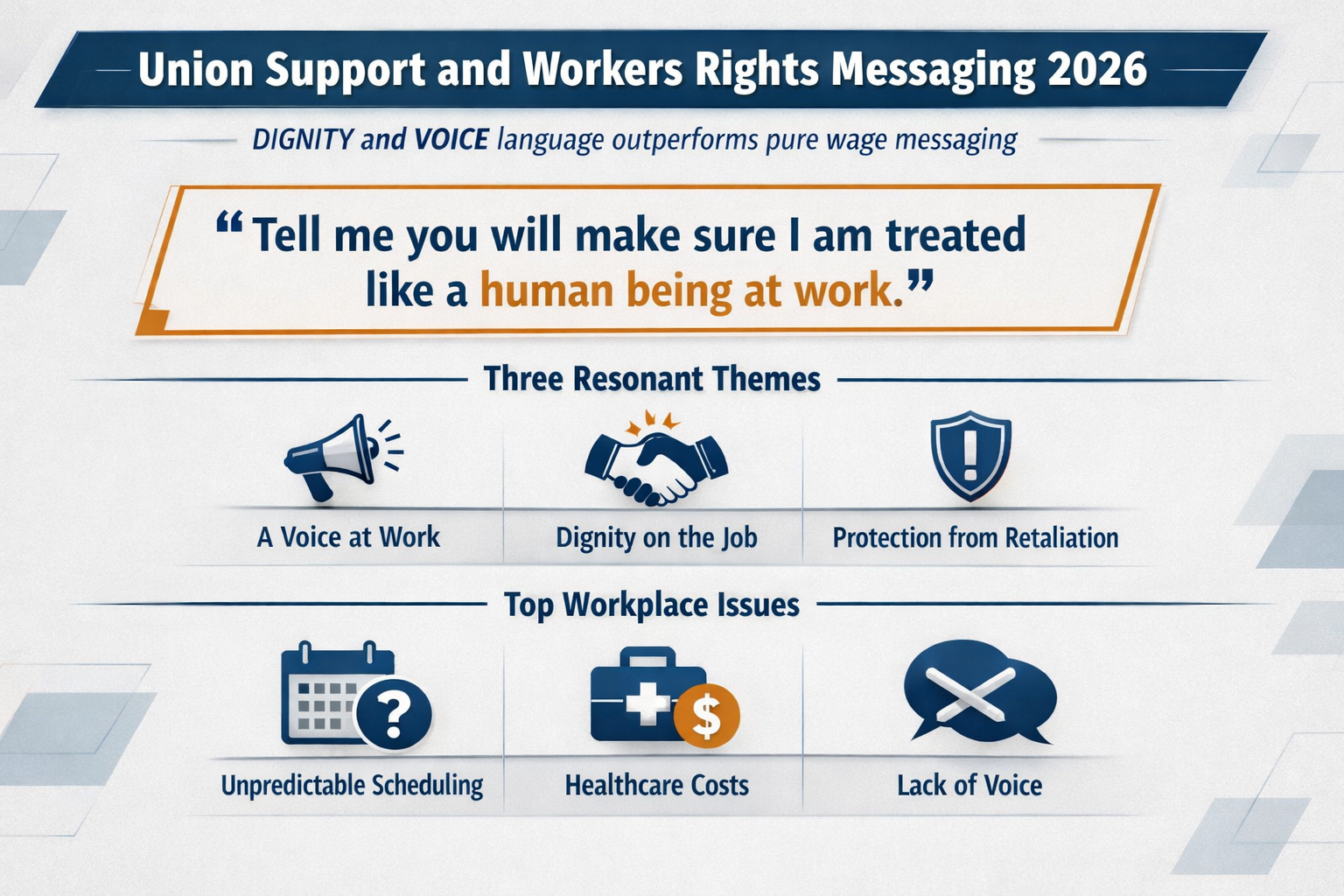
The most emotionally resonant workplace issues weren't wages alone. Scheduling unpredictability, healthcare costs, and respect from management emerged as equally powerful drivers.
Unpredictable scheduling - 'clopenings' and last-minute shift changes
Healthcare costs eating wage gains
Lack of voice in workplace decisions
Retaliation fears when raising concerns
Wage theft through unpaid overtime and misclassification
Messaging That Resonates: Dignity and Voice
When testing political messaging around workers' rights, language focused on 'dignity' and 'voice' consistently outperformed pure wage messaging. Participants responded to framing that emphasized respect and fairness over economic redistribution.
Tell me you'll make sure I'm treated like a human being at work, not like I'm disposable. That's what I want to hear.
'A voice at work' resonated across political lines
'Dignity on the job' connected emotionally
'Fair schedules' hit harder than 'higher wages' for many
'Protection from retaliation' was universally supported
Political Implications for 2026
For campaigns seeking to connect with working-class voters, this research suggests leading with dignity and voice messaging over pure economic populism. The union question isn't left-right for most workers; it's about power dynamics they experience daily.
Candidates who can speak credibly about scheduling fairness, retaliation protection, and healthcare security have an opening regardless of party. The key is specificity: name the problem, propose the fix, show you understand the daily reality.
About This Research
This study was conducted using Ditto's synthetic research platform in January 2026.
View the full interactive study: https://app.askditto.io/organization/studies/shared/T22O9_CjoZHrvgRDVIcgCOACIPLC4JFk4J1Hbdej2gM