Specialty baking products like ladyfingers sit at an interesting intersection. They're essential for classic desserts like tiramisu, but most home bakers have never made them from scratch. So what actually drives purchase decisions?
I ran a study with 6 American home bakers to understand what they want from specialty baking products. The findings should reshape how heritage brands think about marketing.
Who Participated
Our panel included home bakers across the US aged 30-56. We had a stay-at-home parent from El Paso, an operations specialist from Austin, a project manager from Utah, an unemployed adult from San Diego, a facilities manager from Compton, and a healthcare administrator from New Mexico. Mix of income levels, cultural backgrounds, and baking frequency, but remarkably aligned on what matters.
The 90/10 Split: Pre-Made Wins
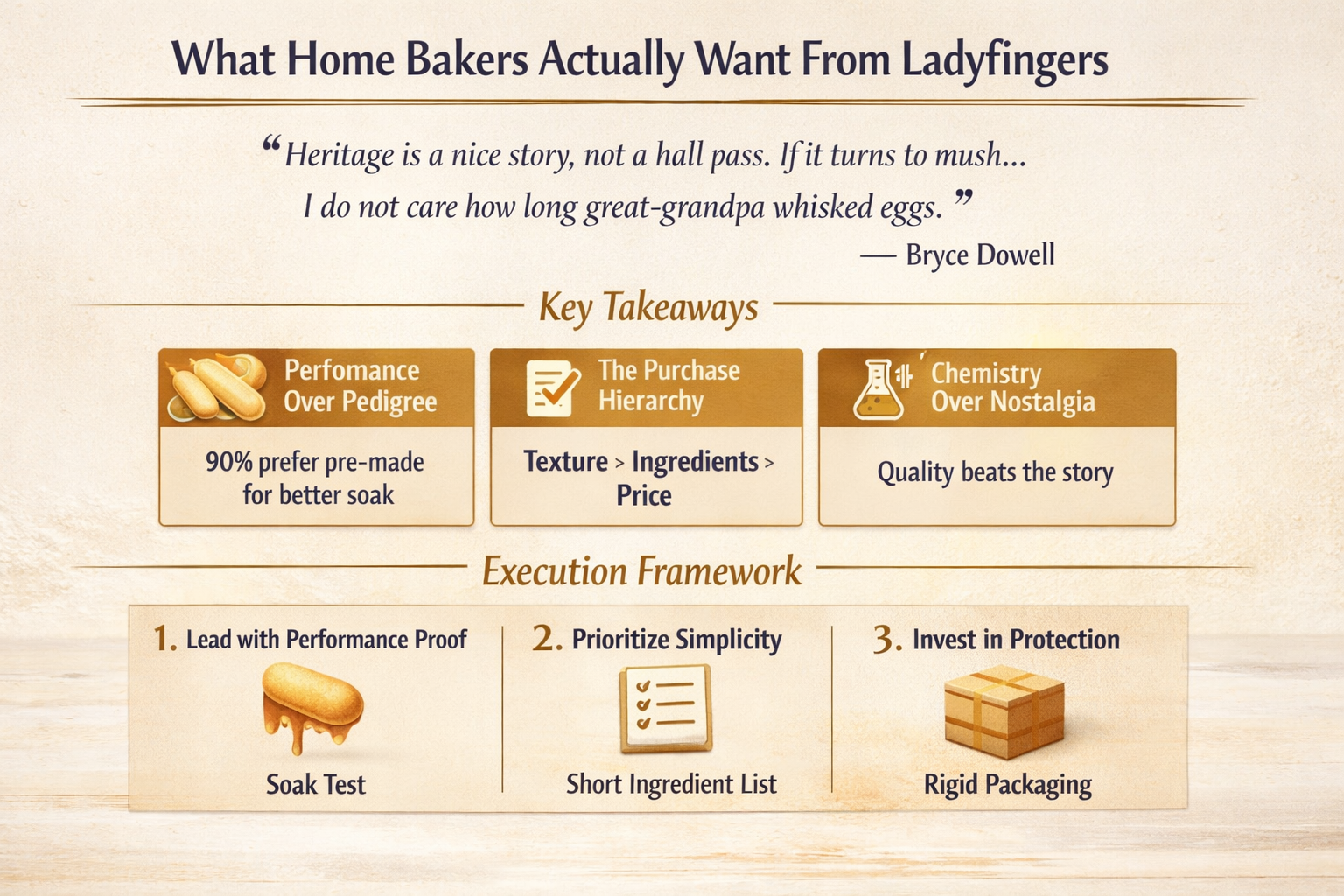
When I asked whether participants make ladyfingers from scratch or buy pre-made, the answer was overwhelming: buy pre-made, 90% of the time.
Eugene from Utah was direct: "I'm not martyring myself to pipe cookies on a Tuesday after a board packet and soccer carpool. Store-bought Savoiardi are sturdier, soak predictably, and I don't have to scrub a piping bag at 9pm."
George from Austin echoed this: "I'm not standing there piping cookies on a Tuesday after staging crews all day, and for tiramisu I want the dry, firm kind that soaks espresso without turning to mush."
Why Pre-Made Actually Works Better
Counterintuitively, participants noted that pre-made ladyfingers often perform better than homemade for tiramisu:
Drier texture holds the espresso soak without collapsing
More uniform size for cleaner layering
Consistent results every time
No humidity or altitude variability
Christopher from San Diego put it simply: "The dry boxed ones hold up better, and I am not firing up the oven in this heat for something that gets soaked anyway."
The Purchase Hierarchy: What Actually Matters
When buying pre-made ladyfingers, participants revealed a clear priority order:
Texture - dry and crisp, holds structure when soaked
Ingredients - short list (flour, eggs, sugar), no weird additives
Packaging - rigid trays, minimal breakage, good seal
Freshness - long expiration date, no stale smell
Price per serving - fair value, not cheapest
Brand/heritage - tie-breaker at best
Bryce from New Mexico was blunt about brand recognition: "Brand recognition is a tiebreaker at best. I buy with my eyes and the ingredient list. If it survives the espresso bath without turning to baby food, it wins."
Jackie from Compton had a similar view: "Brand hype doesn't mean much. If the box is shouting 'artisanal' and the price jumps, I roll my eyes. I buy what works in the bowl and on the plate, punto."
Heritage: Nice Story, Not a Hall Pass
Here's where heritage brands need to pay attention. When I asked about tradition and heritage in baking products, the response was nuanced but clear: heritage matters only when it maps to outcomes.
Bryce captured it perfectly: "Heritage is a nice story, not a hall pass. If a company says they've made ladyfingers the same way for 100 years, cool. But I want that to show up in the bite. If it turns to mush in tiramisu or tastes like vanilla air freshener, I do not care how long great-grandpa whisked eggs."
George from Austin agreed: "Heritage gets respect when the process and ingredients stayed honest and the product still performs. But baking is chemistry, not nostalgia hour. Quality beats the story, and convenience matters when I'm slammed after a storm week."
When Heritage Does Matter
Participants distinguished between packaged products and regional traditions. For specialty baking ingredients, heritage is a tiebreaker. But for cultural items with personal connection, heritage matters more.
Bryce explained: "Where tradition actually sways me is with regional things we have a stake in. Biscochitos at Christmas? I want the real lard-and-anise deal from a local panaderia, not a coconut-oil 'light' version. That's culture, not just cookies."
Tonya from El Paso summed up the practical view: "Me gusta que sigan igual. Se siente bonito. But I decide by price and taste. Tradition matters at Christmas and for tamales. For everyday, comodidad wins."
What This Means for Baking Product Brands
The implications are actionable:
Lead with performance proof. Show the soak test, the layer structure, the texture in action.
Keep ingredients simple. Short list, pronounceable, no mystery additives.
Invest in packaging. Breakage equals lost sales. Rigid trays and good seals matter.
Use heritage to support quality claims, not replace them.
As Jackie from Compton said, quoting his mother: "Lo barato sale caro... y si algo funciona, no lo arregles." The cheap stuff costs more in the end... and if something works, don't fix it.
What the Research Revealed
Here's what participants said in their own words:
Question 1: Do you make ladyfingers from scratch or buy pre-made?
Eugene Counce, 53, Project Manager, Lehi UT: "I buy them 9 times out of 10. I'm not martyring myself to pipe cookies on a Tuesday after a board packet and soccer carpool."
Jackie Bowen, 56, Facilities Manager, Compton CA: "Buy pre-made. Nueve de cada diez veces. I'm not a pastry chef, compa. From-scratch ladyfingers are fussy - whipping, piping, sticky trays."
Bryce Dowell, 30, Healthcare Administrator, Rio Rancho NM: "I buy them. Ninety percent of the time, pre-made wins. Piping ladyfingers on a weeknight is Pinterest fiction."
Question 2: What do you look for when buying pre-made ladyfingers?
George Hernandez, 39, Operations Specialist, Austin TX: "Texture/dryness: I want firm, dry savoiardi that soak espresso without turning to mush. Ingredient list: Flour, sugar, eggs, leavening. Maybe a simple emulsifier. No oils, no weird syrups."
Christopher Valencia, 47, San Diego CA: "Brand name doesn't move me. I buy what holds up. Short list I can read. Flour, eggs, sugar, leavening. No gelatin, no alcohol flavoring. Halal is non-negotiable."
Bryce Dowell, 30, Rio Rancho NM: "Brand recognition is a tiebreaker at best. I buy with my eyes and the ingredient list. If it survives the espresso bath without turning to baby food, it wins."
Question 3: Does heritage and tradition matter when choosing baking ingredients?
Bryce Dowell, 30, Rio Rancho NM: "Heritage is a nice story, not a hall pass. If it turns to mush in tiramisu or tastes like vanilla air freshener, I do not care how long great-grandpa whisked eggs."
George Hernandez, 39, Austin TX: "I like the idea if it's real, not marketing cosplay. Heritage gets respect when the process and ingredients stayed honest and the product still performs."
Eugene Counce, 53, Lehi UT: "Heritage is a nice story, but it does not earn a spot in my pantry by itself. If a recipe or product has survived a century because it still performs, that history is a useful signal."
This research was conducted using Ditto's synthetic persona platform. Want to run similar research for your brand? View the full study here.