Here's a fascinating tension in the fitness supplement industry: brands spend millions building lifestyle identities with influencers, flashy collabs, and aspirational content. But what if consumers actually want the opposite?
I ran a study with 6 American fitness enthusiasts to understand what actually drives their supplement choices. The findings challenge everything about how most brands market themselves.
Who Participated
Our panel included fitness consumers across the US aged 23-40. We had a barber from rural Texas, a property manager from Florida, a fintech customer success manager from Miami, a single dad job seeker from Colorado Springs, a healthcare administrator from New Jersey, and a retail sales rep from California. Diverse backgrounds, budgets, and fitness goals, but remarkably aligned in what they want from supplement brands.
Brand Vibe vs Actual Effectiveness: The 10/90 Split
First question was direct: how much does brand image matter compared to ingredients and effectiveness?
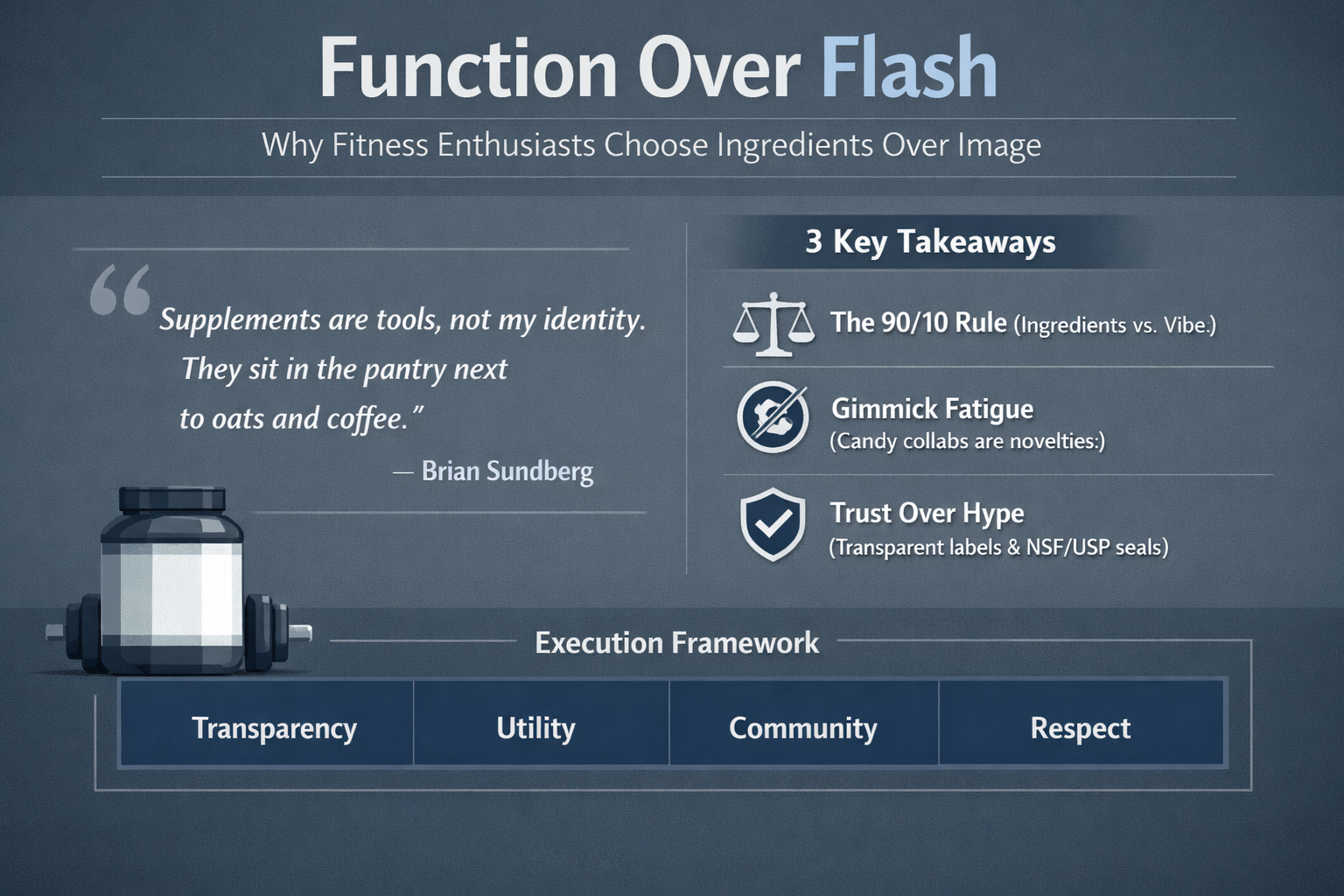
The consensus was striking. Every participant put vibe at 10-20% maximum, with ingredients and effectiveness accounting for 80-90% of their decision. But here's where it gets interesting: that 10-20% isn't about aspiration. It's a filter for cringe.
Felecia from Miami put it perfectly: "Vibe is like 10%. Ingredients and how it performs is 90%. If it tastes like candy and spikes my heart rate for no reason, I'm out. I don't care how slick the Instagram is."
Fernando, the single dad from Colorado Springs, was even more direct: "If a tub screams at me with neon lightning and alpha nonsense, I roll my eyes and keep walking. If you need a lifestyle cult to sell caffeine and whey, I assume the formula is weak."
What Actually Earns Trust
Across all six participants, the trust signals were remarkably consistent:
Transparent labels with exact dosages, no proprietary blends
Third-party testing seals (USP, NSF) visible on the tub
Clear caffeine content with stim-free options
Fair price-per-serving without subscription traps
Simple flavours that work in coffee and smoothies
Brian from New Jersey summed up the approach: "The ingredients and dosing matter a lot more than the vibe. Call it 90-10. I don't need a lifestyle brand. I need a clean label that does what it says and doesn't mess with my sleep or stomach."
Candy Collabs: Mostly Gimmick
I asked about the candy and cookie brand collaborations that have become popular in the supplement space. The reaction was almost universal: gimmick.
Jon, the barber from Texas, kept it simple: "Mostly gimmick, man. Too sweet. My stomach gets weird. Costs more. Same powder."
Felecia had tried one: "I tried a cereal-milk collab last year and it tasted like a melted candle. Wrecked my stomach on a run and I tossed the rest."
The parents in the group raised an additional concern: candy branding on supplement tubs confuses children. Nicole from Florida noted: "I don't love a giant dessert label sitting on my counter with a 6-year-old asking for a 'milkshake.'"
The consensus: collabs work for a week of novelty, then flavour fatigue sets in. Participants overwhelmingly prefer boring, reliable flavours like chocolate, vanilla, or unflavoured that work daily without becoming tiresome.
Supplements as Identity? Hard No
When I asked whether participants view supplements as part of their broader lifestyle or identity, the response was unequivocal: tools, not personality.
Brian put it plainly: "Supplements are tools, not my identity. They sit in the pantry next to oats and coffee. I don't post about powder."
Fernando compared them to household items: "Supplements are utilities. Same way I treat a socket set. Useful, not a personality."
What Would Earn Their Loyalty
Despite the skepticism, participants did outline what would make them wear a brand's apparel or follow on social media:
Low-key apparel: Small logo, neutral colours, quality fabric that holds up
Community receipts: Sponsor local sports, food drives, hurricane relief
Transparent operations: COAs by lot number, formula changes explained
Practical content: Quick tips, restock alerts, budget-friendly suggestions
Respectful communication: No spam, easy unsubscribe, bilingual support
Krystalyn from California, a mother of four, outlined her conditions: "If a brand makes my day simpler, respects my faith and wallet, and talks to me like a grown woman in English or Spanish, ok, I'll wear the tee on park days and toss you a follow. If not, I'll stick to my beans, my walks, and my plain old water."
Hard Nos: What Kills Trust Immediately
The participants were equally clear about dealbreakers:
"Grindset" slogans and alpha energy messaging
Before-and-after shame marketing
Auto-ship traps and dark patterns
Influencer-heavy feeds with minimal substance
Proprietary blend labels hiding actual dosages
Fernando's filter was simple: "If a supplement brand feels like a loud roommate who never pays rent, I mute them. If they feel like a reliable tool in the kit, quiet, useful, and built well, I might wear the hoodie."
What This Means for Supplement Brands
The implications are clear:
Transparency beats lifestyle. Post your COAs, explain your formulas, show your testing.
Simple, reliable products win. Skip the novelty collabs and nail the basics.
Community over influencers. Local sponsorships and real involvement trump paid partnerships.
Respect the customer. No traps, no spam, no cringe. Treat them like adults with busy lives.
The brands that win aren't the loudest. They're the most boring, in the best possible way.
What the Research Revealed
Here's what participants said in their own words:
Question 1: How much does brand vibe matter vs ingredients and effectiveness?
Brian Sundberg, 38, Office Manager, Rural NJ: "The ingredients and dosing matter a lot more than the vibe. Call it 90-10. I don't need a lifestyle brand. I need a clean label that does what it says and doesn't mess with my sleep or stomach."
Felecia Hernandez, 27, Customer Success Manager, Miami FL: "Vibe is like 10%. Ingredients and how it performs is 90%. If it tastes like candy and spikes my heart rate for no reason, I'm out. I don't care how slick the Instagram is."
Krystalyn Estrada, 40, Sales Representative, Hawthorne CA: "Ingredients and how my body feels are like 80%. The brand's vibe is maybe 20%, and only because if it screams bro culture or fake-hype, I won't even pick it up."
Question 2: How do you feel about candy/cookie brand collaborations?
Felecia Hernandez, 27, Miami FL: "Gut reaction: mostly gimmick. Slaps a candy logo on the tub, spikes the price, dials up artificial flavor, and calls it innovation."
Fernando Mcphetridge, 23, Job Seeker, Colorado Springs CO: "They almost never taste like the candy. It's more like a sweet, perfume-y echo. Two shakes in and I'm over it. Feels like paying a premium for a logo."
Nicole Lovvorn, 38, Property Manager, Rural FL: "Gut feeling: mostly gimmick. Cute for a sample or a one-time tub around the holidays, but I'm not picking a supplement because it tastes like a candy bar."
Question 3: Do you view supplements as part of your lifestyle or identity?
Brian Sundberg, 38, Rural NJ: "No. Supplements are tools, not my identity. They sit in the pantry next to oats and coffee. I don't post about powder."
Fernando Mcphetridge, 23, Colorado Springs CO: "No, I don't make supplements part of my identity. They're tools. Same way I treat a socket set. Useful, not a personality. I'm not trying to be the shaker-bottle mascot at preschool pickup."
Krystalyn Estrada, 40, Hawthorne CA: "No. Supplements are not my personality. I'm a mom who walks the kids after dinner, prays, batch cooks, and tries to sleep. If I use a supplement, it's a tool, not my identity."
This research was conducted using Ditto's synthetic persona platform. Want to run similar research for your brand? View the full study here.