
There's a Whole Foods near my office and a Walmart about the same distance in the other direction. Last week I needed apples, bread, and eggs. I went to Whole Foods. The apples cost $1.50 more. The bread was roughly the same. The eggs were actually cheaper at Walmart. I knew all of this. I went to Whole Foods anyway.
Why? It wasn't the products. It was the feeling. The warm lighting. The smell of freshly baked bread from the bakery section. The neatly stacked produce arranged like it was curated rather than delivered. The quiet. Whole Foods feels like a place where good food lives. Walmart feels like a place where food is stored. Same apples. Different planet.
I ran a Ditto study with 10 American consumers to understand exactly what makes a grocery store feel premium when the food is largely the same. The findings are a masterclass in environmental psychology, and they have implications far beyond grocery retail.
Who I Asked
Ten US consumers aged 25 to 55, from Florida to New Mexico to Oregon. Cloud architects, stay-at-home parents, home healthcare workers, nonprofit managers, and artists. A range of incomes, household sizes, and cultural backgrounds including Hispanic and Latino communities. All of them shop for groceries regularly. All of them have opinions about where they shop and why.
The First 10 Seconds: How You Know It's Premium
I asked participants to describe the first thing they notice when walking into their most expensive store versus their cheapest. The answers were incredibly specific, and they had nothing to do with products or prices.
Premium stores announce themselves through sensory cues within the first 10 seconds:
Lighting: Warm, even, almost residential. "Like someone designed it to make food look good, not just visible." Budget stores use harsh, flat fluorescents that make everything look clinical.
Scent: Bakery bread. Rotisserie chicken. Fresh flowers. The premium store smells like food. The budget store smells like cardboard, bleach, or nothing at all.
Sound: Soft background music or quiet. No beeping scanners, no PA announcements about deals in aisle 7. "You can hear yourself think."
Floors and fixtures: Wood or clean tile. Organised shelving. Products faced outward, not piled in boxes. "It looks like someone cares about the space."
Staff: Visible, unhurried, engaged. Someone actually rotating the produce. In the budget store: minimal, rushed, behind glass.
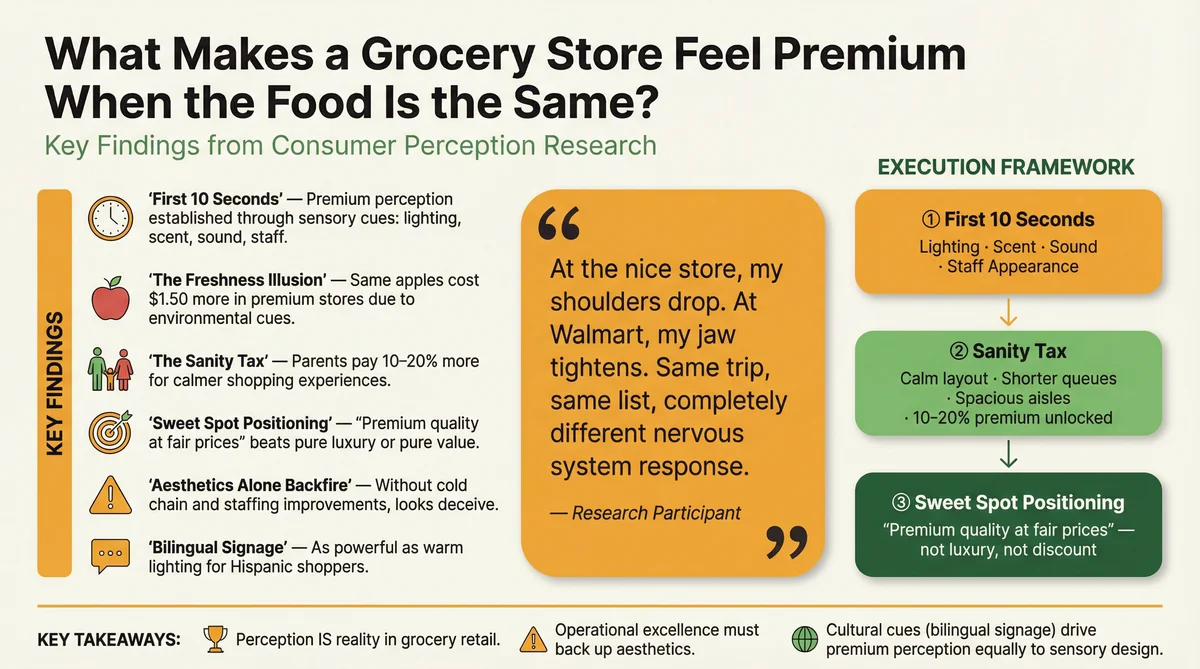
"At the nice store, my shoulders drop. At Walmart, my jaw tightens. Same trip, same list, completely different nervous system response." - Kristyn, 29, Suburb, OR
Key insight: Premium perception is established in the first 10 seconds by environmental cues, not product quality. Lighting, scent, sound, and staff behaviour create an immediate heuristic: "this place cares about quality." The food hasn't been touched yet.
The $4.99 Apple Problem
I gave participants a specific scenario: same bag of apples, $4.99 at one store, $3.49 at another. You bought them at the expensive store. Why?
The answers revealed a phenomenon that every grocery retailer should pay attention to: environmental cues create a freshness illusion that justifies higher prices for identical products.
Display matters: Apples on a wooden crate with a handwritten sign feel fresher than apples in a plastic bin with a printed label. Even when they're from the same supplier.
Lighting matters: Warm, targeted lighting on produce creates a "golden hour" effect that makes colours pop and signals ripeness. Fluorescent overhead lighting flattens everything.
Proximity matters: When the apples sit next to a bakery counter and a flower display, they inherit the freshness halo. When they sit next to a pallet of energy drinks, they don't.
Space matters: A loose, uncrowded display suggests curated selection. A packed bin suggests bulk commodity. "If there's too many, it feels like a warehouse, not a market."
Key insight: Consumers pay more for the same product when the environment signals care, curation, and freshness. The apple isn't better. But the context makes you believe it might be. Grocery pricing is partly environmental theatre.
The Whole Foods vs Walmart Feeling
When I asked participants to mentally walk through a premium store and then a budget store buying the same items, something remarkable emerged: people described fundamentally different emotional states, not just different shopping experiences.
Premium store feeling: "Calm." "Like I'm treating myself." "I feel like I'm making good choices." "My shoulders drop." "I linger." "I discover things I didn't come for."
Budget store feeling: "Mission mode." "Get in, get out." "Stressed." "Hunting." "I feel practical but not good." "I'm comparing everything to save money."
The premium store doesn't just sell food. It sells a better version of yourself. The calm, curated environment allows people to perform a kind of aspirational identity: I am someone who shops at nice places, who values quality, who takes time over food. The budget store strips that away and reduces shopping to pure logistics.
One participant, a parent of three, described it as a "sanity tax": she pays more at the nicer store because the experience is calmer, the kids behave better, and she doesn't leave feeling drained. The extra $15 per trip is the price of not having a meltdown in aisle 6.
Key insight: Premium grocery stores sell emotional regulation as much as food. The "sanity tax" is real: time-pressed parents and professionals will pay measurably more for reduced cognitive load, predictable layouts, and calmer environments.
The Redesigned Walmart Test
I asked a provocative question: if Walmart hired Whole Foods' design team to redesign a store (same products, same prices, new lighting, wooden shelves, ambient music), would people pay more?
The group split into three camps:
"Yes, probably": About half admitted they'd likely spend more, almost unconsciously. The environmental cues would change their behaviour even if they knew the trick. "I'd linger longer and that always costs me money."
"I'd see through it": A vocal minority said they'd recognise the cosmetic upgrade and resist. "Lipstick on a pig. The supply chain hasn't changed, just the wallpaper."
"Only if the operations match": The most interesting response. Several participants said aesthetics alone wouldn't work. They'd need to see real improvements: better cold chain, fresher produce, faster checkout, visible staff. "Pretty shelves with the same wilted lettuce is worse than honest ugly."
Key insight: Aesthetics alone create a short-term premium illusion, but they're not sustainable without operational improvements. The most discerning consumers read design as a promise: if the store looks like it cares, the product quality had better match. Pretty fixtures with poor cold chain management is a broken promise that erodes trust faster than bare concrete.
Three Stores: Curated, Value, or Sweet Spot?
I tested three positioning statements:
Store A: "Curated selections. Locally sourced. Seasonal produce arranged by the growers themselves. An experience, not just a shop."
Store B: "Same brands you know. 30% cheaper. No gimmicks, no frills, just value. In and out in 15 minutes."
Store C: "Premium quality at fair prices. Beautiful stores, great staff, rewards that actually work. The sweet spot between luxury and value."
Store C won. The "sweet spot" positioning resonated with the widest range of consumers. It acknowledged that people want quality and value, that beautiful stores and fair prices aren't mutually exclusive. It promised the premium feeling without the premium price guilt.
Store A attracted a niche audience: food-curious, time-rich, willing to pay for experience. But most participants found it too precious: "I don't need my produce arranged by the growers. I need it to be fresh and affordable."
Store B won respect for honesty but lost on aspiration. "I'd go there, but I wouldn't enjoy it. It's a chore, not an experience." The 15-minute promise was actually a negative for some: it signalled that the store isn't worth lingering in.
Key insight: The winning grocery positioning is the middle ground: premium experience at fair prices. Consumers don't want to choose between nice stores and affordable food. They want both, and they'll be loyal to the store that delivers both.
The Grocery Store Class Signal
I had to ask: do you judge people based on where they grocery shop?
Most participants said no at first. Then, with gentle prodding, admitted: yes, a bit. Grocery store choice is a low-key class and lifestyle signal in America.
"Trader Joe's" = creative, adventurous, probably lives in a city, possibly annoying about tote bags
"Whole Foods" = money, health-conscious, possibly out of touch with normal prices
"Aldi" = smart, practical, budget-savvy, not trying to impress anyone
"Walmart" = practical OR struggling, depending on who's reading it
"Costco" = family, bulk buyer, has a deep freezer, suburban
But the nuance matters: the signal is different depending on who's receiving it. In some circles, saying "I shop at Aldi" is a badge of financial intelligence. In others, it signals something less flattering. The same store can signal frugal-smart or frugal-struggling depending on your audience.
Key insight: Grocery store choice is a soft social signal that consumers are aware of, even if they deny it. Brands can lean into this: Trader Joe's has made its stores a lifestyle badge. That's not an accident.
What This Means for Grocery Retailers
Your first 10 seconds are your brand. Lighting, scent, sound, and staff visibility create an instant quality heuristic. Invest in the entrance experience: bakery near the door, warm lighting, visible produce, clean floors. Those 10 seconds determine whether someone is shopping or just buying.
Aesthetics without operations is a trap. Pretty fixtures with poor cold chain, wilted produce, or slow checkout will backfire. Consumers read design as a promise of quality. If the promise isn't kept, trust erodes faster than if you'd never made it.
The 'sanity tax' is real and profitable. Time-pressed parents and professionals will pay 10-20% more for a calmer, more predictable shopping experience. Wider aisles, staffed checkouts, predictable layouts, and reduced sensory chaos convert stressed shoppers into loyal ones.
Language and inclusion are premium signals. For Hispanic and Spanish-speaking shoppers, bilingual signage and staff greetings are as powerful as warm lighting in creating trust. Inclusion cues aren't just ethical. They're profitable.
The sweet spot wins. Don't position as luxury or value. Position as both. "Beautiful stores, great staff, fair prices" is the positioning that captures the widest audience. People don't want to choose between nice and affordable.
The Bottom Line
What makes a grocery store feel premium has almost nothing to do with the food. It's the lighting, the scent, the sound, the space, the staff, and the invisible signals that tell your nervous system: this is a place that cares. Premium is a feeling, not a product. And in a market where most grocery stores sell the same eggs, the same milk, and the same apples, the store that masters that feeling wins.
Want to test how your retail environment lands with real consumers? Ditto lets you run studies like this in hours, not weeks.
What the Research Revealed
We asked 10 American consumers to share their honest thoughts about grocery store environments, premium perception, and what makes them pay more. Here's what they told us:
Think about the grocery store where you spend the MOST money vs the cheapest. What's the first thing you notice about each? Not prices - the feeling.
Maryann Gutierrez, 54, Unemployed Adult, Kissimmee, FL, USA:
For the store where I spend the most - my big Walmart on 192 - the first thing is the cold AC on my face and those bright white lights on shiny floors. I hear low pop music, sometimes Spanish, and I smell the bakery bread right away. A greeter says “buenos días,” the aisles are wide, carts roll smooth, and signs are in English y español, so it feels calm and organized. At the cheap spot I hit sometimes - Aldi - it feels different the second I walk in. The lights look a little yellow and harsh, floors are plain, and there are boxes stacked on metal racks with pallets in the aisle. No real music, just beeps, fast cashiers, people moving quick with heads down, and you bring your own bags and your quarter for the cart. It feels efficient, no extras - just grab and go.
Mary Contreras, 53, Full-Time Family Caregiver, Rural, NM, USA:
At the store where I spend the most, the first thing is the calm. The lighting is warm, not that buzzing white, and the floors look just mopped so your shoes don’t stick. You hear soft tejano or oldies at a low volume, and the produce is in neat bins with a little mist going - no torn boxes. The staff makes eye contact and says hi by name, and the carts roll straight, no wobble. Other shoppers move steady, not rushing, and it smells like tortillas or roasted chicken, not bleach. Feels like, ok, aquí puedo tomar mi tiempo. At the cheapest place I hit sometimes, it’s harsh lights and a whoosh of cold air from open coolers, and the floor has scuffs and grit from the door swinging open to the wind. Music is either loud pop or nothing, just beeps and pallet jacks, and there are stacks of boxes shrink-wrapped right in the aisle. The carts squeak, the signs are taped up crooked, and you smell cardboard and cleaner. Staff is hustling, heads down stocking, so lines get long and folks get edgy. The shoppers are in work boots and scrubs grabbing quick stuff, kids in tow, and everyone is trying to get out fast - se siente apurado, like a pit stop, not a shop.
James Huerta, 29, Stay-at-Home Parent, Charleston, WV, USA:
Nice one - our Kroger First hit is the bakery smell and the floral section right up front. Warm lighting, shiny floors, and that soft 90s-lite music kind of slow you down. Aisles feel wide, endcaps are tidy, and produce is misting like a little show. Staff says hi, pushes extra carts forward, and someone is always fronting shelves. Other shoppers are strolling, half chatting, kids angling for a free cookie. It feels calm and a little curated - like they want you to linger. Budget one - Aldi The quarter-for-a-cart move already flips my brain to efficiency mode. Bright, almost harsh lights, gray floor, and the hum of the coolers - no music, so you hear wheels and beeps. Boxes and pallets everywhere, stuff stacked in crates with bare-bones signs. The middle aisle is that chaotic treasure hunt, which is fun but a little loud visually. Cashiers are lightning fast and sitting, and you’re bagging at the counter, so the whole flow says hustle. Shoppers have reusable bags, heads down, moving with purpose. It feels stripped-down and practical - like a warehouse got cleaned up just enough to be a store.
Kevin Harris, 51, Job Seeker, New York, NY, USA:
First thing I clock is the lighting and the air. The spend-most place feels like someone set a stage for groceries - warm lights, wood-look floors, a little bloom of flowers by the door, and a low hum of Motown or indie that makes you slow down. The cheapest spot? It hits like a loading dock - bright fluorescents, cool air from the dairy cases, the papery smell of cardboard, and the clatter of a cart with a wobbly wheel you freed with a quarter. The “nice” one feels like this: - Lighting: Soft and a touch amber, no flicker; your shoulders drop. - Floors: Wood-look vinyl that muffles footsteps; clean, even when slushy outside. - Music: Low-volume, familiar; just enough to smooth the edges of a Tuesday. - Stacks: Faced-out, color-blocked produce; chalkboard signs with tidy handwriting. - Staff: Eye contact, names on badges, a “need a hand?” that feels genuine. - Shoppers: Strollers and tote bags, neighbors chatting, no one bulldozing. - Flow: Aisles make sense; there’s space to breathe by the bread. The “budget” one feels like this: - Lighting: Cold fluorescents and a ceiling that’s seen leaks; you notice the hum. - Floors: Scuffed tile or concrete; wheels rattle, you steer around a pallet. - Music: If any, it’s tinny radio under the fridge buzz; mostly beeps and cart clangs. - Stacks: Towering cases, shrink-wrap half torn, hand-taped signs with starbursts. - Staff: Skeleton crew, moving fast; not chitchatty, but they’ll show you the beans if you ask. - Shoppers: Heads down, lists out, calculators; a quiet solidarity in the get-in-get-out. - Flow: Tight turns, surprise bottlenecks, you bag your own at a metal shelf. If I’m honest, the “nice” place is choreographed to make you feel cared for, and it mostly works. The “budget” place feels like the back-of-house of the city - a little rough, very functional - and there’s a dignity to that too if you’re paying attention. On a mild day like today, I don’t mind the trek for the no-frills vibe; on a gray, tired one, give me the warm lights and the Motown.
Ashley Miller, 25, Instructional Technology Coordinator, Fort Myers, FL, USA:
Publix is my “spend the most” spot, and Aldi is my cheap drive-by. The minute I step into each, the vibe flips. Publix feels like I can exhale; Aldi feels like a timed test I forgot to study for. Publix - the nice feel - Lighting: warm and even, no glare. Everything looks camera-ready. - Floors: glossy, super clean, and it smells like the bakery and the floral case had a friendly hug. - Music: soft pop in the background, just enough to slow my brain down. - Entry displays: tidy BOGO stacks, seasonal colors that feel intentional, not shouty. - Staff: someone actually meets your eyes and walks you to the aisle, plus a real bagger at checkout. - Other shoppers: unhurried retirees and parents with calm carts. Nobody angle-sprints. - Overall: I linger, I browse, I grab a sub. AC hits and I forget the 32°C outside. Aldi - the budget feel - Lighting: bright-white and a little harsh. You see everything, including your to-do list guilt. - Floors and fixtures: concrete or basic tile, pallets and cardboard crates right on the floor. - Sound: freezer hum and scanner beeps. Usually no music, so every shuffle feels louder. - Entry vibe: bold red-yellow signs, limited SKUs, produce still in boxes - efficiency first. - Staff: kind but in sprint mode. Cashiers ring so fast my heart rate jumps. - Other shoppers: list-in-hand, heads down, grab-and-go energy. Quarter in the cart or you’re already annoyed. - Overall: purposeful, no frills, a little chaotic by the Aisle of Random. I move fast, bag at the shelf, and bail. If I’m honest, Publix feels like hospitality; Aldi feels like homework that saves my budget. I’ll take both - just not on the same day. I can make a checklist for that.
Brandon Vega, 49, Stay-at-Home Parent, Las Vegas, NV, USA:
Costco is where most of our money goes. Walmart Neighborhood Market is the cheap pinch-hit spot I duck into when I need rock-bottom staples. - Costco, first steps in: That blast of overachieving AC after the Vegas parking lot, then the quiet. No pop music, just forklift beeps and cart rumble. High ceilings, skylights and bright but not headachey LEDs. Bare concrete floors that somehow look cleaner than most tile. Pallets stacked perfectly to the rafters, neat price signs, no shrieky signage. The bakery sugar smell mixing with rotisserie chicken and a whiff of tires from the auto center. Door staff does the quick card nod that feels like a tiny velvet rope without the attitude. Big carts that actually roll straight. Shoppers are mission-focused couples and retirees timing samples like pros. It feels nice because it is orderly, predictable, and the staff moves with purpose. Nothing feels flimsy or desperate. - Walmart Neighborhood Market, first steps in: Fluorescents humming, a little too bright, bouncing off scuffed off-white tile. Air smells like mop water and the candle aisle had a baby with the fried chicken case. Corporate radio DJ chatter over tinny speakers, then a sudden promo blast that makes you flinch. Seasonal junk crammed by the door, end caps shouting with starbursts, a rogue pallet squeezing the aisle. Carts with at least one bum wheel. Shelf tags curling up, a couple empty pegs with handwritten notes, produce mist over-spraying so the floor’s damp. Self-check is a logjam and one poor cashier is stuck doing five things. Shoppers look rushed, a few on speakerphone, kid meltdown near the cereal. Security monitors by the entrance reminding you to behave. It feels budget because everything screams cost-cutting - cheap fixtures, harsh lighting, cluttered stacks, thin staffing. You can practically hear the spreadsheet breathing down everyone’s neck. If I had to boil it down: Costco feels like a well-run warehouse that respects your time. Walmart feels like you saved two bucks and paid for it with your senses.
Monica Robb, 50, Nonprofit Program Manager, Apple Valley town, CA, USA:
Walking in from the high-desert glare, I know within five seconds which world I’m in. My main, higher-spend grocer - it feels composed: - Lighting: warm LEDs that don’t bleach the tomatoes. No flicker. My eyes unclench. - Floors: clean tile, dry entry mats, no mystery stickiness grabbing my shoes. - Sound: low 80s-Motown mix at a sane volume, no shouty promos. - Merchandising: front-faced shelves, slanted produce bins, flowers right up front. Nothing teetering over my head. - Staff: eye contact, quick nod, someone already at the service counter. If I switch to Spanish, no one blinks. - Shoppers: lists out, steady cart flow, nobody playing demolition derby with a pallet jack. - Smell: citrus and bakery, not fryer oil or detergent clouds. The cheap, occasional stop - it feels back-of-house: - Lighting: blue-white fluorescents that make the greens look tired. You can hear the buzz. - Floors: raw concrete with skid marks; every cart rattle vibrates up your spine. - Sound: forklift beeps, plastic wrap crackling, HVAC roar. If there’s music, it’s tinny and fighting the fans. - Merchandising: cases cut open and stacked high, endcaps jammed, hand-taped signs shouting at you. - Staff: thin on the floor, heads down moving freight. Helpful when flagged, but you have to flag. - Shoppers: mission-mode, big carts, bulk staples. Everyone is calculating and moving fast. - Smell: bleach by dairy, onions near produce, a whiff of soap aisle that sticks in your throat. Net: the “nice” store feels edited and humane, like someone thought about my blood pressure. The “budget” place is efficient and honest about it, but it greets you with noise, glare, and pallets. I’ll buy beans anywhere, but after a long field day, that calmer entry keeps me from snapping at strangers.
Michael Pires, 50, Cloud Architect, Austin, TX, USA:
Alright, not talking prices. Two very different gut hits. The nice one - my big Texas chain near Mueller - Lighting: Warm LEDs that don’t fry your retinas. 3000K-ish. You feel human, not lab-tested. - Floors: Polished concrete, clean lines. Carts glide instead of rattling like a shopping cart death march. - Air and smell: Fresh tortillas, bakery, coffee. First inhale says stay a minute. - Soundtrack: 90s R&B or a little Tejano, volume tuned for conversation. No shouty ads. - Stacking: Produce sitting proud, misted, color-blocked. End caps look intentional, not Tetris after three beers. - Signage: Clear, bilingual, little tags calling out local stuff. Feels like someone curated, not dumped. - Staff: Plenty of them, eye contact, quick “you good?” in English or Spanish. They move with purpose. - Shoppers: Families, nurses post-shift, cyclists with helmets dangling off backpacks. People look like they live nearby. - Checkout: Enough lanes open, self-checkout actually works. No chaos at the bagging area. The budget one - the coin-for-cart spot on Riverside - Lighting: Cold, flat, 5000K fluorescents. Everything looks a shade too honest. - Floors: Scuffed tile that squeaks. Every step echoes. You hear your own bad decisions. - Air and smell: Cardboard, cold dairy case, a hint of mop water. Not gross, just warehouse-lite. - Soundtrack: Usually silence or a tinny radio. No vibe, just the hum of compressors. - Stacking: Corrugated boxes on shelves, pallets cracked open. Seasonal aisle whiplash - garden hose next to air fryer next to snow boots. In Austin. In March. - Signage: Big blunt placards. Zero romance, zero storytelling. It’s “here, buy this.” - Staff: Skeleton crew. Cashiers seated, scanning like speedrunners. Minimal chatter, no small talk. - Shoppers: Heads down, in-out mission energy. Pajama pants, work boots, no one lingering. - Checkout: You bag your own on a long ledge. Efficient but clinical. Bring your own bags or wrestle a box. Today’s thunderstorms crank the contrast. The first one feels like a neighborhood hub - warm, alive, you might run into a friend. The second is a supply run - bright, cold, surgical. Both do their job. One invites you to browse; the other dares you to waste a minute.
Kristyn Lin, 30, Mechanical Engineer, Virginia Beach, VA, USA:
Okay, gut check. Most money goes at the big box. Cheapest is the quarter-cart place. The feeling hits fast. Walmart Supercenter - the spendy one - Lighting: Blinding, cold-white. I step in from this warm, breezy air and it’s like a lab. My eyes squint. I already feel rushed. - Floors: Shiny but scuffed tile with auto-scrubber streaks. Sometimes a sticky patch by soda. I steer the stroller around it like a maze. - Air & smell: Random soup - fryer oil from deli, fake floral from detergent, a faint rubber whiff if the tire center is humming. It clashes and makes me tense. - Sound: Pop music fighting with PA announcements, squeaky carts, beeping self-checkouts, a pallet jack screech. It’s a constant buzz. My brain goes mission-mode. - Visuals: Tall shelves, loud endcaps, giant seasonal bins shouting for attention. Pallets in the aisle like obstacles. It feels like a warehouse pretending to be friendly. - Staff: A few hustlers, many look exhausted. Pick-up shoppers zooming those tall blue carts. No one has time to chat. I don’t either. - Other shoppers: Everyone’s dragging families and stress. Pajama pants, crying toddlers, people parked on phones. I grip the kids’ hands tighter. - Feeling: Overstimulated, defensive, checklist brain. Get in, get diapers, do not look at the shiny bins, get out. Zero joy, just volume. Aldi - the cheap occasional run - Lighting: Softer, fewer fixtures. Not cozy, but calmer. My shoulders drop half an inch. - Floors: Plain tile or concrete. Clean, no glare. Feels honest - no polish, no nonsense. - Air & smell: Bananas, bread, maybe coffee from the aisle. Simple. My stomach says fine, let’s move. - Sound: Almost no music. You hear cart wheels and the rapid-fire beeps at checkout. It’s weirdly peaceful, like a library where people sprint. - Visuals: Low shelves, everything still in cardboard boxes. Signs are small, straight lines, no circus. Middle aisle chaos with random specials, but it’s contained. - Staff: Few but fast. They move like a pit crew. No small talk, just precision. I respect it. - Other shoppers: List people. Moms with calculators, seniors with foldable totes, quiet couples. Nobody peacocking. - Feeling: Efficient, almost cold, but in a good way. I bag my own stuff, I feel competent, and my brain stops buzzing. Annoyance spikes if I forget a quarter or bags - then I’m hunting for an empty box like a gremlin. If I’m being picky: Walmart feels like a noisy bus station with cereal boxes. Aldi feels like a clean workshop where we all clock in, do the task, and leave. I don’t “enjoy” either, but Aldi respects my time. Walmart eats it.
Kelly Spencer, 46, Full-Time Family Caregiver, Rural, IN, USA:
- The place where I spend the most is the big supercenter. Walking in, I notice the warm air and that sweet bakery smell, bright shiny floors, and big seasonal displays that look cheery even on a rainy day like this. The lights are soft enough, music is low, aisles are wide, and a greeter usually nods. It feels nice because it’s clean, bright, and a little dressed up, like they tried to make it pleasant, not just stocked. - The cheapest spot I hit now and then is the no-frills place with the quarter-for-carts. First thing I notice is the quiet - no music, just the hum of the coolers and fast beeps at checkout - and that cardboard-and-produce smell. Stuff is stacked in the original boxes on pallets, the lights are harsher and a touch flickery, floors are plain and a bit scuffed, and you bag your own at the end while folks move with purpose. It feels budget because it’s bare-bones and practical - get in, get what you need, get out - no fluff.
Same bag of apples: $4.99 at one store, $3.49 at another. You bought at the expensive store. Why?
Maryann Gutierrez, 54, Unemployed Adult, Kissimmee, FL, USA:
I grabbed the $4.99 because the whole set-up got me. The apples were right up front, bright lights, a little mist, bags tight, no bruises, and at eye level so I didn’t have to bend with my back. A worker was stacking them neat and said “buenos días,” the cold AC felt nice, and I was already there for my receta at the pharmacy and a rotisserie chicken. At the cheap place they sit low in boxes, yellow light, you have to pick through, and I’m not crouching for $1.50 in this heat, no gracias. It felt fresh and easy, so my hand just went for it. Como dice mi abuela, lo barato sale caro.
Mary Contreras, 53, Full-Time Family Caregiver, Rural, NM, USA:
I grabbed the $4.99 because I trusted that bag, plain and simple. The apples were in a clean bin with a light mist, skins looked tight not waxy, and the warmer light showed real color so I could spot bruises easy. The produce guy was right there rotating, said they were fresh, and the bag felt cold and heavy in my hand. I was on a clock between Rosa’s refill and choir, so I wasn’t about to dig through scuffed bags or wait in a cranky line at the budget place. That store smells like tortillas and coffee, the carts roll straight, and the whole vibe says, ok, agarra lo bueno y sigue. By the time I looked up, ya estaba en la banda paying. Do you usually stop to compare bags, or if the fruit looks recién puesto and the cart rolls smooth, you just grab it too?
James Huerta, 29, Stay-at-Home Parent, Charleston, WV, USA:
It was our regular store vibe kicking my brain into autopilot. The apples were right up front by the floral, under warmer lights with the produce mist going, stacked neat instead of sitting in a crate. There was a little LOCAL or new crop sign - nothing huge - but it made them feel fresher. Caleb had the free cookie, Hazel was in the stroller, and the wide aisle let me grab a bag without stopping to nitpick the unit price. Plus it was raining, I wasn’t dragging two kids to a second stop to save $1.50, and I trust that store’s fruit turns faster so the bag felt cold and crisp. Quick hits that tipped me: - Warm lighting + mist made the apples look glossy and clean. - Neat display at eye level vs boxes on the floor. - Subtle signage saying local or fresh harvest. - Calmer pace - music on, staff fronting shelves, I’m not in hustle mode. - Convenience math - already there, kids content, rain outside, fuel points in the back of my head.
Monica Robb, 50, Nonprofit Program Manager, Apple Valley town, CA, USA:
Because that store lowers my blood pressure on contact. I walked straight into a calm, dry, well-lit produce zone, parked my cart without dodging a pallet jack, and saw tidy, vented bags at waist height with no condensation and no bruised soldiers on top. My brain filed it as fresh, safe, fast and I moved on. - Lighting: warm, no flicker. The apples looked alive, not grayscale. - Culling in progress: staff quietly rotating fruit. I trust turnover when I see it. - Space: wide aisle, no beep-beep machinery pushing me along. I could scan a bag without getting jostled. - Signal labels: clean shelf tag with variety and origin, not a red screaming sticker. That reads quality, not chaos. - Texture cues: bags were cool and dry, not sweaty. That screams intact cold chain. - Ambient: citrus-bakery smell instead of bleach-fan roar. My shoulders drop, my guard drops, my wallet opens. Net: I paid $1.50 for predictability and zero friction, not better apples. After a field day and war headlines rattling around, I was not about to burn 12 minutes and my last nerve chasing a cheaper bag under buzzing fluorescents. Call it a convenience tax; I paid it to keep the day from snapping me in half.
Kevin Harris, 51, Job Seeker, New York, NY, USA:
Honestly, I grabbed the $4.99 without blinking because the store had me in that soft-focus headspace where you just move with the flow. It was the whole scene working on me at once, not one flashy thing. - Display: Shallow wood crates, apples faced and unbruised, a tidy chalkboard that said NY state with a farm name. It read as fresh, not warehouse leftovers. - Lighting: Warm, no glare, colors looked saturated. The reds popped, not that washed-out supermarket pink. - Sound and pace: Low Motown, steady checkout rhythm, no barked intercoms. My shoulders dropped and I went on autopilot. - Touch test: I picked one up and it had that firm snap at the stem. No waxy film, no soft spots. Trust kicks in fast when your hand says yes. - Signaling: Little note card that said great for snacking and a staffer saying these just came in. Could be sales patter, but it lands. - Momentum: I was already near the flowers and bread, tote half full, trying to beat the bus and get home to walk the dog. Zero appetite for a second stop. - Burned before: The cheap place has saved me a ton, but I have tossed mealy apples from there. In my head, that turns $3.49 into a false bargain. - Frictions removed: Clear price, clean bags, no digging past dented fruit. Cognitive load set to low. So yes, I paid the Astoria tax for a bag of apples and, fine, I slightly hate that I did. But in that warm light, with the crate looking like a farm stand and my blood sugar dipping, the $4.99 felt like the path of least resistance and better odds.
Brandon Vega, 49, Stay-at-Home Parent, Las Vegas, NV, USA:
Honestly, I grabbed the $4.99 bag because the whole setup told my brain, these are the good ones, move on. It wasn’t about being fancy, it was about trust and not wasting time. - Cold and dry vs soggy: The pricier store had the apples sitting cool and dry. Bags weren’t sweating, no mist overspray, no sticky floor. They felt firm through the plastic. At the cheap place the bags are often damp and a couple apples are already soft. - Clean cull, uniform size: I watched a produce guy actively culling bruised ones and rotating stock. The display looked tight - consistent size, no fruit flies, no sad stragglers. That matters when these end up in Maya’s and Ethan’s lunches. - Lighting and layout: Warmer, even light that makes the reds actually look like food instead of a hospital scene. No shouty signage. Wide aisle, cart rolls straight, I park, grab, go. I’m not doing an obstacle course to save $1.50. - Smell and noise: Neutral air with a hint of bakery, no fried-chicken-candle funk, no tinny radio ads yelling at me. My shoulders drop, I stop second-guessing, I just pick. - Turnover and habit: That store moves volume. I don’t get mealy surprises later. The cheaper spot is hit-or-miss, and I’m done playing bruise roulette. - Time window: It was hot out, I had school pickup on the clock. One stop, in and out. I’m not detouring across town or fiddling with an app coupon for pocket change. - Tiny safety net: If the bag’s bad, I can return it there without drama. That peace of mind is worth the delta. So yeah, the display and lighting helped, but it was more the whole environment - cool, orderly, quiet - that flipped me into autopilot and made the $4.99 bag the obvious grab.
Ashley Miller, 25, Instructional Technology Coordinator, Fort Myers, FL, USA:
I grabbed the $4.99 bag at Publix without blinking because the whole setup told my brain fresh, easy, safe and I was already in glide mode, not bargain-hunt mode. - Mood reset: I walked in from 32°C heat, hit cool AC, smelled bakery and flowers, and my shoulders dropped. Price radar turned down. - Display cues: Waist-high wood table, neat pyramid, warm lights, a little “Peak Season” sign. Apples looked camera-ready, no misty condensation mess. - Quality signals: Produce clerk actively culling bruised ones. Clear bags with bold variety labels felt trustworthy and week-long fresh. - Low friction: Clean cart, calm line, real bagger. I was between PD planning and small group, so $1.50 felt like buying back 10 minutes. - Habit-trust loop: Publix produce usually lasts in my fridge, so I default to yes. It was not the apples; it was the context. I can make a tiny checklist to price-check before I float off on bakery air... but I’ll probably forget and grab the sub too.
Kristyn Lin, 30, Mechanical Engineer, Virginia Beach, VA, USA:
Not the lighting. Not the cute pyramid. I grabbed the $4.99 because my brain was in survival mode, not comparison mode. Sanity tax, basically. - Time pressure: Baby was on a 20-minute nap fuse, Joel needed the van by 4, choir practice later. I saw apples, I took apples. Done. - Path of least resistance: They were right by the door, first aisle, cart-height. The $3.49 ones live deeper in that maze where someone always blocks the aisle with a giant pallet. No thanks. - Kid management: The free-sample table was next to the expensive display. My 6-year-old grabbed a cracker, my 3-year-old yelled apple now. I paid the $1.50 to stop a meltdown. Call it the tantrum premium. - Perceived clean factor: Those bags looked drier, no weird condensation, no loose stems poking through. Same apples on paper, but the bag looked less sketchy. My risk radar wins. - Checkout flow: That store runs fast lanes. The cheap store had three carts of extreme couponers stalling. I value my time more than that buck-fifty when dinner clock is ticking. - Cash-back hack: I needed $10 cash without an ATM fee. Buying there solved two problems in one swipe. Math still favors me. - My mood: I had just doom-scrolled war headlines. Heart rate up, patience down, Virginia Beach felt too warm and sticky inside the car. I reached, I paid, I left. Bahala na. So no, it was not romance lighting. It was me choosing frictionless over frugal for five minutes so I could keep the rest of the day from falling apart. If you want the truth, that store sold me calm, and they hid it inside a bag of apples.
Kelly Spencer, 46, Full-Time Family Caregiver, Rural, IN, USA:
Short answer: I was in a hurry, it was raining, and those apples looked fresher and I trusted them more. What probably nudged me without me thinking was this: - The pricier store is closer, parking is easier, and I had a meal-train drop-off to make. A buck-fifty is gone in gas and time if I chase it. - The display was clean, misting, and bright. The bags were at eye level, no bruisers showing, and a little chalkboard said “picked this week.” That stuff gets me. - I have been burned by mealy apples at the cheaper place, so my brain just says, grab the ones that don’t end up in the compost. Waste costs more than the tag. - The produce guy there knows me and actually pulls bad bags. That trust makes my hand move faster than my math. - The store felt calm and warm, and I was on list-autopilot. Rotisserie chicken smell, soft music, and I’m tossing apples in the cart without a second thought. I noticed the $3.49 later and rolled my eyes at myself, wrote a note in my spiral to check the other store first next time. But that day, time and trust won.
Michael Pires, 50, Cloud Architect, Austin, TX, USA:
It wasn’t the Edison bulbs or some precious pyramid of fruit. I grabbed the $4.99 bag because time beats pennies in my head, every time. - Speed: I was already in that store for salmon and greens, thunder rolling outside, trying to beat the next downpour. Apples were right at the endcap by the entrance. In, grab, out. No extra stop. Ya estaba ahí. - Trust: That store’s produce buyer turns stock fast. Their apples are cold, crisp, not mealy. I’ve been burned enough by “cheaper” bags that taste like fridge sponge. I don’t gamble fruit quality for a dollar and change. - Signal, not vibes: The display wasn’t fancy. What mattered was turnover, clean misting lines, no bruised bags hiding in the back. I squeezed one through the mesh and it had that snap. Done. - Mental load: Fewer clogged aisles, fewer blaring promos, self-checkout that actually moves. My brain wasn’t being pinged every two seconds, so I defaulted to the fast path. - Privacy tax: The cheaper place usually tries to wring a phone number for the “deal.” Hard pass. I’m not trading my data for 1.50. Tiempo mata centavos. - Consistency: I meal prep. If apples go soft midweek, that’s wasted oatmeal toppers and a second errand. Paying for reliability is cheaper than rework. So no, it wasn’t warmer lighting. It was habit loops, trust in quality, and killing friction. If the cheaper store fixes the checkout slog and stops the loyalty-card shakedown, I’ll switch. Until then, I’ll eat crisp apples and get home before the sky opens up.
Walk through a Whole Foods in your mind, then a Walmart. Same trip: milk, bread, eggs, fruit. What is DIFFERENT about how you FEEL while shopping?
Mary Contreras, 53, Full-Time Family Caregiver, Rural, NM, USA:
Whole Foods or that kind of premium spot, cuando voy en Albuquerque, I slow down right at the door. Warm lights, wood crates, flowers and coffee smell, someone offers a tiny sample, and I feel a little polished, like a guest in a nice kitchen, so I reach for the seeded loaf instead of plain. It does make me feel like a tidier version of myself, pero también I feel a tiny pressure, like I should behave and not block the aisle, and sometimes the signs are only in English, which bugs me. Walmart or Aldi is different - bright, cold air from the coolers, pallet stacks, beeps, and I move with purpose. I feel practical and a little competitive, like OK, let’s beat this list and get out, and I get a small thrill when the total is lower. It is not cozy, but it makes me feel capable, like trabajo hecho, even if the cart squeaks and I have to check the eggs twice. Which one makes you breathe slower, and which one makes you grip your list tighter?
Kevin Harris, 51, Job Seeker, New York, NY, USA:
Whole Foods feels like a grocery spa. I walk in, my shoulders drop, there’s that lemony-bakery smell, soft music, chalkboard niceties, and I start believing I’m the guy who buys the good yogurt and heirloom eggs. I feel calmer, yes, but I also feel a little handled - like the store is nudging me toward a pricier version of myself I can’t afford right now. Aldi flips me into checklist mode. Quarter in, cart out, no fluff, bag it yourself at the metal shelf. I feel competent, quietly proud, like I just found five bucks in the couch because I skipped the nonsense. Lighting’s harsh, edges are sharp, but the efficiency scratches an itch. Walmart, when I’m visiting family outside the city, is a different animal. It’s a long bright trek with too many choices and beeps, and I get a touch defensive - hand on the list, head down, get the milk and escape. I don’t feel frugal so much as endurance-tested. So do I feel like a better version of myself in the premium store? No - I feel soothed and slightly upsold. The budget run makes me feel capable and aligned with my spreadsheet, which, frankly, is the version of me that keeps the lights on.
Maryann Gutierrez, 54, Unemployed Adult, Kissimmee, FL, USA:
Whole Foods feels like a little spa for groceries - cold AC, soft music, wood shelves, chalk signs, coffee smell. I walk slower, I stand straighter, I feel a bit fancy... but also like a visitor, watching my wallet, taking a small basket so I don’t get tempted. It does not make me a “better me,” just a pricier me for a minute. Walmart on 192 feels like my rhythm - bright white lights, bilingual signs, bakery smell, the greeter, pharmacy right there. I move with my list on the phone, cart rolls smooth, and I feel organized and calm, like I’m handling business. Aldi is different - yellow light, boxes on pallets, beep-beep, my quarter and my bolsas. I feel practical and a little rushed, but also smart when I pay less, unless the low crates bug my back. So premium gives me a short “oooh” and then I step back. Budget makes me feel I did right for my wallet - como dice mi abuela, el que guarda, siempre tiene.
James Huerta, 29, Stay-at-Home Parent, Charleston, WV, USA:
Premium - Whole Foods vibe Warm lights, wood shelves, chalkboard signs, and that citrus-bakery smell make me slow down. There’s mellow music and tidy produce that looks like it got styled, plus a sample station that nudges you to linger. I don’t feel like a “better person,” but I do feel like the organized, healthier-dad version of myself - standing a little taller, making “good choice” swaps. Tiny voice in my head watches for cart creep, but the overall mood is calm and intentional. Budget - Walmart/Aldi vibe Fluorescents, cooler hum, beeps, and boxes on pallets flip me straight into mission mode. Quarter in the cart, list out, kids buckled - I’m moving with purpose, not browsing. I feel competent and frugal, a little tense at the checkout sprint and bagging dash, but proud when the total lands lower. It’s efficient, sometimes draining, and I’m back in the car before anyone melts down.
Michael Pires, 50, Cloud Architect, Austin, TX, USA:
Same list, different nervous system. Here’s how it hits me, feelings first. Premium store run - Tempo: My pace drops 10 bpm. Wide aisles, warm light, soft soundtrack. I’m an adult with a plan, not prey. - Scent + cues: Coffee and bakery whisper stay a minute. Fruit looks alive, misted, color-blocked. I don’t brace for disappointment. - Signage + story: Clean labels, local callouts. It flatters me with “you care about quality” vibes. I clock the nudge but let it slide. - Staff energy: Present, helpful, quick eye contact. If I ask, I get a straight answer sin drama. - Checkout: Flows. No loyalty shakedown. If someone asks for a Prime scan, I skip it and keep moving. - Feeling: Tuned-up, competent, unhurried. Not a better human, just the version of me with margin in the day. Walmart or Aldi run - Tempo: Shoulders up. Fluorescent honesty, carts clacking, compressor hum. Mission mode clicks in. - Layout: Direct and blunt. Pallets, straight lines, no romance. Bread, milk, eggs, fruit, vámonos. - Staff + crowd: Fewer staff, fast scanners. Shoppers are heads-down. I mirror that energy. - Friction: Aldi coin for cart is fine. Walmart’s app and promo barkers feel like data tolls. I keep my number to myself. - Checkout: Self-bag on a ledge, efficient and a little clinical. I’m watching dates and bruises, not playlist vibes. - Feeling: Practical, tactical, slightly armored. A tiny hit of pride when the receipt is lean and I’m out under 10 minutes. Net: the premium store doesn’t make me a better person. It reduces cognitive load and polishes the errand. The budget trip makes me feel disciplined and no-nonsense, which I respect, but it taxes my senses. On a thunderstorm day like today, I’ll pay for the glide path. On a quiet morning, I’ll run the mission and pocket the win.
Ashley Miller, 25, Instructional Technology Coordinator, Fort Myers, FL, USA:
Whole Foods in my head is spa-grocery. Walmart or Aldi is stopwatch-grocery. Same list - milk, bread, eggs, fruit - totally different me walking the aisles. Premium store - calmer, curated, slightly performative - AC hits after biking in 32°C and I unclench. Lighting is warm, floors gleam, chalkboard signs whisper “you’re doing life right.” - It smells like coffee and oranges, not mop water. I slow down, posture straightens, I read labels like I have a book club for bread. - Displays are tidy and low, so I’m not hunting. Staff makes eye contact and uses complete sentences. I feel seen, not rushed. - Other shoppers move like Sunday afternoon - yoga mats, reusable bags, nobody rams your ankles. - Emotion: I feel put-together and intentional. Not a better person, just a quieter, tidier version of me. Walmart or Aldi - practical, fast, a little adrenal - Lighting pops bright-white. Cart corrals jammed. I’m instantly in mission mode - quarter for the cart, list up, no detours. - Sounds are louder - freezer hum, beeps, intercom. I check eggs for cracks like it’s a lab practical. - Stacking is pallets, boxes, endcap blitz. Efficient, yes, but I’m dodging and weaving. - Staff is kind but sprinting. Self-check lines feel like a mini-boss fight. - Emotion: I feel competent and frugal - and a bit wrung out. Proud when I leave, but I don’t linger. Does the premium spot make me a better version of myself? No - just calmer with nicer lighting. Budget makes me feel disciplined, which I like, even if my shoulders ride up by the dairy case. I can make a checklist for which mood I have before I pick a store.
Kelly Spencer, 46, Full-Time Family Caregiver, Rural, IN, USA:
I don’t hit Whole Foods much - maybe if I’m up in Indy with my sister-in-law - but here’s how it feels in my head vs Walmart or Aldi on a milk-bread-eggs-fruit run. - Premium store: Warm lights, wood crates, fresh flowers by the door, and that coffee-bakery smell. Chalkboard signs make everything look special and the workers in aprons ask if I need help, which is nice but I feel a little watched. The music is soft and folks stroll, not hustle, so I slow down and start eyeing fancy bread I don’t need. My shoulders go back like I should act classy, but my budget radar is buzzing. I feel pampered and slightly self-conscious - like a treat, not real life. - Walmart or Aldi: Cooler hum, bright lights, no fuss. Carts clack, pallets and box displays, and I’m moving with a list and a pen. I check dates, compare store brand, bag my own, and keep a rhythm. People are in work boots and hoodies, we nod, we’re all on a mission. I feel practical, a little tired, but proud - solid stewardship, get it done, get home. Bottom line: the premium place makes me feel like my best version if money grew on trees, and the budget run makes me feel like the responsible version who pays the propane bill and still brings a casserole.
Brandon Vega, 49, Stay-at-Home Parent, Las Vegas, NV, USA:
Short version: premium store makes me stand up straighter and watch my wallet. Budget store makes me put my head down and grind. Same groceries, different mood tax. - Whole Foods, milk-bread-eggs-fruit lap: Doors whoosh, warm lights, wood accents, curated indie playlist at polite volume. Produce is stacked like a still life, mist like stage fog. Chalkboard fonts telling me the chickens had better dental care than I do. Carts glide. Staff actually makes eye contact. I feel calmer, a little self-conscious, like I should hide my cargo shorts and pretend the kids beg for kale. The eggs aisle turns into a philosophy debate about pasture-raised vs omega-whatever. I grab the house brand to keep my dignity and budget intact, but the place definitely nudges me to add berries I did not plan on. It does not make me a better version of myself, no, it just makes me slower and more tempted while pretending that slowness is virtue. - Walmart Neighborhood Market, same list: Fluorescents, tinny radio ads, scuffed tile. Aisles feel tighter, carts have one drunk wheel, and I’m dodging a rogue pallet. Milk is in the back like always, eggs are a wall of cheap options that do not ask about my values. Bread is bagged and fine. Fruit is hit-or-miss, so I squeeze and move on. I feel efficient but keyed up - practical, yes, also a little beat down by the noise and clutter. It is a mission, not a vibe. I move faster, second-guess less, and leave with my shoulders a notch higher from irritation, not pride. Do I feel like a better person in the premium place? No. I feel curated and mildly judged, which is not the same thing. Do I feel frugal in the budget spot? Yeah, but also like I paid with my patience. End of the day, the fridge looks the same. My mood doesn’t.
Monica Robb, 50, Nonprofit Program Manager, Apple Valley town, CA, USA:
Same list, two different headspaces. I’m walking in from high-desert glare, and my nervous system decides where we’re shopping before my wallet does. Premium store - curated calm with a whiff of theater: - Lighting is warm and angled so the fruit looks alive. My shoulders drop. - Floors are spotless and quiet, carts glide, no pallet-jack beeps chasing me. - Music hums at background level, not shouting in my ear. I slow down without meaning to. - Signage talks in soft values language - local, artisanal, sustainable - fine, but it’s performative at times. - Staff makes eye contact, offers help before I ask. I behave better because the place removes friction. Do I feel like a better version of myself? No. I feel calmer and more compliant. That’s design, not virtue. Walmart or Aldi - mission mode, honest edges: - Lighting is bright-blue and unforgiving. Functional, not flattering. - Floors are concrete and loud, my back clocks every cart rattle. Aldi aisles are tight, DIY bagging, quarter out of the cup holder. - Soundscape is beeps, fans, kids, stocking. I keep my elbows in and move with purpose. - Staff is hustling, helpful when flagged. I switch to Spanish more here and it lands naturally. - I feel practical and competent, also a little hunted by time and noise. I exit faster, a bit wrung out, wallet intact. Net: Premium makes me feel regulated and edited - a smoother version of myself, not a better one. Budget makes me feel disciplined and alert - proud of the pragmatism, mildly stressed by the atmosphere. I pay for calm when the day has already chewed me up; otherwise I choose the honest chaos and keep it moving.
Kristyn Lin, 30, Mechanical Engineer, Virginia Beach, VA, USA:
Okay. Same list: milk, bread, eggs, fruit. Same me. Different mood in each store. Premium store - Whole Foods vibe - Lighting: Warm, golden, like a filter on Instagram. Pretty, yes. I move slower, which I hate when I’m on a clock. - Surfaces: Wood, chalkboard signs, mist on the greens. It feels like a museum of lettuce. My 3-year-old is a hazard there. - Smell & sound: Fresh bread, coffee, a little essential oil cloud. Indie music at low volume. Calm, but it whispers spend. - People: Reusable bags, yoga pants, nobody in a rush. Staff asks about my day. I answer, but my brain checks the wallet. - Displays: Fruit is staged like a photo shoot. I feel guilty touching it. I reach careful, like I might set off an alarm. - Feeling: Slight impostor. Edited. Like I should speak softer and pretend I have time for sprouted bread I did not plan to buy. Do I feel like a better version of me? No. I feel like a version performing good decisions with a receipt that will annoy me later. Walmart - Lighting: Cold, bright. I squint. Heart rate goes up. - Aisles: Pallets in the way, endcaps yelling. Families zigzag. I grip the cart, I grip my kids, I keep moving. - Noise: Pop song, PA beeps, wheel squeaks. Overload. My brain snaps into mission mode. - Feeling: Practical but defensive. I do not browse. I execute. No pride, no shame, just get the list done and get out before someone melts down. Aldi - Lighting: Softer. Plain floors. Clean. Honest. - Flow: Cardboard boxes, straight lines, quiet except rapid beeps at checkout. It feels like a clean workshop where everyone clocks in. - Staff: Fast. Efficient. Respect. - Ritual: Quarter cart, bag your own, move. If I forget bags, I mutter hala and hunt a box like a gremlin. - Feeling: Competent, frugal, a bit cold. That is fine. I leave with control still in my hands and money still in my account. So what is different? The premium store sells me calm with stage lighting. I do not buy it. I watch my total and my kids’ fingers. Walmart sells convenience with chaos. I armor up. Aldi sells speed and control. I take that every time. On a warm, sticky day after doom headlines, I am not shopping for a lifestyle. I am shopping for milk, bread, eggs, fruit. Finish the task, keep the budget, go home.
If Walmart got a Whole Foods makeover - same products, same prices, new design - would you pay more? Would the food taste different?
Monica Robb, 50, Nonprofit Program Manager, Apple Valley town, CA, USA:
Short answer: No. I won’t pay a penny more for barn-wood, warmer bulbs, and ambient cello. That’s stagecraft. The food won’t actually taste different unless they fix operations - turnover, cold chain, culling, aisle flow. If it’s just Whole Foods cosplay, I’ll spot it in 30 seconds and keep my wallet shut. If they truly fix the friction - fewer pallet jacks at noon, dry entry mats, active produce rotation, clear bilingual tags, sane audio - I’d shift more trips there at the same prices and probably toss a couple extra greens in the cart because my guard drops. But paying a premium for mood lighting? No. Save me minutes, not sell me mood. Clarifier for your designers: are you upgrading staffing and cold-chain practices, or just swapping shelves and light temps? That’s the line between perception and real value.
James Huerta, 29, Stay-at-Home Parent, Charleston, WV, USA:
Short answer: no - I wouldn’t pay more just because they slapped on wood shelves and nicer lights. If it’s the same jug of milk and the same eggs, I’m not handing over extra for a vibe. That said, I’d probably end up spending more there anyway, because calmer music and warmer lighting knock me out of hustle mode. I’d start grabbing the bakery loaf instead of the cheapest sandwich bread, toss in the “nice” yogurt, maybe a deli salad. In the moment, some stuff feels like it tastes better - produce looks glossier, I eat it sooner, and dinner feels a touch more put-together. But blind at home, milk is milk and a Honeycrisp is a Honeycrisp. So I’d see through the makeover on price, but the mood would still nudge my choices and my cart total.
Mary Contreras, 53, Full-Time Family Caregiver, Rural, NM, USA:
Short answer: No. I’d enjoy the warmer lights and music, sure, I’d walk calmer, but I’m not paying one cent more for the same milk, bread, eggs. Wood shelves aquí con el polvo are just dust catchers, and decor doesn’t make food taste better. In the store, pretty lighting can make fruit look más bonito, maybe I grab faster, but at home it tastes the same. If they also fix the real stuff - fresher stock, cold cases that hold temp, more open lanes, bilingual signs, carts that roll straight - I’d shop there more often, but still at the same price. You talking just pretty shelves, or are you fixing the lines and the carts too?
Kelly Spencer, 46, Full-Time Family Caregiver, Rural, IN, USA:
Short answer: No, I wouldn’t pay more just for pretty lights and wood shelves. If prices stayed the same, I’d enjoy the calmer vibe and clearer signs, and I’d probably walk slower and maybe grab a bakery treat I didn’t plan on. But if they nudged prices a nickel here and a quarter there, I’d spot it on the receipt, circle it in my spiral, and head back to Aldi for staples. As for taste, it might feel nicer while I’m shopping, but once I’m home, milk is milk and apples are apples. The only way it tastes better is if it’s actually fresher and not bruised, not because it sat in a cute crate. Nice store is a bonus, but value and trust still drive my cart.
Kevin Harris, 51, Job Seeker, New York, NY, USA:
No. I’d enjoy the warmer lights and less beep-beep chaos, my shoulders would drop, but I’m not paying a penny more for the same milk, eggs, bread. I watch unit prices like a hawk right now, and cute wooden shelves are just veneer on the same pallet. Would the food taste different? Maybe for a hot minute - the halo kicks in, the apple seems crisper under amber bulbs - but by the time I’m home it’s the same apple. The only real shift is my mood in the aisles, which is nice, but I’m not tipping the register for ambience. If they keep prices flat, fine, dignity for shoppers and staff; if they creep up even 30 cents, I clock it at checkout and take my quarter back to the bag-your-own place.
Brandon Vega, 49, Stay-at-Home Parent, Las Vegas, NV, USA:
Short answer: No. I’m not paying extra because someone slapped wood trim on end caps and tuned the lights to “farmhouse cozy.” - Taste: In the moment, sure, warm lights and bakery air can make an apple look like a magazine cover. But once it’s under my kitchen LEDs, it’s the same apple. Unless they actually fix handling - colder cases, better rotation, real culling - the taste won’t change. Vibe can’t season a tomato. - See through it? Yeah. If it’s still bum carts, mist overspray, promo ads barking, and one cashier doing five jobs, the wood shelves are lipstick on a pig. I notice operations, not just aesthetics. - Would I shop there more if prices stayed the same? Probably. If the layout’s saner, signage clear, music not yelling at me, and it smells like food not mop water, my shoulders drop and I move faster. I might toss an extra item in because I’m less irritated - but I’m not paying a vibe premium. - Edge case: On a brutal day, if the “nice” store gets me in and out faster, I might eat a tiny convenience upcharge without thinking. That’s me paying for time, not ambiance. So, same products, same prices, fancy facelift? I’ll appreciate it, maybe show up more. Pay more for the same can of beans? No.
Kristyn Lin, 30, Mechanical Engineer, Virginia Beach, VA, USA:
Short answer: No. I won’t pay extra for mood lighting and wood shelves. Nice try. - If they fix chaos - wider aisles, no pallets blocking, clear signs, carts that don’t scream, faster checkout - I’ll shop there more. But I’m not tipping them 50 cents a gallon of milk for vibes. Loyalty, yes. Price premium, no. - Wood and warm lights make me slower and suspicious. Feels like a set. My brain goes, where did you hide the markup? I keep my hand on the total. - Taste: In the moment, when I’m calmer and the store smells like bread, I might think the fruit seems sweeter. That’s just my nerves settling. At home, next morning in a lunchbox, it’s the same apple. - What would actually win me: less noise, better flow, produce that looks handled not tossed, and a checkout that moves. Sell me time, not theater. I’ll choose that even on a warm, sticky day when I’m doom-scrolling war headlines and my patience is zero. - If prices creep up, I notice. I roll my eyes, say hala, and go right back to Aldi with my quarter. Hindi ako madaling mauto. So sure, redesign it. Make it calmer. I’ll appreciate it. But I won’t pay more for the same bread, milk, eggs, fruit. I see through the stage lights.
Maryann Gutierrez, 54, Unemployed Adult, Kissimmee, FL, USA:
No, I wouldn’t pay more just because they put wood shelves and soft music - same milk, same eggs, same price, I stick to my lista. The nicer vibe would feel good - cold AC, clean signs en español, wider aisles - and I might walk slower and enjoy it. But the food won’t taste different to me; taste comes from freshness, brand, and how I cook it with mi sofrito, not from the lighting. Pretty displays at eye level could make me grab fruit faster on a tired day, sí, but next trip I’m back to comparing prices and my coupons. If they raised prices after the new look, I’d see it and switch to Aldi or do pickup to avoid temptations. Como decía mi abuela, el hábito no hace al monje.
Ashley Miller, 25, Instructional Technology Coordinator, Fort Myers, FL, USA:
No - I wouldn’t pay more just because Walmart put on warm lights, wood shelves, and pretty signs. I’d enjoy the calmer vibe, especially walking in from 32°C heat, but a rebrand without real service upgrades is just a costume change I can see right through. In the moment, food might feel fresher under cozy lighting and ambient music, but at my kitchen table on a Tuesday it tastes exactly the same. I only budge on price if the polish comes with measurable wins - staffed lanes with real baggers, cleaner carts, fast exits, and produce that’s actively culled. Give me that and on a testing week I might stomach a tiny markup for saved minutes. Otherwise, nice vibes, same wallet; I can make a checklist for vibes vs value before I grab a cart.
Michael Pires, 50, Cloud Architect, Austin, TX, USA:
Short answer: no. I’m not paying a premium because someone slapped warm bulbs on aisle 7 and swapped metal racks for reclaimed cedar. If the products and sourcing are the same, then it’s lipstick on a forklift. I’ll enjoy the nicer lighting and clearer signage - lower cognitive load - but I’m not subsidizing vibes. Would the food taste different? In the moment, maybe it feels fresher under 3000K with a mellow playlist. Humans eat with our eyes. But once it’s in my kitchen under my own lights, milk is milk and a Pink Lady is a Pink Lady. If it tastes better, that means they fixed turnover, cold chain, and handling - not that the shelf was wood. Where I would pay a tiny bit more - because time beats pennies, ya tú sabes - is if the redesign comes with real ops improvements: - Faster checkout that actually moves, fewer promo nags. - Higher produce turnover and less bruising - consistent snap, not mealy roulette. - Better wayfinding that kills the backtrack laps in a thunderstorm. - No data tolls at checkout. Keep your phone-number shakedown. But for decor alone - wooden shelves, ambient music, nicer fonts - I see right through it. Make it glide, I’ll shop there. Hike prices for window dressing, I’m out.
Three stores pitch you: curated/locally sourced experience, 30% cheaper no-frills value, or premium quality at fair prices. Which would you drive further for?
Kristyn Lin, 30, Mechanical Engineer, Virginia Beach, VA, USA:
Short answer: I won’t drive further unless the savings beat gas, time, and kid chaos. Warm day, sticky minivan, doom headlines in my head - I pick speed and control, not vibes. Store A - “Curated selections… an experience” - Gets right: Fresh, seasonal, local feels respectful. I like knowing who grew it. Nice for one treat after Sunday Mass if tomatoes look amazing. - Suspicious: “Curated” means fewer SKUs and higher prices. “Experience” means slow walkers, fancy displays my 3-year-old will topple, and a 40-minute trip for five items. Feels like a vibes tax. Hard pass on a weekday. Store B - “Same brands, 30% cheaper, in and out in 15 minutes” - Gets right: Clear value, no theater. If the 30% is basket-wide and lanes really move, I’m in. That’s my Aldi brain. - Suspicious: Could be loss leaders, then out-of-stock on the stuff I came for. “No frills” sometimes means gross restrooms, dead carts, produce that bruises by Tuesday. If the 15-minute promise dies on Saturdays, I notice and I don’t forgive. Store C - “Premium quality, beautiful stores, real rewards” - Gets right: Good staff and clean layout cut friction. If rewards auto-apply at checkout without an app circus, okay. - Suspicious: “Premium” reads markup. “Sweet spot” usually drifts expensive after three months. Rewards often need a data-hungry app or expire points. Pretty stores slow me down and try to upsell candles I did not budget for. Who wins my extra drive? - Maybe B - but only for a monthly stock-up if the 30% holds on diapers, rice, eggs, oil, and meat, not just cereal and chips. I want fast lanes, clean floors, carts that don’t scream, and produce that lasts. - A and C get zero extra miles. Don’t sell me a lifestyle. Sell me milk that rings right and a checkout that moves. If prices creep, I say hala and go back to my quarter-cart place. Hindi ako madaling mauto.
Monica Robb, 50, Nonprofit Program Manager, Apple Valley town, CA, USA:
Short take: I won’t drive further for vibes. Show me minutes saved or a lower basket total, not poetry. - Store A - gets right: local and seasonal can be legit when it’s within 10 percent on price and the cold chain is tight. Suspicious: “experience” reads as crowding the aisle with crates and signage. “Arranged by the growers” sounds like theater, not operations. Fewer SKUs, higher prices, irregular stock. Hard pass. - Store B - gets right: 30 percent cheaper and “in and out in 15 minutes” hits my two metrics: cost and time. Suspicious: “No frills” often means pallet jacks at noon, buzzing lights, bleach wind, and three open lanes at peak. If the 15 minutes isn’t audited end-to-end with clean floors and active culling, it’s noise. - Store C - gets right: calm stores and staff plus real rewards is the only combo that could displace my routine without spiking my blood pressure. Suspicious: “Premium quality at fair prices” is mushy, and most rewards programs are breakage machines. Prove bilingual signage, smooth flow, and that rewards translate to actual dollars off my weekly basket, not points purgatory. Would I drive further? No on A. Maybe on B or C if they can document it: median entry-to-exit time under 15 minutes, zero pallet traffic at peak, dry entry mats, active produce rotation, and a verified basket that beats my Stater Bros baseline by at least 10 percent. Clarifier: what’s your audited door-to-door time and average savings on a 12-item staple list, and do your rewards pay as instant cash at checkout?
James Huerta, 29, Stay-at-Home Parent, Charleston, WV, USA:
Gut check: I’m not driving far for weekly groceries with two kids and a soggy stroller. If I had to pick one to go out of my way for, it’d be Store C - maybe once a month - but only if the rewards are actually cash-like and the layout saves me time. Store A - Gets right: Local, seasonal, growers telling the story. Feels like Capitol Market on a good Saturday. Nice for a slow shop when grandma has the kids. - Suspicious: “Experience” usually equals parking headaches, tight aisles, and a quiet 12% markup. Gaps on basics. Pretty signs, light on value. Store B - Gets right: Clear promise, fast trip, my list brain likes it. Good for midweek milk-bread-eggs without temptations. - Suspicious: “30% cheaper” across the board sounds like limited SKUs, weird sizes, or produce that turns slow. Fluorescents, two open lanes, and returns that feel like a dare. Store C - Gets right: Clean store, friendly staff, prices that don’t make me second-guess, and rewards that actually work is the hook. If points come off at checkout, I’m in. - Suspicious: “Premium” plus “fair” can hide a quiet creep on meat and prepared foods. Loyalty hoops, expiring points, app-only deals, and email spam are red flags. Bottom line: I won’t drive further for A or B. I might for C if the rewards are real, curbside is smooth, and I’m not wrestling a cart in the rain. Otherwise I stick to our Kroger-Aldi loop and call it a day.
Kelly Spencer, 46, Full-Time Family Caregiver, Rural, IN, USA:
If I’m burning extra gas, it’s for Store B - but only if that 30% shows up on the receipt, not in cute signs. I’ll do a once-a-month stock-up run and circle the totals in my spiral. - Store A - Gets right: real local growers and peak-season produce you can smell from the door. That builds trust. Makes me suspicious: “curated” and “experience” usually mean smaller carts and bigger prices, tight parking, short hours, and pretty chalkboards doing the hard sell. I’d go in July for sweet corn and tomatoes, not for Tuesday milk and eggs. - Store B - Gets right: same brands, in and out, and plain talk. That’s my love language. Makes me suspicious: 30% off across the board sounds like shrinkflation tricks, limits, or dustier inventory. If it’s truly cheaper without goofy hoops, I’ll drive 30 minutes, fill the trunk, and check dates like a hawk. - Store C - Gets right: clean stores, kind staff, and meat you don’t have to second-guess. If rewards take real dollars off at the register, great. Makes me suspicious: app-only points, data grabs, and “premium” being code for prices that creep up while soft music slows your cart. I’d stop if it’s on my route, not detour, unless the rewards work without an app and I can use a normal cashier lane. Cold rainy day like this, I want value and speed - so Store B gets the miles.
Maryann Gutierrez, 54, Unemployed Adult, Kissimmee, FL, USA:
Short answer: I wouldn’t drive further for any. Gas is money, and this Florida heat plus my back says keep it close. If I had to pick one to go a little extra, it’s B - but only if that 30% is real on my whole lista and I can get in and out fast with wide aisles and good AC. - Store A - What they get right: local, seasonal, sounds fresh and cute for a Saturday stroll. Maybe sweet tomatoes. What worries me: “curated” means fewer choices, higher prices, parking drama, and I’m paying for the experience, not my pantry. Feels like a field trip, not a weekly shop. - Store B - What they get right: my same brands, big clear savings, quick trip. That speaks to me. What worries me: 30% off is often “up to”, harsh lights, low crates that hurt my back, long lines, and sometimes the returns are a headache. If the savings are real and the store is organized, ok. If not, no gracias. - Store C - What they get right: clean, pretty, kind staff, maybe good AC and easy signage. If rewards are simple like $5 off with no tricks, nice. What worries me: words like “premium” and “beautiful” usually mean I’m paying more, and rewards can be apps, points, and fine print. I don’t want to chase points or stand around. So no, I won’t drive far. Keep it close, clear, and calm, and I’m faithful. Como decía mi abuela, el que guarda, siempre tiene.
Mary Contreras, 53, Full-Time Family Caregiver, Rural, NM, USA:
Mira, I’m not driving extra miles on pretty words. If a store proves it with fresher stock, fast lines, clear prices, and carts that roll straight, then maybe a small detour. Between Mom’s meds and choir, no tengo tiempo for treasure hunts. - Store A Gets right: Local and seasonal is nice, growers on the floor sounds friendly, good for a Saturday stroll and a ripe tomato. Suspicious: “Curated” usually means thin selection and higher prices. Chalkboard signs in English only, wood crates catching dust with our winds, slow lines because folks are sampling and chatting. Cute, but not a full shop. - Store B Gets right: Straight talk, in and out in 15 minutes fits my style when I’m on the clock. Same brands means I know what I’m getting. Suspicious: “30% cheaper” - ok, what’s the catch - fewer cashiers, short-dated dairy, hit-or-miss produce, squeaky carts, harsh lights, and returns like pulling teeth. If there’s no bilingual signs and the lanes are always backed up, no gracias. - Store C Gets right: The “sweet spot” pitch is my lane if it’s real - calm store, fair prices I can see on the receipt, friendly staff, rewards that knock dollars off right there at the register, sin apps. Suspicious: “Premium” and “beautiful” can be lipstick for higher prices. “Fair” means nothing unless milk, eggs, tortillas match my usual. If rewards are app-only or data-grabby, with our spotty internet, that’s useless. Which would I drive further for? Not A. I’d stick with B if it’s closest. I’d go 10-15 minutes farther for C only if neighbors say it’s consistent - open lanes, cold cases that hold temp, bilingual signs, and rewards by phone number, no app. More than that, no - gas ain’t free. How much farther are we talking, and do they have staffed checkouts y señalamientos en español?
Michael Pires, 50, Cloud Architect, Austin, TX, USA:
Short answer: I’m not adding miles for marketing. If I drive further, it’s because you kill friction and don’t tax my data. Hoy con tormentas, closest wins unless someone proves they’re worth the detour. Store A - Gets right: Freshness signal, local ties, high turnover vibe. If growers are truly involved, produce might actually snap. - Red flags: “Curated” means gaps and upcharges. Theater-y “arranged by growers” smells like Instagram, not ops. Likely slow checkout, tight parking, short hours. Seasonal outages = second errand. Pass. Store B - Gets right: Clear value, straight talk. “In and out in 15” aligns with my mission-mode runs. If no loyalty shakedown, bien. - Red flags: Skeleton staff, bruised produce, cold-chain corners cut. “No gimmicks” often hides app-only coupons and receipt tracking. Returns are pain. I’ll use it when it’s on my route, not across town. Store C - Gets right: Hints at strong ops - quality plus decent pricing plus competent staff. That can lower cognitive load. - Red flags: “Rewards that actually work” = data siphon. “Fair prices” is weasel copy. Beautiful stores mean overhead you’ll slip into margins. Which I’d drive further to visit: None by default. I’d cross town for C only if they prove it’s substance, not script: - Fast self-checkout that works without a phone number or app. - Visible produce turnover and a 48-hour freshness guarantee, no questions asked. - Clean wayfinding so a 10-item run is 10 minutes, peak or not. - Opt-out receipts, minimal data retention. No loyalty gatekeeping. Deliver that, I’ll make the trip. Otherwise, I’ll hit B when it’s on my path, and A can keep its reclaimed-wood altar.
Kevin Harris, 51, Job Seeker, New York, NY, USA:
Short answer: I’m not going out of my way for ambience. On pitch alone, No to A and C. If anyone gets me on a bus, it’s B, but only if that 30% shows up on milk, eggs, beans, rice, and oil without tricks. Store A - Gets right: Seasonal, local, human faces on food. That can taste better and feel good. - Red flags: Curated screams higher prices and missing staples. “An experience” is code for paying for vibes. “Growers arrange it themselves” reads like photo-op theater, not value. - Net: I’m not schlepping for a farmer’s-market cosplay then still needing a second stop for paper towels. Store B - Gets right: Respect for time, clear value, in-and-out energy. That’s my checklist mode. - Red flags: 30% cheaper compared to what, and on which items. Risk of understaffed lines, dented-cans roulette, or “we don’t have that today.” If there’s a surprise membership or data grab, I’m out. - Net: If the unit prices are actually lower on the basics, I’ll go a couple extra subway stops once a month to stock up. Store C - Gets right: Trained staff and a clean, calm store give shoppers dignity. If rewards are simple cash off at the register, that’s useful. - Red flags: “Premium” plus “fair” is marketing soup. Beautiful stores mean overhead baked into my cart. Rewards “that actually work” usually translate to app hoops and data harvesting. - Net: Nice to browse, not worth a longer trip unless their prices consistently beat my local on staples, which they won’t. So, which would I travel further for? B, cautiously, if the savings are real on my core list. Otherwise, I stick close to home and skip the theater.
Ashley Miller, 25, Instructional Technology Coordinator, Fort Myers, FL, USA:
Short answer: Store C, but only by 5-10 extra minutes, not a cross-town trek. In 32°C heat and a school-week schedule, I will not drive farther just for vibes. It has to save me time at checkout and keep my fridge happy by Friday. Store A - I’m not driving farther - Gets right: Local, seasonal, grower story. Feels like a mini farmers market with actual freshness cues. - Suspicious: “Curated” usually means limited SKUs, higher prices, and I still need a second stop for basics. Looks Instagram-ready, but I’m bagging my own stuff and losing 20 minutes to pretty chalkboards. Hard pass on a longer drive. Store B - I’ll go if it’s on my route - Gets right: 30% cheaper and “in and out in 15” is my testing-week energy. Clear value, grab-and-go. - Suspicious: 15 minutes is fantasy at 5 p.m. Self-check pain, carts are a toss-up, and produce QC can be meh. “No frills” often means I am the bagger and the QA team. I won’t drive farther, but I’ll stop if I’m already passing it. Store C - the only one I’d drive a bit farther for - Gets right: Clean carts, calm lighting, staffed lanes, and rewards that actually come off today’s total. If the produce is actively culled and dairy dates are long, that buys my time back. - Suspicious: “Fair prices” is vague. Rewards can be data-harvest plus blackout rules. Pretty stores sometimes hide slow lanes and quiet markups on staples. I need proof it’s not just polished upsell. Net: I won’t burn gas for A. I’ll hit B when it’s convenient. I’ll drive a little farther for C only if checkout is truly fast, bagging is handled, and rewards are simple cash off. Otherwise, nice pitch, same drive. I can make a tiny checklist for this.
Brandon Vega, 49, Stay-at-Home Parent, Las Vegas, NV, USA:
Gut check first: I’d only drive further for B if it actually delivers real savings on my full cart. A is a hard no. C sounds like a pretty brochure until proven otherwise. - Store A - “Curated, local, an experience” Gets right: Fresh, seasonal done well can be great, and I like supporting local when it doesn’t turn into homework. Suspicious: Experience is code for higher prices and smaller selection. Hand-lettered signs, tiny carts, slow counters, and I still need a second stop for basics. Feels like weekend-stroll energy, not Tuesday 5 pm with kids. Also, “arranged by growers” sounds like theater, not operations. - Store B - “Same brands, 30% cheaper, no frills, 15 minutes” Gets right: Straight talk, my brands, save cash, in and out. If that 30% is on my whole basket, not cherry-picked loss leaders, that’s worth a longer drive once a week. Suspicious: 30% cheaper means something’s getting squeezed - staffing, cleanliness, produce rotation. “15 minutes” usually means Tuesday at 10 am, not Sunday rush. I’m watching for busted carts, empty pegs, and mystery package sizes that fake the deal. - Store C - “Premium at fair prices, beautiful stores, great staff, real rewards” Gets right: If it’s basically a clean, calm warehouse vibe with competent staff and predictable prices, yeah, that’s the sweet spot. Suspicious: “Premium” and “beautiful” equals overhead I end up funding. “Fair prices” is weasel-speak for not cheapest. “Rewards that work” usually means an app, data grab, exclusions, and points expiring right before I use them. Which I’d drive further for: B, if it proves itself over a few trips: full-cart total actually 20 to 30 bucks lower, cold cases cold, carts roll straight, checkout under 10 minutes without a self-check circus. Otherwise, no. A is a nice field trip, not my weekly shop. C can win me if it hits warehouse-level pricing without loyalty hoops, but I’m not betting the gas on promises.
Do you judge people based on where they grocery shop? What does 'I shop at Trader Joe's' vs 'I go to Aldi' tell you about someone?
Mary Contreras, 53, Full-Time Family Caregiver, Rural, NM, USA:
Sí, un poquito. I notice patterns, pero I don’t judge your heart by your cart. For me it’s more lifestyle and geography than class, porque out here you shop where the road and your time let you. “I only shop Trader Joe’s” tells me you’re near a city, you like cute seasonal things and frozen shortcuts, and you have time to chase them - sometimes a little fussy, though they do spark fun weeknight meals. “I go to Aldi” says practical, budget-minded, tight list, ok with bagging your own - probably feeding a crew and watching the total. Walmart folks are like me - one stop for meds, oil filter, tortillas - not a personality, just logistics. The only thing that bugs me is when someone talks like their store makes them better than folks at el Walmartito - ahí sí, eye roll. When you say where you shop, are you flexing ahorros or a vibe?
Michael Pires, 50, Cloud Architect, Austin, TX, USA:
Short answer: no, I don’t judge your character by your grocery store. I clock a few signals, but I’m not handing out class badges at the tortilla aisle. Store choice is usually about proximity, time, and what you can tolerate. Hoy con tormentas, closest wins, ya tú sabes. What I do read, lightly: - Trader Joe’s: You like curation and snacks, tolerate lines, cook light or assemble meals. You’ll trade depth for vibe and novelty. Fine. - Aldi: Practical. Private label is cool, coin-for-cart doesn’t scare you, in-out discipline. Probably data-averse. Respect. - Whole Foods: You want low-friction and nicer air. Could be ingredient-focused or just buying yourself calm. If you brag about the app, I side-eye the data trade. - H-E-B: Texas default. Good ops, decent produce turnover. Says nothing except you value sanity. - Walmart: Route convenience or hard budget guardrails. Mission mode. You can handle chaos. No judgment. - Costco: You’ve got storage, maybe kids or meal prep. Willing to commit to the membership treadmill for unit economics. Class signal? Weak. Zip code and car tell more. Lifestyle signal? Stronger - it maps to your friction tolerance and time-vs-money curve. I don’t judge where you shop; I judge how you act there. Put the cart back, don’t block the aisle, treat staff with respect. Everything else is noise.
Kevin Harris, 51, Job Seeker, New York, NY, USA:
Short answer: No, I don’t judge people by their grocery store. I clock signals, sure, but they’re about logistics - budget, proximity, car or no car, time crunch - not virtue. In this city you shop what’s on your route from the train or what’s near home when your feet hurt. The only thing I side-eye is the “I only shop at X” brag - that reads as precious or out of touch when most folks mix and match to survive. - “I only shop at Trader Joe’s”: I hear routine and novelty snacks, small-basket energy, probably a store within walking distance. Budget-aware but likes a curated vibe. Fine. If it’s a flex, I roll my eyes and move on. - “I go to Aldi”: I picture a list, a quarter for the cart, bags in the trunk or backpack, and a person who values time-to-savings ratio. Frugal, not fussy. My people. - “Whole Foods” a lot: Either chasing specific items or buying calm because the week is loud. Could be means, could be migraines and needs predictability. I don’t assume rich, I assume tradeoffs. - “Bodega” runs: Time is tight, supporting the block, paying a small convenience tax to make dinner happen. Been there a thousand times. - “Costco”: Car, storage space, meal-prep brain, maybe a family. Not a class tell so much as a square-footage tell. Is store choice a class signal? A little, but mostly it is a zip code and schedule signal. Volunteering at the pantry cures you of moral judgments fast - people do what they must to feed themselves. I notice the patterns, then I let them go and ask what they’re cooking.
Kelly Spencer, 46, Full-Time Family Caregiver, Rural, IN, USA:
Short answer: No, I try not to judge, but I do pick up clues about rhythm and priorities. - Aldi: List in hand, quarter ready, bag your own. Practical, watch dates, stretch dollars. My people. - Trader Joe’s only: Likes fun snacks and freezer shortcuts. Probably cooks smaller meals. If they say “only” like a badge, I think they enjoy a vibe more than a stock-up. - Whole Foods: Special diets or clean-ingredient sticklers. Some wiggle room in the budget. Not a Tuesday store for me. - Walmart: One-stop, busy week, grab dog food and oil filters with the milk. Time beats pretty. - Farmers market or local butcher: Cares about taste and local folks. Chats, asks questions, picks quality on purpose. - Warehouse club: Big families, batch cooking, chest freezer life. Likes to stock up and be done. - Middle-of-the-road with coupons: Rewards watcher, ad-matcher, steady beats flashy. If it signals anything, it is lifestyle, not class. I judge more on how someone treats the cashier and if they put their cart back. If they act snooty about never stepping into Walmart, I roll my eyes. If they bring a casserole when it counts, I do not care where they bought the noodles.
Ashley Miller, 25, Instructional Technology Coordinator, Fort Myers, FL, USA:
Short answer: No, I don’t judge character off a grocery store. I do clock it as a lifestyle signal, kind of like shoes or a phone case. It mostly tells me their time budget, food rules, and tolerance for chaos, not their class. In 32°C heat, AC and baggers say more about your week than your wallet. - Trader Joe’s: snack-curious, label-loyal, likes seasonal drops. Probably cooks light-from-frozen on weeknights. A little performative, but fun. - Aldi: quarter-in-cart discipline. Meal-prep brain. Will trade polish for price and speed. I respect it. - Publix: pays for service and calm. BOGOs, a sub, produce that lasts. Teacher-and-retiree energy. - Whole Foods: strict ingredients or allergy needs. Wellness-first. Sometimes aspirational, sometimes medical necessity. - Walmart: one-stop survival mode. Bigger carts, time-starved, thick skin for noise and self-check. If someone says “I only shop at Trader Joe’s,” I assume they like a curated cart and cute packaging. “I go to Aldi” reads as focused and budget-tuned. Class signal? Sometimes, but neighborhood and schedule explain most of it. I can make a tiny checklist for vibe vs reality, then just be kind and grab my apples.
Maryann Gutierrez, 54, Unemployed Adult, Kissimmee, FL, USA:
No, I don’t judge people by the store. It just tells me a tiny bit - your prioridad: budget, time, or a cute vibe. If you say Aldi, I think you like value, fast in-and-out, bring your bolsas, no extras. If you say “only Trader Joe’s,” I think you enjoy small carts, fun snacks, calm music, and you do small shops more often. Walmart says you want one stop, pharmacy, good AC, and a lista like me. “Class signal”? For me no - location, family, diet, and pain days decide more; como decía mi abuela, para gustos, los colores.
Monica Robb, 50, Nonprofit Program Manager, Apple Valley town, CA, USA:
Short answer: No, I don’t judge your character. I do clock what it says about your time, nerves, and constraints. It’s a lifestyle tell, not a morality play. - “I only shop at Trader Joe’s”: you like curation and calmer aisles, smaller baskets, freezer aisle as a weeknight crutch. Probably not tracking staple prices closely. If you sneer at Walmart, I tune out. - “I go to Aldi”: disciplined, time-aware, fine with DIY bagging and the quarter routine. You can tolerate noise to keep the basket cheap. Practical beats pretty. - Walmart: pragmatist energy. One-and-done list, maybe kids in tow. You’ll eat the glare to get it done in one stop. - Costco: batch-cooks, has storage and a car, maybe feeds a crew. You think in unit cost and plan your week. Respect. - Whole Foods: either real dietary needs or you’re paying for calm. If you turn that into purity talk, red flag. - Stater Bros or similar local: default lane. Knows the aisles, chasing decent prices without chaos. That’s me most weeks. - Ethnic markets: cooks for real, flavor-first, comfortable bilingual. You know where the good herbs and chilies live. - Farmers market-only: either lucky on time and budget or treating it as a Saturday ritual. If you guilt people about not doing it, eye roll. - Delivery-only: time, mobility, or sensory constraints. Not a character flaw. It’s logistics. Net: it’s mostly a constraint signal - time, proximity, budget - with a side of vibe tolerance. Class leaks through sometimes, but ZIP code and store density do more of the choosing than virtue. I judge the snobbery, not the store.
Brandon Vega, 49, Stay-at-Home Parent, Las Vegas, NV, USA:
No. I don’t judge people by their grocery store. I get little snap reads, sure, but I file them under “context,” not character. Half the time it’s just where the nearest parking lot doesn’t make you hate life or who has milk at a decent price that week. - “I only shop at Trader Joe’s” - I roll my eyes a bit. Sounds like a vibe hobby. Probably likes easy wins, frozen shortcuts, seasonal snacks. Nothing wrong with that, just don’t preach to me about your cauliflower gnocchi like it’s a belief system. - “I go to Aldi” - Spreadsheet brain. Quarter for the cart, bag your own, unit-price hawk. Respect. Probably ignores brands and focuses on totals. My kind of practical, even if the lighting makes you feel like you’re in a DMV. - “Whole Foods” - Could be dietary stuff or just chasing calm aisles. I assume they buy the house brand to keep the total from getting stupid. If they brag about it, I tune out. If they just get in and out, fine. - “Costco” - Family, bulk, lunches, freezer Tetris. Time over theater. That’s me. Not fancy, just predictable. - “Walmart/Neighborhood Market” - Clock-driven, cost-driven, tolerance for some chaos. Probably juggling kids or shifts. I get it. I’m not judging someone for saving 20 bucks on a Tuesday. - “Kroger/Sprouts/etc.” - App coupons, gas points, produce-first people. Feels like middle-lane shoppers trying to balance sanity and price. Is store choice a class signal or lifestyle signal? Lifestyle and logistics most of the time. Class leaks through when someone makes it a personality - “we would never shop at X” or “we’re a Y family.” That’s not money, that’s ego. I notice how people talk about it more than where they go. If you’re humble and feeding your crew, we’re good. If you’re performative about pasture-raised enlightenment, I’m out. Having worked ops, I care about operations - clean cases, staff not drowning, carts that roll straight. Stores are systems. People are people. I catch myself making a quick assumption, then I walk it back because distance, schedules, and heat here in Vegas push choices more than virtue ever will. So yeah, do I clock it? Sure. Do I judge you for it? No. Show up to the potluck with something that tastes decent and doesn’t wreck my kitchen, and I don’t care if it came from a marble temple or a noisy tile floor. It’s sunny out - I’d rather be in the yard than ranking grocery tribes.
Kristyn Lin, 30, Mechanical Engineer, Virginia Beach, VA, USA:
Short answer: No, I don’t judge your worth. But yes, I clock a signal in two seconds. It’s not class for me. It’s constraints - time, kids, routes, diet, stress. Then I adjust when I actually know you. - Trader Joe’s: Snack explorer, small-cart life, seasonal hype, cute tote. Probably cooks 3-4 nights a week and likes fun. If they brag “I only shop there,” I roll my eyes and move on. - Aldi: Quarter ready, bag-your-own pro, spreadsheet brain. Frugal, fast, unbothered. Likely freezes bread and runs a meal plan. My people on busy weeks. - Walmart: One-stop under pressure. Kids in tow, tight timing, tight money this week. High noise tolerance, low patience. Not precious, just practical. - Whole Foods: Ingredient rules, maybe allergies, pays for calm. Clean produce, warm lights. If they sneer at “budget stores,” my eyebrow hits the ceiling. - Costco or Sam’s: Big family or party planner, trunk space, does math per ounce. Chicken for three days, rice for a month. Respect the efficiency. - Farmers market: Weekend ritual, likes local, hobby-cook energy. If they lecture “never Walmart,” I tune out. - Asian market: Home cook, not scared of whole fish or strong smells, feeds a crowd, hunts deals. That’s me on payday Fridays. - Dollar store for staples: End-of-paycheck triage. Zero judgment, only empathy. What it actually tells me: - Lifestyle signal: how you cook, how you manage time, what annoys you. - Logistics signal: your commute, car space, kid nap windows, freezer size. - Class signal: a little, but it’s fuzzy. I’ve seen BMWs at Aldi and beater vans at Whole Foods. Life is messy. Today’s warm, sticky air and doom headlines have me extra prickly. So no, I do not care about your reusable bag flex. Finish the run, keep the budget, go home. If you’re kind to staff and don’t block the aisle, we’re good. If you call Walmart shoppers “low,” I’m out.
James Huerta, 29, Stay-at-Home Parent, Charleston, WV, USA:
Short answer: no, I don’t really judge. I make quick reads, sure, but they fade once I know someone’s schedule, kids, and what’s near their house. What I assume for a split second: - Trader Joe’s: Likes fun snacks and easy frozen meals, cooks a bit, follows recipe reels. For us it’s a Pittsburgh run when we visit my sister, not a lifestyle. - Aldi: Practical, budget-minded, fine with bagging your own and moving fast. List person. My people. - Whole Foods: Ingredient-focused or has diet needs, or just wants a calm shop. Might splurge on meat and produce. - Walmart: One-stop, time-crunched, chasing the lowest total. Get in, get out. - Kroger: Default family groove. Fuel points, predictable layout, nice enough vibe to keep kids calm. - Capitol Market/farmers: Likes local and seasonal, Saturday stroll energy. To me it’s mostly a lifestyle and logistics signal - nap windows, parking, what’s on your route - not class. On a rainy day with two kids, the “closest cart corral” tells me more about you than the logo on the door.
If you had unlimited money but your regular schedule, would your grocery shopping actually change?
Mary Contreras, 53, Full-Time Family Caregiver, Rural, NM, USA:
Short answer: No, not really. Same loop, same main store, because it fits my route for Mom’s meds and they know me, y los carritos ruedan derecho. With unlimited money I’d just stop squinting at unit prices and I’d upgrade a few things - thicker cuts for Sunday, berries for Rosa in winter, the good coffee, maybe pre-cut veggies cuando la rodilla anda terca, and I’d grab fresh flowers without thinking. I’d still check for cold produce and good dates, porque confianza first, price second. On crazy weeks I’d pay for call-in curbside at the same store and a hot chicken, but I’m not wasting time driving to a fancy place in the city. So I guess I’m optimizing for time, consistency, and respeto more than dollars. If money was no issue for you this week, what would you actually upgrade - the meat, the coffee, or would you just pay for pickup to save 20 minutes?
James Huerta, 29, Stay-at-Home Parent, Charleston, WV, USA:
Short answer: no, not much would change. With our nap windows and preschool runs, I’m still doing the same Kroger-Aldi loop because it fits the route, the carts are where I need them, and I can park, grab, go without drama. Unlimited money does not buy me extra minutes when Hazel is rubbing her eyes or it’s raining like today. What would shift is the basket, not the map: - Upgrades: Better coffee beans, bakery bread, nicer yogurt for Emily, more berries year-round, wild salmon, and a good steak for the grill. - Shortcuts: Pre-cut veg, salad kits, rotisserie on soccer nights, maybe hot bar once a week. - Occasional splurge stop: A calm lap through Whole Foods or Capitol Market on a kid-free Saturday, but not a new weekly habit. - Curbside/delivery: I’d punt heavy pantry stuff to pickup when it is pouring, still hand-pick produce. What that says: I’m optimizing for time, predictability, and kid calm, with a side of habit. Price matters now, sure, but even with blank-check money I’m chasing routine and low-friction more than vibes.
Kelly Spencer, 46, Full-Time Family Caregiver, Rural, IN, USA:
Short answer: I’d mostly keep my same loop and just stop sweating nickels. I’d still do Walmart/Aldi because they’re on my route and I like getting it all done in one swing. I’d just grab the better meat from our local butcher more often, toss in fresh flowers, and buy the good coffee every time without doing math in my head. On choir or potluck nights I’d snag pre-cut veggies and a rotisserie without the guilt, and when it’s in season I’d hit the farmers market for produce first. I wouldn’t shop more often because time is still time, and I don’t want extra stops just to feel fancy. I’d still check dates, still hate waste, and still write a quick note in my spiral, I’d just skip the coupon shuffle. What that says I’m optimizing for is time, trust, and freshness with low drama at the register. Nice vibe is gravy, but I’m chasing a calm, reliable shop and food that actually gets eaten.
Monica Robb, 50, Nonprofit Program Manager, Apple Valley town, CA, USA:
Short answer: No. Unlimited money doesn’t hand me extra hours or clear the pallet jacks at noon. I’d keep the same Stater Bros + TJ’s rhythm with a monthly Costco, because that route is predictable, close, and doesn’t spike my nervous system walking in from the desert glare. What would shift at the margins: - Less mental math: I’d stop scanning unit prices and just grab the calm aisle every time. - Quality bumps: wild-caught fish more often, the good olive oil, better cheeses, berries out of season when I feel like it, flowers for Shabbat weekly. - Prep cheats: pre-cut mirepoix or washed greens when the week is stacked. Only if they’re cold, dry, and look freshly rotated. - Logistics: occasional delivery for heavy staples with a fat tip, but I still pick my own produce and fish because trust. - Rewards/coupons: ignored. I’m not standing in a bleach wind for 3 dollars off. Net: my shopping is optimized for time, predictability, and low sensory load, not status. Money smooths a few edges, but the calendar and store operations still run the show.
Maryann Gutierrez, 54, Unemployed Adult, Kissimmee, FL, USA:
Con dinero ilimitado pero mi misma rutina, casi no cambio mi compra. Sigo yendo a mi Walmart en 192 o hago pickup, por el AC frío, la farmacia, y los letreros en inglés y español. Cambiaría cositas: compraría más fruta pre-cortada para mi espalda, mejor café, pan bueno de la panadería boricua, y tal vez berries orgánicas si se ven lindas. En días de dolor o calor, pagaría por entrega sin pensarlo, y una vueltecita a Whole Foods solo para un queso o flores cuando quiero darme un gustito. No voy a manejar más lejos ni a perder tiempo, porque lo que optimizo es facilidad, frescura, y energía para mi cuerpo, no apariencia. Como decía mi abuela, el tiempo es oro, y no me gusta el desperdicio.
Ashley Miller, 25, Instructional Technology Coordinator, Fort Myers, FL, USA:
Short answer: No - my routine would look almost the same. The clock runs my cart more than my wallet. In 32°C heat after a long school day, I still want calm AC, fast checkout, and produce that lasts. I’d probably skip most Aldi runs and lean even harder on Publix, but I’m not adding extra trips or chasing fancy aisles. What I’d tweak a little - Grab pre-cut produce and salad kits on testing weeks. - Buy nicer berries, fresh seafood, and better coffee from a local roaster. - Toss in flowers and a bakery loaf without blinking. - Occasional curbside when I’m slammed, but still Sunday batch-cook like always. What stays the same - Same core stores on my route, same one-and-done list. - No cross-town detours for vibes. Checkout speed and baggers still matter most. - Still hate food waste, so I’d buy what we actually eat, not a fantasy cart. What that says I’m optimizing for: time, predictability, service, and fridge life more than price. Money helps me buy back a few minutes, but my schedule is the boss. I can make a tiny checklist for splurges that actually save time.
Kevin Harris, 51, Job Seeker, New York, NY, USA:
Short answer: No, not wildly. I’d still run my Astoria loop and cook, just without the unit-price squint, and on a mild day like this I’d enjoy the walk instead of doing mental math. I’d fold the greenmarket in as my default, hit the fish guy once a week, upgrade the olive oil, coffee, and bread, and say yes to February berries and a real wedge of cheese without the Catholic guilt. I’d shop a touch more often for freshness, get the heavy stuff delivered so my 4th-floor walk-up and lower back stop grousing, and tip like I mean it. I still wouldn’t chase app points or travel for vibes; I’d spend into kindness and low hassle - the cashier who knows my name, the store that keeps the lines moving. What that says: I’m optimizing for rhythm, reliability, and taste with as little friction as possible, not for status; money loosens my shoulders, but the map stays the same.
Kristyn Lin, 30, Mechanical Engineer, Virginia Beach, VA, USA:
Short answer: No, I won’t become a Whole Foods butterfly. Same schedule, same kids, same chaos. If money is unlimited, I spend it to delete friction, not to buy stage lighting. What I’d change - Delivery + curbside: All heavy, boring stuff delivered monthly at night. Rice, oil, diapers, laundry soap, cans. Fresh basics twice a week via curbside. I’ll pay every fee to avoid lines and tantrums. - Convenience foods: More pre-cut veggies, salad kits, rotisserie chicken, marinated meats. I buy back 45 minutes on weeknights. Worth it. - Quality bump: Better coffee, good olive oil, wild-caught fish on Fridays, berries that don’t die in two days. If it lasts longer or cooks faster, I upgrade. - Treats with purpose: Sunday bakery stop stays. Maybe throw in mangoes and decent cheese without doing mental math. What I wouldn’t change - Store vibe chasing: Still no. Pretty aisles slow me down. I’m not paying with time. - My list and flow: Batch-cook, pack lunches, Asian market for real flavors. That rhythm works. - Waste radar: Even rich-me still hates paying for useless packaging and bruised produce. Habit is welded on. Would I stop checking prices? I’d glance less, but I’d still side-eye sneaky markups. It’s not just money. I hate feeling played. What this says I optimize for: Time control, predictability, and low mental load. Not prestige. I buy calm, speed, and food that holds up. On a warm, sticky day with war headlines frying my brain, I will throw money at silence and fast handoff, not at curated tomatoes.
Brandon Vega, 49, Stay-at-Home Parent, Las Vegas, NV, USA:
Short answer: No, not much would change. I’d stop nickel-and-diming, but the backbone stays the same because what I’m optimizing for is time, predictability, and not getting annoyed. - Stores: Costco stays my anchor. I’d drop Walmart Neighborhood Market entirely. Quick fill-ins shift to Smith’s or maybe Trader Joe’s when I want calm aisles and decent produce. I might dip into the fancy place for seafood once in a while, but I’m not turning grocery runs into a personality project. - Products: I’d default up a notch on the stuff we already eat - organic berries year-round, better coffee beans, bakery bread instead of the squishy loaf, nicer yogurt and cheese for Jess, maybe prime cuts from Costco or a local butcher now and then. More prepped veg and salad kits on soccer nights because time, not virtue. - Habits: Same schedule, fewer stops. One big Costco run or delivery, one midweek top-up. No app-coupon scavenger hunt, no unit-price math in the aisle. I still grab my own produce because I don’t trust a picker to avoid the mealy apples. Heavy stuff delivered so I’m not hauling cases in August heat. - Vibe vs value: I’m not paying extra for wood shelves and indie playlists. If a calmer store is on my route, sure, I’ll use it. If it’s out of the way, no. Operations matter more than ambiance - cold cases cold, carts that roll straight, staff not drowning. What that says about what I’m really optimizing for: sanity, time, and reliability. Money just removes the irritation tax of chasing deals and tolerating noisy, cluttered stores. The fridge looks the same, dinner gets on the table faster, and my shoulders sit lower. Unlimited money changes the receipt, not the route.
Michael Pires, 50, Cloud Architect, Austin, TX, USA:
Short answer: 90% stays the same. Unlimited money doesn’t buy me more hours or less thunder. I’d still hit the big Texas chain near Mueller because the ops are tight and the turnover is real. The coin-for-cart spot stays “only if it’s on my route.” I’m not switching to a vibe palace. I don’t need a harpist in produce to feel “elevated.” What would actually change, a little: - Products: I’d upgrade staples where taste is obvious - better olive oil, pastured eggs, peak-season fruit, traceable seafood. More legit mezcal for weekends. Same list, cleaner inputs. - Cadence: Same Sunday meal prep, same one big run. I am not adding errands. If anything, I’d push more boring pantry restocks to a recurring drop from a local co-op and keep produce in-person so I can pick snap over mush. - Convenience: I’d use curbside on storm days if they let me pay quietly with Apple Pay and skip the loyalty shakedown. I still don’t trust gig shoppers to pick my avocados. - Privacy: With cash not a constraint, I’d ignore every “scan your app” nudge. No phone number, no email, no data tolls. Tranquilo. - Sustainability: I’d pay the premium for lower-waste packaging and credible sourcing if it doesn’t add friction. If it adds friction, no gracias. What that says about what I’m optimizing for: time, predictability, and autonomy. Not status, not ambient lighting. I’m buying reliability and low cognitive load so my week doesn’t wobble. Money isn’t my bottleneck; attention is.