
I have a bottle of Cholula in my fridge right now. It's been there for two years. Not the same bottle, obviously, but the slot in the door? That's Cholula's slot. I don't even remember choosing it. It just... happened. And when someone brought Frank's RedHot to a party last month, I caught myself thinking "that's not right" the way you'd react to someone putting ketchup on a steak.
Which is absurd. It's hot sauce. It's vinegar and peppers and salt. But I'd bet you have a favourite too, and I'd bet you can't quite explain why. That's what I wanted to test. I ran a Ditto study with 10 American consumers about hot sauce loyalty, and what I found was that hot sauce preference operates less like a product choice and more like a piece of identity. And almost nobody can articulate why.
Who I Asked
Ten US consumers aged 25 to 55, spread across Florida, Michigan, Texas, Colorado, North Carolina, California, and New York. The group included chefs, caregivers, logistics workers, food stylists, healthcare administrators, and educators. A rich cultural mix: Hispanic and Latino households, Filipino diaspora, Southern BBQ culture, and Midwestern practicality. All of them use hot sauce regularly. All of them had opinions.
The Question Nobody Can Answer
I started with what seemed like a simple question: what is your go-to hot sauce, and why? Not "I like the taste." Why specifically?
What happened next was fascinating. Every participant could name their favourite instantly. Cholula. Crystal. Valentina. Frank's. Datil pepper sauce from a local market. Sawsawan from a family recipe. The names came out like reflexes. But when forced to explain why, the answers got beautifully tangled.
People reached for technical language they clearly don't use in everyday life: "the vinegar-to-pepper ratio," "the viscosity on scrambled eggs," "it doesn't hijack the dish." But underneath the attempted rationality, the real reasons kept slipping through:
"It's what my mom had in the kitchen"
"The bottle just feels right in my hand"
"I've been buying it since college and I've never had a reason to stop"
"It's the one that goes with my food"
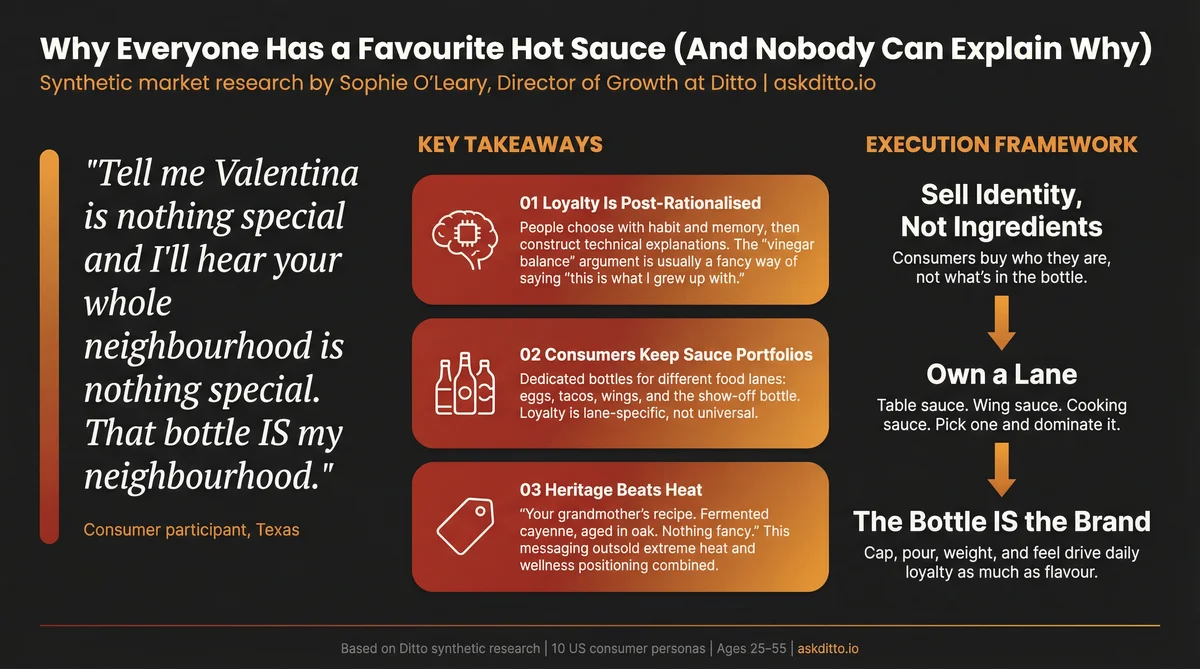
Key insight: Hot sauce loyalty is post-rationalised, not reasoned. People choose with habit and memory, then construct a technical explanation after the fact. The "vinegar balance" argument is usually a fancy way of saying "this is what I grew up with."
The Sriracha Test: How Defensive Do People Get?
I wanted to see if hot sauce preference is something people actually defend, or if it's more casual than that. So I tested it: "Someone says Sriracha is the best hot sauce and it's not even close. What's your gut reaction?"
The results split cleanly into two camps:
The Pragmatists: Shrugged it off. "Everyone's got a lane. Sriracha's fine for what it does." These were typically the chefs and the higher-income professionals: people who keep multiple sauces for different purposes and don't tie their identity to any single one.
The Tribalists: Got genuinely heated. "Sriracha is a gateway sauce at best." "That's a tourist opinion." One participant described feeling "personally affronted" when someone dismissed his preferred brand. These were typically the culturally-rooted consumers: people whose sauce choice connects to family, neighbourhood, or heritage.
"Tell me Valentina is nothing special and I'll hear 'your whole neighbourhood is nothing special.' That bottle IS my neighbourhood." - Jeremy, 28, Warren, MI
Key insight: For a significant subset of consumers, hot sauce is an identity marker, not just a condiment. Criticising someone's hot sauce can feel like criticising their culture, their family, or their taste. Brands that understand this don't just sell flavour. They sell belonging.
The Sauce Portfolio: Different Bottles for Different Jobs
One of the most interesting findings was that most participants don't have one hot sauce. They have a portfolio. Different sauces for different lanes:
The everyday table sauce: Cholula on eggs, Crystal on rice, Valentina on fruit. The workhorse that goes on everything.
The cooking sauce: Something thicker, maybe chipotle or adobo-based, that goes INTO the dish rather than on top.
The wing sauce: Buttery, Frank's-style. Dedicated to wings and pizza. Some participants insisted this is a completely different product category.
The show-off bottle: The artisan habanero-mango from a farmers' market. Comes out for dinner guests and weekend cooking.
The Filipino participant described something even more specific: sawsawan, a thin vinegar-based condiment whose entire purpose is to reset the palate and preserve the texture of the dish. "Mainstream red-bottle sauces change the food. Sawsawan supports it."
Key insight: Hot sauce loyalty often applies to a specific use case, not to "hot sauce" generically. A person who's fiercely loyal to Cholula on eggs might happily use Frank's on wings. Brand loyalty in this category is lane-specific.
The Blind Taste Test Nobody Trusts
Can you actually pick your favourite hot sauce out of a blind lineup?
Most participants said maybe, but with caveats. On a spoon? Probably not. But on their food? Maybe. The chefs were most confident, pointing to specific pepper notes and vinegar profiles they claim to recognise. The casual users were more honest: "I think I could, but I wouldn't bet money on it."
But the really interesting question was the follow-up: if your favourite turned out to be a $2 store brand, would you switch?
Almost nobody said yes. Even facing proof that the taste is identical, participants found reasons to stick with their original: "It's not just about the sauce on a spoon, it's about how it works on my food." "The bottle matters. The pour matters." "I've been buying it for 15 years, I'm not switching because of a trick."
"A blind spoon test means nothing. Put it on my Tuesday night tacos and let me live with it for a week. Then we'll talk." - Sadie, 35, St. Augustine, FL
Key insight: Hot sauce loyalty is remarkably resistant to rational evidence. Even when people know they can't distinguish their favourite in a blind test, they won't switch. The loyalty lives in the ritual, the bottle, the memory, not in the molecule.
Three Pitches: Extreme Heat, Grandma's Recipe, and Wellness
I tested three brand positionings:
Brand A: "Handcrafted. Carolina Reaper and mango habanero. For serious heat seekers. 500,000 Scoville units."
Brand B: "Your grandmother's recipe. Fermented cayenne, aged in oak. Nothing fancy, just decades of practice."
Brand C: "Hot sauce reimagined. Probiotic-infused, organic, sugar-free, keto-friendly. The healthy way to add heat."
Brand B won clearly. The nostalgia pitch landed hard. "Your grandmother's recipe" triggered exactly the emotional wiring that drives real hot sauce loyalty: heritage, simplicity, trust. "Fermented" and "aged in oak" signalled craft without pretension. "Nothing fancy" was, paradoxically, the fanciest thing you could say.
Brand A attracted a small, vocal minority of heat seekers who saw Scoville numbers as a badge. But most participants dismissed it: "500,000 Scoville units is a dare, not a condiment."
Brand C was universally rejected. "Probiotic hot sauce" was the point where every participant drew the line. Keto-friendly? Sugar-free? These are not attributes anyone associates with hot sauce. The wellness language felt like a cynical graft onto a product that doesn't need fixing.
"The second I see 'keto-friendly' on a hot sauce bottle, I know it was designed by a marketing team, not a cook." - Leslie, 38, Miami, FL
Key insight: Hot sauce consumers reward authenticity and heritage over innovation. The winning pitch doesn't disrupt. It evokes. And wellness-washing a condiment that people love because it's a little bit bad for you is a strategic miscalculation.
If Your Favourite Disappeared Tomorrow
The final question was designed to test the depth of loyalty: if your go-to brand vanished, how would you feel?
The range of responses told the whole story:
The Pragmatists: "Mildly annoyed. I'd find something close within a week." These consumers use hot sauce as a tool. The tool is replaceable.
The Sentimentalists: "It would be like losing a kitchen friend." One participant described the bottle as "part of the landscape of my fridge." Another said it would feel like "the restaurant in your neighbourhood closing."
The DIY Crowd: "I'd try to reverse-engineer it." A surprising number said they'd attempt to recreate the sauce at home, treating it as a puzzle worth solving.
What nobody said was "I'd just move on without replacing it." Hot sauce, it turns out, is not optional. The slot in the fridge door will be filled. The question is by whom.
Key insight: Hot sauce occupies a unique position in the condiment hierarchy: it's both deeply personal and entirely replaceable. People are loyal to the ritual more than the brand. If you disappear from the shelf, someone else fills the slot within days.
What This Means for Hot Sauce Brands
You're selling identity, not ingredients. The brands that win long-term are the ones that become part of someone's kitchen identity. Heritage, family, place, culture: these are your moat. Not Scoville counts.
Own a lane, not the whole table. Consumers keep portfolios. Don't try to be the sauce for everything. Be the undisputed champion of eggs, or tacos, or wings. Lane dominance beats broad positioning.
The bottle is the brand. Dispense mechanics, cap reliability, the weight in the hand: these physical attributes influence daily loyalty as much as flavour does. A leaky cap can kill a 15-year relationship.
Don't wellness-wash. Probiotic, keto-friendly, sugar-free hot sauce is a product nobody asked for. Hot sauce consumers love it partly because it's simple, honest, and a little indulgent. Adding health claims strips the soul out of the product.
Nostalgia is your strongest weapon. "Your grandmother's recipe" outsold extreme heat and health innovation combined. In a category where loyalty is built on memory, the most powerful thing you can do is remind people of where their loyalty started.
The Bottom Line
Hot sauce loyalty is one of the most irrational, durable, and identity-driven brand attachments in the entire grocery store. People can't pick their favourite in a blind test, they can't explain why they prefer it, and they won't switch even when confronted with evidence that a cheaper option tastes the same. The loyalty isn't about flavour. It's about what the bottle represents: family, culture, habit, and a small daily assertion that this is mine.
If you're building a hot sauce brand, stop trying to win on taste. Win on meaning.
Want to test your own product positioning with real consumer reactions? Ditto lets you run studies like this in hours, not weeks.
What the Research Revealed
We asked 10 American consumers to share their honest thoughts about hot sauce loyalty, identity, and the brands that live in their fridges. Here's what they told us:
What is your go-to hot sauce and WHY is it your favourite? Explain without just saying 'I like the taste.'
Antonio Lu, 53, Logistics Coordinator, Jacksonville, FL, USA:
No, not the trendy red squeeze bottle. The one that lives in my fridge door is a Filipino spiced cane vinegar with siling labuyo, garlic, and peppercorns. That is my north star. - Heat: Sharp 4 out of 10. Quick jab, then it gets out of the way. I do not want a sauce hanging around like a bad meeting. - Acid: Cane vinegar hits bright but rounded. Not that harsh white-vinegar bite. It cuts fat clean and resets your palate so the next bite tastes like the first. - Thickness: Water-thin. It wicks into fried crust and does not turn anything soggy-sweet. If I want syrup, I will eat pancakes. - Aroma: Real garlic and peppercorns. No fake smoke, no perfume. It smells like a kitchen, not a campfire accident. - Color: Pale straw with tiny red flecks. Looks honest. Nothing neon to prove. - Bottle: Flip-top that drizzles. Lives in the door next to the eggs. Zero drama, all uptime. - Memory: Sawsawan bowls on a plastic table in Laguna, my tito crushing chilies with a spoon. Lumpia disappearing faster than chismis. If I had to defend it to someone married to a thick, smoky, or candy-sweet brand, I would say this: your sauce jumps in the driver seat and hijacks the route. Mine rides shotgun, clears the lane, keeps the food on-time. It amplifies pork, fish, chicken, even pizza crust, without repainting it in sugar and ego. If you want pain, chew a battery. I want lunch that stays crisp, wakes up my mouth, and makes me reach for a second piece without feeling like I licked a campfire. That is why this vinegar-chili mix wins my fridge, every time.
Jeremy Arriaga, 35, Operations Specialist, Miami, FL, USA:
Valentina Negra. Siempre. It lives in the fridge door like the milk, bro. If it’s not there, me pongo nervioso. - Heat: Medium that stacks. I can hit eggs twice and it builds, pero it doesn’t wreck my mouth. The Extra Hot is just right for wings. - Vinegar: Low. Not that sharp pickle vibe. My arroz y frijoles still taste like food, not like salad dressing. - Thickness: It grabs the food. Sticks to yuca frita, pan con bistec, arepas. No red water on the plate. - Flavor: Chili-forward, a little smoky. You taste pepper, not just acid and salt. - Color: Dark red that looks legit, not neon. Makes everything look crave-y. - Bottle: Big cheap bottle at Sedano’s, flip cap, no clog drama. I squeeze, I’m done. It lasts. - Memories: Pickup soccer, late-night tacos, beach at Crandon with chips y mango. My boy put me on, and it stuck. If someone rides for another brand, cool, pero here’s my line: yours slides off and tastes like straight vinegar. Mine coats, keeps the food’s flavor, and I control the burn. So you want heat you can actually eat, or you want spicy soup on your plate?
Vanessa May, 47, Healthcare Administrator, Rural, VA, USA:
Bottom line: I keep a thin, vinegar-forward cayenne hot sauce in the fridge. Big bottle, flip-top, lives in the door. Not fancy. Reliable. Why it wins for me: - Heat level: Medium and clean. It wakes things up without nuking my tastebuds or scaring the kids. Heat shows up, then gets out of the way. - Vinegar bite: Bright enough to cut through eggs, beans, greens, and anything fatty. It’s basically edible citric acid with manners. - Thickness: Thin by design. It seeps into rice and chicken instead of sitting on top like ketchup in a Halloween costume. - Salt and tang: Salty enough to finish a dish when I’m not dragging the shaker to the table. No sugar weirdness, no smoke bomb. - Color: Honest brick red, not neon. Looks like peppers, not a lab experiment. - Bottle: Flip cap drips, not dumps. Doesn’t crust shut. Survives the fridge door slam after a long day when I’m hangry and the dog’s pacing. - Everyday fit: Works on eggs, collards, lentils, leftover rotisserie, tuna with mayo, even a lazy vinaigrette. I can whisk it with olive oil and be done in 30 seconds. - Availability: I can grab it at the regional grocery or Costco. Cheap, predictable, no hunting. - Memory: First apartment beans-and-rice budget meal. Still tastes like competence in a bottle. Also what my dad splashed on greens at Sunday supper. If someone swears by their thick, sweet, or smoky bottle, here’s what I’d actually say: - Different job: Your sauce is a mood piece. Great for wings or a single dish. Mine is the wrench I use daily. - No sugar coats: I don’t want dessert on my eggs. I want acidity and heat, not a syrupy glaze. - Signal over noise: Fruity-habanero and chipotle have places, but they hijack the whole plate. This one lifts food instead of announcing itself on a bullhorn. - Repeatable: I cook in batches. I need the same result on Tuesday at 8 pm that I got last Sunday. Novelty gets old. Reliability doesn’t. So no, I’m not chasing the latest mango-ghost gimmick. I’ll take the straightforward cayenne-vinegar workhorse that actually plays nice with dinner and doesn’t stain my sanity.
Tracy Mcfarlin, 45, Hair Stylist, Jacksonville, FL, USA:
The bottle that lives in my fridge, ride or die, is a St. Augustine datil pepper hot sauce from a small local maker. If I had to defend it: - Heat curve: medium and bright. It pops, builds for a few beats, then gets out of the way. No lingering capsaicin throb that bulldozes everything for the next 20 minutes. - Acidity: there’s vinegar, but it’s rounded, not pickly. It lifts eggs and seafood without making them taste like a jar of brine. - Sweetness: the pepper itself has a light natural sweetness that reads sunny, not sugary. It plays nice with shrimp, black beans, and avocado. - Texture: true medium body. It clings to a breakfast sandwich and tacos, but it is not gloopy. No soggy toast, no red puddles. - Aroma and color: fruity nose, zero smoke. The color is golden-amber, so it makes food look appetizing instead of muddy. - Bottle logistics: woozy bottle with a restrictor so I do not drown my plate, fits in the fridge door, label does not slough off with condensation. Yes, I notice that stuff. - Memories: day trips to St. Augustine with the kids - the fort, Minorcan chowder, grabbing a fresh bottle at a market stand. It tastes like our weekends. That matters. If someone swears by their favorite and wants to argue, fine. Here is what I’d say: - Thin Louisiana-style: great for gumbo, but too sharp and watery for my egg sandwiches. I am not into vinegar soup on bread. - Thick table salsa style: good on chips, but the cumin-garlic thing steamrolls fish. I want pepper-first, not spice-rack-first. - Buffalo-forward: that belongs on wings. I do not want my breakfast or Cuban sandwich tasting like a sports bar. - Heat-chaser bottles: if your goal is to sweat through a T-shirt, congrats. I am trying to feed kids and still taste my shrimp. Bottom line: I pick it because it makes Florida food taste more like itself. If I could only keep one bottle for a month, it would be that datil sauce, every time. You can keep the chest-beating ghost pepper stuff. I do not need to prove anything at breakfast.
Justin Garcia, 29, Full-Time Family Caregiver, Warren, MI, USA:
Valentina Black Label. The extra hot one. It sits in the door next to the Gatorade Zero and it gets used 5 to 6 days a week. - Heat: Medium-high that builds, not a sharp sting. I can hit eggs and chicken bowls and still taste food. - Vinegar: Low. It tastes like dried chiles first, not vinegar first, so it does not fight beans, rice, or steak. - Thickness: It sticks. It does not run off tacos or soak bread. Good on wings and pizza too. - Salt: Balanced. I do not need to salt after. Saves 10 to 20 seconds and one step. - Color: Dark red, looks like real chile, not neon. It makes food look better in pics. - Bottle: Big plastic, wide cap, no clog. I can squeeze fast with one hand while holding Mateo with the other. - Price: Big bottle is about $2.79 at Meijer or the tienda, lasts me 6 to 8 weeks. Zero drama, no tiny glass bottle for $6. - Memory: Fruit with Valentina and limón after church, chips at my tia’s. It just feels right on snacks. If you swear by something else, cool, but here is my take: - Cholula tastes fine but it is mild and costs too much for the size. I am not paying extra for a wood cap. - Tapatío is decent on pizza, but it is thinner and slides off eggs. - Tabasco tastes like straight vinegar and water. Good for oysters, not tacos. - El Yucateco hits hard on carne asada night, but it kills a bowl and my kid taps out fast. - Sriracha is for noodles and fried rice. It fights cilantro and onion on a street taco. So yeah, Valentina Black Label wins on heat that works, low vinegar, thick pour, and under $3 for a month and a half. That is my line.
Will Christopher, 31, Maintenance Technician, Rural, IN, USA:
The everyday bottle in our fridge is the classic cayenne wing sauce, the one you make buffalo dip with. Yeah, that one. - Heat: Middle of the road so you can actually taste dinner. I can lay it on eggs or pulled chicken and not blow out my tongue. The kids can handle a dot, which matters on weekday chaos nights. - Vinegar: Bright but not sharp. It wakes food up without that nose-stinging lab smell some thin stuff has. - Thickness: Just sticky enough to cling. Toss it with a knob of butter and it turns into real sauce that coats wings and doesn’t slide off pizza. - Salt: It seasons while it heats, which is handy on cheap eggs, leftover chicken, or a sad turkey sandwich at 2 a.m. on night shift. - Color: That proper orange-red that screams buffalo. Looks right on mac and cheese and doesn’t make the plate muddy. - Bottle: Big plastic, wide mouth, no drama. Lives in the door, doesn’t clog, and I can buy the big boy for not much cash. - Memories: Sunday football wings with my dad and now my boy stealing the drumettes. It just tastes like game day at home. If someone swears by a different brand, I’d say this: if you want a sharp vinegar spike, go thin and fancy, knock yourself out. If you want taco-stand warmth, grab the wooden-cap stuff. I want straight-up buffalo that plays nice with ranch, mixes with butter in 30 seconds, and doesn’t hijack the whole meal. It does the job every time, and I’m here to eat, not do a heat stunt. At least that’s been my experience.
Jessica Ocasio, 42, Risk Manager, Cleveland, OH, USA:
Valentina, the regular yellow-label bottle. It stays because it hits a daily-driver baseline without drama. On cold, gray mornings like this, I need predictable, not a stunt. - Heat level: medium, stable. I can stack a few shakes and not cross my pain threshold. No mouth-numbing aftertaste that ruins coffee. - Acid: low vinegar. I do not want my kitchen to smell like cleaner. It supports eggs and arepas instead of taking over. - Texture: mid-weight. It clings to arepas and roasted potatoes, not a watery puddle, not a paste. - Salt-sweet balance: neutral. I do not have to recalibrate beans or lentils after adding it. - Cost-size logic: big bottle, low price. I use it freely and stop thinking about rationing. - Use cases: eggs, arepas, tacos, lentils. One bottle covers 80% of scenarios. If I had to defend it: Louisiana styles are fine for oysters, but on breakfast they read as vinegar first, food second. The fancy wooden-cap one tastes good, but I am not paying a premium for packaging when the effect is similar. Sriracha is a different product class - sweet-garlic - great for noodles, wrong for arepas. And the ultra-hots feel like capsaicin cosplay; I need control and repeatability, not a dare. Does that make sense?
Sadie Henderson, 39, Chef, Rural, GA, USA:
Texas Pete. That’s my ride-or-die in the fridge door, and no, I’m not switching. Here’s why, not just “I like it”: - Heat level: warm, not macho. It wakes up eggs and greens without turning breakfast into a dare. - Vinegar-salt balance: bright enough to cut through butter and yolk, but not so sour it bites your tongue like some others. - Body: thin and quick. It slides into grits and beans so the whole bowl gets touched, not clumped up like ketchup-thick sauces. - Pour control: small spout, tap-tap, done. I don’t drown my biscuit by accident, and I can hit that last bite of catfish just right. - Color: real red, not neon orange. It kisses food, doesn’t paint it. - Everyday price: big bottle at Dollar General, grabs easy on a Thursday after work when I’m tired and counting singles. - Memory: my uncle at the fish fry flicking it over hot fried perch, and me copying him on a paper plate. Also the regular at my cafe who says “two dashes” on his country potatoes - this hits that note. If somebody swears by their brand, I’d say: - To the sharp-vinegar folks: yours is fine in a Bloody Mary. On eggs, it’s loud and sour. I’m eating, not puckering. - To the thick, chili-heavy crowd: great on tacos. In grits, it muddies the bowl and sits like paste. - To the sweet-garlic crew: good for wings. Not at 6 a.m. with buttered toast and a fried egg. - To the heat chasers: if you need a sauce that screams to feel something, cool. I want balance so I can finish my plate. It’s simple, steady, and it plays nice with Southern breakfast and a Friday fish plate. That’s what works for me.
Leslie Alvarez, 30, Customer Success Manager, Newark, NJ, USA:
The one living in my fridge door is a thick, chili-forward Mexican-style hot sauce in a big flip-top bottle. Not the runny, sharp-vinegar type. I keep it because it performs the same every single time, across breakfasts and sheet-pan dinners. - Heat: medium, stackable. I can do 10–15 shakes on eggs and still taste the eggs. - Acid: low vinegar. It boosts, it does not hijack the dish. - Body: thicker, so it clings to potatoes, fajitas, and air-fryer chicken. No red puddles. - Flavor profile: dried chili first, clean finish, no weird sweetness, no fake smoke. - Color: deep red-orange that looks right on tacos and breakfast, not neon. - Bottle: big plastic, flip-top, controlled flow, minimal cap crust. Lives in the door without leaks. - Stability: does not separate into watery top layer. Zero shake theatrics. - Versatility: eggs, tuna bowls, fries, pizza crust dip, quick mayo mix for a sandwich spread. - Availability: easy to find around NJ. No panic when I run low. - Cost-per-use: large bottle under 3 bucks, lasts about a month with daily use. Call it a few cents per meal. - Memory hook: we ran it hard on a spontaneous cabin weekend with friends. Breakfasts were simple and it just worked. If someone swears by a different brand, I’d say this: I want low vinegar, medium heat, thick cling, big bottle, clean finish, consistent batch to batch, and a sub-$3 price point. Match that, then we can compare. Tradeoff: it is not super bright or smoky, which I do not need Monday through Friday.
Tina Jarrell, 54, Associate Dean for Academic Affairs, Alhambra, CA, USA:
Cholula Original. Non-negotiable. - Heat: Medium. I can use a real pour, not three timid drops. It lifts eggs, beans, salmon bowls without nuking my palate. - Vinegar: Present but restrained. It does not hijack the dish the way the sharper stuff does. - Thickness: Actual body. It clings to roasted veg and avocado, not a red puddle running to the plate edge. - Salt read: Balanced. It doesn’t make a seasoned bowl suddenly taste like brine. - Bottle control: Glass with a restrictor. Clean dosing, no sticky nozzle, recyclable. I value not scrubbing caps at 6 a.m. - Reliability: Always on the shelf. After the sriracha shortage mess, I default to what is consistently available. - Versatility: Plays nice across cuisines. No garlic bomb, no weird sweetness. It amplifies instead of overwriting. - Visual: Warm red that looks good on eggs and greens. Yes, aesthetics matter a little at breakfast. - Associations: Saturday breakfast burritos and the farmers market tamale stand. Muscle memory pairing. - Unit cost: Reasonable TCO for a daily driver. I don’t want a boutique bottle I ration like perfume. If someone swears by another brand, I’d say this: I want a sauce that boosts flavor, doses predictably, and shows up every time I open the door. Most rivals fail one of those gates - too vinegary, too sweet, or too fussy. This one clears all three. If you need napalm or candy water, enjoy, but I’m eating the food, not the label. What do you put it on most - eggs, tacos, or grain bowls?
Someone says 'Sriracha is the best hot sauce and it's not even close.' What's your gut reaction? And how does it feel when someone dismisses YOUR favourite?
Jeremy Arriaga, 35, Operations Specialist, Miami, FL, USA:
Gut reaction? Disagree. Sriracha is fine, pero not king. It’s sweet, garlicky, kinda one-note, and it fights my arroz y frijoles. On pho or noodles, cool. On wings or yuca, nah. So it’s the best? For what? On what? If someone calls my sauce “nothing special,” I feel a little hit in the chest, bro, not gonna lie. Then I breathe and say, taste the food first. Mine coats, keeps the flavor, and I can stack the heat without turning the plate into soup. If you still don’t vibe, dale, eat your thing. People get defensive, for sure. Hot sauce is like team colors and family table vibes. It’s your abuela’s plate, your late-night tacos, your hangover eggs. You’re not just knocking a bottle. You’re poking someone’s memories.
Will Christopher, 31, Maintenance Technician, Rural, IN, USA:
Gut reaction to that Sriracha brag? Hard no. It’s fine on noodles or mixed in mayo, but “not even close” is goofy. Different food, different sauce. My game-day wings and breakfast eggs want buffalo heat and butter, not sweet garlic and a squeeze bottle. If someone calls my go-to “nothing special,” I kinda smile. That’s the point. It shows up, seasons the food, and doesn’t hijack dinner. Call it basic while I keep eating. Works for Sunday wings with my dad and my boy, and it still works at 2 a.m. on a sad shift sandwich. Do people get defensive about hot sauce? Yeah, like trucks, grills, and lawn mowers. Little bottle, big ego. I’ll argue a minute, then pass the plate. At least that’s been my experience.
Vanessa May, 47, Healthcare Administrator, Rural, VA, USA:
Gut reaction: Nope. Not even close. Sriracha is fine for what it is, but it’s a thick, garlicky, slightly sweet sauce that sits on top of food and shouts. My daily driver is thin and vinegar-forward. Different job. Where Sriracha works vs where it annoys me: - Wins: Pho, noodle bowls, mayo dips, burgers when I want garlic heat and a little body. - Loses: Eggs, beans and rice, greens, grilled fish. Too sweet-thick. I want acid that seeps in, not a red sweater on top. Also that nozzle clogs and crusts. Hard pass. Flip it: someone calls my go-to “nothing special.” - Honestly, that’s the point. It’s a wrench, not a showpiece. Clean heat, bright acid, repeatable. I don’t need a personality cult in a bottle on a Tuesday night. Do people get defensive about hot sauce? - Yes, weirdly. It’s food-tribe identity, nostalgia, and control in a tiny bottle. Folks learned to love a certain heat curve with certain meals and now it’s their flag. - Me? I’ll die on exactly one hill: no sugar on my eggs. Everything else is context. Use the tool that fits the plate.
Justin Garcia, 29, Full-Time Family Caregiver, Warren, MI, USA:
Gut reaction: No, not even close. Sriracha is for noodles and fried rice. It is sweet, garlicky, and thin, and it fights cilantro and onion on tacos. You love it, cool, use it. I am not putting that on carne asada. If someone calls my Valentina “nothing special,” I shrug. I still buy the $2.79 big bottle and use it 5 to 6 days a week. It is thick, low vinegar, and it sticks to eggs, wings, and pizza. It does the job and I do not overpay. Do people get defensive? Yeah, because it is what they ate growing up and who they eat with, so they treat it like a team. I am not pressed. Hot sauce is a tool. Heat, flavor, price, pour. If it works, it stays in my fridge. If not, pass it down the table.
Sadie Henderson, 39, Chef, Rural, GA, USA:
Gut reaction? No. Sriracha’s fine for noodles or a squirt in mayo on a chicken sandwich, but calling it the best-not-close sounds loud to me. It’s thick, sweet-garlicky, and it takes over the plate - that’s not what I want on eggs, grits, or greens. If you call my hot sauce “nothing special,” I’d smile, slide the bottle back to my side, and keep eating. It’s supposed to be simple and quick, not some personality test. Folks do get weirdly defensive about hot sauce, though - same energy as barbecue or sweet tea. I see grown folks at my cafe swear their brand is the only way, then still clean their plate with the other one when that’s what’s on the table. Like what you like, but don’t act brand-new about it. That’s what works for me.
Jessica Ocasio, 42, Risk Manager, Cleveland, OH, USA:
Disagree. Sriracha is a different product class in my head. Good in its lane, not a universal best. At a dinner table I would not argue it. I would just reframe it as use-case fit, not a ranking. - If noodles or stir-fry: Sriracha makes sense. The sweet-garlic profile matches. - If eggs, arepas, beans: It skews sweet and drags the plate. I need low vinegar, medium heat, steady salt. - If I have coffee after: I avoid sauces with lingering garlic-sugar. It collides. If someone says my hot sauce is "nothing special," that lands as accurate. That is the value proposition. Baseline, predictable, covers breakfast to lentils without recalibration. I do not need special at 7 a.m. on a cold Cleveland morning. I need control. Do people get defensive about hot sauce? Yes, often. It is brand loyalty, nostalgia, and pain tolerance all mixed. I treat it like a tool selection problem. Wrong tool for the job is the only thing that triggers me, not the label. Does that make sense?
Leslie Alvarez, 30, Customer Success Manager, Newark, NJ, USA:
Short answer: disagree. Sriracha is fine, but "not even close" is lazy. I keep a bottle in the fridge for noodles and sandwiches. It falls flat on eggs and tacos, and the sugar-garlic profile gets samey fast. Also the price creep and clogged nozzle annoy me. If someone calls my favorite "nothing special," I shrug. Sauce is a tool. I buy by use case, not identity. People do get defensive, but it reads like brand tribalism, not taste. I am not debating condiments at a dinner table. My quick audit: - Sriracha - sweet-garlic, mid heat, good on noodles and leftovers, cost per ounce trending high. - Vinegar-forward red - cheap per ounce, reliable on eggs and tacos, clean pour. - Green jalapeño or tomatillo - bright, low-medium heat, ideal for fajitas or chicken. - Habanero - small hits, real heat, I grab it when I want a kick, especially if I vaped a little. It’s mild out today, so fajitas later. That gets green sauce, not Sriracha.
Tracy Mcfarlin, 45, Hair Stylist, Jacksonville, FL, USA:
Gut reaction to “Sriracha is the best and it’s not even close”: No. My eyebrow goes up. I like it in its lane - noodles, a little in mayo, late-night fries - but it is too sweet-garlicky and flat-acid for my eggs, shrimp, or a Cuban. It blankets. I want lift, then exit. My datil sauce does that. Florida food tastes more like itself, not like one big red note. Flip it. Someone calls my favorite “nothing special”: I’d smile and pass it back, but yeah, it lands a little. That bottle is St. Augustine Saturdays with my kids, market runs, beach air. You are not just dunking on a condiment. You are poking a memory. I am not arguing at the table though. I will just enjoy my plate and let your tongue chase whatever it chases. Do people get defensive about hot sauce? Absolutely. - It is routine plus identity. What lives in your fridge becomes a hill. - Heat is performative for some people, comfort for others. - Bold declarations read like “your taste is wrong,” which makes folks dig in. I am not precious about it, but do not tell me one bottle wins at everything. Eat what you like. Just do not drown my sandwich in that chili-garlic squeeze and call it balance. I am not trying to prove anything at breakfast.
Antonio Lu, 53, Logistics Coordinator, Jacksonville, FL, USA:
Gut reaction? No. Sriracha is fine in a pinch, but best and not even close? Come on. It’s thick, a little sugary, and it repaints the food. Good on eggs, sure, but on fried stuff it gums up the crust. I want a sauce that clears the lane and lets the bite land crisp - my spiced cane vinegar does that. If someone calls my vinegar nothing special, it hits a nerve for half a second - like you just called my tito’s sawsawan basic. Then I shrug and keep dipping. It is not a flex sauce. It’s a tool that makes pork, fish, lumpia snap. If you don’t taste it, sayang, more for me. Do people get defensive about hot sauce? Yeah, because it’s not just heat, it’s identity and control: - Memory: You’re defending your table at home, not the bottle. - Style: Driver vs. passenger. Some want the sauce to lead, I want it to assist. - Ritual: The squeeze or the drizzle is muscle memory. Mess with that, folks bristle. - Ego: The heat scoreboard turns into a weird contest fast. Susmaryosep. So no, I don’t agree. Keep your red squeeze bottle. I’ll keep my vinegar riding shotgun, keeping the route clean and on-time.
Tina Jarrell, 54, Associate Dean for Academic Affairs, Alhambra, CA, USA:
Bottom line: I disagree. “Not even close” is lazy. Hot sauce is use-case specific. - Gut reaction: eye roll. Sriracha is fine for a sweet-garlic hit, but it’s light on heat and has felt inconsistent since the pepper supply mess. I use it on eggs in a pinch, not as a default. - Do I feel attacked? No. I feel bored by absolutism at the table. - Flip side: if someone calls my go-to nothing special, I shrug. For tacos I grab a vinegar-forward Mexican red. For noodles or grain bowls, chili crisp. For fish, yuzu kosho or sambal. Different jobs, different bottle. - Do people get defensive? Yes. Brand loyalty plus taste-as-identity. Cheap way to signal “I have a palate.” I opt out. Not worth the airtime.
Walk me through how you actually USE hot sauce in a typical week. Different sauces for different foods? Have you ever put it on something that was a terrible idea?
Will Christopher, 31, Maintenance Technician, Rural, IN, USA:
Cut to the chase: I don’t drown everything in it, but it shows up 4 or 5 days a week. Different bottles for different jobs, and the buffalo wing stuff does most of the heavy lifting. - Morning: Scrambled eggs get a couple lines of buffalo. Breakfast burrito day, same deal. If it’s a cold, wet week like this, I’ll hit instant ramen with a spoon of it so it tastes like food and not hot dishwater. - Work lunch: Leftover chicken and rice, splash of buffalo. Sad turkey sandwich at 2 a.m. on nights, a quick zigzag so it doesn’t taste like fridge air. If I’ve got cup noodles, I’ll add the wooden-cap taco heat instead. Different vibe. - Dinners: Taco night gets the wooden-cap red on the table, buffalo stays in the door. Jarred pasta sauce gets 3 or 4 dashes of buffalo while it simmers so it wakes up a bit. Sheet-pan chicken, I’ll stir a spoon of buffalo into ranch for a dip so the kids can try it without crying. - Weekend: Wings get the real treatment - buffalo plus a knob of butter in a pan till it shines. Pizza leftovers get a drizzle. Mac and cheese gets a swirl when it’s mine, not the kids’. Chili day I reach for smoky chipotle, not buffalo. - Cooking vs after: Both. I mix it in when I want it built into the bite, and I finish with it when I just want the top note. If it ain’t broke, don’t fix it. Terrible idea confession: I once hit pancakes with buffalo by habit on a Sunday. Reached for the wrong bottle while flipping cakes and thought, eh, maybe sweet-heat works. It did not. Tasted like spicy drywall. Into the trash, made a new batch, took my lumps. Another time I tried a buddy’s habanero on pizza like it was normal buffalo and basically couldn’t taste the fourth quarter. At least that’s been my experience.
Justin Garcia, 29, Full-Time Family Caregiver, Warren, MI, USA:
No, it is not on everything. I use it 5 to 6 days a week, but only where it makes sense. Valentina Black Label is the default. I do 2 to 3 squeezes, like 1 tablespoon, after I plate so Mateo’s food stays mild. - Breakfast: Eggs or papas con huevo get Valentina. Tortilla on the side. No sauce on yogurt or oats. I am not that guy. - Lunch: Chicken and rice bowls I batch on Sunday. Hit it with Valentina and a squeeze of lime. Done in 10 seconds. - Dinner tacos: If it is taquería night, I use their roja or verde. At home, I use Valentina on my plate. For carne asada I keep El Yucateco for me only, small hits, not for the kid. - Wings: Air fryer, then toss in melted butter, Valentina, and lime. Fast, sticks, no mess. - Pizza: Valentina or a Tapatío packet if I am out. It stops the slice from tasting flat. - Soups on cold days like today: Caldo de pollo, two lines of Valentina and lime. Warms up fast. - Snacks: Mango, cucumber, or chips with Valentina and limón. That is automatic. - Noodles or fried rice: Sriracha only. Valentina stays off Asian stuff. Cooking vs after: 90% after. I plate first so Mateo eats. I only cook with it on wings or when I reduce it quick with butter for a glaze. Do I have different bottles? Yes. Valentina Black Label daily. El Yucateco when I grill and want heat. Sriracha lives by the stove for noodles. A few Tapatío packets ride in the glove box for emergency pizza or gas station burritos. Terrible idea I did once: I tried to mix Valentina into plain Greek yogurt to make a “dip.” Looked fine, tasted like sour chalk. Trashed it in 30 seconds and ate the chips dry. I do not put hot sauce on desserts, coffee, or oatmeal. Waste of food and time.
Tina Jarrell, 54, Associate Dean for Academic Affairs, Alhambra, CA, USA:
Bottom line: not on everything. It’s a finishing tool about 80% of the time. Different bottles for different jobs. I’m eating the food, not cosplaying a fire drill. - Breakfast - 3 to 4 days: Eggs or tofu scramble get a real pour of my default medium red. Avocado toast gets a light stripe. Cottage cheese with tomatoes gets a few dashes for salt-acid, not heat. - Lunch: Grain bowls and beans get the same default red or a sharper vinegar-forward one if the bowl is rich. Noodle bowls get chili crisp, but sparingly because oil. If I’m stuck with cafeteria noodles, fine, a squeeze of the sweet-garlic stuff to make it edible. - Dinner: Roasted salmon or seared halibut gets yuzu kosho on the side - tiny dab, high payoff. Stir-fries or braises get a spoon of sambal during cooking. Tacos out in the neighborhood - I use the salsa bar, not a bottle from home. - Cooking vs finishing: Mostly finish. I’ll cook with sambal or paste when I want integrated heat. I hit Instant Pot beans at the end with a vinegar-leaning red for brightness. Control matters; I don’t want a one-note pot. - Frequency: Probably 8 to 10 meals a week see heat. Off-limits: good sashimi, delicate soups like miso, anything dairy-forward where the vinegar will curdle the vibe. - Edge cases: Roasted veg loves a medium red because it clings. Salmon bowls like a half-and-half mix of default red plus a touch of mayo or yogurt - fast sauce, stable texture. - Bad idea I regret: I once put chili crisp on mango sorbet. Oil on ice-cold fruit? Slick, numbing, and wrong. Objective failure. Never again. If a dish already has balance, I leave it alone. Hot sauce is a tool, not a personality quiz. Are you cooking yours in, or only using it as a finisher?
Jeremy Arriaga, 35, Operations Specialist, Miami, FL, USA:
Not on everything. Relax. I use it like a tool, not paint. How I run it in a week: - Breakfast: Weekdays I skip or do toast. No sauce. Weekend eggs get Valentina Negra, two hits. On arepa with queso, light line. That’s it. - Lunch: Leftovers at work. Arroz y frijoles gets 3 taps, mix, taste, then maybe 1 more. On roast chicken, a little on the bite, not the whole plate. Picadillo - almost none. I don’t fight the sofrito. - Dinner: Yuca frita - coat, sit 30 seconds so it sticks. Tacos - generous. Grilled fish - tiny drizzle after, plus limón. Wings night - I toss with the Extra Hot and a splash of oil so it hugs. - Snacks: Chips with Valentina and lime. If it’s crazy hot outside like today, I go lighter or I sweat like a fool. - Soups: Two drops in black beans or sancocho, stir, done. No red water on my spoon. - Sandwiches: Pan con bistec - thin stripe under the papitas. If it slides, I get mad. Different bottles, different jobs: - Main: Valentina Negra - daily driver. - Backup: Little habanero bottle for taco night only. It’s mean. I respect it. - Green: Aji verde from the arepa spot for empanadas and rotisserie chicken. - Sriracha: Only on noodles or fried rice. Nowhere near my frijoles. Cook with it or after? - Mostly after. I want to taste the food first. - Sometimes I mix it in: quick wing toss, or a spoon into mayo for fries. Easy dip, no drama. Worst ideas I did anyway? - Pastelito de guayaba y queso with Valentina. Terrible. Sticky, weird sweet-spicy, my wife just stared at me like, “por qué eres así?” I ate it out of shame. - Once hit tuna salad way too hard before a meeting. Hiccups, forehead sweat, tie stuck to my neck. Bad look. So yeah - not on everything. It rides shotgun. The food drives.
Jessica Ocasio, 42, Risk Manager, Cleveland, OH, USA:
Short answer: not on everything. I run it like a tool with defined slots. The yellow-label bottle lives in the fridge door and comes out 5-6 times a week, more on gray, cold mornings. - Breakfast: eggs on arepas get 3-4 shakes; roasted potatoes get a light toss while hot; avocado gets a single stripe. Never on oatmeal, yogurt, or fruit. Coffee follows, so low vinegar matters. - Lunch meal-prep: lentils/beans - I sauce per-portion, not in the pot, so salt and heat stay controllable across the week. Rice-bowl chicken gets a drizzle at the desk, not before storage. - Dinner: tacos and quesadillas - yes; roasted veg - yes, small pass right before plate-out. Fish - usually no; if anything, a mild green salsa instead of the red bottle. - Cook-in vs finish: 80% finish. 20% quick glaze in a skillet with lime for chicken. I avoid pressure-cooking it - heat flattens the flavor and the steam stinks up the kitchen. - Inventory: baseline red for most things; a tomatillo-green for lighter proteins; a smoky chipotle element for marinades or mayo. A sweet-garlic bottle sits there for noodles only. That is it. - Process control: test on a spoon first, then 3-4 shakes baseline. Paper towel under the plate to avoid orange stains on the counter. I do not drown food - that reads as palate fatigue. Bad idea I did anyway: I once put the red stuff into the Instant Pot with lentils. The whole batch went flat-bitter, the silicone ring smelled like cleaner for a week, and I had five sad lunches. Second place: folded it into Caesar dressing for meal-prep - turned it into orange sludge and nuked the greens by day two. Learned: add at serve, not in the batch. Does that make sense?
Sadie Henderson, 39, Chef, Rural, GA, USA:
Short answer: No, it is not on everything. It lives on the table, not in my pocket. Here is how a normal week goes: - Breakfast: two taps on scrambled eggs, sometimes a light swirl into grits. If I do avocado toast, I skip it. Coffee and vinegar heat do not mix, so I keep it calm early. - Work lunch: leftover beans and rice or a turkey wrap gets a streak inside so it spreads even. Country potatoes at the cafe get a tap-tap, same as my regular who says “two dashes.” - Greens night: collards or mustard greens get a shake at the table. If the pot liquor tastes flat, I splash a little in the pan right at the end, not while it cooks the whole time. - Fish Friday: fried catfish or a tuna melt gets a kiss of heat. I might dot it into tartar or mayo so it does not shout. - Chicken: if I bake thighs, I brush a little mixed with oil and honey in the last few minutes. It sticks and shines without burning. - Snacks: I stir a drop into ketchup for oven fries. Popcorn gets salt and butter only, no hot sauce. Learned that lesson. Cooking vs after: mostly after. I will cook a bit into pintos or black-eyed peas so the heat feels built-in, but I do not drown the pot. I want to taste the beans first. Different sauces: 90 percent is my one bottle. I keep a small garlicky chili sauce in the pantry for noodle nights, and that is about it. I am not running a tasting room. Terrible idea I tried: I hit a glazed doughnut with hot sauce after a long shift because somebody swore it “slaps.” It tasted like hot vinegar fighting church bake sale sugar. One bite, shook my head, went back to normal food. That is my rhythm. Simple, steady, tap-tap, done. That is what works for me.
Antonio Lu, 53, Logistics Coordinator, Jacksonville, FL, USA:
Short answer: No, I don’t drown everything. My hot sauce is a tool, not a paint roller. The spiced cane vinegar rides shotgun and keeps bites crisp, especially in this warm weather when fatty food can feel heavy. How a normal week runs: - Breakfast: Eggs get a quick drizzle. If it is a silog day, the vinegar goes straight in the sawsawan with a squeeze of calamansi. Never on oatmeal, I am not a monster. - Work lunch: I carry a tiny leakproof bottle in my lunch kit. Leftover adobo or roasted chicken? Dip, not soak. On reheat pizza, I dip the crust so it wakes up without turning the slice into wet cardboard. - Midweek fry-up: Air-fried bangus or pork chops - vinegar with labuyo cuts the fat and keeps the crust talking. If I cook pancit, no hot sauce. That dish already knows where it’s going. - Wings or ribs: I do a light toss at the end with the vinegar to sharpen, not a syrup bath. For guests who want red, I keep one thin Louisiana-style bottle. Still vinegary, still quick. No candy barbecue, please. - Soups and stews: Sinigang, bulalo, tinola - hands off. Those broths are the main event. Maybe a dash in papaitan or paksiw, but only at the table, last minute. - Salads and fish: I fold a spoon of the vinegar into my calamansi vinaigrette. On grilled fish, I drizzle right before serving. Bright, clean, done. Cooking vs after: - Marinade: Small splash in chicken or pork marinades to tighten the flavor. Not too early or it goes mealy. - Finish: I hit the pan at the end to deglaze for a quick dipping sauce. If you cook the vinegar to death, you kill the nose. Last-mile move. Different sauces for different stops on the route: - Spiced cane vinegar: Default. Fried, roasted, grilled. - Green salsa from the taco truck: Tacos only. I respect the lane. - Chili crisp: Noodles or fried rice nights, sparingly. Texture play, not ego. Worst idea I tried? I splashed my vinegar-chili on leftover fettuccine Alfredo after a long shift. Susmaryosep, it split the sauce into a greasy, tangy mess. Tess gave me the look. I ate it anyway because I was hungry and stubborn, but yeah - objectively terrible. Learned my lesson. Hot sauce is a finisher, not a wrecking ball.
Vanessa May, 47, Healthcare Administrator, Rural, VA, USA:
Bottom line: It’s not on everything. I use a thin, vinegar-forward cayenne most days as a finisher, and pull specialty bottles when the dish actually calls for it. Rough split: finish 70%, cook-in 30%. How a typical week looks: - Sunday prep: A few dashes into a pot of black beans while they simmer. Whisk with olive oil and salt for a 30-second vinaigrette that lives in a jar all week. If we’re grilling chicken, I’ll splash some into a lemon-garlic marinade for edge. - Monday: Scrambled eggs and greens get two quick drips. Lunch leftover chicken and quinoa - drizzle to wake it up. Dinner sheet-pan veg and thighs - I finish after roasting so the acid stays bright. - Tuesday - sports night tacos: Smoky stuff belongs here. I’ll use a smoky-chile sauce in the pan with the meat, then the cayenne bottle at the table for me. Kids stick to mild. Fine. - Wednesday: Tuna with mayo and celery - a few drops in the bowl to cut the richness. Salad gets the jarred vinaigrette. If it’s burger night, I’ll allow a garlicky thick sauce or mix a spoon into mayo. It’s one of the few places that makes sense. - Thursday: Lentil soup or chili - I keep the pot classic, then hit my bowl with the vinegar-hot. If it’s fish, I switch to a green sauce - cleaner heat, less sugar, doesn’t bulldoze the fillet. - Friday: Pizza or noodle bowls. Noodles get the thicker, garlicky stuff. Pizza usually gets nothing - I’m not painting a mural on cheese. - Saturday: Brunch eggs and collards - cayenne, always. If we air-fry wings, I melt butter with the vinegar sauce for a fast tangy glaze. No syrupy nonsense. What lives in my fridge: - Daily driver: Thin cayenne-vinegar, big flip-top bottle. - Situational: A green jalapeño-style for fish and bowls, a smoky one for tacos and chili, and a thick garlicky for pho or burger nights. That’s it. No mango-ghost circus. Cook with it or after? - After when I want brightness and control. - During for beans, chili, taco meat, marinades, and wing butter. Terrible ideas I’ve actually done: - Oatmeal. Cinnamon-raisin, half-asleep, muscle memory reached for the bottle. Two drops of salty vinegar on sweet oats - tasted like bad science. I ate three bites out of spite and threw it out. - Delicate grilled salmon with a smoky sauce. Regret. It tasted like campfire fish. Never again. Net-net: It’s a tool, not confetti. Eggs, beans, greens, tuna, tacos - yes. Desserts and delicate fish - no. And no sugar on my eggs, ever.
Tracy Mcfarlin, 45, Hair Stylist, Jacksonville, FL, USA:
Short answer: no, it’s not on everything. It’s a finisher, not a personality test. Here’s my week in practice: - Breakfast - Eggs or a breakfast sandwich get my St. Augustine datil sauce. Three dashes, sometimes four. It lifts, then exits. Never on oatmeal or yogurt because I am not a monster. - Workday lunches - Leftover rice + black beans + avocado gets the datil too. If it’s taco leftovers, I’ll swap to a green jalapeño-tomatillo sauce. I keep a travel bottle in my salon bag, because the break room ketchup is tragic. - Dinners - Shrimp tacos or baked fish on Fridays in Lent: datil with lime on the plate, not cooked in. Sheet-pan chicken nights: usually none, unless I do a quick spicy mayo for the grown-ups. Publix chicken tender sub? Datil, yes, but light so it doesn’t swamp the mustard. - Takeout lanes - Pho or noodle bowls: that’s when Sriracha earns its keep. Fries late after a long shift: Sriracha-mayo. Everything else, I stick with the datil. Different bottles, different lanes: - Datil pepper - default for eggs, seafood, beans, and anything Florida-adjacent. - Thin vinegar style - only for gumbo or collards. Too sharp for sandwiches. - Sriracha - noodles and dipping sauce lane, full stop. - Green salsa - taco nights and breakfast burritos when I want bright without sweet. Do I cook with it? Mostly after, not during. - I’ll whisk a spoon of datil into slaw dressing or spicy mayo. - A few drops in the pan when warming black beans wakes them up. - If I marinate shrimp, it’s brief - lime, garlic, a teaspoon of datil - then off the heat fast so the pepper stays sunny, not bitter. Have I made a terrible hot-sauce choice? Yes. - I once dotted a Cuban with Sriracha out of habit. It fought the mustard and pickles, turned the bread soggy, and tasted like two radios playing at once. Never again. - Bonus stupidity: tried a “reaper” dab on pizza at a block party, then went back to the salon. Hiccups, watery eyes, and I had a grey blend sitting in my chair. I deserved that. Bottom line: I use it a lot, but it’s targeted. Right sauce, right lane, light hand. I want my food to taste more like itself, not like I knocked over a bottle.
Leslie Alvarez, 30, Customer Success Manager, Newark, NJ, USA:
Short answer: not on everything. I run three lanes and pick by use case. Typical week: - Breakfast - eggs get the thick Mexican-style, 10-15 shakes. Avocado toast gets 3-4. Leftover tortilla española gets a light stripe, not soaked. - Lunch - tuna bowl gets a quick mayo mix with the thick sauce. Rotisserie chicken wrap gets green jalapeño or tomatillo. Soups or rice bowls get 4-6 shakes at the table. - Dinner - sheet-pan fajitas get green sauce only. Air-fryer chicken thighs get the thick stuff after cooking, never before. Salmon stays clean with lemon and salt, maybe a tiny habanero dab on the broccoli. Pizza night, I use the thick one as a crust dip. - Weekend - breakfast burrito gets both thick red and a few habanero dots. Fries at the diner, I mix hot sauce into ketchup. If I vaped a little, I reach for habanero on tacos, 2-3 drops max. Cook with it or after: - Finishing: ~70% of the time. - Quick mixes (mayo or yogurt alt): ~20%. - In the pan or marinade: ~10%, only for wings or beans, never fish. Bad idea I actually did: I glazed air-fryer salmon with a habanero-heavy mix once. It scorched, tasted muddy, and my kitchen smelled off. I scraped it and ate the sides. Fish stays clean now. Micro-audit: - Bottles in rotation: thick red daily, green for fajitas and chicken wraps, small habanero for hits. - Usage rate: thick bottle lasts about a month, green lasts 6-8 weeks, habanero lasts 3 months. - Cost-per-use: thick red a few cents per meal, green about 1 cent per taco, habanero basically pennies per week. - Tradeoffs: no hot sauce on delicate fish or creamy pasta, it steamrolls. Green beats red on anything with peppers and onions. Habanero only in dots or it hijacks the plate. It is mild out today, so fajitas later. That means green sauce, not the thick red.
Blind taste test: five hot sauces on identical spoons. Could you pick your favourite? And if your favourite turned out to be a $2 store brand, would you switch?
Vanessa May, 47, Healthcare Administrator, Rural, VA, USA:
Gut check: No, I wouldn’t bet the mortgage on nailing it blind. I could probably narrow it to two, but there are a lot of thin cayenne-vinegar twins out there. What I’d key on: - Nose: Sharp vinegar that hits the sinuses clean, not garlicky or smoky. If it smells like pasta night, it’s out. - Viscosity: Runs like hot pepper water. If it gloops, pass. - Heat curve: Front-of-tongue pop, medium, exits fast. No creeping habanero drama, no smoke coat. - Salt-tang balance: Salty enough to finish a bite, but the vinegar still leads. No sweet note, no tomato gravy vibe. - Aftertaste: Short, clean, a little briny. If I’m still tasting it a minute later, wrong bottle. - Color: Honest brick red, not neon ketchup or brownish chipotle. If I got it wrong and the winner was a $2 store brand: - I’d be annoyed for five minutes, then I’d do a weeklong home test on eggs, greens, chili, and grilled chicken. - Switch criteria: Same taste profile, no sugar, consistent batch to batch, flip cap that doesn’t crust, easy to buy at my regular stores, decent price per ounce. If it checks those boxes, I switch. I’m not sentimental about condiments. - Reasons I’d stay: If the cheap one has a dumb cap, unpredictable heat, or disappears from shelves right when I need it. Reliability beats a couple bucks saved. Bottom line: I care about the workhorse profile, not the label theater. If the store brand does the job every Tuesday at 8 pm without hijacking dinner, it earns the spot in the fridge door. If not, I stick with the proven bottle and move on.
Sadie Henderson, 39, Chef, Rural, GA, USA:
Short answer: No, not off five naked spoons. On food, I’m 90 percent sure. Off a spoon, everything leans vinegar and heat, and it’s easy to get cute and be wrong. What I’d look for: - Body: it should run thin and quick off the spoon, not sit like chili paste. - First hit: bright vinegar then salt, not sweet-garlic or smoky. - Heat: warm and steady, not a sharp sting that makes your lips buzz. - Finish: clean, gone in a few seconds so I still want another bite. - Color-smell check: real red and a straight-up tang, nothing candy-orange or perfume-y. If I picked wrong and the one I loved was a $2 store brand, I’d laugh and test it where it counts - eggs, greens, fish. If it hits the same notes and the spout doesn’t flood my plate, I’d switch and keep it moving. If the pour is wild or it turns my grits muddy, I’d keep my usual. Maybe I’d use the cheap one for cooking into beans and save my regular for the table. I’m not loyal to labels, I’m loyal to how it eats with breakfast. That’s what works for me.
Will Christopher, 31, Maintenance Technician, Rural, IN, USA:
Cut to the chase: yeah, I’m pretty sure I could spot mine 8 out of 10. Not by label, by how it hits and how it sits. - Heat curve: Quick, even cayenne pop that stays middle lane. Not sugary garlic, not smoky creep, not taco-stand warmth in the back of the throat. - Vinegar: Bright but not nose-sting sharp. Wakes it up without smelling like you cleaned the counter with it. - Thickness: Light gloss that clings to the spoon. Not watery, not ketchup-thick. - Salt finish: Tastes seasoned, not just hot. Leaves me ready for butter and wings, not reaching for water. - Aftertaste: Clean, chicken-wing memory, no weird sweet tail or smoke haze. If I blew it and the winner was a $2 store bottle, I’d shrug and switch for weekday use. I’m here to eat and save a buck, not worship a label. Only reasons I’d stick with the usual: if the cheap one separates when I melt it with butter, comes in a tiny cloggy bottle, or disappears from shelves every other week. Game day with my dad and my boy, I might still grab the old standby out of habit, but for eggs, pizza, and sauce duty, cheapest one that performs gets the job. At least that’s been my experience.
Tracy Mcfarlin, 45, Hair Stylist, Jacksonville, FL, USA:
Gut check: in a five-spoon lineup, probably not 100%. Tasting sauce straight is a stunt, not how I eat it. My datil sauce shows up best on eggs, shrimp, beans - not on a cold spoon where vinegar and heat get shouty. What I’d hunt for anyway: - Aroma: fruity-pepper nose, not garlic cloud or smoke. - Heat curve: medium that builds, then exits. No 10-minute capsaicin throb. - Acidity: lifted but rounded - not pickly. - Sweetness: a sunny hint from the pepper, not sugar. - Texture: true medium body that would cling to a breakfast sandwich, not watery, not gloopy. - Aftertaste: clean finish where food would still taste like itself. If I got it wrong and my “favorite” was a $2 store brand, I’d roll my eyes, laugh, then get practical. - Taste first: if that cheap bottle really matches the heat curve and finish on actual food, I’ll use it - weeknight beans, marinades. - But I’m not ditching my St. Augustine bottle. The restrictor, consistency, and the whole Saturday-market-with-the-kids thing matter to me. I like knowing who I’m buying from. - So I’d split lanes: cheap for bulk cooking, my local bottle for eggs, shrimp, and sandwiches where balance shows. Bottom line: spoon tests are cute, but I pick sauces for how they behave on a plate. If a bargain nails it, I’ll make room - I’m not precious. But I’m not abandoning the bottle that tastes like our Florida weekends just to win a gotcha on price.
Jessica Ocasio, 42, Risk Manager, Cleveland, OH, USA:
Short answer: not 100%. I think I could spot it maybe 60-70% of the time, but blind spoons remove context and that hurts accuracy. - Nose: low vinegar, chili-forward, no garlic-sugar halo. - Viscosity: mid-weight that clings, not watery beads, not paste. - Heat curve: medium, ramps then plateaus, no numbing echo. - Aftertaste: clean, coffee-safe, salt stays neutral. If I guessed wrong and the match was a $2 store brand, I would not switch off one event. I would run a two-week A/B on eggs, arepas, and lentils with criteria: taste match, vinegar nose, cap clog/leak, batch consistency, and whether it collides with coffee. If it passes and price-size math beats my current bottle by at least 15-20% with steady shelf availability, I re-baseline for weekdays. If it fails on consistency or packaging, I keep the original because I do not want to re-optimize breakfast on a gray Cleveland morning. Does that make sense?
Jeremy Arriaga, 35, Operations Specialist, Miami, FL, USA:
Gut check? No, not 100%. Blind on spoons messes me up. Two sauces can feel the same fast. I trust my plate more than a spoon. What I’d look for: - Thickness: It grabs the spoon. No red water ring. - Vinegar hit: Low nose. If it smells like pickle, out. - Heat: Stack heat, not needle burn. I want warm build, not sting. - Flavor: Chili first, tiny smoky vibe, not sweet garlic. - Aftertaste: Clean, salty enough, no metal, no sugar coat. - Look: Dark red, not neon. Little body, not glossy syrup. If I got it wrong and my “favorite” was a $2 store brand? I’d laugh, then cringe. Sofia would clown me. I’d test again on eggs and yuca, not spoons. Would I switch? No - not full switch. I’d maybe grab the cheap one as backup or for taco night. But my regular stays in the fridge door because: - Reliability: Same taste every time. No weird batch swing. - Control: It coats, I control the burn. No soup plate. - Bottle: Big, flip cap, no clog. Easy squeeze. Lasts. - Availability: Always at Sedano’s. No hunting. - Memories: Pickup soccer, beach chips, late tacos. That counts. So yeah - on five spoons I might whiff. On a real plate, I know my sauce. And I’m not dumping my go-to over one blind spoon test in this Miami heat, bro.
Tina Jarrell, 54, Associate Dean for Academic Affairs, Alhambra, CA, USA:
Bottom line: not confidently. On identical spoons I’d maybe hit 60-70%. Sauce performs on food; a spoon is a gimmick. Useful, but not the job. What I’d key on: - Heat curve: Medium, ramps then exits fast. No late throat burn. - Vinegar read: Present but secondary. If acid is first, it’s not mine. - Body: Slightly thick, cohesive. If it runs like tinted water, out. - Salt finish: Clean. If my tongue hums saline after 10 seconds, wrong. - Garlic-sweetness: Low. Any candy note or garlic fog, pass. - Aftertaste length: Short. Clears before the next bite. If I got it wrong and the winner was a $2 store brand, I would not auto-switch. I’d run a one-week pilot on eggs, beans, and a salmon bowl. Gates: - Availability: On shelves where I already shop, reliably. - Dose control: Cap and restrictor that don’t gunk up. - Consistency: Same heat and texture bottle to bottle. - Ingredients: No weird sweeteners or dyes. Sodium not absurd. - Packaging: Recyclable glass preferred. No sticky plastic mess. - TCO: No extra trips or storage drama to chase a bargain. If it clears those, fine - I switch or keep both. If it fails any, I stick with my original. I buy for reliability, not to win a blind spoon test. Do you actually eat it straight, or are we talking eggs and beans like normal people?
Justin Garcia, 29, Full-Time Family Caregiver, Warren, MI, USA:
No. On plain spoons I would not bet on it. On eggs, tacos, or wings, yes, I can spot it fast because of how it sticks and the low vinegar. What I look for in a blind hit: - Thickness: Heavy and it stays. Not watery. - Vinegar: Low. Dried chile first, not sour first. - Heat curve: Builds in 5 to 10 seconds, not a sharp sting up front. - Salt balance: Tastes set without adding salt after. - Smell: Chile pulp smell, not garlic-sugar, not straight vinegar. - Color: Dark red, not bright orange. - Aftertaste: Clean, no weird metal note, no sweet film. If I got it wrong and the winner was a $2 store brand, I would not panic. I would buy one bottle and test for 2 weeks on eggs, chicken bowls, pizza, and caldo. If it matches on heat, vinegar, and thickness, and the bottle is big with a wide cap and no clog, I switch. If it is a tiny glass drip that slides off food or tastes fine on a spoon but dies on a taco, I stay with my $2.79 bottle. Savings of 79 cents every 6 to 8 weeks is nothing if the pour or taste is worse. I pick sauces on food, not on spoons.
Leslie Alvarez, 30, Customer Success Manager, Newark, NJ, USA:
Short answer: I could probably spot it, but I’d cap confidence at 70%. Blind on identical spoons removes my main tell, which is how it clings to food. What I’d key on: - Viscosity: thicker, no runoff on the spoon, light coat that stays put. - Acid: low vinegar on the nose. If it stings sharp, that is not mine. - Flavor order: dried chili first, then salt, then clean finish. No sweetness, no smoke. - Heat curve: medium that stacks. Warmth builds after 10 seconds, no quick spike. - Texture: faint chili flecks, no watery ring separating at the edge. - Color: deep red-orange, not neon red, not brownish. If I got it wrong and the favorite turned out to be a 2 dollar store brand, I would not defend the old one on principle. I’d run a one-week A/B and switch if it wins on performance: - Use cases: eggs, fajitas, air-fryer chicken, and a quick mayo mix. Must cling and not drown the dish. - Bottle: flip-top or at least controlled flow. Minimal cap crust. No leaks in the fridge door. - Stability: no separation, no watery first squeeze. - Ingredients: chili-forward, no corn syrup, no fake smoke. - Availability: stocked at my usual NJ stops. No hunt, no outages. - Cost-per-use: stays under my current few-cents-per-meal baseline. If it fails on bottle control, separation, or stock reliability, I stick with the original and pay the small premium. No loyalty tax, but no tolerance for mess or inconsistency either. Tradeoff: I pick repeatable results over a theoretical savings that adds friction.
Antonio Lu, 53, Logistics Coordinator, Jacksonville, FL, USA:
Short answer: No, I wouldn’t bet the house I could nail it on five blind spoons. I’m pretty sure, but not cocky. Too many vinegars ride the same lane. What I’d look for: - Body on the spoon: Mine runs thin and clean. If it clings or looks syrupy, out. If it leaves a slick film, out. - Nose: Bright cane vinegar with real garlic-peppercorn. Not barnyard-fermented, not smoky perfume. - Heat curve: Quick jab, 4 out of 10, fade in under 10 seconds. If it lingers like a bad meeting, wrong bottle. - Finish: Mouth resets. I should want another bite, not water. No sugar echo, no gummy tongue. - Look: Pale straw, little red flecks. Anything neon or opaque red, pass. If I got it wrong and the winner was a $2 store brand, I’d laugh, then do a quick QC like it’s a route audit: - Label: Cane vinegar first, no gums, no caramel color, no fake smoke. Short ingredient list or it’s a no. - Consistency: Same heat and acid across batches. If bottle 2 is a dud, I’m out. - Hardware: Cap that doesn’t dribble or clog. I’m not scrubbing the fridge door every week. If it passes those, yes, I’d switch. I’m not married to branding; I’m married to results. If it flunks on any of that, I’ll find reasons to keep my original because uptime matters more than a cheap thrill. Taste is one stop on the route - reliability is the whole day.
Hot sauce people vs non-hot-sauce people: is there a personality difference? What separates them?
Will Christopher, 31, Maintenance Technician, Rural, IN, USA:
Cut to the chase: no, not a real personality divide. It’s mostly what you grew up eating, what your gut can handle, and habit. Everything else is folks peacocking. - Upbringing: My aunt thinks black pepper is wild because potlucks were beige. My buddy who grew up on taco nights hits hot sauce like it’s salt. That’s not bravery, that’s pantry muscle memory. - Body stuff: Some people’s sinuses and reflux say nope. That’s not timid, that’s survival. - Food lane: If your week is casseroles and church suppers, heat feels loud. If it’s chili, tacos, or wings, hot sauce just feels normal. - Habit: Night shift, I splash buffalo on a sad sandwich to wake it up. Do that long enough and your tongue expects it. - Masculinity: Some guys turn heat into a stunt. Eye-roll. Little bottle, big ego. Then they can’t taste dinner. - Generational: Younger folks saw more sauces in school cafeterias and TV. But my neighbor in his 60s puts jalapeños on everything, so there go the neat boxes. So yeah, you can squint and say adventurousness, but mostly it’s taste training and tummy tolerance. It’s seasoning, not a personality test. At least that’s been my experience.
Sadie Henderson, 39, Chef, Rural, GA, USA:
Short answer: No, I don’t think hot sauce people are a different species. It’s not a personality, it’s a habit you picked up at the table you grew up at. What I see in real life: - How you were raised: In my family, fish fry nights and greens came with a bottle on the table, so heat feels normal. If you grew up on mild casseroles, of course pepper feels loud. - Culture and pantry: Around here, some folks keep pepper vinegar for collards, some reach for a chili sauce with noodles. You eat what your people keep in the cabinet. - Generational vibe: Older men sometimes treat heat like a test. Younger folks on TikTok drench food for show. Most of us land in the middle and just want breakfast to taste right. - Work and sleep: Early shift folks hit hot sauce to wake up dead taste buds. If you roll in late and tired, you might flood the plate before you even taste it. I see that at the cafe all the time. - Body stuff: Some people get heartburn easy or have touchy sinuses. That is not a moral failing, it just means pepper hurts. - Budget and access: If Dollar General stocks one thing and it’s two bucks, that becomes your flavor. Not deep, just what is there. - Temperament: Sure, some heat chasers like to peacock. But I also know quiet folks who keep a bottle in the glove box and loud talkers who think black pepper is fiery. So that theory falls apart quick. Hot sauce can hint at where you’re from and what you’re used to, but it does not prove you’re bold or boring. Taste is trained, not a personality test. Like what you like, pass the bottle if someone asks, and quit acting brand-new about it. That’s what works for me.
Tracy Mcfarlin, 45, Hair Stylist, Jacksonville, FL, USA:
Short answer: no. Not a real personality divider. It is mostly exposure, purpose, and body chemistry. The rest is people performing a bit at the table. What I actually see in real life: - Upbringing and pantry - If you grew up with a bottle on the table, you reach for it. If your mom salted once and called it done, you do that. Not brave or boring, just trained. - Food lanes - Folks who eat a lot of seafood, beans, and rice use heat for lift. Dairy-and-casserole households lean mild. My Minorcan clients treat datil like oxygen. My Midwest cousins think black pepper is a plot. Shocking. - Body stuff - Reflux, migraines, sensory sensitivity, meds that dry your mouth - these decide more than “adventurousness.” I have clients who love flavor but pay for it at 2 a.m., so they tap out. Fair. - Identity theater - Yes, some guys chest-beat with reaper drops. It is a masculinity thing for a subset. But the fiercest heat-lover I know is a church grandma who douses greens. So, stereotypes crack fast. - Generation and trend - Younger folks had global flavors at school and on TikTok, so hot sauce reads normal. Older folks often stick to the one bottle they trust. Not universal, just patterns. - Control knob for busy people - I use hot sauce to fix bland Tuesday beans without cooking a whole new dinner. It is a tool, not a personality. If someone puts it on everything, I do not read “daredevil.” I read “this is how they balance their food.” If someone thinks pepper is spicy, fine - just do not lecture me while chugging a double IPA like that is somehow different. Bottom line: it is mostly context. I side-eye the performative heat Olympics, but otherwise it is live and let live. Just do not drown a Cuban in sweet chili-garlic and call it balance. We cannot share a table for that.
Tina Jarrell, 54, Associate Dean for Academic Affairs, Alhambra, CA, USA:
Bottom line: mostly exposure and physiology, not personality. People read way too much identity into condiments. What I actually see: - Upbringing: If you grew up with chiles on the table, it’s salt-with-heat. If you didn’t, it feels like a stunt. That maps cleaner than any trait label. - GI tolerance: Reflux, migraines, sinus stuff - real constraints. Not cowardice. I know spice lovers who tapped out at 40 when their gut revolted. - Access: In the SGV you hit salsa bars and Sichuan spots weekly. Reps matter. If your local options are bland diners, your baseline stays low. - Use-case thinking: Some people like control and repeatability. They want the dish as designed. Others like to mod. That’s not bravery; it’s a preference for dials. - Masculinity theater: A subset of guys peacock with Scoville scoreboard behavior. Boring. That’s performance, not palate. - Generational drift: Younger folks had more cross-cuisine exposure in school and online. Not universal, but the average threshold skews higher. - Sensation-seeking: A small link, maybe. But I see plenty of spreadsheet people who love medium heat and plenty of adrenaline chasers who hate vinegar. Weak predictor. - Sugar and acid tolerance: Some tongues flag vinegar or sweetness fast. They’re not anti-heat; they’re anti that profile. So no, I don’t buy “hot sauce people” as a personality bucket. It’s learned habit plus body limits plus what’s around you. The macho heat Olympics can sit out. I’ll keep using a medium red where it earns the seat and leave balanced plates alone. Where did you grow up eating - lots of chiles on the table or not at all?
Leslie Alvarez, 30, Customer Success Manager, Newark, NJ, USA:
Short answer: No. It is not a personality type. It is exposure, habit, body tolerance, and pantry norms. Culture and generation set the baseline, then people calibrate to their own stomachs and what they cook. - Exposure - if you grew up with chile on the table, heat reads as normal seasoning, not bravery. - Physiology - reflux, migraines, IBS, sinus stuff. Avoiding heat is cost-control, not timidity. - Use case - if your weekly menu is eggs, rice, tacos, bowls, hot sauce fits. If it is cream sauces and delicate fish, it does not. - Social signaling - some guys use heat as a stunt in their 20s. That wears off. People who cook want control, not pain. - Access - if a good bottle is 3 bucks at your usual store, usage goes up. If it is niche or pricey, you skip it. - Sensory preference - some want brightness and kick, others want clean salt-fat-acid without heat noise. - Habit loop - daily dosing builds tolerance. If you never ramped, black pepper can feel loud. My micro-audit: Drivers - exposure, digestion, cuisine frequency, access, signaling. Not drivers - courage, masculinity, moral superiority. Tradeoff: heat adds variability, so I keep it medium and predictable on weekdays. If someone wants to perform their palate at a party, cool, but I am not turning condiments into a personality quiz.
Jessica Ocasio, 42, Risk Manager, Cleveland, OH, USA:
Short answer: I do not see a clean personality split. It looks like exposure, habit, and body tolerance, not character. Based on what I see at home and at work, the drivers are pretty mechanical. - Culture/household baseline: What sat on the table when you were a kid sets your default. If you had ají or chiles next to salt, you use them. If not, you do not. - Physiology: Acid sensitivity, reflux, headaches. After 35-40, a lot of people downshift heat because the cost curve gets ugly. - Environment/time: Morning coffee, commute, meetings. Garlic-sugar or high vinegar collides with coffee and office air. People optimize around that. - Generational/availability: Younger shoppers grew up with fast-casual sauce bars and wider supermarket shelves. Older shoppers had fewer SKUs, so habits are stickier. - Masculinity/performance: A slice of men treat heat like a stunt. That is performative, not culinary. Different category from daily sauce users. - Risk appetite vs personality: I see no link. My most heat-obsessed coworker is the most conservative in model risk. So the stereotype breaks. - Economics/habit formation: Big cheap bottle in the fridge drives usage. If the unit cost is low, people default to it on everything. Net: I would not map hot sauce to being bold or spicy as a person. It is inputs and constraints. On cold, gray Cleveland mornings I pick medium and predictable; at a taco stand on Saturday I move one click up. Does that make sense?
Vanessa May, 47, Healthcare Administrator, Rural, VA, USA:
Bottom line: No - hot sauce people vs non-hot-sauce people is mostly habit and context, not a personality diagnosis. Heat is a tool. Some folks use it daily; others don’t need it. That’s it. What I actually see in real life: - Upbringing: I grew up with vinegar-pepper on greens at Sunday supper. My Midwestern friend grew up with buttered noodles. Neither of us is braver or duller - we were just trained different. - Sensory limits: Sinuses, reflux, migraines, pregnancy taste shifts - those change heat tolerance. Not a character flaw. - Food quality: People who douse everything are often compensating for bland food or low salt. I reach for a thin, vinegar-forward cayenne to tune, not to hide mistakes. - Culture and region: Southern tables normalize acid and pepper. Tex-Mex homes have a different baseline. Southeast Asian homes another. It’s pantry gravity, not swagger. - Generational: Teens raised on viral “challenge” sauces act like pain equals personality. My dad’s crowd used pepper vinegar like salt. Same behavior, new marketing. - Masculinity theater: The HVAC shop guys do Scoville peacock routines at lunch. Funny for five minutes, then it’s just sweaty bragging. Not depth, just dares. - Adventurousness: True adventurous eaters explore sour, bitter, funk, texture - not just heat. Chasing napalm is a party trick. Patterns I notice, if we must box people: - Tinkerers: A few dashes to balance a plate. My lane. - Signal-boosters: Pour it on everything because the base food is meh. - Peacocks: “Hottest ever” collectors. Performative. Pass. So yes, the stereotypes exist, but mostly it’s palette training + pantry + body chemistry. I’m not a “hot sauce person.” I’m a no sugar on my eggs person who keeps a workhorse bottle in the fridge door and uses it when dinner needs acid and a nudge.
Antonio Lu, 53, Logistics Coordinator, Jacksonville, FL, USA:
Short answer: No. Not a real personality divide. It’s training and table culture, not courage. What I see, route by route: - Upbringing: I grew up with sawsawan on the table. Some folks grew up on casseroles and salt. You practice what your mouth learned young. - Control knob: I use heat like a tuner. Add acid, pop the fat, keep the bite crisp. Some people hate surprises and want food predictable. That’s not fear. That’s preference. - Generational: My lola had chilies in a jar. A lot of older Americans didn’t have that lane. Younger crowd had taco trucks, KBBQ, pho. Different inventory in the pantry, different habits. - Masculinity: The macho Scoville flex is goofy. If your identity is a pain scoreboard, okay champ, enjoy your numb tongue. The real ones season and sit down. - Physiology: Some folks sweat and get reflux, period. I keep my heat at 4 out of 10 because I like lunch, not drama. That’s not a character flaw. - Context: In this Florida heat, heavy sauces feel like a winter coat. My vinegar rides shotgun and keeps the route light. Different climate, different play. At work I’ve watched a rookie drown everything in syrupy red for a month, then switch to a thin vinegar after seeing his fried chicken stay crisp. Not personality, just a better fit for the job. So yeah, those takes about bravery or manliness are mostly stereotyping. It’s exposure, comfort, and use-case. I’ll offer the sawsawan. If you pass, all good. Just don’t call black pepper “spicy” in my kitchen while reaching for my lumpia, kasi susmaryosep, that’s rich.
Jeremy Arriaga, 35, Operations Specialist, Miami, FL, USA:
Gut? No. Not a real personality split. It’s mostly what you grew up eating, what your stomach can handle, and a little bit of show-off vibes. I love heat, pero I don’t drown plates. I use it like a tool. Some folks never had it at home, so of course they’re like “pepper is spicy.” That’s not a character flaw, bro. That’s just your table. What I see in my people: - Cultural: If your house had salsa, ají, pique, you ride with heat. I’m Cuban, our food isn’t spicy, pero Miami mixes everything. Tacos on Flagler trained me up. - Generational: Older family says “me da acidez.” They keep it light. My cousins go harder, then complain later. Same me after that tuna salad hiccup day. - Masculinity: Some dudes flex on IG with ghost pepper like it’s CrossFit. Ay ya. Looks cool, tastes like pain. I don’t need applause with my yuca. - Adventurous: A little, sure. People who try food trucks try sauces. But I’m not a thrill guy. I want control and flavor. No spicy soup on my plate. - Body stuff: Some tongues and guts just say no. Sofia taps out fast. I respect that. I dial back on crazy hot days or I sweat like a fool in this Miami heat. - Habit and access: If your bodega has the same cheap bottle by the register, that becomes your move. Sedano’s got mine. Easy grab, done. So yeah, hot sauce doesn’t make you brave or boring. It’s home training plus your belly. If you like it, cool. If not, también cool. Just don’t tell me to put Sriracha on my frijoles, por favor.
Justin Garcia, 29, Full-Time Family Caregiver, Warren, MI, USA:
Gut answer: No. It is not a personality type. It is what you grew up eating and what sits on your table. - Culture: If your family kept salsa next to salt, you use it. If not, you don’t. Simple. - Habit and pantry: Beans, eggs, tacos 4 to 5 nights a week means hot sauce lives out. Smoothies, baked chicken, salads all week means it stays in the door. - Body stuff: Heartburn, sensitive stomach, or work where sweat and spicy breath suck, you skip heat. Not a character flaw. - Budget: A $2.79 big bottle gets used daily. A $6 tiny glass bottle makes people “save it” and then they barely use any. - Masculinity: The “watch me chug this” guys look goofy. Heat is for food, not a dare. - Generation: Mixed. My abuela crushes chiles and fruta with Valentina. I know 20-somethings who think black pepper is hot. So that take is weak. - Adventurous: Trying a ghost sauce once is “adventure.” Daily use is just routine and what tastes right. - Kids: With a toddler you sauce after plating or you keep it mild. That changes habits, not your personality. Today it is cool and cloudy, so caldo de pollo with two lines of Valentina hits. That is comfort, not identity. Hot sauce is a tool - heat, vinegar, thickness, price. If it works, use it. If not, pass.
Three new brands pitch you: extreme heat (500K Scoville), grandmother's recipe (fermented cayenne, aged in oak), or wellness hot sauce (probiotic, keto-friendly). Which goes in your cart?
Jeremy Arriaga, 35, Operations Specialist, Miami, FL, USA:
Cart: Brand B gets a small bottle test, nada más. Shelf: Brand A and Brand C stay right there. - Brand A: Gets right that it’s clear about heat and mango on wings can slap. But 500k Scoville and Reaper? That’s pain cosplay. Mango plus fire turns into sweet-burny syrup. Not weekday food, not in this Miami heat. I’m not trying to sweat through my polo for a flex, bro. - Brand B: “Grandmother’s recipe” and simple cayenne, ok, I respect that. Decades of practice sounds real, not hype. My worry is vinegar level and runny pour. If it smells like pickle and slides off yuca, out. If the pour has body, vinegar is chill, and price is under 6 bucks at Sedano’s, it rides. - Brand C: Sugar-free, fine. But “probiotic, organic, keto, reimagined” - ay ya. That’s a gym smoothie, not sauce. Reads like a $12 upcharge to taste like pickle water. I don’t want my hot sauce to teach a wellness class, por favor. So yeah, B gets a try, tiny size. A is for YouTube dare guys, not my fridge door. C is marketing homework. Price is what? Pour is thick? Vinegar low? If yes, dale. If not, back on the shelf.
Will Christopher, 31, Maintenance Technician, Rural, IN, USA:
Cut to the chase: Brand B goes in the cart. A and C stay on the shelf. - Brand A: - Gets right: Straight-up about the heat and what peppers are in it. Posting Scovilles helps me decide fast. - Eye-roll: “Handcrafted” and “serious heat seekers only” is chest-thumping. 500,000 is a dare sauce, not a weeknight sauce. Mango reads sweet, which fights buffalo butter and hijacks pizza. It’ll end up as a novelty bottle that gathers dust while I’m trying to taste dinner. - Brand B: - Gets right: Fermented cayenne in oak sounds like clean tang with a little roundness - right in the buffalo lane. Simple, steady, plays nice with butter, ranch, eggs, pizza, leftovers. That’s my speed. If it comes in a sensible shaker top and a decent-size bottle, we’re good. - Watch-outs: “Grandmother’s recipe” could be marketing fluff. If it leans too funky or shows up in a skinny glass dripper, I’m out. But on paper, this is the everyday workhorse. - Brand C: - Gets right: If it’s clean-label and not sweet, fine. Some folks care about that, and good for them. - Eye-roll: “Reimagined,” “probiotic,” “keto-friendly” - it’s hot sauce, not yogurt. Sounds pricey, thin, and fussy in the fridge. I’m not buying a health lecture for taco night. Bottom line: I’d buy B, test it on eggs and a quick butter toss for wings. If it sticks, it becomes the new weekday bottle. A I’d try a dab at a buddy’s cookout and move on. C can stay in the wellness aisle. At least that’s been my experience.
Antonio Lu, 53, Logistics Coordinator, Jacksonville, FL, USA:
Cart: Brand B. On the shelf: A and C. - Brand A - Carolina Reaper + mango - Gets right: Clear about the heat. No coy marketing. If you want a dare, fine. - Eye-roll: 500,000 Scoville and fruit syrup will hijack the route. In this warm Jacksonville heat, sticky-sweet napalm turns fried food soggy and hangs around like a bad meeting. "Serious heat seekers" reads like macho scoreboard. Pass. - Brand B - Fermented cayenne, aged in oak - Gets right: Sounds thin, vinegar-forward, steady 3-4 heat. "Nothing fancy" is my lane. If it drizzles clean and resets the bite, we’re on-time. - Eye-roll: If the oak shouts vanilla-woody or turns it perfumey, I’m out. Keep it simple, lola-style. I’ll test-drive a bottle. - Brand C - Probiotic, organic, keto-friendly - Gets right: No sugar is fine. I like clean labels. - Eye-roll: "Reimagined" plus wellness buzzword convoy... susmaryosep. I want a sauce, not a supplement. If it needs babysitting in the fridge or goes fizzy, that kills uptime. Hard no. Bottom line: I want a thin, bright drizzle that rides shotgun and keeps food crisp. Brand B gets the nod; the other two can keep posing on the shelf.
Sadie Henderson, 39, Chef, Rural, GA, USA:
Cart: Brand B. Shelf: Brand A and Brand C. Here is why. - Brand A: Gets right - it’s honest about being hot and the fruit might glaze up wings nice. Eye roll - “serious heat seekers only” and that Scoville chest thump. Mango-reaper reads thick, sweet, and sticky. That’s a mess on eggs, greens, or grits. I’m eating breakfast, not taking a dare. Stays on the shelf. - Brand B: Gets right - fermented cayenne and “nothing fancy” sounds like the thin, bright stuff that plays nice with butter, yolk, and pot liquor. “Grandmother’s recipe” rings true around here because that’s how most of us learned to season - by hand, not in a lab. I’d still check the pour spout and the price, and hope that oak is light so it does not taste woody. If it looks like real red and runs quick, it’s riding home with me. Goes in the cart. - Brand C: Gets right - some folks watch sugar and might want cleaner labels. Fine. Eye roll - “reimagined,” “probiotic,” “keto-friendly” stacked like hashtags. I’m not buying hot sauce to take vitamins. If I want gut help, I’ll eat yogurt and keep it moving. Also reads pricey for what is basically vinegar, pepper, and salt. Stays on the shelf. I want a thin, bright sauce that wakes food up and minds its business. Not sweet, not a stunt, not a wellness sermon. That’s what works for me.
Leslie Alvarez, 30, Customer Success Manager, Newark, NJ, USA:
Short answer: none goes straight in my cart. If I had to test one, I’d grab Brand B in the smallest bottle only if the price and pour check out. - Brand A - gets right: clear heat spec, no hiding the punch, good as a 1-drop add-on for people chasing a kick. Eye-roll: 500k SHU is stunt heat, not weekday food. Mango reads sweet and sticky. Reaper sauces clog, crust, and sit half-used. Price-per-ounce is usually dumb for the 3 times a month I’d even touch it. - Brand B - gets right: fermented cayenne is predictable and plays nice with eggs, pizza, and soups. "Nothing fancy" usually means stable batches and easy replacement. Eye-roll: "Aged in oak" feels like label theater and often means higher price. Likely thin and vinegar-sharp, which I only want in small hits. If it separates or needs a shake every pour, hard pass. - Brand C - gets right: sugar-free is fine, organic is fine if price is normal. Eye-roll: probiotic-infused hot sauce is wellness fluff. "Reimagined" and diet tags scream markup. I do not buy condiments for a health halo. If it is thin and tart with no body, it fails my use cases. My micro-audit for cart status: - Use cases - eggs, fajitas, air-fryer chicken, mayo mix. Needs medium heat, low vinegar, thicker cling. - Bottle control - flip-top, no leaks, minimal cap crust. - Price - under 3 bucks for a big bottle or I wait for a sale. Decision: Brand A stays on shelf. Brand C stays on shelf. Brand B gets a trial only if viscosity is medium-thick and the acid is tame at a normal price point. It’s mild out today, so fajitas later, which means green sauce anyway.
Justin Garcia, 29, Full-Time Family Caregiver, Warren, MI, USA:
Cart: Brand B as a test only if the price and pour are right. Shelf: Brand A and Brand C. - Brand A - Reaper + mango - Gets right: Clear about heat. Tells me what peppers. No guessing. - Eye roll: 500,000 Scoville is a dare, not dinner. Mango plus Reaper screams sweet then pain. Tiny glass drip, $8 to $12, gathers dust. I cook for a 3-year-old. I am not wrecking a bowl for clout. - Brand B - fermented cayenne, oak - Gets right: Simple pitch. “Grandma’s recipe” means it probably works on eggs and pizza. If it comes in a big squeeze bottle, I can use it fast. - Eye roll: “Aged in oak” sounds like price creep. If it’s vinegar-first like a table vinegar sauce, hard pass. I want dried chile first, not sour first. - Brand C - probiotic, organic, keto - Gets right: Sugar-free is fine. Clean label is fine. - Eye roll: “Reimagined,” “probiotic,” “keto-friendly” is buzzword soup. I buy hot sauce for heat and flavor, not gut health. If I want probiotics I buy Greek yogurt for $3 at Meijer. How I decide in 60 seconds: - Price: Under $4 for a decent-size bottle or it stays. My Valentina is $2.79 for weeks of use. - Pour: Big plastic, wide cap, no clog. If it drips like perfume, no. - Taste on food: Low vinegar, medium heat that builds, sticks to eggs and chicken bowls. Bottom line: - Cart: Brand B only if it’s a big squeeze bottle under $4 and not vinegar-first. I’d run a 2-week test on eggs, pizza, and wings. - Shelf: Brand A and Brand C. One is pain-for-views, the other tries to be a vitamin. It’s cool and cloudy, so I’m doing caldo later. Reaper is useless there. I’ll stick to the $2.79 bottle that actually works.
Tracy Mcfarlin, 45, Hair Stylist, Jacksonville, FL, USA:
Cart: Brand B. Shelf: A and C. Brand A - Carolina Reaper + mango, 500k Scoville - Gets right: clear disclosure on heat. Fruit-with-heat can be fun in tiny glaze moments. - Eye roll: 500k is a dare, not Tuesday food. Reaper has that bitter after, mango reads sticky-sweet, and the heat hangs. I have kids, eggs, and seafood. I am not trying to sweat through breakfast or nuke a Cuban. Hard no. Brand B - fermented cayenne, aged in oak - Gets right: fermentation depth, oak to round the vinegar, humble pitch. That usually means balance, not chest beating. I can use this on collards, gumbo, beans. It earns a trial-size ride home. - Watchouts: likely thin and vinegar-forward. If it waters down an egg sandwich, it moves to the greens-only lane. Please have a restrictor cap and keep the salt sane. Brand C - probiotic, organic, sugar-free, keto-friendly - Gets right: clean ingredients are fine. I do not need corn syrup in my sauce. - Eye roll: “probiotic-infused” hot sauce is wellness cosplay. Acid and heat are not a yogurt cup. “Healthy way to add heat” is a halo, not a flavor note. Sugar-free often means weird aftertaste or flat body. Feels overpriced and joyless. Bottom line: - B comes home as a utility bottle for gumbo-greens nights. - A stays put. I already learned my reaper lesson with hiccups in the salon. - C can keep its buzzwords. I buy hot sauce for flavor and behavior on a plate, not a diet label. And no, none of these replace my Florida-datil lane for eggs and seafood. I am not trying to prove anything at breakfast.
Jessica Ocasio, 42, Risk Manager, Cleveland, OH, USA:
Cart: Brand B as a one-bottle test. Shelf: Brand A and Brand C. My weekday baseline is medium heat, coffee-safe, low vinegar, predictable dosing. I optimize for breakfast eggs, arepas, and lentils, not stunts or wellness halos. - Brand A - Reaper/mango Gets right: clear heat disclosure; real chiles; small-batch implies some process control. Eye roll: 500,000 Scoville and "serious heat seekers" reads like a dare. Mango pushes sweet and collides with coffee. Dosing risk is high and it becomes capsaicin cosplay. Likely cap clogs and gloves energy. Pass for weekdays. - Brand B - fermented cayenne, oak Gets right: "Nothing fancy" maps to my daily-driver criteria. Ferment can add depth if the vinegar is balanced. Decades of practice signals consistency batch to batch. Eye roll: "Grandmother's recipe" is nostalgia copy. Oak aging could be performative and price-padding. If the vinegar nose is strong, it moves to oysters-only. Still, this is the only one I would trial. - Brand C - probiotic, organic, keto Gets right: No added sugar could be coffee-safe. Organic is fine if price is normal. Eye roll: "Probiotic hot sauce" is marketing salad. Heat, acid, and shelf life make the claim fuzzy at best. "Healthy way" plus diet tags signal premium price for uncertainty. I do not pay for halo labels without clear taste and stability data. Net: I add Brand B to cart for a small-run trial on tacos and beans, not breakfast. A and C stay on the shelf. Does that make sense?
Vanessa May, 47, Healthcare Administrator, Rural, VA, USA:
Bottom line: Brand B goes in the cart. A and C stay on the shelf. Brand A - Carolina Reaper + mango, 500,000 Scoville, "serious heat seekers" - Gets right: Clear about the heat. I know it’s a dare bottle, not Tuesday eggs. Maybe fun for one wing night with the HVAC crew. - Eye-roll: Reaper plus mango screams performative pain and sticky-sweet glaze. 500k Scoville reads like a gym PR, not dinner. I’m not turning breakfast into a stunt. - Decision: Hard pass. I need clean, vinegar-forward utility, not a mango fire drill. Brand B - Fermented cayenne, aged in oak, "nothing fancy" - Gets right: Fermented cayenne is my lane - thin, bright, salty-tang that lifts food. "Nothing fancy" is the brief. If it pours like peppery vinegar and minds its business, we’re good. - Minor side-eye: "Grandmother’s recipe" is marketing shorthand, and oak aging could muddy the brightness if they overdo it. I’m not sipping this like bourbon. - Decision: In the cart, pending label check for peppers, vinegar, salt - no sugar - and a flip cap that doesn’t crust. If it hits eggs, beans, and greens without hogging the plate, it earns fridge-door real estate. Brand C - Probiotic-infused, organic, sugar-free, keto-friendly - Gets right: "Sugar-free" is the only phrase that matters to me. No sugar on my eggs, ever. - Eye-roll: Probiotic hot sauce? "Reimagined" condiment with a wellness halo makes me tired. If your pitch needs a health sermon, I assume the flavor is an afterthought and the price is silly. - Decision: Shelf. If it quietly tastes like a thin fermented cayenne and costs normal money, maybe later. I’m not paying extra for buzzwords. Net-net: I buy tools, not dares or detox tonics. Give me a reliable, vinegar-forward cayenne that pours clean, finishes bright, and doesn’t turn dinner into a personality test.
Tina Jarrell, 54, Associate Dean for Academic Affairs, Alhambra, CA, USA:
Bottom line: Brand B goes in the cart. A and C stay on the shelf. - Brand A - Gets right: clear labeling on heat. No surprises. Good for a micro-dab in chili or a marinade test if I needed impact fast. Eye roll: “For serious heat seekers only” plus 500k Scoville is peacocking. Mango-habanero screams sticky-sweet sidecar. Not a daily driver. Zero dosing control, low versatility, high regret rate. I’m eating dinner, not running a pain tolerance KPI. - Brand B - Gets right: fermented cayenne and aging usually mean body, umami, and a clean medium heat. Predictable on eggs, beans, and greens. Likely glass, likely stable, likely finish-or-cook flexible. That’s the time ROI I want at 7 a.m. Eye roll: “Grandmother’s recipe” is marketing fluff. “Aged in oak” edges into cosplay if the acid is loud. If sodium is sane and the texture clings, I’m fine. This is the only one I’d run a one-week pilot on. - Brand C - Gets right: organic is fine, fermentation can add depth. Eye roll: probiotic hot sauce, keto-friendly, sugar-free health halo - hot sauce is already low-cal. If you’re selling me bacteria, now I’m babysitting cold-chain and reading labels for weird sweeteners. “Reimagined” signals thin, sharp, and overpriced. Hard pass. If I have to defend it: B clears my three gates - flavor boost without hijacking, predictable dosing, and reliable shelf presence. A fails on usability; C fails on credibility.
If your favourite hot sauce disappeared tomorrow, how would you actually feel? How replaceable is it?
Antonio Lu, 53, Logistics Coordinator, Jacksonville, FL, USA:
Short answer: No. I wouldn’t mourn a bottle. Mildly annoyed for a day, then I re-sequence and keep eating crisp food like a civilized person. What I’d actually do: - Buffer stock: If I spot it anywhere, I grab 2 bottles, not a case. I’m not that hoarder. Scalper prices? Susmaryosep, hard pass. - Closest sub: Any thin, cane-or-cider-vinegar chili that drizzles clean. I test on fried lumpia and roast chicken. If it keeps crunch and resets the bite, it stays. - DIY lane: Cane vinegar + smashed garlic + cracked peppercorns + sliced labuyo + pinch of salt. Into a clean jar 24-48 hours, then decant into my old flip-top. Label and date because I’m that guy. - QC: Heat 4 out of 10, fast fade. Bright nose, no sugar echo, no gummy tongue. If batch 2 tastes different, it’s out. - Move on if fussy: If DIY turns into babysitting, I pick the most consistent store brand and keep rolling. Uptime beats romance. How replaceable is it? Very. I’m married to results, not a logo. The memory is the sawsawan on a plastic table in Laguna, not the label art. Keep the food on-time, keep it crisp, and I’m good.
Tina Jarrell, 54, Associate Dean for Academic Affairs, Alhambra, CA, USA:
Bottom line: replaceable. I’d be mildly annoyed for a week, not bereft. It’s a habit, not an heirloom. Saturday breakfast would feel a little wrong, then I’d reset. What I’d do: - Shortlist: Two medium, vinegar-restrained Mexican-style reds with real body and a clean restrictor cap. Buy both. - Pilot: One week across eggs, beans, salmon bowl. Gates: heat curve medium and clean exit, acid secondary, clings to food, sodium sane, bottle doesn’t gunk, always on the shelf where I already shop. - Choose: Winner becomes the new default. If nothing clears all gates, I run a two-bottle stack to cover use-cases. - Buffer: Keep two backups in the pantry. FIFO so I’m never out. What I’m not doing: - DIY: Time ROI fails. Inconsistent heat, bottling hassle, food safety overhead. Not scalable. - Boutique chase: Limited runs and hype drops break reliability. I don’t ration condiments like perfume. Net: I’d miss the muscle-memory pairing for a couple weekends, then move on. The job is predictable dosing and dependable supply. If a bottle can’t deliver both, it’s out.
Tracy Mcfarlin, 45, Hair Stylist, Jacksonville, FL, USA:
Short answer: no, it is not fully replaceable. How I would actually feel: genuinely bummed. Not gutted, but it would feel like losing a little weekend ritual. That bottle is St. Augustine runs with the kids, Minorcan chowder, salt air. It is not just heat. What I would do, in order: - Ration and sulk for a week. Hide the last inches in the fridge door and use it only on eggs and shrimp. I know myself. - Hunt local substitutes. Try two or three other datil makers from the market and small shops. I am looking for the same heat curve, rounded acid, light natural sweetness, and a restrictor cap that does not drown my sandwich. - Split lanes if nothing nails it. Thin vinegar style goes to greens and gumbo. Green salsa covers tacos. Sriracha stays in the noodle-only lane. I refuse to pivot to a garlic-sugar blanket on seafood just because the internet says it is king. - Maybe a DIY weekend. If I can grab fresh datils in St. Augustine, I will tinker with a small blender batch. I am not trying to become a saucier. Just close enough for eggs. Replaceability score in my head: - Flavor and function: 70% replaceable with effort. - Memory and ritual: 0% replaceable. That part is gone. So yes, I would move on, but not cleanly. I would test, grumble, and eventually land on a “good enough” datil stand-in. And if the new bottle leaks, has no restrictor, or turns my Cuban into soggy chili-garlic chaos, it gets benched. I am not compromising breakfast to prove a point.
Will Christopher, 31, Maintenance Technician, Rural, IN, USA:
Cut to the chase: I’d be mildly ticked, not heartbroken. It’d feel like when a trusty work glove blows out - annoying because it just did the job without drama. Game-day wings with my dad and my boy would feel a little off that first Sunday, then we’d move on. Here’s what I’d do: - Grab 3 stand-ins - a basic supermarket buffalo, the store brand, and a fermented cayenne style - and run a quick egg test, then a butter-on-2-wings test. - Winner lives in the fridge door. If none nail it, I’ll hack a batch with cayenne, vinegar, salt, garlic powder, and butter for wing nights, but I’m not babysitting sauce every week. How replaceable is it? Like 80 percent. I care about the heat curve, the cling, and how it plays with ranch, not the label. Big bottle, no clog, middle-lane heat, clean tang - hit those and we’re back in business. At least that’s been my experience.
Justin Garcia, 29, Full-Time Family Caregiver, Warren, MI, USA:
No - not an old friend. It’s a $2.79 workhorse that lives in the fridge door. I’d be annoyed for 2 to 3 days because I’d miss the thick pour and low vinegar that sticks to eggs, wings, and pizza, then I’d move on. Dinner still has to be on the table in 10 minutes with a toddler. What I do next: - Same day: Hit the tienda and Meijer. Grab two thick, low-vinegar reds under $4 in big squeeze bottles - something like La Botanera, Búfalo, Tamazula, or a big Tapatío if that’s all they have. - 2-week test: Use on eggs, chicken-rice bowls, pizza, caldo, and a butter-lime wing glaze. If it sticks, builds medium heat, and doesn’t taste like straight vinegar, it wins. If both fail, I keep El Yucateco for grill nights and lean on taquería salsas more. Make my own? No. I already make fresh salsa for tacos. Trying to clone a bottled sauce wastes an hour per batch, stinks up the house, needs bottles, and clogs. Shelf life gets sketchy, and the “savings” is like $1 a month. Not worth time with a 3-year-old. How replaceable? 85%. I’d miss the exact pour and that chile-first hit, and yeah, fruta with that sauce had a vibe, but the memory is the people, not the label. I’ll find a close match and keep rolling. It’s cool and cloudy, so caldo tonight - I just need a thick red that doesn’t fight lime. Zero drama.
Leslie Alvarez, 30, Customer Success Manager, Newark, NJ, USA:
Mildly annoyed for a week, not heartbroken. It is a tool, not an identity. I’d grab 2 backup bottles if I catch wind it is disappearing, then I’d move on after a quick A/B swap test. I am not making my own - that is a time tax with messy returns. The memory from that cabin weekend stays, but I am not paying a nostalgia tax forever. My micro-audit if it vanished: - Filters - medium heat, low vinegar, thicker cling, clean finish, flip-top, no separation, under 3 bucks, stocked locally. - Trial plan - 2 contenders, 7 days: eggs, air-fryer chicken, tuna-mayo mix, pizza crust dip. Track pour control and stacking heat. - Fallback hack - if shelves are thin, cut a cheap vinegar red with a dab of tomato paste and a little oil at the table for temporary cling. - Decision rule - if a replacement hits 80% of the performance at similar price and zero mess, it wins. If not, I pay a small premium for the closest match. - Replaceability - 8 out of 10. Exact flavor is nice, repeatable behavior matters more Monday to Friday. It is mild out, so fajitas later - green sauce anyway - so I would survive day one just fine.
Sadie Henderson, 39, Chef, Rural, GA, USA:
Short answer: No, I wouldn’t be heartbroken. I’d be a little salty for a week, mostly because it messes with my morning rhythm, then I’d move on. It’s a bottle, not a cousin. What I’d do next: - Find a stand-in: grab the thinnest, bright red cayenne-vinegar style on the same shelf, buy two small bottles, and test them on eggs and greens. If it wakes the bite without shouting, it stays. - Mind the pour: if the spout floods my plate, I’d rinse my old bottle and decant the new stuff so I still get that tap-tap control. - Stopgap: for collards I can ride with plain pepper vinegar a while. On eggs, I’ll fake it with a splash of white vinegar and a tiny pinch of chili flake till I settle on a new bottle. - DIY long-term: probably not. I’m not running a sauce lab after a 5 a.m. shift. I want quick and steady. How replaceable is it? Pretty replaceable for taste, less so for the memory hit of my uncle at the fish fry. I’d miss that part, but breakfast still needs eating, so I’d sort it out and keep it moving. That’s what works for me.
Vanessa May, 47, Healthcare Administrator, Rural, VA, USA:
Bottom line: mildly annoyed, then methodical. It’s a tool, not a friend. I’m not grieving a condiment while the world is on fire. I’ll miss the familiar flip-cap in the fridge door for about five minutes, then I’ll replace the function and move on. What I’d actually do: - Pantry check: I usually keep a spare. If I’m out, fine. - Buy 3 contenders: All thin, vinegar-forward cayenne types. One regional, one store brand, one national. No sweet-thick stunts. - Run a 1-week test: Eggs, greens, black beans, grilled chicken. Winner gets the door slot, loser gets demoted to chili duty or the trash. My keep-or-toss criteria: - Vinegar leads, medium clean heat, exits fast. - Thin flow, flip cap that does not crust, no sugar creep. - Reliable supply at my regular grocery or Costco, decent price per ounce. If nothing hits the mark: - Short-term hack: Warm white vinegar with a pinch of salt and cayenne, strain. It’ll save the greens and beans. On eggs it’s fine, not ideal. - Low-effort DIY: Jar of garden peppers topped with vinegar in the pantry. Different product, but it scratches the acid-heat itch on collards till I land a new bottle. How replaceable is it? - 8 out of 10 replaceable. The profile is a commodity. What is harder to replace is the reliability - consistent heat and a cap that does not make a mess. - If a $2 bottle nails the job and stays on shelves, I’ll switch without a eulogy. If it flakes on supply or clogs, I pay more for the one that behaves. I buy duplicates of proven items on purpose. Net-net: I’d roll my eyes, run a tight little trial, and slot in the next thin, vinegar-forward workhorse. And no, I’m still not putting sugar on my eggs.
Jessica Ocasio, 42, Risk Manager, Cleveland, OH, USA:
Short answer: replaceable. I think I would be annoyed for two weeks, not heartbroken. It is a tool, not a friend. The real cost is re-optimizing breakfast on a gray Cleveland morning. - Immediate plan: check my shelf, slow usage, buy 3-4 candidate bottles in the same style. Run a week of A-B tests on eggs, arepas, lentils. - Criteria: low vinegar nose that is coffee-safe, medium heat that plateaus, mid-weight cling, neutral salt, cap that does not clog or leak, stable supply, unit cost inside my normal threshold. - Bridge move: use tomatillo-green on breakfast and a smoky red only for marinades until a red baseline wins. - What I will not do: I am not home-fermenting or babysitting pH strips. I am not chasing limited releases or paying for wooden caps. I am not switching to high-vinegar for breakfast. - Outcome: if a store brand matches and is 15-20% cheaper, I switch. If the closest match costs a little more but saves me time, I pay it. If nothing passes, I live with green at breakfast and keep red for tacos. Net: 80-90% replaceable. The last 10-20% is habit and dosing muscle memory, which fades fast. Does that make sense?
Jeremy Arriaga, 35, Operations Specialist, Miami, FL, USA:
Gut? Genuinely upset. Not crying, but I’d feel that little empty spot every time I open the fridge door. It’s a routine thing. Hand reaches, nada. Me da ansiedad, bro, especially in this Miami heat when I want a quick hit on eggs or yuca. What I’d do: - Week 1 hunt: Sedano’s, Presidente, the bodega on 8th. I’d ping my cousin in Hialeah. If I hear it’s truly gone, I’d try to snag any dusty bottles, two max. No hoarder vibes. - Rules for a sub: Low vinegar, dark red, thick pour, big cheap bottle, flip cap. Chili first, not sweet garlic. Under 6 bucks. If it slides like red water, out. - Test plan: Eggs, yuca, beans, in that order. Two taps, mix, wait 30 seconds. Does it coat? Does it stack? Do my frijoles still taste like food? If my plate turns to soup, basura. - Little hacks: If a sauce is close but thin, I hit it with a tiny splash of oil on wings so it hugs. For fries I’ll do the mayo mix. I am not starting jars or fermenting stuff. No jars in my tiny kitchen, por favor. - Reality check: I’ll start a notes list, 1 to 5, then forget to finish it and go by vibe. Sofia will clown me anyway. How I’d feel after? Annoyed for a week, then I settle on the closest thing and complain under my breath for a month. Hot sauce replaceable? No - not 100%. I can get to like 80, maybe 85. The coat, the control, the memories... that combo is hard to fake. I’ll move on, pero I’ll never stop side-eyeing the new bottle and asking the three things: low vinegar, thick pour, under 6 bucks, right?