
I paid $5.50 for a bottle of water at an airport last month. It wasn't even a nice bottle. It was the same plastic 500ml I'd normally grab for $1.29 at a petrol station. But I'd just been through security, my reusable bottle was empty, and the refill station had an "out of order" sign on it. So I paid. And I didn't even think twice.
That moment stuck with me, because I knew I was being overcharged and I did it anyway. Which made me wonder: what is it about water, the most basic thing on earth, that makes people willingly pay 350% markups? Is it the brand? The bottle? The occasion? Or something more interesting?
I ran a Ditto study with 10 American consumers to find out. The answer turned out to be simpler, and stranger, than I expected.
Who I Asked
Ten US consumers aged 25 to 55, spread across Colorado, New Jersey, Michigan, Illinois, Missouri, California, Idaho, Georgia, New York, and Florida. A mix of software engineers, logistics workers, teachers, parents, retirees, and small business owners. Household incomes ranged from under $20,000 to well over $100,000. All of them drink water. All of them have, at some point, paid more than $3 for a bottle.
I asked them seven questions about premium water: when they buy it, why they buy it, whether they can actually taste the difference, and what they think about the health claims plastered across those sleek glass bottles.
The $5 Water You Bought and Immediately Regretted
I started with a simple question: think about the last time you bought water that cost more than $3. Where were you?
The answers were remarkably consistent. Almost every premium water purchase happened in a captive setting: an airport after security, a stadium during a game, a hospital waiting room, a concert venue where outside drinks weren't allowed. These aren't impulse purchases driven by branding. They're forced purchases driven by circumstance.
"Newark Airport, Terminal B, early morning. I had to dump my reusable at TSA, and the refill station had a big plastic bag over the spout. I paid $4.99 for a 1-litre because I needed water to take my blood pressure pill and I did not have time to hunt alternatives." - Marvin, 53, Rural NJ
Another participant described grabbing a $6 bottle at a baseball game: "The refill station line was 20 deep. I almost never buy bottled water over $3, but the sun was baking and the alternative was dehydration."
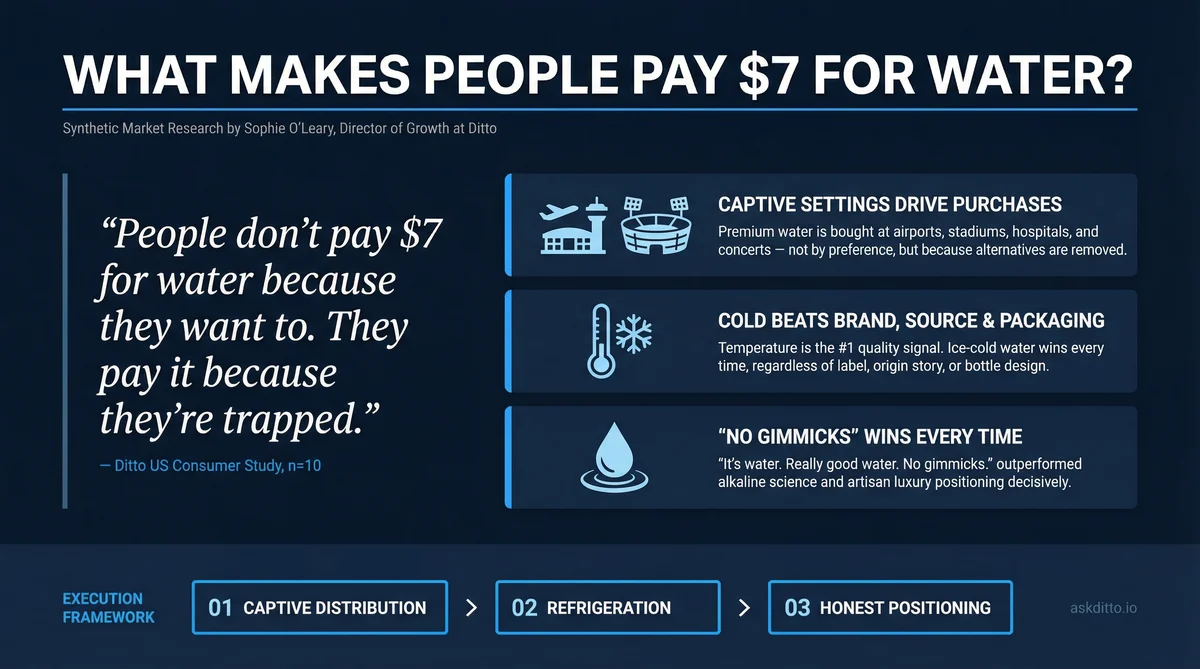
The pattern is clear: people don't pay $5-7 for water because they want to. They pay it because they're trapped. The airport, the stadium, the hospital, the concert: these are environments designed to remove alternatives. The premium isn't for better water. It's a convenience tax on captive consumers.
Key insight: Premium water purchases are situational, not aspirational. The number one driver isn't brand preference. It's the absence of a cheaper alternative.
The $8 Restaurant Water vs The $4 Gas Station Water
This was the question that revealed the most about how context changes everything. I asked: a nice restaurant offers you still or sparkling water for $8. Do you say yes? Now the same brand is $4 at a gas station. Do you still buy it?
The split was fascinating:
At the restaurant: Most participants said yes, but only in specific circumstances. A special occasion. A proper date night. A meal where you're already spending $80+ per person. The $8 water becomes part of the ritual: "A cold bottle on the table says we are settling in, not rushing."
At the gas station: Almost universal rejection. The same water, the same brand, but in a fluorescent-lit convenience store? "No chance." One participant put it perfectly: "At the gas station, I'm buying function. At the restaurant, I'm buying pace."
"I am not paying $8 to play pretend-fancy. Water means status at a restaurant and I do not need to play that game. I ask for tap with ice and move on." - Amanda, 47, Columbia, MO
But here's the nuance: the participants who said yes at the restaurant weren't paying for the water. They were paying for the experience. The cold glass bottle on a white tablecloth. The pause before the meal arrives. The signal to a dinner companion that this is a night worth investing in. The water is a prop in a larger performance.
Key insight: Context doesn't just influence willingness to pay. It completely changes what the product is. At a restaurant, premium water is a ritual object. At a gas station, it's overpriced hydration. Same liquid. Entirely different product.
When Your Friend Brings Fiji to a Dinner Party
I love this question. I asked: a friend shows up to a dinner party with a bottle of Voss or Fiji instead of wine. What's your honest reaction?
The responses were a glorious mess of contradictions. Most participants thought it was weird, but couldn't quite articulate why. Some saw it as a health statement ("they're sober and making a point"). Some read it as pretentious ("they're saying 'look how premium my hydration is'"). A few thought it was just socially tone-deaf ("bring sparkling water if you want, but call it what it is: not bringing wine").
The signal premium water sends is deeply ambiguous. It's not clearly positive or clearly negative. It sits in an uncanny valley between health-conscious and show-offy, between thoughtful and oblivious.
"It's like bringing a really expensive candle to a barbecue. Nobody asked for it, it kind of makes sense, but mostly it just raises questions about the person." - Jason, 45, Rural MI
Key insight: Premium water as a social signal is unreliable. Unlike wine, whiskey, or craft beer, expensive water doesn't have an established gifting or sharing culture. The brand equity exists, but the social script doesn't.
The Blind Taste Test Nobody Passes
I gave participants a scenario: three waters, blind. Tap, $2 store brand, $7 premium. Can you tell the difference?
The honesty was refreshing (pun intended). Nearly every participant admitted they probably couldn't distinguish the $2 from the $7. Most thought they could identify tap water by its chlorine taste, especially if it wasn't ice-cold. But premium vs regular bottled? "They blend," as one participant put it.
And here's the important follow-up: if you couldn't tell the difference, would that change what you pay?
For most, the answer was an immediate yes. If the taste is identical, the premium evaporates. But a small group said something more interesting: they know the taste is the same, and they pay the premium anyway. For them, the premium was never about taste. It was about the bottle feeling cold in their hand, the label looking clean, the cap sealing properly. Functional aesthetics, not flavour.
"Blind and cold, they blend. Unless the premium is a high-mineral European bottle, my palate doesn't split them. Knowing that, I grab whatever is cold and cheap." - Molly, 34, Longmont, CO
Key insight: Premium water fails the blind taste test and most consumers know it. The premium is sustained not by flavour but by packaging, temperature, and situational constraints. Remove the bottle and the context, and the willingness to pay collapses.
Three Pitches: Science, Simplicity, and Luxury
I tested three brand positioning statements to see which resonated:
Brand A: "Naturally alkaline. pH 9.5. From a volcanic spring in Iceland. Detoxifies and hydrates at the cellular level."
Brand B: "It's water. Really good water. Simple, clean, no gimmicks. $1.50."
Brand C: "Artisan mineral water, hand-selected from a high-altitude aquifer. Paired perfectly with fine dining. $7."
Brand B won decisively. Not unanimously like the cooking study, but a clear majority. The appeal was the honesty: it's water, it's clean, it's cheap. No pretension, no pseudoscience, no attempt to make water something it isn't.
Brand A drew the most hostility. "Detoxifies at the cellular level" was called out by nearly every participant as marketing nonsense. The pH claims were dismissed as gimmicks. Even participants who do buy alkaline water said the language felt manipulative. Interestingly, the Iceland provenance got more respect: at least it told a story.
Brand C was met with eye-rolls. "Hand-selected water" felt absurd. "Paired perfectly with fine dining" felt exclusionary. But a few participants admitted that in the right setting (a dinner out, a special event), they might grab it. Context again.
Key insight: Consumers want water brands to be honest, not theatrical. The winning pitch doesn't try to make water more than it is. It says: this is good water, it's cold, it's affordable. The brands that dress water up in pseudoscience and luxury language are fighting their own customers' BS detectors.
Alkaline, Mineral-Rich, Hydrogen-Infused: Who Believes This?
Almost nobody, as it turns out.
I asked participants to evaluate common water health claims. The verdict was brutal: vague wellness language like "detoxifying" and "alkaline" is broadly dismissed as snake oil. Terms like "electrolyte-enhanced" and "mineral-rich" fared slightly better, but only when backed by specific numbers (milligrams per serving, total dissolved solids).
Trusted: Electrolyte content with specific mg counts, mineral profiles with measurable specs, spring source with geographic specificity
Dismissed: "Detoxifying," "hydrates at the cellular level," "hydrogen-infused," "alkaline" without context
Depends on packaging: The same claims on a glass bottle vs a plastic bottle landed differently. Glass signalled quality; plastic made the claims feel "even more hollow"
One participant with high blood pressure said he actually avoids certain mineral profiles for medical reasons, making him more label-literate than most. But he's the exception. For the majority, health claims on water are white noise.
Key insight: The water industry's health marketing has a credibility crisis. Consumers have been burned by vague wellness claims so many times that even legitimate mineral content is met with scepticism. Brands that want to make health claims need to show their data, not their adjectives.
$10 for a Week of Water: How People Really Think
The final question was a budget allocation exercise. I gave participants $10 and asked them to buy water for a week.
The overwhelming strategy? Invest in infrastructure, not individual bottles. Filters, bulk jugs, and reusable bottles dominated. The most common approach was: spend $3-5 on a large jug or a pack of store-brand bottles, and save the rest. Nobody, not a single participant, said they'd buy one premium bottle and refill it.
And the follow-up: if money were no object?
Even with unlimited budgets, most participants wouldn't change much. They'd upgrade their filter, maybe buy a nicer reusable bottle. A few admitted they'd try premium sparkling water at home. But the general consensus was: money doesn't change the fundamental truth that water is water. You can make it colder, cleaner, and more convenient, but you can't make it worth $7 a bottle on a daily basis.
"Even rich, I'd just buy a better filter and a good steel bottle. I'm not subscribing to Voss like it's Netflix." - Ernest, 36, Rural ID
Key insight: Consumers view premium water as a situational concession, not a lifestyle choice. Even when money isn't a constraint, people default to tap or filtration. The premium water market lives and dies by captive occasions, not repeat customers.
What This Means for Water Brands
If you're selling premium water, this research is both sobering and clarifying:
Your real customer is a captive one. The highest-value moments for premium water are airports, stadiums, hospitals, and events. Invest in distribution at captive venues, not in converting grocery shoppers.
Temperature beats branding. Across all 10 participants, cold water was the single most important quality cue. A cold $2 bottle outsells a room-temperature $7 bottle every time. Invest in refrigeration, not packaging redesigns.
Drop the pseudoscience. "Detoxifies at the cellular level" is actively hurting you. If you have real mineral content or electrolyte specs, lead with numbers, not adjectives. Consumers trust data; they dismiss marketing language.
Context is your product. The same water is a $1.50 commodity at a grocery store and an $8 experience at a restaurant. Stop trying to change the water. Start engineering the occasion.
The honest pitch wins. "It's water. Really good water. Simple, clean, no gimmicks." That outsold volcanic springs and artisan aquifers combined. In a market drowning in pretension, simplicity is the differentiator.
The Bottom Line
Premium water isn't really about water. It's about context, convenience, and captivity. People pay $7 at an airport not because they believe Fiji tastes better than tap, but because their reusable bottle is empty, the refill station is broken, and their flight boards in 12 minutes.
The brands winning in this space aren't the ones with the best origin story or the most impressive pH level. They're the ones that are cold, available, and present at the exact moment someone has no other choice. That's not glamorous. But it's honest. And as this research shows, honesty is the one thing water consumers actually trust.
Want to test how your product positioning lands with real consumers? Ditto lets you run studies like this in hours, not weeks.
What the Research Revealed
We asked 10 American consumers to share their honest thoughts about paying premium prices for water. Here's what they told us:
Think about the last bottle of water you bought that cost more than $3. Where were you? What made you reach for that specific bottle instead of a cheaper one, or instead of just filling up a reusab...
Molly Kubek, 34, MRI Technologist, Longmont, CO, USA:
- Where: Ball Arena for an Avalanche game with coworkers. Concessions only, so bottled or nothing. - Why not my reusable: They were not letting outside bottles through and I was not wasting time hunting a refill station in the upper bowl between periods. - Constraint: Long day plus a warm ride in. I was already a bit dehydrated and not interested in soda or beer. - What I grabbed: The coldest 20-ish oz bottle with a sport cap and light electrolytes. Brand did not matter. Cap and temperature did. - Why that one: Recloseable so it would not spill under the seat, decent volume per trip, and the sodium-magnesium panel looked better than plain water for cramp control. - Why not cheaper: The cheaper option was a tiny no-cap bottle or an open cup. Both are spill risks and force a second line later. Hard no. - Decision logic: Pay the stupid arena premium once, keep the cap, hydrate, and stop thinking about it. - Post-buy take: Still annoyed at the price-gouge, but it solved the problem with one walk and zero mess. That is the spec. The failure point is venues making basic water access a hassle.
Marvin Nguyen, 53, Sales Manager, Rural, NJ, USA:
Newark Airport, Terminal B, early morning. I had to dump my reusable at TSA, hustled to the gate, and the refill station had a big plastic bag over the spout - out of order. I grumbled, then paid $4.99 for a 1‑liter at the newsstand because I needed water to take my blood pressure pill and I did not want to play the tiny-cup game on the plane. Not proud of it, but time and setting boxed me in. - Setting: Post-security, boarding in 20 minutes. Convenience beat principle. - Size: Grabbed the 1‑liter so I could make it through the flight and still have some for the train. The 16.9 oz bottles are gone in three gulps. - Cap and shape: Chose a sturdy twist cap and wide mouth. Sport tops leak in a bag, and the tall skinny bottles tip over. I reuse it later, so the cap threads matter. - Coldness: Took one from the back of the cooler. If I am paying that much, it better be cold. - Taste/minerals: Skipped the fancy mineral and sparkling stuff. They taste a little salty to me, and I am watching sodium. - Price games: There was a 2‑for‑$7 sign. I am not hauling two big bottles just to chase a fake deal. So was it the brand? A little. Mostly it was the post-security trap, the need to take my meds, and the bottle design I know will not annoy me later. If the refill station had been working, I would have filled my own and kept the five bucks.
Richard Stansbury, 28, Project Manager, San Diego, CA, USA:
Petco Park. Day game last summer. Sun baking the seats, Padres bullpen already looking gassed. I almost never buy bottled water over $3 - I carry a stainless bottle like it’s a tool pouch - but security waved me through with it empty and the refill station line was 20 deep. What made me grab that specific one: - Time pressure: two minutes before first pitch, anthem wrapping. I wasn’t missing Tatis’ first at-bat to babysit a fountain. - Temperature: it was cold. Actual condensation. The cheaper bottles in the kiosk were room temp. Hard pass. - Cap and size: I wanted a 1L with a screw top so I could stash it under the seat and not chug the whole thing. The little 16.9 oz guys are a joke in the sun. - Placement: eye-level in the cooler, easy grab. I’m not crouching behind ten people to save 80 cents. - Brand story: didn’t care. Glacier poetry on a label doesn’t make me less dehydrated. I knew I was getting gouged and I was annoyed, but it was a setting decision, not a brand romance. Stadium tax, hot day, short clock. Paid, drank, moved on.
Jason Rice, 45, Operations Specialist, Rural, MI, USA:
Short answer: I don’t pay that unless I’m boxed in. Last time was at Ford Field for a Lions game. - Setting: Concourse, hot day, kids thirsty, kickoff coming fast. Security said no outside bottles. My reusable stayed in the truck. - Why that bottle: It was the coldest one in the ice bin. Screw cap so it wouldn’t spill in the seat. Big size for better price per ounce. Brand didn’t matter. - Decision: Lines at refill stations were long. Fountains looked sketchy and slow. I had a headache starting. I grabbed the big cold bottle, paid the stupid price, and moved. - Cost gripe: Around five bucks. It’s water, not rocket fuel. I hate it, but there was no real option if I wanted everyone hydrated and in our seats. - After: Refilled it at halftime to stretch the spend. Kept an eye on it so we didn’t run dry in the 4th and get stuck in traffic with nothing. So yeah - setting forced it. Cold, resealable, and size won. Brand and packaging were a zero.
Amanda Wise, 47, Unemployed Adult, Columbia, MO, USA:
I almost never pay over $3 for water. Last time I did, they boxed me in. - Where: Mizzou Arena, cheap ticket a friend handed me. - Setting: Security took my half-full reusable at the gate. No outside drinks. - Body check: Dry mouth from meds. Needed to take ibuprofen. Standing longer would spike my pain. - Options: Warm fountain way across the concourse with stairs and a line. Vendor by my section had cold bottles for about $4.75. - Why that bottle: It was cold, had a cap, and I could see the seal. Brand didn’t matter. I paid cash and sat down fast. - Trade-off: I ate the markup to save 15 minutes of hobbling and a headache. Still felt like highway robbery. - Cost ripple: That five bucks meant no Harold’s donut that week. That’s the part that stung.
Jeffrey Harpe, 55, Sales Representative, New York, NY, USA:
Moynihan Train Hall, newsstand by the Amtrak gates, heading to Philly to see my sister. I’d left my reusable bottle in the drying rack and I was tight on the clock, so no detour to hunt a fountain and no time to bank on the cafe car line. I grabbed a mid-shelf 1 liter that was actually cold with a solid sealed cap so it wouldn’t leak in my backpack. Brand didn’t matter. Price did, but in that moment the setting won - captive audience, pay the convenience tax, move on. What pushed the choice: - Cold and ready vs warm shelf stock - Resealable cap so it rides under the seat without spilling - Size that lasts the ride, not a tiny 12 oz gimmick - Time - two minutes to board, no fussing with lines or fountains I hate paying more than $3 for what’s basically tap in plastic, but sometimes you just eat it and get on the train.
Ernest Banwait, 50, Asset Manager, East Los Angeles CDP, CA, USA:
LAX, early flight to Sacramento. I paid a little over $4 for a 1-liter bottle. It felt like signing a lease at above-market rent because the downtime risk was higher than the premium. Not the brand. It was a captive-market, time-pressured buy. - Setting: Post-security, 25 minutes to board. No refill option without a bottle. Airports extract monopoly rent. I accept the markup to eliminate schedule risk. - Occasion: Back-to-back meetings on landing. Hydration is cheap insurance against a headache that would tank focus. - Packaging: I picked the tallest 1-liter with a cap that actually reseals and fits upright in my bag. Cost per ounce beat the 16.9 oz toys. - Brand: Irrelevant. I avoided the alkaline and designer labels. I paid for volume and function, not mountain graphics. - Reusable bottle: Left it on the counter. That is on me. Paying 5x grocery pricing still penciled better than arriving undercaffeinated and dehydrated. Net: It was setting and time, not marketing. Like choosing Class A space at a premium when vacancy carry costs would be worse.
Christopher Pratt, 37, Management, Pawtucket, RI, USA:
Short version: I almost never pay more than $3 for water. The last time I did was at PVD, sprinting to a gate after TSA because I’d left my reusable bottle on the kitchen counter while babying a cranky back. Captive-audience pricing, limited options, clock ticking - I grabbed what solved the problem fastest. What made me pick that specific bottle: - Setting: Airport. Water fill station near the gate was taped off, and the other one had a line. Boarding in 10 minutes. Decision speed mattered more than the extra buck. - Cold and size: I reached for the coldest 1L I could see so I could refill it twice and not think about it the rest of the day. If I’m paying the penalty, I want fewer future hassles. - Cap and plastic: I avoid the ultra-flimsy bottles that collapse after two sips. I looked for a sturdier screw cap that actually reseals and won’t leak in a backpack. - No gimmicks: Skipped the boxed-water carton and the alkaline pH miracle nonsense. I’m not paying extra for marketing buzzwords. - Taste/source: I’ll pick something labeled as spring over “purified” if I have the option. Fewer weird aftertastes on a dry plane. Brand didn’t sell me. Availability, cold, volume, and not leaking sold me. I refilled it twice after landing to squeeze value out of a dumb purchase I could have avoided by remembering my bottle.
Neil Mejorada, 39, Healthcare Administrator, Aurora, IL, USA:
Movie theater in town, Saturday matinee with Nora. Concessions-only policy, no outside drinks. I hate paying that much for water. Feels like a tax on being unprepared. I had rushed out after spilling coffee on my shirt, swapped bags, left my reusable in the sink. Kid needed a drink, and I’m not buying soda. Here’s how I picked it: - Setting: No outside bottles allowed. Lines were moving. I wasn’t going back to the car. - Occasion: Dark theater. I wanted a quiet, non-crinkly bottle that wouldn’t leak on her lap. - Packaging: I grabbed the one with a sport cap and thicker plastic. Easier for an 8-year-old. Resealable. - Temperature: Took the one from the coldest rack with actual condensation. No lukewarm surprises. - Label: Plain water. No flavor, no alkaline fluff. I don’t need marketing in my mouth. - Price: All were overpriced within fifty cents. Not worth comparison shopping at a counter. Logged it under entertainment-misc in the budget app and moved on. It was the setting and the cap, not the brand. Wouldn’t buy it again unless policy blocks refills and I’m managing a kid in a crowd.
Alexandra Lopezibarra, 38, Stay-at-Home Parent, Rural, FL, USA:
I hate paying that. Feels dumb. But I did it. - Where: Urgent care waiting room. My 8-year-old had fever. Needed to take the pill with water. - Why that bottle: Only the vending machine. No fountain. The sink looked bad. I wanted sealed and cold. Small cap for kids. No smell. I grabbed the first cold one. - Brand or package: I did not care. Just cold, sealed, not the tiny one. Not the fancy one. The sticker looked clean. That is it. - Price: It said $3.25. I said, how much total? Is it $3.25 total with tax? The screen still said $3.25. Ok, $3.25 total. I paid cash. I was mad at the price. - Why not refill bottle: I forgot my bottle at home. Long morning. Niño llorando. I did not trust the sink there. I needed it fast. - Other choices: I could wait, but he needed to take the pill now. I could go to the car, but the water there was hot. So I paid. - How I felt: Bad. Expensive. But safe for my kid. Worth it for that moment. Next time I pack my bottle.
You're at a nice restaurant and they offer you still or sparkling water for $8. Do you say yes? Now imagine you're at a gas station and the same brand is $4. Do you still buy it? What changes betwe...
Amanda Wise, 47, Unemployed Adult, Columbia, MO, USA:
No at the restaurant. I ask for tap with ice and move on. I am not paying $8 to play pretend-fancy. Probably no at the gas station too. If I am dry-mouth from meds and my bus is late, I grab the cheapest cold bottle, not the $4 brand. - Restaurant: That price is theater. Water means status. I do not buy into it. I would rather put that $8 toward food I can taste. - Gas station: Different vibe. Fast stop. Water means function. I only pay if my body needs it right now and there is no fountain. - Triggers: Pain level, pill timing, bus wait, and cash on hand decide it. - Dollar math: $8 water equals a sale chicken. $4 water equals two bus rides. That is the real meaning for me.
Molly Kubek, 34, MRI Technologist, Longmont, CO, USA:
Restaurant at $8: no. I say, "tap is fine," and move on. If I actually want bubbles, it is because I want the fizz with food, not because the label is fancy, and even then I cap it at one glass, not a whole bottle. Gas station at $4: default no. I only buy if I am mid-ride or on-call driving, empty bottle, limited time, and I can get a cold, recloseable bottle with some sodium-potassium on the panel. Brand still irrelevant. Cap, temperature, and volume per dollar drive it. What changes: - Restaurant: seated, free tap available, no spill risk, no time pressure. Bottled is an upsell. - Gas station: in transit, tap access uncertain, spill risk matters, temperature matters, time is money. - Decision rule: pay for logistics, not for a label. If logistics are solved, I skip it. It is not about the water. It is about context signaling at the table vs solving a hydration problem on the move. Here is the spec: seated service with free tap vs mobile refill under time pressure. Here is the failure point: paying for status packaging when constraints do not require it.
Marvin Nguyen, 53, Sales Manager, Rural, NJ, USA:
Short answer: at the nice place, I usually say yes if it is a real night out; at the gas station, almost always no. At a restaurant, the $8 is part of the pace and ritual. A cold bottle on the table says we are settling in, not rushing, and I do not want to nickel-and-dime a night we planned. I’ll pick still, since some sparkling and mineral stuff tastes a little salty to me and I am watching sodium. At a gas station, the meaning flips to pure utility, so I think in cost per ounce and skip the markup. I either refill my own or buy a bigger jug for a little more and throw it in the trunk. What changes is not the water. It is context and intent: - Restaurant: experience, service rhythm, linger time, small luxury that keeps me off soda and pairs clean with dinner. - Gas station: hydration and price. If I am stuck, hot, or need to take a pill right then, fine, I will pay the $4. Otherwise, pass. So yes in the dining room on a true occasion, no at the pump unless I am boxed in.
Jeffrey Harpe, 55, Sales Representative, New York, NY, USA:
Restaurant: No. I ask for NYC tap with a lemon. Eight bucks for a bottle feels like a table tax, not hospitality. Gas station: usually no. Maybe yes if it’s a hot day and I’ve got a long stretch - then a cold 1 liter with a tight seal earns the convenience premium. Otherwise I grab the cheaper store brand or skip it. What changes isn’t the water. It’s context and control - at the restaurant it’s status theater and an upsell, at the gas station it’s hydration, speed, and a cold, resealable bottle.
Christopher Pratt, 37, Management, Pawtucket, RI, USA:
Short answer: No at the restaurant, and probably no at the gas station too. Tap is fine with dinner. At a gas station I’d grab a cheaper cold liter with a decent cap or skip it if I have my bottle. Let’s sanity-check the contexts: - Nice restaurant - $8: That’s not hydration, that’s the upsell tax. You’re paying for the theater of service, the white-napkin script, and a label that means nothing to me. I’ll spend the eight bucks on bread service or put it toward a drink that actually tastes like something. - Gas station - $4: Pure utility. No ambiance premium, just shelf space and refrigeration. I still pass unless I’m dehydrated, stuck, or need a big cold bottle for a long drive. If I’m paying above my threshold, I want volume, cold, and a cap that won’t leak. What changes between settings? - Signal vs function: Restaurant water is a status cue. Gas station water is a logistics solve. - Value anchor: In a dining check, $8 disappears into the total, which is why they ask. I notice anyway. At a gas station, $4 sits next to $1.50 options and loses the comparison. - Friction: Restaurant script pressures you to say yes. At a gas station there’s no social script - I can just pick the practical bottle and move on. It’s not about the water. It’s about what it signals at the table vs what it solves at the pump. Either way, I’m not paying a premium for a label on clear liquid.
Neil Mejorada, 39, Healthcare Administrator, Aurora, IL, USA:
Restaurant: No. I ask for tap. Eight bucks for water pads the check and the tip base, and it signals I'm fine with add-ons. I might do one bottle of sparkling on a legit celebration or client dinner, but not by default. Gas station at $4: No. I either refill my bottle or grab the cheap liter. I only pay that if it's an actual need - sick kid, heat, long drive, nothing else cold and sealed. What changes: - Restaurant: It's a signal and a pace-setter. You opt into a ritual and a higher spend rate. - Gas station: It's utility. Hydration, temperature, seal, size, cap. No status layer. So it's not the water. It's what the water means in the setting, and whether I'm boxed in by constraints.
Jason Rice, 45, Operations Specialist, Rural, MI, USA:
Restaurant - $8: No. Tap is fine. If they push, I say it again. I’d rather put that eight toward the tip or an appetizer. Sparkling messes with the food for me and makes me burp. Hard pass. Gas station - $4: Usually no. I scan for price per ounce and grab the bigger cheap one. If I’m tight on time, kids cranky, and it’s the only ice-cold option, I’ll pay and move. Then I’ll kick myself and refill it later. What changes: - Control: At a table I have a free option. At a pump I might be boxed in by time and cold stock. - Purpose: Restaurant water is an upsell. Gas station water is utility. - Signal: $8 says “fancy.” I don’t need that. $4 says “get moving.” If I’m rushed, fine. - Value check: I pay for cold, size, and resealable. Brand means nothing. Bottom line: It’s not about the water. It’s about context, control, and not getting played. Let’s not overcomplicate it.
Ernest Banwait, 50, Asset Manager, East Los Angeles CDP, CA, USA:
Restaurant at $8: No. I ask for tap. $8 for 750 ml is roughly $10.50 per liter, zero incremental utility. That is valet pricing for a street-parking need. I would rather allocate that spend to the food where the marginal satisfaction actually moves. Gas station at $4: Usually no. If I am time-pressed and dry, I will buy it, same logic as my LAX purchase. $4 per liter is still rich, but if it saves 10 minutes and prevents a headache, the avoided downtime pencils. - What changes: Context and signaling. In a dining room, the water upsell is table-spend theater. At a pump, it is a utility buy tied to speed and convenience. - Meaning: At the restaurant, saying yes signals you are buying the full white-tablecloth amenity stack. I do not need to signal that. At the gas station, saying yes means I am paying to compress friction and protect focus. - Net: It is not about the water. It is about whether the premium buys tangible value. Restaurant water is a resort fee. Gas-station water is surge pricing that sometimes clears.
Alexandra Lopezibarra, 38, Stay-at-Home Parent, Rural, FL, USA:
Eight dollars for water? No, gracias. I say tap water with ice, lemon if free. I pay for food, not that. - Restaurant $8: I say no. I ask, how much total? Eight dollars total? Eight with tax? Then I say no, just tap please. Fancy place wants me to feel fancy. I do not need that. Feels dumb. Feels like show. - Gas station $4: Maybe. I ask, how much total? Four dollars total? Four with tax? If kids are hot and crying, or pill time, or no other cold bottle, I buy one. If not, I wait. I look for the cheap one or the gallon. Same cold, same wet. - What changes: Not the water. It is the moment and the place. Restaurant is about status and service. Gas station is about fast and need. At the table I can get free tap. At the pump I just need cold and sealed for the kids. - How I feel: $8 makes me mad. $4 still hurts, but if it is for my child and now, I do it. If not, I keep my money.
Richard Stansbury, 28, Project Manager, San Diego, CA, USA:
Restaurant: I say no to $8 still. Tap with ice is fine. If it’s a date or a celebration, I’ll greenlight one big bottle of sparkling for the table. That’s about the vibe and the ritual, not thirst. One and done. Gas station: same brand at $4 is a no. If I’m cooked after a surf and my bottle’s empty, I’ll grab the cold 1L store brand with a screw cap or something with electrolytes. Brand poetry does zero for me. Cold and size matter. Price per liter matters. What changes: - Context: Restaurant is hospitality and signal. Gas station is utility. - Sharing: At a table you split a 750 ml and it feels like part of the meal. At a pump you’re solo-chugging and paying the dumb tax. - Expectation: I’ll pay a small luxury tax when the service elevates it. I won’t pay a curbside markup for the same water. So no to $8 still at the table. Maybe to one sparkling if we’re marking something. Gas station at $4? Hard pass. It’s not about the water. It’s about what the water means in that moment. I try not to fund dumb taxes.
A friend shows up to a dinner party with a bottle of Voss or Fiji water instead of wine. What's your honest reaction? Does premium water signal something about a person?
Molly Kubek, 34, MRI Technologist, Longmont, CO, USA:
Gut reaction: eye roll. It reads as buying packaging to dodge the bring-something-shareable norm. What it signals to me: - Status flex via a safe object. - Control over inputs, bordering on fussy. - Alcohol avoidance without the courtesy of bringing a real alternative for the group. Net signal: slightly negative. Here is the spec: show up with something that adds to the table. Here is the failure point: pricey water that no one asked for and no one shares.
Jeffrey Harpe, 55, Sales Representative, New York, NY, USA:
Gut reaction: I’d say thanks and park it in the fridge, but inside I’m thinking, really? You brought branded water to a dinner? Feels like you missed the brief. If you don’t drink, I respect that, but a single fancy bottle reads more like packaging than contribution. What it signals to me: - Status-conscious - buying the label, not the liquid - Risk-averse - scared to pick the wrong wine, so you punted - Wellness/performance vibe - optics of “clean” without much substance - Last-minute - grabbed something cold at the bodega and called it a day - Out-of-towner energy - not trusting NYC tap, which is silly Net read: mostly confusing with a slight negative tilt. It flips to neutral or even fine if the host is sober, asked for non-alcoholic, or it’s a hot summer night and you brought a case for the table, not a single trophy bottle. Otherwise it’s packaging theater. Bring cookies, seltzer, or a basic table red and call it good.
Ernest Banwait, 50, Asset Manager, East Los Angeles CDP, CA, USA:
Gut reaction: slight eyebrow raise. It reads like a branding flex, not hospitality. You are paying roughly $8 to $12 per liter for something that delivers near-zero incremental utility over filtered tap, which is like paying Class A rents for a storage use. What it signals to me:- Label-conscious and price-insensitive, maybe a little performative. - Wellness or sobriety cue if they do not drink, which I respect if they bring enough volume for the table and chill it. - Last-minute grab at the register if it is a single bottle with no context. Net: without context, the signal skews negative-to-confusing because the ROI is poor and the gesture feels cosmetic. If they say, "We are off alcohol and brought cold mineral water for everyone," that flips to thoughtful. Volume, temperature, and intent are the comps that make it pencil.
Alexandra Lopezibarra, 38, Stay-at-Home Parent, Rural, FL, USA:
Honest? I roll my eyes a little. Feels like show. Water is water. Bring ice or bread, not a $6 bottle. - My reaction: I say ok gracias, but inside I think, why this fancy thing. One bottle does nothing for a group. Looks pretty, not useful. - What it signals: They want to look fancy. Maybe they do not drink alcohol. Maybe they think tap is dirty. Maybe they want pictures. - Positive? If they bring a whole pack, cold, with cups for everyone, that is nice. Also good if the host does not want wine. Está bien. - Negative? One tall bottle for ten people feels expensive and silly. Like flex. Like waste. - Overall: Mostly confusing. A little negative. I drink it if it is cold. Then I move on.
Jason Rice, 45, Operations Specialist, Rural, MI, USA:
Gut reaction: little eye roll, quick thanks, I set it by the ice. Feels like a flex for plain water. If they do not drink, fine. If not, it reads try-hard and pricey for nothing. - Signal 1: Trying to look fancy on the cheap. Glass bottle, big logo. - Signal 2: Could be sober or driving. If so, that’s thoughtful. - Signal 3: Last‑minute grab at the checkout. No plan. - Signal 4: Instagram brain. Packaging over substance. - Signal 5: Host might not drink. Then it’s useful for everyone. Net read: usually negative or a bit confusing unless sobriety or host preference is clear. It’s water, not rocket fuel. If it’s cold with a cap, we will drink it. Otherwise it just sits there while I wish they brought a decent 10 buck table wine or a bag of good ice. Let’s not overcomplicate it.
Neil Mejorada, 39, Healthcare Administrator, Aurora, IL, USA:
First reaction: slight eye roll. It reads like performative hydration, not hospitality. What it signals, to me: - Status flex: brand aesthetic over substance. - Diet-control vibe: clean, curated, a little precious. - Sober cue: could be a quiet way to say they do not drink, which I respect. - Last-minute: airport-gift energy, grabbed on the way. - Host judgment: subtle hint their tap is not good enough. Net take: slightly negative, or just confusing without context. If they are clearly sober, fine, I clock it as considerate. Otherwise it lands as a flex and I move on. Works fine if the group is mostly non-drinkers, otherwise it misses the room.
Amanda Wise, 47, Unemployed Adult, Columbia, MO, USA:
First reaction: tiny eye roll, then a polite thanks. Premium water at a dinner party reads like a flex unless you say it’s for sobriety, meds, or the host asked. Those heavy glass bottles also bug my hands on flare days. - Positive: You’re sober, driving, on meds, or the host is dry. Thoughtful. Functional. - Positive: Mixed crowd, you brought plenty and cups. It helps everyone. - Negative: Brand-forward entrance, little speech about how it’s “the best.” Status play. Waste of cash. - Confusing: No reason, just the tall bottle. Looks out of touch. Net: slightly negative for me. It’s just water, and at $5+ that could have been bread or ice we all use. What does that actually get us at this table?
Richard Stansbury, 28, Project Manager, San Diego, CA, USA:
Gut reaction: eyebrow up, tiny laugh. Showing up with Voss or Fiji instead of wine reads like a hydration flex. Cool bottle, wrong context. What it signals to me: - Status play: Label-first thinking. Glass bottle as personality. Kinda try-hard. - Wellness vibes: Purity, microplastics, aura of clean living. Fine, but loud for a dinner table. - Last-minute stop: Grabbed the shiniest thing at the register and called it a day. - Possible sober cue: If they do not drink, fair. Then bring enough for the table and some citrus. That reads thoughtful, not precious. Net take: mostly confusing sliding to negative if it is one lonely bottle. It is like showing up to a BBQ with a single hot dog. If they roll in with a chilled sleeve of good sparkling, cups, maybe limes, I flip to positive. That says, I read the room and brought something everyone can enjoy. Otherwise I smile, park the trophy water by the sink, and pour from the pitcher. And yeah, I might roast them lightly: bold move, bringing runway water to a potluck.
Marvin Nguyen, 53, Sales Manager, Rural, NJ, USA:
Honest reaction? I raise an eyebrow and think, ok, that is a flex for a very basic need. If you do not drink, just say so and bring something everyone can actually share. One tall Voss feels like you bought the label, not hospitality. I drink plenty of water, but paying steakhouse prices for a bottle at a dinner table reads more performative than thoughtful. What it signals to me: - Image-first: brand-aware, maybe chasing a clean-aesthetic moment. - Health or sober cue: could be signaling no alcohol or designated driver, which I respect if it is clear. - Risk-avoidance: safe, can’t-be-wrong item that dodges picking a dish or a wine. - Questionable stewardship: paying markup for packaging when a case of good seltzer or a pie would serve the room. Net read: mostly confusing, tilting negative unless the host asked for NA options or it is a hot July cookout and they brought a full sleeve on ice. One or two premium bottles feels like label-first. If it were me, I would rather see a Costco case of seltzer, barley tea, or a tray from the Korean bakery than water in a fancy cylinder.
Christopher Pratt, 37, Management, Pawtucket, RI, USA:
Gut reaction: a tiny eye-roll, then polite thanks. It reads like trying to make water a personality. I’ll drink it, but I’m not impressed. Let’s sanity-check the signal: - Status cue: Feels like label-forward theater. Pretty cylinder, glacier story, all that. It says, “I curate.” - Non-drinker flag: If they do not drink or the host asked for NA only, fine. Then it says, “I’m participating without booze,” which I respect. - Wellness performative: Sometimes it screams, “I optimize hydration.” That lands as try-hard unless there’s context. - Design brain: Some people love the bottle as an object. I get it, even if it’s a funny hill to die on. Net read: - Positive: If they clearly made a considerate NA move or paired it with something useful like dessert or ice. Signals awareness. - Negative: If it is the whole contribution. Signals shallow flexing and not reading the room. - Confusing: If they present it like a gift you should be excited about. It is still water. I’m not doing tasting notes. My honest take: I’d rather someone bring decent bread, a salad, or nothing than premium water as the headliner. If it shows up quietly as a backup option, no problem. If it’s meant to impress, it misses.
Blind taste test: you try three waters. One is from your kitchen tap, one is a $2 grocery store brand, and one is a $7 premium brand. Do you think you could tell the difference? And if you couldn't...
Neil Mejorada, 39, Healthcare Administrator, Aurora, IL, USA:
Short answer: probably not. If all three are the same temperature in unmarked cups, I might catch tap on a chlorine note once in a while, but I wouldn’t bet on picking the $7 reliably. Taste isn’t the driver for me. If I can’t tell, I’m not paying more. My ceiling is the $2 store bottle when I forget my reusable. The $7 is a context tax, not flavor. What I ever pay premium for: - Constraints: no outside drinks, security, kid needs sealed - Packaging: sport cap, thicker bottle, quiet plastic - Temperature: actually cold, not shelf-cold - Size/fit: cup holder, backpack pocket - Occasion: rare sparkling on a real celebration So no, not paying for taste. I pay for logistics and setting. Works fine until a policy boxes me in.
Molly Kubek, 34, MRI Technologist, Longmont, CO, USA:
Short answer: maybe on picking tap, no on separating $2 vs $7 if they are both still and equally cold. - Tap vs bottled: I can usually catch the chlorine/hardness edge on tap, especially if it is not ice-cold. Confidence ~70%. - $2 vs $7 bottled: blind and cold, they blend. Unless the premium is a high-TDS mineral water with that slick mouthfeel, I would not reliably call it. - If I could not tell: my willingness to pay does not change. I already cap bottled buys to logistics only - cold, recloseable, decent volume, light electrolytes if I am crampy. - What the premium buys: packaging, venue rules, and a story on the label. Not taste. Here is the spec: temperature, cap, electrolytes, and time pressure. Here is the failure point: paying $7 for a bottle that does nothing my tap or a $2 RO bottle cannot do.
Marvin Nguyen, 53, Sales Manager, Rural, NJ, USA:
Short answer: I can pick my tap most days, but I doubt I could split the $2 from the $7 blind. If all three are cold in the same cup, my odds drop fast. My tap has a faint mineral bite if it is not cold, and some premium stuff runs a little salty, which I avoid for blood pressure. Between two plain bottled stills, taste is a wash for me. If I cannot tell the difference, I am not paying extra. Any premium I ever pay is about context and hardware, not flavor: - Setting: post-security trap or a sit-down dinner where a cold bottle signals we are settling in. - Bottle design: sturdy cap, wide mouth, 1-liter I can reuse. I am not babysitting a tall, tippy glass cylinder. - Cold and timing: I want it cold now, not five minutes from now. - Health cue: I need water on hand for my pill and I skip mineral-heavy stuff. At home it is tap or a chilled pitcher. On the road I buy for function, not the label. If I cannot taste a win, I will not pay for one.
Jeffrey Harpe, 55, Sales Representative, New York, NY, USA:
Short answer: no. If all three are poured cold, side by side, I probably can’t pick the $7. I might spot the tap once in a while from a faint chlorine note if the faucet’s first run, but the $2 vs $7 tastes the same to me. If I can’t tell, I’m not paying. My ceiling is about $2 for a liter when I’m not a captive customer. I only pay up for:- Cold right now - Size that lasts a train ride - Resealable cap that won’t leak in my bag - Timing when I’ve got 2 minutes to board The premium isn’t taste. It’s packaging, a little status theater, and sometimes location markup. On a mild day like today, I just fill my bottle at home and skip the whole song and dance.
Jason Rice, 45, Operations Specialist, Rural, MI, USA:
Short version: I can spot my tap most days. The taste has a little softener/mineral note. Between a $2 bottle and a $7 bottle, same temp, both still, I doubt I could tell them apart. - If I can’t tell: No way I pay seven bucks. I’ll take tap or the cheap bottle. I pay for cold, size, and a solid screw cap that won’t leak in the truck. Brand is zero. - What I notice: Temp first, clean smell, no weird aftertaste. If I’m sweaty and thirsty, they all taste fine anyway. - What “premium” is really about: Packaging, venue rules, and a little flex. Not taste. Bottom line: If I can’t taste a difference, I won’t pay a difference. It’s water, not rocket fuel. Let’s not overcomplicate it.
Christopher Pratt, 37, Management, Pawtucket, RI, USA:
Short answer: I could probably pick tap vs bottled at room temp, but I doubt I could reliably tell the $2 from the $7. Make them cold and I’m not betting money on any distinction. Let’s sanity-check the variables: - Tap vs bottled: At room temp I can usually catch a little chlorine or a pipe note from my tap. Brita helps, but it is there sometimes. Bottled tends to taste cleaner or a bit “flatter.” - $2 vs $7: Coin flip. Unless the premium one has a high mineral profile that gives that slick, slightly salty finish, they blur together. Cold wipes most of that out anyway. - Blind conditions: If you hand me three plain, still waters at the same temp, I might separate tap from not-tap. Past that, it’s noise. If I couldn’t tell the difference, my willingness to pay does not move. I’m already capped. I pay for cold, volume, and a cap that does not leak, not for a glacier fairy tale. The premium, to me, is packaging and context - restaurant theater, airport captivity, or a design object someone wants to show off. Taste isn’t earning a $5 spread on clear liquid.
Richard Stansbury, 28, Project Manager, San Diego, CA, USA:
Short answer: No. Blind, same temp, same cup, I doubt I could tell $2 from $7. I can usually sniff out my tap if there is that chlorine bite, but bottled vs bottled is a coin flip. If I can’t taste a real difference, I’m not paying a premium. I already don’t. What I actually pay for: - Cold: If it is frosty, it wins. - Size + cap: 1L, screw top. Usable on the move. - Convenience: Stadium, airport, job site kiosk. - Function: Electrolytes if I am cooked post-surf. - Occasion: Sparkling at a nice dinner for the ritual. Still water label does not move me. The $7 is about signal and packaging. Glacier poetry on a label, heavy glass, front-of-cooler placement. Tastes like marketing. I’d rather put the extra five toward tacos.
Amanda Wise, 47, Unemployed Adult, Columbia, MO, USA:
Short answer: I can usually tell tap vs bottled, but I doubt I could tell the $2 from the $7. Taste alone never earns that price from me. - Tap: Fine most days. Sometimes a pool smell if it’s warm. I chill a pitcher and it’s fine. - $2 store brand: Cold, neutral, does the job. No notes. - $7 premium: Maybe feels a bit “smoother,” maybe glass bottle. Blind, I don’t think I’d pick it right. - What I pay: Home is free. Out and dry-mouth from meds, I cap it around $1–$2 for a cold sealed bottle. $7 is a hard no unless I’m boxed in like that arena day. - What premium buys: Packaging, label, vibe. Maybe minerals. I don’t care. I buy function, not theater. - Dollar math: $7 water equals two bus rides and a snack. That wins every time. Net: If I can’t taste a real difference, I won’t pay for it. What does that actually get me this month? Nothing but a pretty bottle to carry home.
Alexandra Lopezibarra, 38, Stay-at-Home Parent, Rural, FL, USA:
Honesta: no. Si están frías y sin olor, yo no distingo casi nada. Agua es agua. - Del grifo: Si sale fría, bien. A veces sabe a cloro si está tibia. Entonces no me gusta. - $2 tienda: Normal. Si está caliente, sabe a plástico. Fría, está bien. - $7 premium: La botella se ve bonita. La tapa fuerte. El sabor... igual. Tal vez digo "suave" porque la vista engaña. - Prueba ciega: Yo escojo la más fría y sin olor. Creo que fallo adivinando la cara. - Pagar si no noto diferencia: Grifo o la más barata. $7 no. Solo si es emergencia con mi hijo y ya. Y pregunto: ¿cuánto total? ¿Siete total? ¿Siete con tax? Entonces digo no. - Qué pago en verdad: Pago por fría, sellada, sin olor, tapa que no bota, y que sea rápido. No pago por show. Me da coraje pagar más por agua. La bonita es para fotos. Yo quiero fría y barata.
Ernest Banwait, 50, Asset Manager, East Los Angeles CDP, CA, USA:
Blind and chilled, probably not. I might pick out the tap if there is a chlorine edge or it is warm, but the $2 vs $7 would read like the same asset class once temperature and cup are controlled. If I could not tell, my willingness to pay resets to commodity pricing: at home I drink tap, in store I grab the cheapest sealed liter that stands upright. Paying $7 only clears when the setting forces it - airport, tight clock - where I am buying time and a sealed container, not flavor. Otherwise it is like agreeing to $42 PSF when market is $38 for the same floor plate. It does not pencil. What the premium ever buys for me: - Logistics: sealed, leakproof cap that will not trash my bag - Format: 1-liter that rides vertically in a side pocket - Context: captive market or zero-refill environment - Signaling: which I do not value enough to pay for
Three water brands pitch you. Brand A: alkaline, volcanic spring, detoxifying. Brand B: simple, clean, no gimmicks, $1.50. Brand C: artisan mineral water, fine dining. Which would you pick up, and ...
Neil Mejorada, 39, Healthcare Administrator, Aurora, IL, USA:
I’d grab Brand B. I’d walk right past A and C unless I’m boxed in by policy or it’s the only sealed option cold in the case. - Brand A Gets right: Cold, sealed, probably a sturdy bottle. Fine if I need a sport cap and it’s the only one. Eye roll: “pH 9.5,” “volcanic,” “detoxifies at the cellular level.” That’s marketing fluff. I’m not paying a premium to import tap with a story. - Brand B Gets right: Price, plain copy, no gimmicks. If it’s cold and the plastic isn’t crinkly, I buy it. Bonus if there’s a sport cap option. Eye roll: “Really good water” is nothing-speak, but at $1.50 I don’t care. - Brand C Gets right: Looks nice on a white tablecloth. Maybe works as a single bottle of sparkling on a real celebration. Eye roll: “Artisan,” “hand-selected,” “paired with fine dining.” $7 is a status tax. Not paying your brand story. Net: default is B. A only if constraints and it has the better cap. C never, unless someone else is picking up the check.
Jason Rice, 45, Operations Specialist, Rural, MI, USA:
Pick: Brand B if it’s cold, decent size, and a tight screw cap. Walk past: Brand C first, then Brand A unless I’m trapped. - Brand A - Gets right: Sounds clean. If it’s ice-cold, fine. - Eye roll: “Detoxifies at the cellular level” is marketing fluff. pH 9.5 reads like a gimmick. Likely pricey. Price per ounce probably ugly. - Brand B - Gets right: $1.50, simple pitch, no gimmicks. That’s how you sell water. - Eye roll: “Really good water” means nothing if it’s a tiny bottle or warm. Show me ounces and a cap that won’t leak in the truck. - Brand C - Gets right: Might look nice on a white tablecloth. - Eye roll: $7 for water is a hard no. “Artisan, hand-selected, paired with fine dining” is an upsell. Heavy bottle, not practical, not resealable half the time. Bottom line: I buy on cold, size, cap, and price per ounce. Brand talk is noise. Let’s not overcomplicate it.
Molly Kubek, 34, MRI Technologist, Longmont, CO, USA:
Default: I walk past all three. If I have to pick, I grab Brand B. A and C are a hard no. - Brand A Gets right: lists pH and a source. At least it states a spec. Eye roll: "detoxifies at the cellular level" is nonsense, and pH 9.5 is a marketing crutch. Importing volcanic spring water is paying for a story, not function. No mention of cold, recloseable, volume, or sodium-potassium. Price will be inflated for zero logistics gain. - Brand B Gets right: $1.50, no gimmicks, says what it is. That aligns with how I buy water. Eye roll: "really good water" is fluff, but fine. If it is cold and recloseable, I would actually pick it up. If it is a warm, flimsy, no-cap bottle, I still skip it. - Brand C Gets right: positioning for dining might matter if it specified high TDS and a taste profile. It does not. Eye roll: "artisan," "hand-selected," "high-altitude aquifer" are empty signals. $7 for still water is a table tax. No logistics value, just packaging. Pick-up: Brand B, conditionally. Walk past: Brand A and Brand C. Here is the spec: cold, recloseable, decent volume, light electrolytes when needed. Here is the failure point: paying for a label when the use-case is hydration, not theater.
Amanda Wise, 47, Unemployed Adult, Columbia, MO, USA:
Pick: Brand B. Walk past: Brand A and C. - Brand B Gets right: Clear price at $1.50. Plain talk. No gimmicks. If it’s cold with a cap, I’m good. Eye roll: “Really good water” is vague, but fine. Just don’t shrink the bottle. - Brand A Gets right: Maybe it tastes smooth if it’s cold. That’s it. Eye roll: “Detoxifies” and “cellular level” - come on. pH 9.5 does nothing for my bus wait. Likely pricey, and shipping from Iceland feels like I’m paying for the trip, not the sip. - Brand C Gets right: They told me the price up front. Pretty bottle for a white tablecloth, I guess. Eye roll: $7 water “paired with fine dining” is water trying to be wine. Hard no. $7 equals two bus rides and a snack. That wins every time. Net: I grab B. A and C can sit there and pose. What does that actually get me this month? B hydrates me for cheap, and I still have change.
Jeffrey Harpe, 55, Sales Representative, New York, NY, USA:
Quick take: I’d pick Brand B. I’d walk right past A and C. If it’s a mild day like today, I just fill my bottle at home and skip all three anyway. Brand A: - Gets right: maybe it’s cold and a 1 liter with a tight cap. If so, fine. - Eye-roll: pH 9.5, “volcanic,” “detoxifies at the cellular level.” That’s wellness theater. I don’t need homework with my water. Brand B: - Gets right: “It’s water.” $1.50. No fluff. That’s my lane. If it’s cold and at least 1 liter, I’m in. - Eye-roll: only if it’s a tiny 12 oz or warm shelf stock. Don’t shrink it and call it a deal. Brand C: - Gets right: probably looks nice on a white tablecloth. If a host insists, sure. - Eye-roll: “artisan,” “hand-selected,” “paired with fine dining” at $7. That’s a table tax, not hydration. Bottom line: I pay for cold, size, and a resealable cap when I’m on the clock. Everything else is packaging poetry.
Ernest Banwait, 50, Asset Manager, East Los Angeles CDP, CA, USA:
Pick up: Brand B. Walk past: A and C. - Brand A: Eye roll at "pH 9.5" and "detoxifies at the cellular level." That is health-theater with no operational value. "Volcanic spring in Iceland" is a location flex, not a benefit. If it comes in a 1-liter with a tight cap, the format is fine, but the pitch reads like paying a view premium for the same floor plate. - Brand B: Gets the pricing and posture right. "No gimmicks" matches how I buy water. If it is a full liter and stands upright without leaking, sold at $1.50. "Really good water" is fluff, but the number pencils so I ignore the copy. - Brand C: "Artisan," "hand-selected," "fine dining," $7. That is an amenity stack I do not need. Looks nice on a white tablecloth, sure, but I am paying for optics, not hydration. Same outcome as tap for me, so the premium is a resort fee. Net: I buy on format and price per liter, not mythology. B clears. A and C read like cap rate compression without NOI growth.
Alexandra Lopezibarra, 38, Stay-at-Home Parent, Rural, FL, USA:
Pick up: Brand B. Walk past: Brand C. Maybe walk past A too if it costs more than the cheap one. - Brand A: "Naturally alkaline... detox... Iceland" - Gets right: If it is cold and sealed, ok. Big cap that does not leak is good. - Eye roll: "Detoxifies" and "cellular" - sounds like show. Iceland? I live in Florida. How much total? If it is over $2, no. If same price as cheap and very cold, maybe. But I do not want science words. I want water. - Brand B: "It's water... simple... $1.50" - Gets right: Simple. Cheap. Says the price. I ask, how much total? $1.50 total? $1.50 with tax? $1.50 out the door? If yes and it is cold, I take it. - Eye roll: None. Just do not be warm. Do not taste like plastic. - Brand C: "Artisan... fine dining... $7" - Gets right: Maybe pretty bottle for a photo at a wedding. Not my life. - Eye roll: $7 for water? No gracias. How much total? Seven total? Seven with tax? Still no. "Fine dining" - I eat at home. I need cold and cheap, not fancy words. Bottom line: I grab B. I pass C. A only if it is the same price as B and very cold and I am tired and the kids need water now. Otherwise, agua es agua.
Christopher Pratt, 37, Management, Pawtucket, RI, USA:
Quick take: I’d pick up Brand B. I’d walk right past A and C unless I’m trapped and thirsty. Let’s sanity-check the pitches: - Brand A: “Naturally alkaline. pH 9.5... Detoxifies at the cellular level.” - Gets right: Lists a source. I prefer spring over vague “purified.” - Eye-roll: Detoxifies at the cellular level is supplement-shelf nonsense. pH 9.5 is not a performance spec I care about. Feels like paying a tax for a volcano story. - Brand B: “It’s water. Really good water. Simple, clean, no gimmicks. $1.50.” - Gets right: No theater, clear price, respects my intelligence. If it’s cold, 1L, and has a real screw cap that won’t dribble, that’s exactly my use case. - Eye-roll: “Really good” is still fluff. Give me size, source, and cap type. But at $1.50, I’m not picky. - Brand C: “Artisan mineral water... high-altitude aquifer... paired with fine dining. $7.” - Gets right: In a white-napkin setting, sure, it fits the script. If they posted mineral content and TDS, at least that’s data. - Eye-roll: Artisan and hand-selected mean nothing here. $7 for clear liquid is the ambiance fee. I’m not paying a menu tax at the gas station. Decision rule: - Buy: Brand B - if it’s the biggest cold bottle with a decent cap. - Skip: Brand A and C - I’m not buying a glacier fairy tale or a dining costume piece.
Richard Stansbury, 28, Project Manager, San Diego, CA, USA:
Pick up: Brand B. Walk past: Brand A and Brand C. Brand A: - Gets right: Specificity grabs eyes on a shelf. Iceland, pH number, volcanic spring. That’s shelf theater. - Eye roll: “Detoxifies at the cellular level” is nonsense. I’m buying water, not a magic potion. Alkaline bragging feels like horoscope copy. Price is probably silly too. Brand B: - Gets right: Simple. Price is fair. No fluff. If it’s cold and comes in a 1L with a screw cap, I’m in. - Minor gripe: “Really good water” is nothing. Say size, say cold, show the cap. If you add an electrolyte version for cooked days, even better. Brand C: - Gets right: Looks nice on a white tablecloth. Restaurants love a prop bottle. - Eye roll: $7 for still water and “paired perfectly” is costume jewelry. I’ll only touch it if it’s sparkling, ice-cold, and the table wants the ritual. Otherwise, hard pass. Net: I buy function. Cold, 1L, screw cap, reasonable price. Brand B wins if it hits those. A and C can keep their glacier poetry and tuxedo pricing.
Marvin Nguyen, 53, Sales Manager, Rural, NJ, USA:
Quick take: I’d grab Brand B without thinking. I’d walk past A and C unless I’m trapped post-security or sitting down for a real white-tablecloth dinner. - Brand A: What’s right: cold, clear source story can signal basic quality. Eye-roll: pH 9.5 and “detoxifies at the cellular level” reads like bathroom-mirror science. Alkaline stuff tastes a little slippery to me and sometimes skews salty, so I skip it for blood pressure. - Brand B: What’s right: “no gimmicks” and $1.50 is my lane. If it has a sturdy twist cap, wide mouth, and a 1-liter option that’s cold in the back of the cooler, I’m in. Eye-roll: if the bottle is tall and tippy or they hide a tiny size behind that price, I’m out. - Brand C: What’s right: fits a fine-dining table where the bottle signals we’re settling in and not rushing. Eye-roll: “artisan” and “hand-selected aquifer” is a tuxedo for tap, and $7 on a shelf is a hard no. I’d only say yes when the context is the meal, not the label. Net: I buy B in real life. A and C get a polite pass 9 times out of 10. If you tell me bottle size and cap, I’ll check that and circle back.
When you see water marketed with health claims - alkaline, mineral-rich, electrolyte-enhanced, hydrogen-infused, detoxifying - do you believe any of it? Which claims seem credible and which feel li...
Amanda Wise, 47, Unemployed Adult, Columbia, MO, USA:
Short answer: No. Most of those health words read like snake oil to me. Today is cool and rainy, so it hits me even harder how silly it is. I need cold water and a cap. Not a sermon. - Credible to me: Electrolytes when I’ve been sweating hard or sick. I’ve felt that help. I still grab the cheap option if I ever need it. - Maybe: Mineral as a taste thing. Sometimes it tastes different. Health boost, I don’t feel it. - Hard no: Alkaline, detoxifying, cellular hydration, hydrogen-infused. Sounds like a pitch. My body has filters. A pricier label does not fix my bus wait. - Packaging trust: Same words on glass vs plastic land the same. Glass feels like a status play and it is heavy on flare days. Plastic is lighter and cheaper. I trust a sealed cap and cold more than any bottle vibe. - My filter: Price, seal, cold, timing for meds. That’s it. Net: I pay for function, not theater. What does that actually get me this month? If it is just fancy words, it gets me nothing.
Richard Stansbury, 28, Project Manager, San Diego, CA, USA:
Short answer: No. Most of those health claims read like label theater. I buy water for cold, size, cap. Not enlightenment. What lands for me: - Electrolyte-enhanced: Credible if there are plain numbers on the label. Sodium, potassium, maybe magnesium, listed in mg per serving. If I’m cooked after a surf or a hot job walk, that helps. If it just says “electrolytes” in big font with no specs, I call fluff. - Mineral-rich: Fine for taste and mouthfeel. I can believe “has minerals.” I don’t buy it as a health upgrade. - Alkaline pH 9+: Snake oil to me. pH bragging doesn’t fix thirst. I’m not balancing a pool. - Hydrogen-infused: Hard snake oil. Sounds like a podcast ad for people who buy crystals for their Nalgene. - Detoxifying: Nope. That word is a red flag. I drink water, eat decent, sleep. That’s the detox. Does packaging change trust? - Glass bottle: Looks fancy, restaurant prop. Doesn’t make the claim truer. If the copy is fluffy, I trust it less because it’s leaning on the costume. - Plastic bottle: Cheaper vibe, but if the label is blunt with numbers and it’s a 1L with a screw cap, I trust it more. Function over theater. - Either way, cold + 1L + screw cap beats any health halo. Net: I believe measurable electrolytes when I’m wiped. Everything else reads like glacier poetry. If I want “health,” I’ll eat a burrito bowl and refill my stainless at the sink.
Jason Rice, 45, Operations Specialist, Rural, MI, USA:
Short answer: no, I don’t buy most of it. I pay for cold, size, and a screw cap. The health talk reads like upsell. - Alkaline: Feels like a gimmick. I don’t feel anything different. Eye roll. - Mineral‑rich: Credible as taste. Like well water. Not a reason to pay extra. - Electrolyte‑enhanced: Sometimes credible if I’m sweating hard and cramping. Still not paying a big premium unless it’s the only ice‑cold option. - Hydrogen‑infused: Snake oil vibes. Hard no. - Detoxifying: Instant no. Marketing fluff. - “Cellular hydration,” “pH balanced”: Noise. Show me ounces and price per ounce. Packaging and trust: - Glass bottle: Looks fancy. Doesn’t make the claim truer. Heavier, breaks, often not practical. Reads restaurant upsell. - Plastic with a tight cap: More trust because it’s usable. If the label shows plain numbers per serving, I trust it more. If it’s buzzwords and shiny foil, I trust it less. Bottom line: If I can’t taste it or feel it right away, I won’t pay for it. It’s water, not rocket fuel. Let’s not overcomplicate it.
Christopher Pratt, 37, Management, Pawtucket, RI, USA:
Short answer: No, I don’t believe most of it. Let’s sanity-check the buckets. Credible-ish to me: - Mineral content with actual numbers on the label. If they list calcium, magnesium, TDS, etc., I at least know what I’m drinking. Taste can shift a bit, which I notice more at room temp. - Electrolytes only if you’re replacing sweat. If I’ve been out in the heat or did a long hike, fine. Otherwise it feels like putting a spoiler on a minivan. Snake-oil bucket: - Alkaline pH as a health hack. I don’t buy that as a performance spec worth paying for. - Detoxifying, “cellular-level hydration,” “oxygenated,” hydrogen-infused - that’s supplement-aisle copy dressed up as water. Hard pass. - Volcanic-glacier-moonbeam origin stories that stop short of real data. Pretty tale, no substance. Packaging effect: - Glass reads like restaurant theater and a higher markup. It looks cleaner, but the words don’t get more true because the bottle is heavier. - Plastic is fine if the cap seals and the bottle isn’t tissue-thin. I trust a boring label with numbers over a fancy silhouette every time. - Same claim on glass vs plastic? Lands the same with me. If anything, glass makes me more suspicious I’m paying for ambiance, not value. Net: I pay for cold, volume, and a cap that won’t leak. If you want me to believe a health claim, show the dull specifics. Otherwise it’s just pricier clear liquid in a nicer costume.
Neil Mejorada, 39, Healthcare Administrator, Aurora, IL, USA:
Short answer: mostly no. I read the claims, then I look at the label. If it’s all vibes and no numbers, I pass. What sounds credible enough to me: - Electrolytes: If I actually sweated and the panel shows real sodium and potassium, fine. If it’s a sprinkle and sugar, that’s just a pricier sports drink in disguise. - Mineral-rich: Maybe for taste and mouthfeel. I don’t treat it like medicine. What goes in my snake oil bin: - Alkaline: pH talk is marketing. I don’t buy that it fixes anything. - Detoxifying: My body already runs that process. Slapping “detox” on a label doesn’t add function. - Hydrogen-infused: Sounds like a science fair pitch. Hard no. - Ionized/structured/energized: Word salad. I walk past it. Does packaging change trust: - Glass: Looks clean on a white table. Doesn’t make claims truer. It just signals you want me to spend more. - Plastic: I only care if it’s quiet, sturdy, and has a sport cap for the kid. Claims read the same to me in either material. My filter is simple: - If I need sealed and cold, I buy the cheap one. - If the claim matters, I want numbers on the panel. No numbers, no trust. - Everything else is a story I’m not paying for. Net: I’ll pay for logistics - cap, seal, temperature, size. I won’t pay for a paragraph.
Jeffrey Harpe, 55, Sales Representative, New York, NY, USA:
Short answer: no. Most of it reads like wellness theater with a price hike. I pay for cold, size, and a tight cap. The rest is poetry on a label. What I believe vs eye-roll: - Alkaline: snake oil to me. I don’t buy that it does anything special. - Detoxifying: hard no. “Detox” is a marketing word, not a feature. - Hydrogen-infused: nope. Sounds like a gimmick chasing buzz. - Mineral-rich: plausible as a taste thing. Fine if you like the flavor, not a health miracle. - Electrolyte-enhanced: credible only when I’m sweating on a hot July platform or after a long walk. Otherwise I don’t need salts in my desk water. Packaging and trust: - Glass vs plastic: Glass screams table tax and white tablecloth. It doesn’t make the claim truer. It just makes the bill higher and the bottle heavier. - I trust labels that show numbers on a panel more than adjectives. If you say electrolytes, list the mg. If you say minerals, say which ones. - A cold 1 liter with a resealable cap earns more trust from me than frosted glass with fancy fonts. Today’s mild out, so I fill my bottle at home and skip the sermon on the label. Call it water and price it fair.
Alexandra Lopezibarra, 38, Stay-at-Home Parent, Rural, FL, USA:
Gut feeling: no. Most of that sounds like show to charge more. Agua es agua. I want fría, sellada, no olor, cheap. The rest me da coraje. - Alkaline: Sounds fancy. I do not feel anything. If costs more, no. - Mineral-rich: Sometimes tastes like metal. I do not like. Maybe true, but I still take the cheap one. - Electrolyte-enhanced: Maybe if we are very hot after soccer or fever. But not $4 water. I grab the cheap cold one or a sports drink on sale. If same price, ok. If more, no. - Hydrogen-infused: I do not get it. Sounds like a machine. Feels fake. - Detoxifying: That word makes me roll my eyes. Water makes you pee. That is it. No gracias. Packaging trust: - Glass: Looks clean and pretty, yes. Also heavy, breaks, kids drop it, usually expensive. I do not trust it more. Just feels like show. - Plastic: Fine if the seal is tight and the cap does not leak. If it smells like plastic when warm, I put it back. - Same words on glass or plastic land the same for me: if it costs more, no. If it is cold and cheap, ok. I always ask the price: How much total? Is that the total with tax? So... how much out the door? If it is high, I walk. I pay for cold and sealed, not for big words.
Ernest Banwait, 50, Asset Manager, East Los Angeles CDP, CA, USA:
Short answer: I discount 90% of it. I buy water on format, seal, and price per liter. Health copy rarely moves an outcome for me. How I rank the claims: - Electrolytes: Credible only in a narrow use case. After a hot Peloton ride or summer hike, if the label shows real numbers per liter, I will consider it. Desk day or light workout, it is a pointless premium for me. - Mineral-rich: Plausible as a taste profile if they publish TDS and a mineral panel. Health benefit for me is noise. If it tastes clean and the cap does not leak, fine. - Alkaline: I do not buy it. Reads like wellness theater. For my body and my outcomes, zero signal. - Hydrogen-infused: That lands as snake oil. Feels like casino-floor wellness, not a utility product. - Detoxifying: Immediate eye roll. If a bottle needs that word, I walk. Packaging and trust: - Glass vs plastic: Glass signals a 200-400 bps price premium with no added utility for me. Maybe less plastic taste, but my trust does not change. I trust numbers on the back label, not the container. - Labeling: Big-font pH and mountain art are a pass. A clear mineral panel with mg per liter and a boring source line earns more credibility. If the cap seals tight and the bottle rides upright at 1 liter, that is what gets me to pay. Net: Most health claims feel like cap rate compression without NOI growth. I pay for volume and reliability. On a hot day like today, I just want cold water that will not leak in my bag.
Molly Kubek, 34, MRI Technologist, Longmont, CO, USA:
Short answer: no, I do not buy most of it. If there is no number on a panel, it is marketing, not a claim I take seriously. What I consider credible vs snake oil: - Credible enough: Electrolyte-enhanced only if it lists real amounts of sodium-potassium-magnesium per serving. Mineral-rich only if it posts TDS or a mineral breakdown. Carbonation is a taste choice, not health. - Mostly marketing: Alkaline as a health pitch. Mineral-rich with no numbers. Electrolytes that say "trace" or sprinkle pixie-dust levels. - Red flags: Hydrogen-infused, detoxifying, ionized, structured. I read those and assume zero functional value. Packaging and trust: - Packaging does not change my trust. Glass vs plastic is irrelevant to the claim. I read the panel, not the bottle. - Same words on glass vs plastic land the same. Glass signals table tax. Plastic with a recloseable cap and cold storage solves logistics. That is what I pay for. Here is the spec: numbers on the label, cold, recloseable, decent volume. Here is the failure point: buzzwords with no data and premium packaging that adds zero function.
Marvin Nguyen, 53, Sales Manager, Rural, NJ, USA:
Short answer: I believe very little of it. If there are clear numbers on the label and a plain claim, I’ll listen. If it’s buzzwords stacked on buzzwords, I walk right past. What feels credible enough to me: - Electrolytes with numbers: list the actual mg of sodium, potassium, magnesium per serving. If it is spelled out, fine. Most days I do not need it, and I watch sodium. - Mineral content posted: mg per liter and TDS can explain taste. That is a preference thing, not a miracle. If it leans salty, I skip it. - Source and filtration stated simply: spring location or RO, a lot code, maybe a water-quality link. That reads like someone expects an audit. What reads like snake oil to me: - Detoxifying, cellular hydration, immunity boosts: marketing fog. Hard no. - Alkaline pH 9.5 fixing your balance: I pass. I do not like the taste anyway. - Hydrogen‑infused magic: feels like a party trick in a bottle. - “Electrolyte-enhanced” with no numbers: empty claim. Show the panel or don’t say it. On packaging: a glass cylinder does not make a sketchy claim true. It just gets heavier, pricier, and tippy in my truck. Same words on plastic or glass land the same for me; I trust labels with numbers, a sturdy twist cap, and a 1‑liter I can actually use. Net: give me cold, simple, and honest. If there is a spec sheet or QR to real test results, I’ll check that and circle back. If not, I’m out.
You're given $10 to buy water for a week. How do you spend it? And if money were no object, would your water choices change?
Christopher Pratt, 37, Management, Pawtucket, RI, USA:
Short version: I’m not burning $10 on labels. I already have a reusable bottle and a Brita at home. I pay for cold, volume, and a cap that won’t leak, not a glacier poem. How I’d actually spend the $10 for a week: - Home base: Tap through the Brita into my reusable. Cost: $0. If the tap tastes a little pooly one night, I chill it longer. Cold masks minor notes. - Fridge backup: One 2.5-gallon store-brand jug for the fridge. Typically cheap, low hassle. Cost: roughly half the budget. - On-the-go hedge: One sturdy 1L store-brand bottle that’s cold on day 1, with a real screw cap. I’ll reuse it all week if I forget my main bottle. Cost: a couple bucks. - Trunk stash: One or two 1-gallon jugs for the car in case I get stuck without a fill. Cheap insurance. Whatever’s left from the $10 lands here. Why this works: - Low friction: Refilling beats buying singles all week. - Cold solved: Fridge jug plus ice packs if I need it. No daily store run. - Waste controlled: Reuse the same container. No case of crinkly bottles. - Cost predictable: I’m under $10 and hydrated without thinking about it. If money were no object: - Daily habit barely changes. I’d still drink filtered tap in an insulated bottle. - Upgrades, not trophies: Under-sink carbon block with a dedicated faucet, maybe a small chiller. A couple of rock-solid insulated bottles with leakproof caps. - Occasional treat: Keep a few glass bottles of high-mineral water in the pantry for pizza or spicy takeout. That’s a taste thing, not a lifestyle. Net: I’m not buying a premium logo to feel hydrated. Give me reliable filtration, cold, and containers that do not dribble. Everything else is theater.
Richard Stansbury, 28, Project Manager, San Diego, CA, USA:
Ten bucks for a week? Easy. I’m not buying one trophy bottle and playing pretend. I already carry a stainless, so I buy a cold backup and a home base. Here is exactly how I’d spend it: - 2.5 gal fridge box for the apartment - around 3 to 4 bucks. East Village tap has a chlorine bite some weeks. This smooths it out. - One cold 1L electrolyte bottle with a screw cap - 1.50 to 2. I’ll crush it after a surf or hot job walk, then refill that same bottle all week. - Ice - 2 bucks for a bag if it is a warm stretch. Cold beats any brand story. - One lemon - under a buck. Slice in the pitcher when the tap taste gets loud. Total: 8 to 9 bucks. Balance sits for a second post-surf grab if the week cooks me. How I run it day to day: - Morning: fill the stainless with ice + box water. Toss a lemon slice if I’m feeling fancy. - Midday: if I’m cooked, hit the cold 1L. Refill that bottle from the box after. - Restaurants or office: tap with ice. Zero shame. I’m not paying a dumb tax for glacier poetry. Cold + 1L + screw cap. That’s the spec. If money were no object, do my choices change? No, not really. I’d just upgrade the infrastructure, not the label: - Under-sink carbon filter with a chiller. Maybe RO if the building line tastes like a pool that lost an argument. - Nugget ice machine because I’m a texture gremlin. - Sparkling maker for dinner rituals. One big bottle at restaurants if the table wants it. - Case of 1L electrolyte bottles stashed for heat waves and long site days. Still not dropping 7 bucks on still water unless I’m trapped in a stadium with a two-minute clock. Extra cash goes to tacos, not costume water.
Ernest Banwait, 50, Asset Manager, East Los Angeles CDP, CA, USA:
$10 for a week is a utility problem, not a branding problem. I buy to maximize price per liter and portability. - My actual move: Spend ~$1.50 on a sturdy 1-liter with a tight cap, then refill from tap all week. Pocket the remaining ~$8.50. That is like locking in a long-term lease at market and avoiding amenity creep that does not move NOI. - If I am forced to buy all water: Target 14-18 liters for the week. Buy 4-5 store-brand gallon jugs at ~$1.25 each, plus one 1-liter to carry. Total lands around $7-$8. Any leftover stays unspent. This hits 2-2.5 liters per day without paying for mountain art. - Edge case - travel day: Allocate $4 of the $10 for a captive-airport 1-liter if I have a flight. The rest comes from the gallon jugs at home. I am paying for schedule protection, not taste. If money were no object, my choices do not change much. At home I would plumb a simple carbon-block filter with a small chiller and keep using a 1-liter bottle that seals. On the road I would still buy the cheapest sealed liter that stands upright. Premium labels feel like paying Class A rents for a storage use - optics, not outcomes.
Alexandra Lopezibarra, 38, Stay-at-Home Parent, Rural, FL, USA:
$10 for a week? I don’t play fancy with water. I buy cheap, cold, sealed. I use tap at home. - What I buy: - 1 cheap 24-pack for the car and school. Like $3.50-$4 if cold. - 1 big 2.5 gal jug with spout for the fridge. Around $2.50-$3. - 1 one-gallon jug for backup. About $1. - I ask: How much total? Is that the total with tax? So... how much out the door? If it stays under $10, ok. If not, I drop the gallon. - How I use it: - Keep the big jug in the fridge. Cold all day. - Refill two small bottles for the kids. Freeze half for soccer. - 24-pack is for on-the-go and pill time. I hide 4 bottles for emergencies. - At home I mix tap if it tastes ok and it is fría. If the tap smells, I stick to the jug. - What I do not buy: - No premium bottle. Waste. - No filter this week. Too expensive up front. I need water now. I hate paying a lot for water. Me da coraje. Last time the power went out at night, those big jugs saved me. I keep one cold always. If money was no object: - I still say no to $7 water. Water is water. - I get a good sink filter and a cold dispenser that does not leak. - I keep cases stacked for hurricane season, and delivery so I don’t carry heavy. - Glass bottles? No. Heavy, kids drop it. I want safe, cold, easy. Bottom line: I pay for cold and sealed, not for show. I ask the total three times. If it is high, I walk.
Marvin Nguyen, 53, Sales Manager, Rural, NJ, USA:
Short version: with $10, I buy function, not labels. - Base supply: Grab a store-brand 2.5-gallon cube with a spigot for the garage fridge. That covers refills all week for me and Hannah without fiddling. I’m watching sodium, so I skip anything that tastes mineral-salty. - Daily carry: Buy one cold 1‑liter with a sturdy twist cap and wide mouth, then reuse it all week. I need something reliable for my morning pill and the truck. - Contingency: Hold a few bucks for a forced buy if I get stuck post-security or on a hot route day. If I do not hit that trap, the leftover rolls to next week. Why this works: it keeps price per ounce low, keeps me off the tippy glass cylinders, and I’m not babysitting tiny bottles that explode into recycling. If money were no object, very little changes. I’d install a simple under-sink carbon block for taste and chlorine, keep the same 1‑liter wide-mouth bottle in stainless so it stays cold, and maybe stock a case of plain seltzer for guests. I’m still not paying $7 for dressed-up water unless it’s part of a real sit-down meal. If I can’t taste a win, I won’t pay for one. If you want exact local prices, tell me the store and I’ll check the circular and circle back.
Neil Mejorada, 39, Healthcare Administrator, Aurora, IL, USA:
Short version: I’d spend almost nothing. I drink tap and carry my own bottle. The ten bucks is for backup and those annoying sealed-only moments. How I’d actually use the $10: - $2: One store-brand 1 gallon for the trunk. Label the cap with a date and replace monthly. - $3: A 2.5 gallon fridge jug with a spout. Cold, easy kid pours, zero crinkle. - $1.50: One cheap 1 liter with a sport cap. I’ll reuse it all week for gym and kid events. - $0: Home and work are tap refills. It’s cool out, so I don’t need electrolytes. Chlorine note is fine. - Leftover: Roll it to next week. I’m not lighting money on fire for branding. My checklist: - Keep the trunk gallon out of the sun, replace on a set date. - Fridge jug gets a quick wipe and refill on Sunday meal prep. - Sport-cap bottle lives by the door so I do not repeat the coffee-spill-rush mistake. If money were no object: - I’d install a solid under-sink carbon block with a dedicated tap. No subscription delivery, no pallets in the garage. - Upgrade to a better insulated bottle for me and a leakproof kid sport cap for Nora. - Maybe a simple home carbonator for the rare sparkling with dinner. That’s it. Even with unlimited budget, I’m not paying for stories on a label. Tap plus a good filter and the right cap solves 99 percent of use cases. Works fine unless a venue forces sealed.
Jason Rice, 45, Operations Specialist, Rural, MI, USA:
Short version: I stretch the ten and buy bulk. Cold, resealable, cheap per ounce. Brand is zero. - Target: Call it 1 gallon a day for me. 7 gallons total. - Buy: - Two 2.5‑gallon jugs with spigots for the fridge - about 5 gallons. Cheap, steady pour. Roughly six bucks. - One 24‑pack of store brand 16.9 oz for the truck and work floor - about 3 gallons. Four bucks if I shop right. - Use: Fill my reusable from the jugs at home. Grab a cold bottle for the drive. Refill bottles midweek. If the freezer ice is low, I’ll peel a buck for a bag and still land near ten. - Why: Best price per ounce, stays cold, all screw caps, and I’m not stuck if the tap tastes off or the power blips and the well pump quits. One premium bottle and refill the rest? No. Warm halfway through the day and worse value. Bulk wins. If money were no object: I still would not buy seven‑dollar glass bottles. I’d plumb a decent under‑sink filter with a chilled dispenser, keep the garage fridge stocked, swap fridge filters on time, and carry a tough insulated bottle. I’d still stash a cheap 24‑pack in the truck and a couple emergency jugs in the basement, because running dry in August traffic is how the day goes sideways. Let’s not overcomplicate it.
Amanda Wise, 47, Unemployed Adult, Columbia, MO, USA:
Short answer: I would not buy premium. I use tap at home, chill a pitcher, and spend the $10 to cover out-of-home needs and a backup. It is cool and rainy, so I do not need much ice this week. - If I have a ride - $4.50: 24-pack store brand, cold with caps. - $1.50: One 1-gallon jug for backup if tap tastes off. - $2.00: Bag of ice if a warmer day pops up. If not, I hold the cash. - $2.00: One emergency cold single while I am out. Total: $10.00. Zero premium. Maximum function. - If it is a bus-only week to avoid hauling weight - $3.00: Two 1-gallon jugs for the fridge and cooking. - $4.00: Four single cheap bottles across the week for meds and bus waits. - $3.00: Hold for one more cold bottle or ice if pain spikes. Total: $10.00. Lighter to carry. Money no object? Not really. I would still drink tap most days. I would pay for comfort and less strain, not fancy labels. - Get a solid filter pitcher with long-life filters. - Buy one sturdy insulated bottle with a handle and a cap I can open on flare days. - Schedule grocery delivery for a 24-pack before heat waves so I do not lug it. - Keep a few cheap electrolyte packets for sick days. No glass status bottles. Net: No to premium. What does that actually get me this month? Nothing but weight and a higher bill.
Molly Kubek, 34, MRI Technologist, Longmont, CO, USA:
Baseline: I use tap. Longmont’s tap is fine if it is cold. I am not paying retail for water unless logistics force it. How I’d use the $10 for one week: - $5 - electrolyte packets or tablets with posted sodium-potassium-magnesium per serving. That fixes cramps on runs and 12s. - $3 - bag of ice for the fridge pitcher so the chlorine edge drops. Cold solves 90% of taste. - $2 - one cold, recloseable sport-cap bottle as an emergency if I get stuck in transit. I refill it from tap afterward. No premium bottle. No bulk jugs. I already own reusable bottles, so the rest is temperature and salts. If money were no object: - Install a high-capacity carbon block under-sink with published certifications and a dedicated faucet. Change once or twice a year, done. - Add a quiet countertop carbonator for bubbles at dinner. CO2 is for taste, not health. - Keep two insulated, recloseable 24-32 oz bottles in rotation and a small stash of verified electrolyte mix. Still zero spend on fancy labels. Here is the spec: tap, cold, recloseable, numbers on the panel for electrolytes. Here is the failure point: paying for packaging when temperature control and a filter solve the actual problem.
Jeffrey Harpe, 55, Sales Representative, New York, NY, USA:
Gut check: with $10 for a week of water on a mild week like this, I’m not lighting it on fire. NYC tap is fine. I use my bottle and keep it moving. My real plan: - Monday: buy one cold 1 liter store brand with a tight resealable cap - about $1.50. That’s my travel bottle all week. I refill at home and at the museum’s bottle filler. - Home: if I want cold without waiting, grab one 1 gallon jug for the fridge - roughly $1.50. Pour from that, recycle when it’s empty. - Buffer: if I blow past my bottle one day, I allow one more $1.50 pickup. Total spend: $3-4. The other $6-7 goes back in the envelope. I’m paying for cold, size, cap when I’m on the clock, not labels. If you force me to do bottled only for the week, I’d do the math: ~14 liters needed. Buy four 1-gallon jugs for around $6 and one 1 liter for commute days at $1.50. Still lands under $10 and covers the week without trophy bottles. Money no object? No. I’d still drink tap. Maybe I’d spring for a simple carbon filter so the fridge water tastes a touch cleaner and a better insulated bottle that never leaks. I’m not paying $7 for glass on a white tablecloth or signing up for some delivery plan with auto-renew. In a restaurant, it’s still NYC tap with a lemon.