I got curious about something. Jonathan Nez, the former Navajo Nation President, is running for Congress in Arizona's 2nd District. If elected, he'd be the first Native American to represent Arizona in Congress. That's a big deal. But here's the question that kept nagging at me: does that historic angle actually move votes?
AZ-02 is a complicated district. It's Arizona's largest geographically, home to 14 tribal nations, with Native Americans making up nearly 20% of the population. But it also leans Republican (Cook PVI R+7), and Nez lost his last race against incumbent Eli Crane by about 10 points. The conventional wisdom says his tribal ties might limit his appeal to non-Native voters.
I wanted to test that assumption. So I ran a study with 6 American voters to see how they actually react to Nez's candidacy, his background, and his issues. The findings challenged some of my expectations.
The Voters We Spoke To
We recruited 6 American voters aged 25-65 from across the country, including rural areas. The panel included a manufacturing engineer from Ohio, a compliance analyst from Kentucky, a retired school paraprofessional from Nebraska, an office manager from New Jersey, a delivery driver from Wisconsin, and a project manager from Georgia. A mix of political leanings, life stages, and economic circumstances.
Does Tribal Leadership Actually Help?
We asked voters: "A former Navajo Nation President named Jonathan Nez is running for Congress. He would be the first Native American elected to Congress from Arizona. Does his background as a tribal leader make you more or less interested in his candidacy?"
The answer was nearly unanimous: his tribal leadership background is a clear asset. But not for the reasons you might expect.
Voters didn't care about the "first" angle. What they valued was the practical governing experience that comes with running a tribal nation.
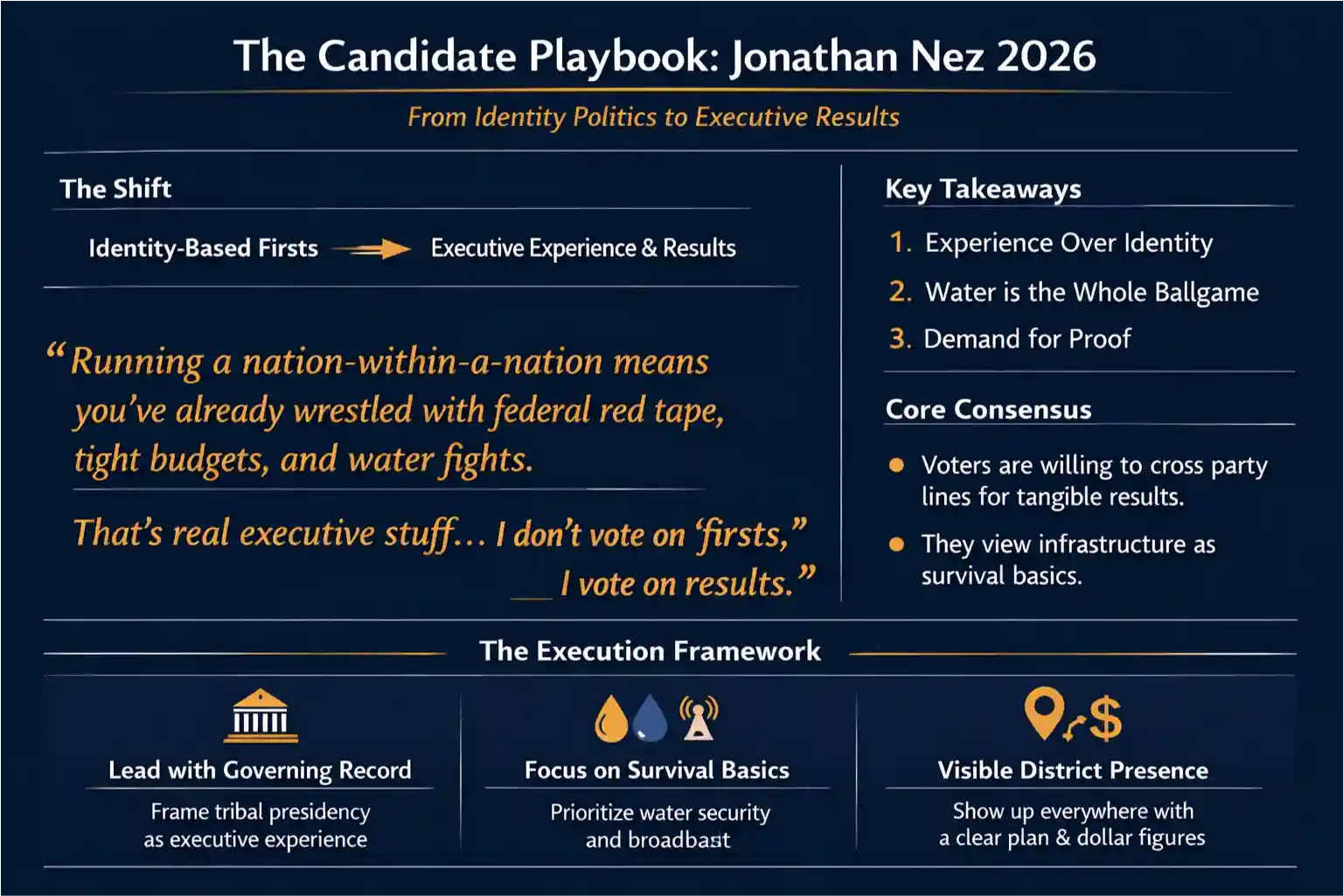
One voter, a 45-year-old delivery driver from Wisconsin, put it this way: "Running a nation-within-a-nation means you've already wrestled with federal red tape, tight budgets, water fights, law enforcement overlap, and healthcare access. That's real executive stuff, not TV sound bites."
A manufacturing engineer from Ohio echoed this: "I don't get misty-eyed over first-this-or-that. Nice milestone, sure, but I care what happens to roads, water, jobs. His background as a tribal leader makes me more interested because it usually means he's wrestled with hard, unsexy stuff."
Key insight: The "first Native American from Arizona" framing won't win votes. Voters explicitly said "I don't vote on firsts." But tribal leadership as proof of practical governing experience? That resonates across the political spectrum.
Whose Issues Win?
We presented voters with a choice: Nez emphasizes water security, rural broadband, and affordable healthcare. His opponent, Republican incumbent Eli Crane, focuses on border security and reducing government spending. Which priorities resonate more?
Five of six voters preferred Nez's issues. The reasoning was brutally practical.
A retired Nebraskan voter said: "Water is the whole ballgame. No water, no farms, no homes, no clinics. If your tap runs dry, border chatter doesn't matter one lick."
The Wisconsin delivery driver agreed: "Border talk gets loud, but water, roads, internet, and healthcare are the stuff you feel every single morning. If your well runs low or your road busts your shocks, nothing else matters. That's not theory. That's groceries, commutes, and property value."
Even the one voter who leaned toward the incumbent's priorities (border security and spending discipline) acknowledged: "Water is huge in Arizona, no argument."
Key insight: Infrastructure beats ideology. Voters see water, broadband, and healthcare as survival basics. Border security matters, but not as a standalone platform. "'Reduce spending' sounds tidy until it lands on rural hospitals, water projects, and seniors," one voter noted.
What Would Actually Win Votes?
Nez lost by 10 points last time, though he outperformed other Democrats. We asked voters: What would he need to do or say to win YOUR vote, regardless of party?
The answers revealed a consistent vulnerability and a clear path forward.
The vulnerability: whole-district optics. Voters want to see Nez in non-tribal towns. "If the schedule is all national media and reservation stops, I'm out," said the Wisconsin voter. A Kentucky compliance analyst said: "Show he sees the whole district, not just the easy photo ops."
The path forward: receipts, not rhetoric. Voters demanded specifics: "Numbers and timelines on water, roads, and broadband. Not vibes. I want a one-pager that says miles resurfaced, percent of households to X-speed internet, specific wells or storage projects, with who pays and when shovels hit dirt."
The Georgia project manager summarized it perfectly: "Receipts, not vibes. Past delivery as tribal president with names, dates, dollars. Which clinics opened on time, how many miles of pipe got laid, what audits came back clean."
Key insight: Voters are willing to cross party lines for infrastructure delivery. But they need proof: specific accomplishments, clear plans with timelines, and visible presence across the entire district.
What This Means for the Nez Campaign
Based on this voter research, here are the strategic takeaways:
Lead with governing experience, not identity. The "first Native American" framing falls flat. But "I ran a nation that delivered $4B in infrastructure" lands hard.
Water is the killer issue. Make it specific: wells, storage, CAP allocations, drought planning with dates and dollars.
Show up everywhere. Town halls in non-tribal precincts, office hours at feed stores and libraries, staff that reflects the whole district.
Publish a scorecard. Quarterly updates on promises. Miles of road, households connected, clinics supported. Accountability builds trust.
Don't abandon border, but reframe it. "Back local sheriffs, add manpower at ports, go after traffickers. No theater." Practical, not performative.
Name your breaks with the party. Multiple voters asked for this explicitly. Independence matters.
The Bottom Line
Jonathan Nez has a real shot in AZ-02. His tribal leadership background is an asset, not a liability, when framed as governing experience. His issues beat the incumbent's on pure resonance. But voters need to see him everywhere, with receipts.
As one voter put it: "Firsts are nice; results are what I vote on. Show me roads fixed and water secured, and the rest can follow."
That's the message. That's the path.
Ditto lets you run voter research studies like this in minutes, not weeks. Test messaging before ad buys. Track sentiment shifts in real-time. See how actual voters talk about candidates and issues. Book a demo at askditto.io.
What the Research Revealed
We asked voters to share their thoughts on Jonathan Nez's candidacy. Here's what they told us:
On Nez's Tribal Leadership Background
Andrew, 45, Delivery Driver, Wisconsin: "Running a nation-within-a-nation means you've already wrestled with federal red tape, tight budgets, water fights, law enforcement overlap, and healthcare access. That's real executive stuff, not TV sound bites... Firsts are nice; results are what I vote on."
Carlo, 47, Manufacturing Engineer, Ohio: "I don't get misty-eyed over first-this-or-that. Nice milestone, sure, but I care what happens to roads, water, jobs. His background as a tribal leader makes me more interested because it usually means he's wrestled with hard, unsexy stuff."
Ann, 56, Compliance Analyst, Kentucky: "His being a former tribal president makes me more interested, not less. That's real governing in a rural context, dealing with federal agencies, budgets, water, roads, clinics. But it's not a free pass."
On Issue Priorities
Margaret, 65, Retiree, Nebraska: "Water is the whole ballgame. No water, no farms, no homes, no clinics. If your tap runs dry, border chatter doesn't matter one lick... 'Reduce spending' sounds tidy until it lands on rural hospitals, water projects, and seniors."
Heather, 54, Project Manager, Georgia: "Water, broadband, healthcare resonate more, full stop, because they are the backbone of rural viability and have a clear federal role with measurable ROI."
On Winning Their Vote
Andrew, 45, Delivery Driver, Wisconsin: "Numbers and timelines on water, roads, and broadband. Not vibes. I want a one-pager that says miles resurfaced, percent of households to X-speed internet, specific wells or storage projects, with who pays and when shovels hit dirt. Quarterly scorecards posted publicly."
Heather, 54, Project Manager, Georgia: "Receipts, not vibes. Past delivery as tribal president with names, dates, dollars. Which clinics opened on time, how many miles of pipe got laid, what audits came back clean."
Ann, 56, Compliance Analyst, Kentucky: "Show up in the church basements, VFWs, chapter houses, and school gyms from the far edges of the district, not just the county seats. Leave behind a one-page plan with dollar figures and phone numbers."