There's a pattern I keep noticing across gig economy platforms. Every single one uses the same trust language: vetted, background-checked, verified. These words are supposed to make us feel safe inviting strangers into our homes. But do they actually work? Or have consumers become so numb to marketing language that these badges now trigger skepticism instead of trust?
I ran a study with 6 US consumers to understand how people really think about home services marketplaces like TaskRabbit. The participants ranged from a 9-year-old in Fremont to a 78-year-old veteran in rural Pennsylvania. What they told me was genuinely surprising, and it has massive implications for anyone building trust in the gig economy.
The Participants
I recruited a deliberately diverse group: a retired bookkeeper from rural Missouri, a 17-year-old aspiring UX designer in Tacoma, an operations specialist in Arlington, Virginia, a 77-year-old Spanish-speaking senior in Massachusetts, and a 78-year-old veteran and parish volunteer in Pennsylvania. Ages 9 to 78. Urban, suburban, and rural. Tech-savvy teens and flip-phone seniors. What unified them was that they all face the same decision: when something needs fixing at home, who do you trust?
The Decision Hierarchy Nobody Talks About
I asked participants how they decide between DIY, asking a friend, using TaskRabbit, or hiring a local handyman. The answer was strikingly consistent across all ages and backgrounds. There's a clear hierarchy, and app-based services are at the bottom.
One participant put it perfectly:
"I sort it by safety, time, tools, and trust. If I can fix it in under an hour with parts on hand and no ladder, I do it myself. If I need a second set of hands or a truck, I ask a neighbor. If it could flood or spark or mess with the roof, I hire a local pro I already know. TaskRabbit is last, and only for a tiny job if they meet my rules."
This hierarchy appeared in every single response, regardless of age or location:
DIY first - if it's low risk, under an hour, and they have the tools
Friend or neighbour - for two-person jobs, borrowed tools, or a quick 15-minute favour
Local handyman with referrals - for anything with water, power, gas, or height
App-based services (last resort) - only for simple tasks, with extensive verification, and usually only if the local guy is booked
Key insight: TaskRabbit isn't competing with other apps. It's competing with DIY YouTube tutorials, helpful neighbours, and the handyman someone's church friend recommended. And in that hierarchy, it starts at a massive disadvantage.
Why "Vetted" Sounds Like Marketing
I showed participants TaskRabbit's value proposition: hire vetted strangers starting at $49. The reaction was immediate and consistent. "Vetted" reads as marketing language, not as genuine trust.
A 78-year-old veteran in Pennsylvania said:
"Forty-nine bucks sounds like bait to get a foot in the door, then it turns into nickel-and-diming. And 'vetted' - by who, exactly, and how deep did they look?"
The 17-year-old in Tacoma had a similar reaction:
"The whole vetted strangers thing reads like marketing, and $49 starting usually means fees on fees."
What participants wanted instead of badges and marketing claims was transparency with specificity. They wanted to see:
The date of the background check, not just a badge
Who ran the check and what it covered
Insurance documents they can actually read, not tiny icons
A photo that matches who shows up at the door
One participant nailed it:
"I want a name from church, a written price, and proof of insurance. Not a tiny icon."
Key insight: "Vetted" is an empty signifier. Consumers have learned that marketing claims are cheap. What builds trust is showing your work: dates, documents, specific coverage limits.
The "$49 Starting" Problem
Almost every participant flagged "starting at $49" as a red flag. The word "starting" immediately signals that the final price will be higher. In a category where trust is already fragile, anchoring on ambiguous pricing destroys credibility before the customer even books.
A 77-year-old senior said:
"That '$49 starting' - starting - usually means it ends up more. Ay bendito, I'm on a fixed check."
What consumers actually wanted:
All-in pricing before they book: labour, platform fees, travel, parts, taxes
A hard cap option that cannot be exceeded without explicit approval
No tip screens before the work is done
Written scope of work in the app before payment
The 60-year-old operations specialist in Arlington summarised it:
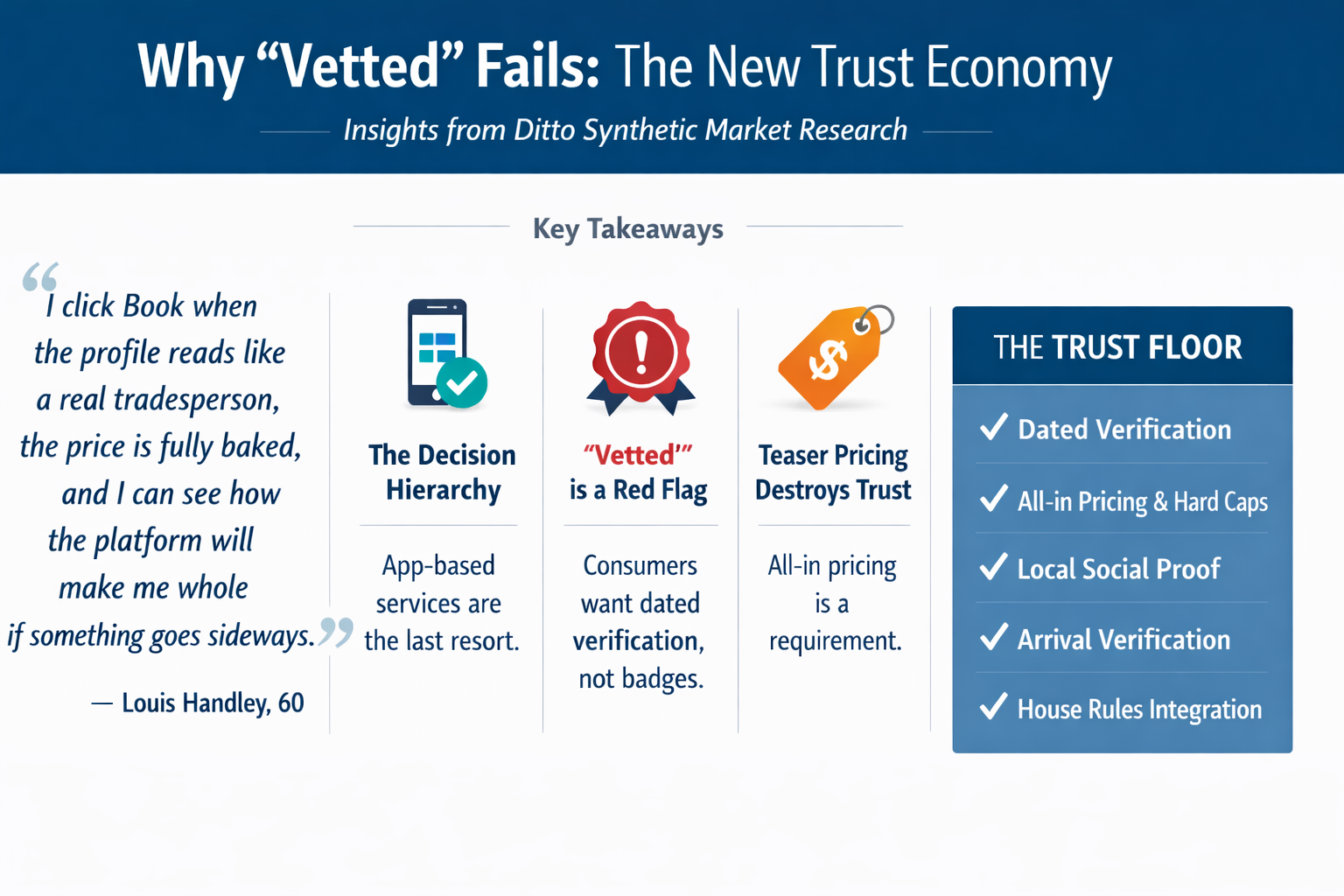
"I click Book when the profile reads like a real tradesperson, the price is fully baked, and I can see how the platform will make me whole if something goes sideways."
Key insight: Teaser pricing works for airline seats. It destroys trust in home services. When you're inviting someone into your living room, "no surprises" is a feature, not a limitation.
The Trust Floor: What Actually Makes People Book
I asked participants: what would you need to see on TaskRabbit before you'd actually click Book? The answers converged on a clear trust floor:
Verified ID with DATE - not just a badge, but when the check was run
Photo that matches arrival - pre-arrival selfie verification
Insurance proof that's readable - coverage limits, what's excluded, how to file a claim
Local reviews from recognisable areas - "jobs done in my county last 90 days"
All-in pricing with no surprises - total cost visible before booking
House rules toggle - no shoes, pets present, parent/spouse must be home
Human support with a phone number - not just chat
A 9-year-old captured this beautifully:
"Real name and clear face with no hat and no sunglasses, and the same picture on a little ID when they come."
Key insight: The trust floor isn't about fancy badges or marketing language. It's about showing your receipts: dated verification, readable documents, local proof, and consistent identity from profile to doorstep.
The Oversight Requirements Nobody Mentions
One theme that emerged across all demographics: consumers don't want to be alone with a gig worker in their home, at least not initially.
The 17-year-old: "I'm a minor. If Mom or Carlos can't be home, I'm not inviting a stranger in, period."
The 65-year-old: "I schedule when my husband is home and the dogs are put up."
The 77-year-old: "My neighbor can sit in the kitchen while they work."
The 9-year-old: "I'd only be chill if Mom or Dad are here and it's daytime."
This has product implications. Features like "daytime slots only," "second adult present," and "tight arrival window" aren't nice-to-haves. They're dealbreakers for a significant portion of the market.
Key insight: Trust isn't just about the Tasker's credentials. It's about giving customers control over the environment: who's home, what room they work in, and how quickly they can cancel if something feels off.
What This Means for Marketplace Product Teams
If you're building or iterating on a home services marketplace, here's what this research suggests:
Replace "vetted" with dated verification. Instead of "background checked," show "Background check completed January 10, 2026 by [Provider]." Specificity beats claims.
Kill teaser pricing. Show all-in estimates before booking. Add a hard cap feature. Let customers set a maximum they cannot exceed without approval.
Add local social proof. "Booked by 3 neighbours" or "12 jobs in your zip code this month" is worth more than 500 anonymous stars.
Build house rules into booking. Let customers require shoe covers, no additional helpers, daytime only, pets secured. Make the Tasker confirm these before accepting.
Implement arrival verification. Pre-arrival selfie that the customer can match against the profile photo. This was mentioned by almost every participant.
Offer a "small job first" onramp. Multiple participants said they'd try a new worker on a simple task before trusting them with anything serious. Make this an explicit feature.
Provide human support with a phone number. The 78-year-old veteran mentioned remembering "that outage mess" when apps go dark. Escalation paths and human backup matter.
The Bigger Picture
Home services marketplaces face a fundamental trust problem that marketing language alone cannot solve. Consumers have developed sophisticated filtering mechanisms for separating genuine signals from corporate noise. "Vetted" sounds like the latter.
The platforms that win won't be the ones with the cleverest trust badges. They'll be the ones that show their receipts: dated verification, readable insurance, local proof, and all-in pricing. In other words, they'll act less like marketing departments and more like the local handyman who got his reputation from word of mouth.
Want to understand how your customers really perceive your marketplace? Ditto lets you run studies like this in hours, not weeks. Book a demo at askditto.io.
What the Research Revealed
We asked real consumers to share their thoughts. Here's what they told us:
What is your gut reaction to hiring vetted strangers from an app?
Louis Handley, 60, Operations Specialist, Arlington CDP, VA:
Gut reaction? Mixed. For simple stuff - IKEA bookcase, haul a futon, swap a light fixture cover - I'm fine paying for speed. My Saturdays are not sacred to an Allen wrench. But "starting at $49" smells like teaser pricing. By the time the service fee, tip prompts, and some mystery surcharge show up, it's real money. And I am not thrilled about a total stranger wandering around my townhouse unless I can see how the platform stands behind them.
Catherine Pattavina, 65, Retiree, Rural, MO:
Gut reaction? Not crazy about it. Strangers off an app in my house makes me tense, and $49 to start is not cheap out here. I would rather call the handyman my neighbor uses, or someone from church. With all the messy news lately and videos not lining up with stories, I feel extra protective at my front door.
Abigail Mendoza, 17, High School Student, Tacoma, WA:
Gut reaction: convenient but kinda sus. The whole vetted strangers thing reads like marketing, and $49 starting usually means fees on fees. My mom would not love a rando in our South Tacoma house unless Carlos is home, and honestly if it's a basic shelf I'd rather YouTube it and not have Mochi freaking out.
Willie Hill, 78, Retiree, Rural, PA:
Gut reaction? Suspicious. Forty-nine bucks sounds like bait to get a foot in the door, then it turns into nickel-and-diming. And "vetted" - by who, exactly, and how deep did they look? I've got a one-story place and a lifetime of tools in the shop, so I only bring strangers in for the stuff I can't or shouldn't touch - electric panel work, chimney, that sort of thing.
What would you need to see before clicking Book?
Louis Handley, 60, Operations Specialist, Arlington CDP, VA:
Short version: I click Book when the profile reads like a real tradesperson, the price is fully baked, and I can see how the platform will make me whole if something goes sideways. If it feels like a mystery grab bag, I close the tab. I want: date-stamped background check with renewal date, years on platform, total jobs, rehire rate, before and after photos of this exact kind of task, all-in estimate before I book, and a live customer support number with hours and an escalation path.
Abigail Mendoza, 17, High School Student, Tacoma, WA:
I'd only tap Book if the app shows me real receipts, not vibes. Profile clarity: full name, clear unfiltered photo, ID verified with date, background check date, years active, total jobs. Reviews with substance: 20+ detailed reviews, recent, photos of finished work, a few 4-star critiques so it doesn't look fake. Transparent pricing: full all-in estimate before I commit. Option to set a hard price cap. House rules toggle: no-shoes, dog aware, willing to be on doorbell cam.
Judith Seelig, 77, Retiree, Rural, MA:
Gut says still no click. But if my niece sat me down and showed me the page, I'd need: full real name and clear face photo, background check with a date I can read, plus license/insurance if it's repairs. Reviews from real locals, total price in writing before booking, paper receipt option, and a phone number with a human who answers in Spanish or slow English.
How do you decide between DIY, friend, TaskRabbit, or local handyman?
Catherine Pattavina, 65, Retiree, Rural, MO:
I sort it by safety, time, tools, and trust. If I can fix it in under an hour with parts on hand and no ladder, I do it myself. If I need a second set of hands or a truck, I ask a neighbor. If it could flood or spark or mess with the roof, I hire a local pro I already know. TaskRabbit is last, and only for a tiny job if they meet my rules. What tips it is pretty plain: risk, cost, and who stands behind it.
Willie Hill, 78, Retiree, Rural, PA:
Short answer? I start with safety and accountability, then my back and ladder tolerance, then time and clarity. Apps are last pick unless it is basic, low-risk, and capped. Is it safety or code critical? Hire a licensed pro. Not TaskRabbit. I want permits, insurance, and a name that shows up on an invoice my insurer respects.
Leo Ly, 9, Primary School Student, Fremont city, CA:
It kinda depends what the thing is and how fast we need it. Do it ourselves if it is small and not scary. Like Ikea shelf, wobbly chair. Dad has the drill and I hold the screws. Ask a friend or neighbor if they just did the same thing. Hire a local handyman if it is big or can break stuff. TaskRabbit only if nobody we know can help and it is simple and daytime and Mom is home.