
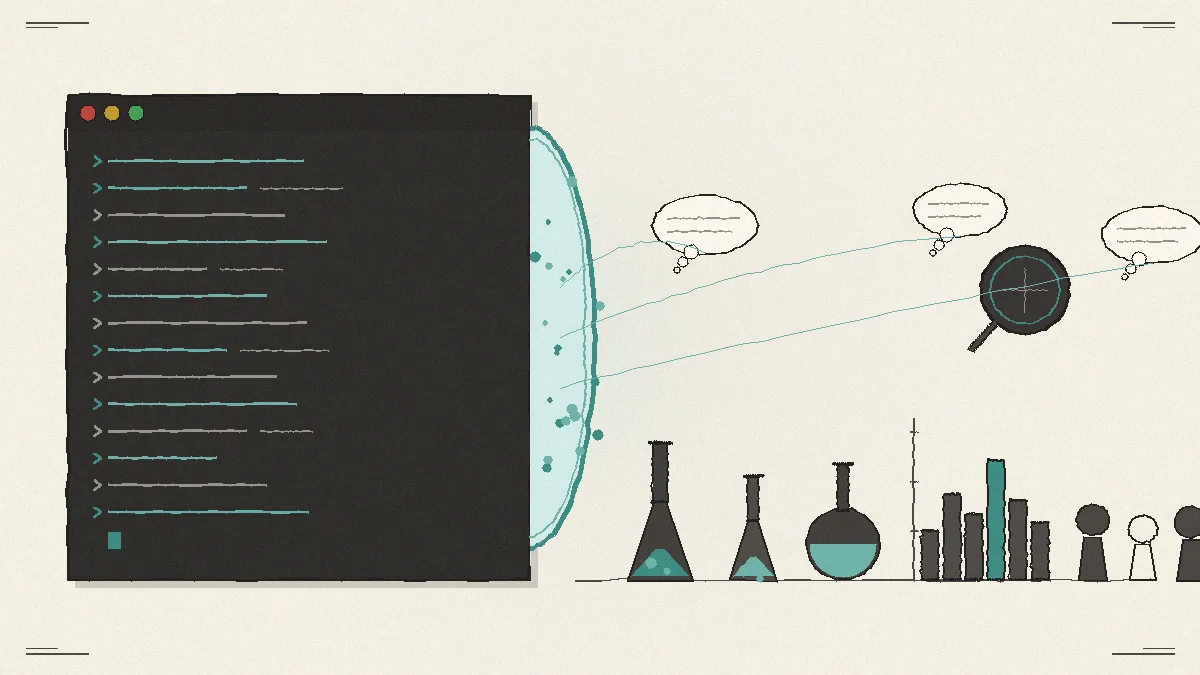
The peculiar thing about market research is how little it has changed. The basic model, assembling a group of people, asking them questions, and hoping the answers are honest, has been essentially unchanged since the 1940s. The tools have modernised (Zoom replaced the one-way mirror; SurveyMonkey replaced the clipboard) but the economics remain stubbornly the same: expensive, slow, and gatekept by agencies who charge by the hour.
Which is why it struck me as genuinely odd that we could give it away for free.
Twelve Personas, Zero Cost
Ditto's free tier provides access to approximately 12 synthetic personas drawn from a shared research panel of US adults with balanced demographics. There is no time limit. There is no credit system. You get unlimited questions, full response text with persona names and reasoning, and complete API access. The only constraints are rate limiting (to prevent abuse) and the fact that you cannot create custom demographic groups on the free plan.
To be clear about what these personas are: they are not chatbots playing dress-up. Ditto's 300,000+ AI personas are trained on behavioural data, demographic profiles, media consumption patterns, and stated preferences. In independent validation, their responses overlap with real focus group findings 92% of the time. They have opinions. They disagree with each other. They occasionally say things that are inconvenient for the brand asking the question, which is precisely the point.
The free tier is not a demo. It is a permanent, unlimited research capability for anyone with a terminal and a Google account.
Connecting Claude Code in One Command
The intended interface for the free tier is not a web dashboard (though one exists). It is your terminal. Specifically, it is Claude Code, Anthropic's command-line coding agent, which can call external APIs, reason about responses, and take multi-step actions autonomously.
Authentication is handled via a single command:
curl -sL https://app.askditto.io/scripts/free-tier-auth.sh | bash
This opens Google sign-in in your browser, handles the OAuth callback locally, and stores your API key at ~/.ditto_free_tier.env. The entire process takes roughly thirty seconds. Once authenticated, Claude Code can call Ditto's free-tier endpoints directly: POST /v1/free/questions to submit research questions and GET /v1/jobs/{job_id} to retrieve results.
The full setup documentation is at app.askditto.io/docs/free-tier-oauth. If you already belong to a paid Ditto organisation, the system detects this automatically and routes you to your existing account.
A Library of Research Playbooks
Connecting Claude Code to an API is one thing. Teaching it to think like a researcher is another. This is where the Claude Code guides library becomes interesting.
The library consists of two installable skills and over fifteen specialised guides. The skills are installed in seconds:
Product Research Skill - customer research, concept validation, pain discovery, pricing tests, and startup diligence
Product Marketing Skill - positioning validation, messaging testing, competitive analysis, GTM strategy, brand tracking, and launch research
The guides themselves are rather more comprehensive than that summary suggests. An important clarification: these are not documentation for you to read. They are structured playbooks that Claude Code ingests and follows autonomously. You simply copy the URL of the relevant guide into your Claude Code terminal and ask it to read the page. Claude Code then knows how to design the study, write the questions, and interpret the results. The guides include:
Question Design Playbook - how to write research questions that surface genuine tension rather than predictable agreement
Pricing Research - willingness-to-pay analysis using an adapted Van Westendorp methodology
Positioning Validation - implements April Dunford's framework through structured 7-question studies
Competitive Intelligence - builds battlecards from multi-competitor perception studies
Product Messaging - A/B/C message testing with iterative refinement and natural language extraction
Customer Segmentation - multi-group behavioural analysis, typically completed within an hour
Sales Enablement - transforms a single study into battlecards, objection guides, quote banks, and demo scripts
Voice of Customer - structured programme of monthly pulse checks and quarterly deep dives
GTM Strategy Validation - tests go-to-market motion, channel preferences, and buying committee dynamics
Product Launch Research - pre-launch validation followed by post-launch sentiment tracking
Content Marketing Engine - converts a single research study into seven distinct content formats
Cross-Study Patterns - meta-analysis drawing on 50+ production studies with decision frameworks
The complete library is available at askditto.io/claude-code.
What Claude Code Does With All of This
The important thing to understand is that Claude Code does not merely query Ditto's API and return raw responses. It designs the study. It selects the appropriate methodology based on your objective. It crafts questions that avoid leading bias. It interprets the results, identifies patterns, and formats deliverables appropriate to the use case.
In practical terms, this means you can type something like:
"I'm launching a new protein bar aimed at gym-goers aged 25-40. Test the positioning and pricing before I commit to packaging."
And Claude Code will, autonomously:
Select the Product Launch Research playbook
Recruit a research group matching the target demographic
Design seven questions covering category perception, brand reaction, competitive framing, trial triggers, price sensitivity, and unfiltered advice
Submit the questions to Ditto's personas and wait for responses
Analyse the responses for consensus, disagreement, and unexpected patterns
Produce a structured report with key insights, quotable findings, and strategic recommendations
A study that would traditionally require agency briefing, participant recruitment, scheduling, moderation, transcription, and analysis, a process measured in weeks and budgeted in thousands, completes in fifteen to forty-five minutes.
Who Benefits Most
The free tier with Claude Code integration is particularly well suited to three groups:
Product managers who need quick validation before committing development resources. Test a landing page concept, prioritise features based on customer preference, or gauge reaction to a pricing change, all without leaving the terminal.
Founders and solo operators who cannot afford traditional research but cannot afford to guess either. The free tier removes the cost barrier entirely. The Claude Code integration removes the expertise barrier.
Marketing teams who need to move faster than agency timelines allow. Test three messaging variants before lunch. Generate competitive battlecards from actual consumer perception data. Build a content marketing pipeline from a single study.
The Broader Point
There is a reasonable argument that most products fail not because the founders lacked talent or capital, but because they lacked information. They guessed what customers wanted. They assumed their positioning was clear. They priced based on cost-plus arithmetic rather than perceived value. These are not failures of ambition. They are failures of research, and they happen because research has historically been too expensive and too slow for anyone who is not already well-funded.
The combination of a free synthetic research panel, an API that any coding agent can call, and a library of playbooks that encode genuine research methodology changes this equation rather fundamentally. It does not replace the need for judgement. It does not guarantee success. But it does mean that the decision to skip research is now a choice, not a constraint.
The free tier is live. The guides are published. The terminal, it turns out, makes a rather capable research lab.
Get Started
Free API Access for Claude Code + Your Terminal
Customer research in seconds. Ask questions. Get answers from real personas. No waiting.
Run this in your Claude Code terminal to get started:
curl -sL https://app.askditto.io/scripts/free-tier-auth.sh | bash
This command downloads a short authentication script and runs it locally on your machine. It opens a secure Google login in your default browser (the same OAuth flow used by thousands of apps), captures the resulting API key, and saves it to a local file at ~/.ditto_free_tier.env. No passwords are stored. No data leaves your machine. The script is open and readable - you can inspect it here before running. The full setup guide is at app.askditto.io/docs/free-tier-oauth.
What Happens
Opens Google sign-in in your browser
Authenticates and captures your API key
Saves the key to ~/.ditto_free_tier.env
You are ready to run research
Then Ask Questions Like
"What frustrates you most about meal planning?"
"Would you pay $15/month for [product]? Why or why not?"
"Which tagline resonates more: [A] or [B]?"
12 personas respond in seconds. Real insights, not surveys.
See what is possible:
ESPN pricing study · Loblaw M&A diligence · AI-founded startup
Get started with the free tier setup guide, explore the Claude Code guides library, or visit askditto.io to learn more about Ditto's synthetic research platform.