
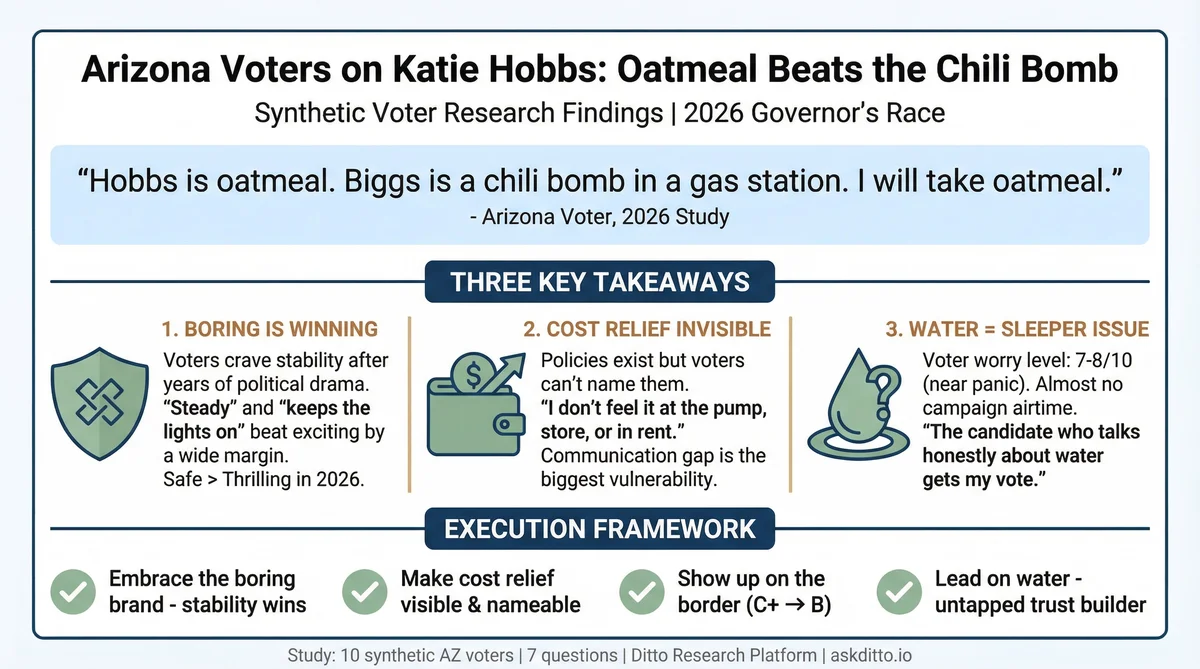
Arizona is a state where politics and daily life crash into each other constantly - water rights, border policy, housing costs that make your eyes water. So when we ran a voter research study with 10 synthetic Arizona voters on Governor Katie Hobbs' re-election chances, I expected complexity. What I got was a masterclass in voter pragmatism, summed up by one unforgettable quote:
"Hobbs is oatmeal. Biggs is a chili bomb in a gas station. I will take oatmeal."
This study used Ditto's synthetic voter research platform - 10 AI personas modelled on Arizona voter demographics, 7 questions each, covering everything from Hobbs' performance to the border to water scarcity. The findings are sharp, surprising, and deeply useful for anyone working on Arizona's 2026 governor's race.
'Boring but Steady' Is Winning
The most consistent theme across every respondent was that Katie Hobbs' perceived boringness is not a weakness. It is her strongest asset. In a state that has experienced years of political drama, constitutional crises, and election denialism, voters are craving stability - even if it is not exciting.
Respondents described Hobbs with words like:
"Steady"
"Quiet worker"
"Not flashy but keeps the lights on"
"The adult in the room"
Nobody was thrilled about Hobbs. But they felt safe. And in Arizona's current political climate, safe is beating exciting by a wide margin. Campaigns take note: boring is a viable brand in 2026.
Cost Relief: The Policy No One Can Feel
Hobbs' administration has pushed cost-of-living measures, but voters are not feeling the effects. This is not a perception problem - it is a communication problem. Voters know there have been some policies. They just cannot name them, describe them, or point to a single way those policies have changed their daily expenses.
"I hear there have been some cost relief measures, but I do not feel them. Not at the pump, not at the store, not in my rent."
This gap between policy output and voter perception is where Hobbs is most vulnerable. She is governing responsibly by most measures, but voters are not experiencing responsibility - they are experiencing sticker shock. The campaign needs to bridge this gap with tangible, visible, named proof points that voters can connect to their own wallets.
The Border Gets a C+
We asked voters to grade Hobbs' handling of border issues, and the average landed somewhere around a C+. Not failing. Not great. Just adequate enough to avoid being a crisis but nowhere near strong enough to be a selling point.
The nuance here matters. Voters did not blame Hobbs for the border situation - they mostly recognised it as a federal issue. But they wanted more visible engagement. Not necessarily policy changes, but the appearance of taking it seriously, visiting border communities, funding local law enforcement, and showing up.
For the re-election campaign, this is manageable. The border is not an F. It is a C+ that could become a B with visibility and consistent local engagement. The danger is ignoring it entirely and letting the Republican challenger define the narrative.
Water Is the Sleeper Issue
This was the finding that surprised me most. When we asked voters how worried they are about water scarcity, the average response was 7 to 8 out of 10. That is near-panic levels for an issue that gets almost no campaign airtime.
Voters talked about water in deeply personal terms:
"My neighbour had to drill a new well this year because the old one went dry"
"I think about water every time I see a new housing development go up"
"We are building like there is no limit, but there is a limit, and it is called the Colorado River"
"Nobody wants to be the candidate who talks about water limits, but somebody has to. The person who does it honestly gets my vote."
For any candidate running in Arizona in 2026, water is the issue that separates serious candidates from performative ones. Voters are worried, they know the maths is bad, and they are waiting for someone to level with them.
Hobbs vs. Biggs: Oatmeal vs. the Chili Bomb
When we asked voters to compare a potential Hobbs vs. Andy Biggs matchup, the contrast was stark. Hobbs was described as 'boring stability.' Biggs was described as 'MAGA circus,' 'unpredictable,' and 'more interested in Fox News hits than Arizona water tables.'
But here is the thing - boring stability was winning. Not by a landslide. Not with enthusiasm. But with a resigned, pragmatic shrug that said: I know what I am getting with oatmeal. The chili bomb might blow up in my face.
This is Hobbs' strongest position: she is the known quantity in a state exhausted by political volatility. The campaign should lean into boring, not run from it. Own the oatmeal. Make it a brand.
How We Ran This Study
We built this study using Ditto's synthetic voter research platform - 10 AI personas modelled on Arizona voter demographics including age distribution, urban versus rural split, ethnic composition, and political lean. Each persona answered 7 open-ended questions covering governor performance, border policy, cost of living, water scarcity, and candidate matchups. The full study completed in under two hours. For campaign teams operating on tight timelines and tighter budgets, this kind of speed-to-insight is a genuine competitive advantage.
What This Means for the 2026 Governor's Race
Embrace the boring brand. Voters are choosing stability. Give them more of it, louder.
Make cost relief visible. If policies exist, name them, quantify them, put them on billboards.
Show up on the border. It is not about policy overhaul - it is about visible engagement.
Lead on water. This is the untapped issue. The candidate who takes it seriously first wins enormous trust.
Let the contrast speak for itself. Hobbs does not need to attack Biggs. She needs to stand next to him and let voters see the difference.
The full study is live - every voter response, every insight, every quote. Explore the full Arizona voter study here.
Working on a campaign in Arizona? Reach out and we can run a study tailored to your race, your district, and your questions.