Here's something I've been wrestling with: why do Democratic candidates keep losing swing districts they should win? The national polling looks decent, the issues poll well, but come Election Day, the margins slip. So I did what I always do when I'm confused: I asked actual voters. Well, synthetic voters, but you know what I mean.
I ran a study with 6 swing district voters from across the United States, Florida to Iowa to Ohio to California to Illinois to Indiana, using Ditto's synthetic research platform. These weren't party loyalists. These were the persuadable middle: working-class independents, budget-conscious parents, rural county analysts, urban gig workers. The ones who actually decide close races.
What I found was striking. Not because the answers were complicated, but because they were so stunningly consistent. Every single participant said some version of the same thing.
The Universal Demand: Deliverables with Dates, Not Vibes
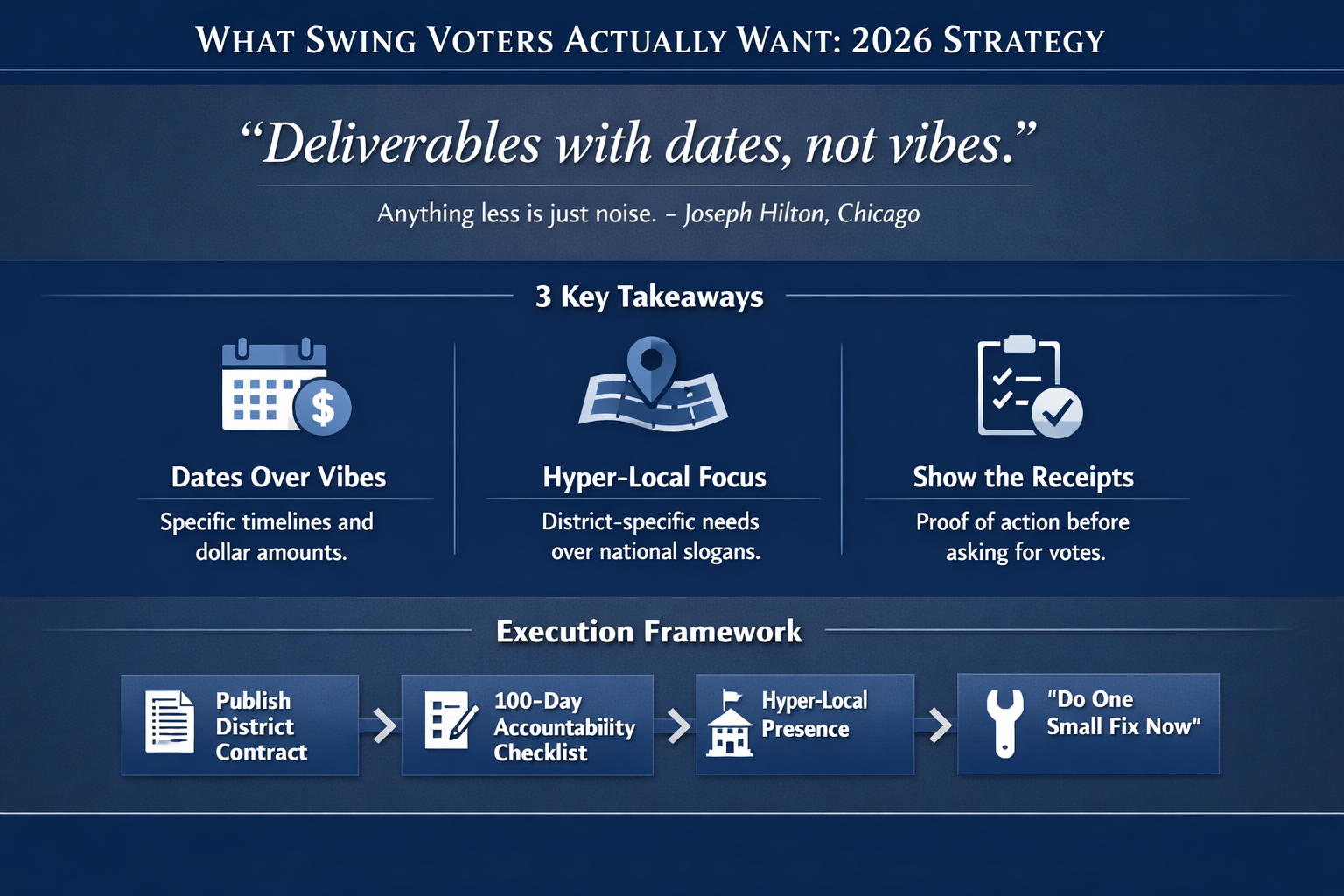
One participant, Joseph Hilton, a 44-year-old courier from Chicago, put it perfectly:
Deliverables with dates, dollars attached, and your face in the neighborhood when it's dark and cold. Anything less is just noise.
That quote could have come from any of the six participants. Across every state, every income bracket, every demographic, swing voters are saying the same thing: stop talking in slogans, start talking in spreadsheets.
Brittany Bedell, a 29-year-old former teacher and grad student in Cincinnati, demanded "no vibes, no slogans" and wanted candidates to "publish a first-year Cincinnati checklist with dates and partners." Daniel Langdon, a 30-year-old budget analyst in rural Indiana, said he'd take a second look at a Democrat who showed up at "a drafty township hall on a Tuesday night, no cameras" with a signed one-pager that "ties specific dollars to specific projects."
If I can trace every dollar from source to plow-truck, he said, you've got my attention.
The Participants
I recruited 6 synthetic personas from Ditto's US model, all from competitive swing districts:
Natasha Santos, 45, Maintenance Technician, Homestead FL (non-citizen but community voice)
Brittany Bedell, 29, Graduate Student/Former Teacher, Cincinnati OH
Henry Bartos, 62, Facilities Manager, Rural IA
Daniel Langdon, 30, Budget Analyst, Rural IN
Lisa Ocana, 30, Administrative Assistant, Fresno CA
Joseph Hilton, 44, Logistics Coordinator, Chicago IL
What united them: they're all persuadable. They're not voting straight-ticket anything. They're watching, waiting, and deeply skeptical of politicians who "say the right things" but never deliver.
What Comes to Mind When They Think "Democratic Candidate"?
I asked participants what they picture when they imagine Democratic candidates running for Congress in 2026. The answers were honest, and not particularly flattering.
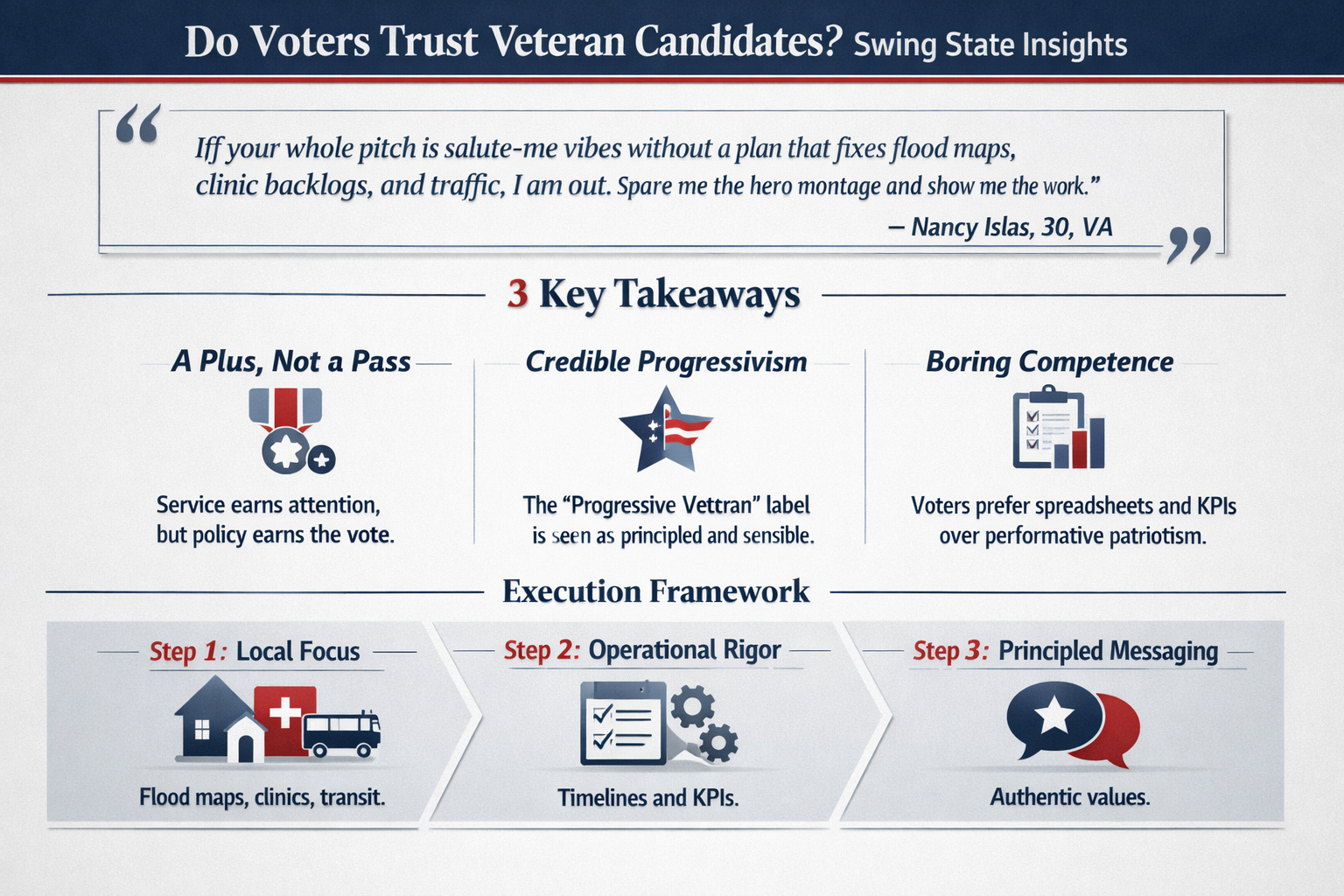
Joseph from Chicago: "I hear a lot of vibes and see not enough receipts." Lisa from Fresno: "Coastal talking points, glossy Instagram, and big promises that skip farm roads." Henry from Iowa: "Lots of slogans, not enough nuts-and-bolts for towns like mine."
The pattern was clear: swing voters see Democrats as disconnected from local realities, heavy on national messaging, light on district-specific plans.
Key insight: The perception problem isn't about policy positions. It's about presentation. These voters assume Democrats will talk at them about national issues rather than with them about local problems.
Does the Standard Democratic Message Resonate?
I tested the standard Democratic messaging framework: protecting Social Security, lowering costs, holding corporations accountable. Does it land?
Sort of. But with major caveats.
Social Security protection resonated universally. Joseph: "That's my mom's check and my future." Henry from Iowa wanted specifics: "Show the fix, the timeline, and who pays." Daniel from Indiana demanded "a 10-year score and a 75-year outlook" before he'd believe it.
"Lowering costs" landed as a concept but failed on execution. Brittany from Cincinnati: "It only resonates if you name the bills I actually pay: groceries, rent, utilities, meds, and surprise hospital charges." Lisa from Fresno wanted to know "which bill drops and when."
"Holding corporations accountable" was met with skepticism. Henry: "Good, but not with press conferences. Do the work." Joseph wanted to "feel it at the register, not in a press release."
Key insight: The message pillars are fine, but voters have heard them before. They want receipts. Show me your spreadsheet, said Daniel from Indiana. Spell out pay-fors, timelines, and how counties like mine aren't stuck holding the bag.
What Would Actually Win Their Vote?
The final question was the most revealing. In a close House race, what would a Democratic candidate need to do to win your vote? What's the one thing that would make you take a second look?
The answers coalesced around a single framework: hyper-local district contracts with accountability mechanisms.
Brittany from Cincinnati wanted "a time-stamped, first-100-days district contract posted before Election Day: three local projects, the committee actions or bills you will file, target dates, and a promise to report back at the Main Library by a specific week."
Natasha from Florida wanted candidates to "name 3 fixes with dates: weekend clinic hours start X date, brighter lights and a crosswalk at the busy corner, later bus service with safe stops. No fog."
Daniel from Indiana asked candidates to "show up at a drafty township hall, no cameras, and hand me a signed one-pager that ties specific dollars to specific projects for EMS and roads."
Henry from Iowa wanted candidates to "bring three local employers and the community college to the table and lock in 50 paid apprenticeship slots for next year, in writing."
The through-line: stop running national campaigns in local races. These voters want to see their specific street, their specific clinic, their specific bus route in the candidate's plan.
Key insight: The winning formula isn't complicated: publish a district-specific contract with 3-5 concrete items, dates, dollar amounts, and a public reporting mechanism. Then show up without cameras and do the small things now.
What Turns Them Off
The turn-offs were just as consistent as the demands:
Culture-war lectures and Twitter fights
Vague slogans without line-item plans
Photo ops without follow-through
Fundraising spam and consultant-speak
National talking points that ignore local realities
"App-only" engagement that excludes offline voters
Parachute campaigning: showing up with cameras, then disappearing
Natasha from Florida summed it up: "Talk straight, show up, bring a simple plan, and come back after election day. Poco a poco, but you have to tighten the screws, not just wave the tool."
What This Means for Democratic Campaigns
If I were advising a Democratic House candidate in a swing district, here's what I'd tell them based on this research:
Publish a district contract before Election Day with 3-5 specific, local items, dates, and dollar amounts
Create a 100-day accountability checklist that voters can put on their fridge
Host quarterly town halls at the local library, not just union halls and churches before elections
Do the small fixes now: get a streetlight turned on, bring a mobile clinic, plow the bike lane
Show up without cameras, take notes, leave a one-pager with a phone number that answers
Stop running national campaigns in local races: your district's potholes matter more than Twitter dunks
The core message from these swing voters is almost painfully simple: be specific, be local, be accountable. Show me the spreadsheet. Then show up.
The Bottom Line
Swing voters in 2026 aren't ideologically locked. They're not asking Democrats to become Republicans. They're asking Democrats to prove they can deliver. And proof, to these voters, means dates, dollars, and your face in the neighborhood when it's unglamorous.
The research points to an uncomfortable truth: swing districts aren't lost because of policy positions. They're lost because voters don't believe the promises will turn into action. The candidate who can break that cycle, who can show receipts before asking for votes, is the one who wins.
Do one small fix now. For real.
Want to test your own messaging with synthetic voters? Ditto lets you run studies like this in hours, not weeks. Book a demo at askditto.io.
What the Research Revealed
We asked real consumers to share their thoughts. Here's what they told us:
When you think about Democratic candidates running for Congress in 2026, what comes to mind?
Joseph Hilton, 44, Logistics Coordinator, Chicago city, IL, USA:
When I think about Dems in 2026, I hear a lot of vibes and see not enough receipts. I'm not anti-Dem - I lean that way - but I'm tired of candidates chasing headlines instead of fixing stuff you feel when you're waiting on the L at 5 a.m. in the snow. Bottom line: show me deliverables with dates, show your budget lines, and show your face in the neighborhood when there's no camera.
Brittany Bedell, 29, Graduate Student, Cincinnati city, OH, USA:
When I picture Dems running in 2026, I think a mix of earnest policy folks and too many consultant-smoothed candidates who say 'fighting for working families' 20 times and never answer a straight question. If your campaign feels like a PowerPoint, I am voting with my feet.
Henry Bartos, 62, Facilities Manager, Rural, IA, USA:
First thing that comes to mind: lots of slogans, not enough nuts-and-bolts for towns like mine. I'm an independent. I vote for whoever treats rural work like real work. Tighten the bolts before you paint the machine. Show me parts, steps, timelines, costs.
Lisa Ocana, 30, Administrative Assistant, Fresno, CA, USA:
Honestly? When I hear 'Democratic candidate,' I picture coastal talking points, glossy Instagram, and big promises that skip farm roads. Valley Dems can be different - if they show up in dusty boots and talk water, I listen. Be practical, Valley-first, straight about costs.
Democrats say they are focused on protecting Social Security, lowering costs, and holding corporations accountable. Does that message resonate with you?
Daniel Langdon, 30, Budget Analyst, Rural, IN, USA:
It's half a message and half a bumper sticker. I care about Social Security and lower costs, but I need to see the math and the levers, not slogans. If Democrats say 'protect Social Security, lower costs, hold corporations accountable,' my response is: show me your spreadsheet. Spell out pay-fors, timelines, and how counties like mine aren't stuck holding the bag.
Joseph Hilton, 44, Logistics Coordinator, Chicago city, IL, USA:
Kinda, but I'm tired of vibes. Protect Social Security hits because that's my mom's check and my future. Lower costs sounds nice, but if my grocery bill and heat bill still jump, miss me. Hold corporations accountable only lands if I feel it at the register, not in a press release.
Natasha Santos, 45, Maintenance Technician, Homestead city, FL, USA:
Protect Social Security yes. Do not play with that money. Lower costs yes, but say which bills. Rent, clinic visits, meds, car insurance, light bill, groceries. No surprise fees. Talk straight, show receipts, come back after election day. If it is real, I clap. If it is smoke, I walk.
Brittany Bedell, 29, Graduate Student, Cincinnati city, OH, USA:
It half lands. Protecting Social Security is table stakes, so say it plainly - no raising the retirement age, no privatization, and explain how you will shore it up without dinging middle earners. Lowering costs only resonates if you name the bills I actually pay in Cincinnati.
In a close House race, what would a Democratic candidate need to say or do to win your vote?
Brittany Bedell, 29, Graduate Student, Cincinnati city, OH, USA:
If it is close, I need them to get painfully specific, local, and accountable. No vibes, no slogans. The one thing that makes me take a second look: a time-stamped, first-100-days district contract posted before Election Day - three local projects, the committee actions or bills you will file, target dates, and a promise to report back at the Main Library by a specific week.
Joseph Hilton, 44, Logistics Coordinator, Chicago city, IL, USA:
Cold, close race like this, talk is cheap. If a Democrat wants my vote, I need receipts with dates, not vibes. The one thing that would make me take a second look: drop a written, dated 'portable benefits' plan for gig workers with draft bill text, the first-100-days timeline, and letters of support. Bottom line: deliverables with dates, dollars attached, and your face in the neighborhood when it's dark and cold. Anything less is just noise.
Daniel Langdon, 30, Budget Analyst, Rural, IN, USA:
Show me a local, line-item plan I can audit, not vibes. The one thing that makes me take a second look: show up at a drafty township hall on a Tuesday night, no cameras, and hand me a signed one-pager that ties specific dollars to specific projects. If I can trace every dollar from source to plow-truck, you've got my attention.
Natasha Santos, 45, Maintenance Technician, Homestead city, FL, USA:
Name 3 fixes with dates: weekend clinic hours start X date, brighter lights and a crosswalk at the busy corner, later bus service with safe stops. No fog. The one thing that makes me take a second look: Do one small fix now. For real. Like get a dead streetlight by a bus stop turned back on this week or bring a free Saturday mobile clinic.