
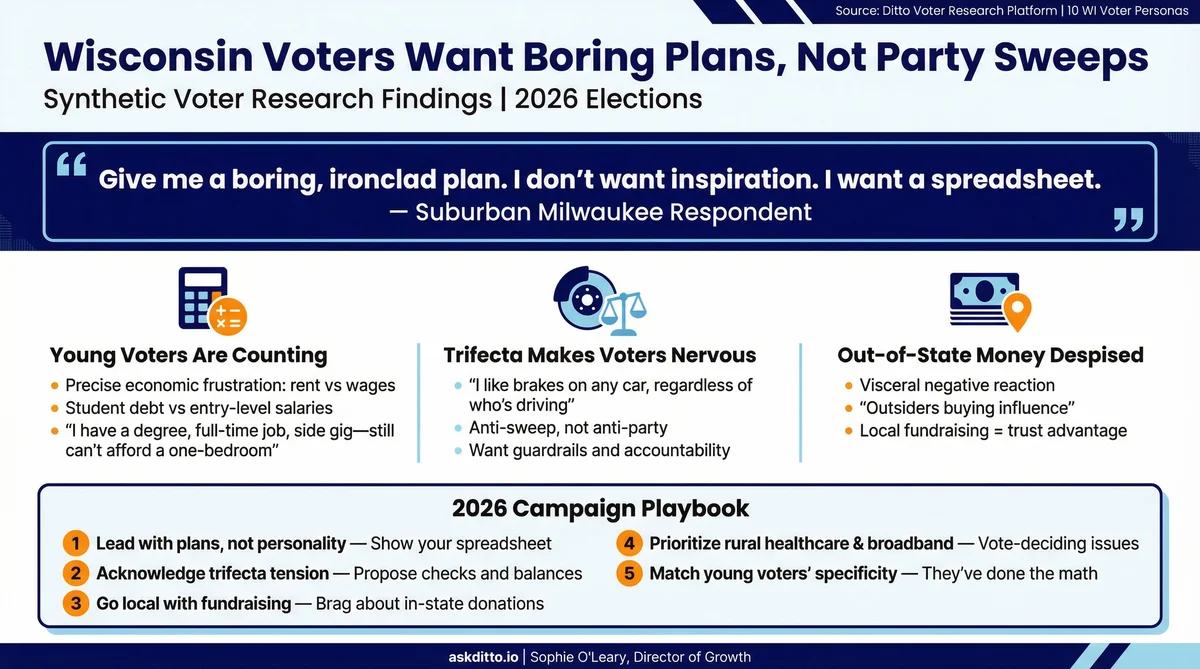
Wisconsin is one of those states where voters take their politics personally - and seriously. So when we built a voter research study with 10 synthetic Wisconsin voters, I expected strong feelings about the governor's race and the state's trifecta. What I did not expect was how many of them would use the word boring as a compliment.
This study was run using Ditto's synthetic voter research platform - 10 AI personas built on Wisconsin voter demographics, each answering 7 questions about priorities, frustrations, and what they want from candidates in 2026. The result is a snapshot of a state that is deeply pragmatic and quietly furious about being taken for granted.
Young Voters Are Doing the Maths, and It Does Not Add Up
One of the most striking findings was how clearly younger Wisconsin voters (under 35) articulated their economic frustration. This was not vague anxiety about 'the economy' - it was precise arithmetic. Cost of rent versus wage growth. Student debt payments versus entry-level salaries. The price of a first home versus what their parents paid.
"I have a degree, a full-time job, and a side gig, and I still cannot afford a one-bedroom without a roommate. What exactly is working?"
This is not a messaging problem campaigns can fix with optimistic language. These voters are counting, and the numbers do not lie. Any candidate who leads with 'the economy is strong' will lose this cohort immediately. They want acknowledgement first, then a plan with numbers attached.
Trifecta Control Makes Voters Nervous
Wisconsin has been under unified Democratic control since 2024, and I assumed voters would either celebrate it or condemn it along party lines. Instead, the dominant sentiment was something more nuanced: discomfort with unchecked power, regardless of party.
One moderate respondent put it perfectly:
"I like brakes. I like brakes on any car, regardless of who is driving. One party running everything makes me nervous."
This is a critical insight for the 2026 governor's race. Voters are not necessarily anti-Democrat - they are anti-sweep. They want guardrails, checks, and visible accountability. Candidates who acknowledge the tension of trifecta power and actively propose their own accountability measures will earn more trust than those who celebrate unified control as a mandate.
Out-of-State Money Is a Lightning Rod
We asked voters about campaign spending, and the response was visceral. Wisconsin voters despise out-of-state campaign money. Not mildly dislike. Despise. They see it as a direct insult - outsiders trying to buy influence in a state they do not live in or understand.
"Every election cycle we become a piggy bank for national groups who could not find Oshkosh on a map"
"The ads are not even about Wisconsin issues. They are national talking points with a Wisconsin ZIP code slapped on"
"I want to know who is paying for the ad before I listen to a word of it"
For campaigns, this is both a warning and an opportunity. Candidates who can visibly demonstrate local fundraising - small-dollar, in-state donations - will have a significant trust advantage. And any campaign flooding the airwaves with out-of-state PAC money should know that every dollar spent might be actively turning voters off.
Rural Healthcare and Broadband: The Unsexy Top Issues
Ask national pundits what Wisconsin voters care about and you will hear about the governor's race, the trifecta, maybe education. Ask actual Wisconsin voters (even synthetic ones) and two issues rise to the top in rural areas that get almost zero airtime: healthcare access and broadband internet.
Rural respondents described driving 45 minutes to see a GP. They talked about telehealth being useless when your internet cannot hold a video call. They described pharmacies closing and emergency rooms being understaffed.
"You want my vote? Tell me how you are going to keep the clinic in my town open. That is it. That is the whole pitch."
Broadband was equally urgent. Remote work, remote school, farm management software, even basic banking - all of it requires internet that rural Wisconsin still does not reliably have. Voters are not asking for fibre-optic luxury. They want functional internet that does not cut out during a storm.
'Give Me a Boring, Ironclad Plan'
The single best quote from the entire study came from a suburban Milwaukee respondent who captured the mood of the whole state in one sentence:
"Give me a boring, ironclad plan. I do not want inspiration. I want a spreadsheet."
This is the thesis of the entire study. Wisconsin voters in 2026 are not looking for charisma, big swings, or partisan red meat. They want competence. They want specifics. They want someone who has clearly done the homework and can explain exactly how their plan works, what it costs, and when it will deliver results.
The word 'boring' appeared more than any other adjective in positive descriptions of what voters want. That is not an insult - it is an instruction.
How We Ran This Study
This study used Ditto's synthetic voter research platform. We recruited 10 AI personas calibrated against real Wisconsin voter demographics - age, geography, education, income, and political lean. Each persona answered 7 open-ended questions about governance priorities, economic frustrations, campaign spending attitudes, and what they actually want to hear from candidates. The entire study ran in under two hours. That speed matters - campaigns cannot afford to wait weeks for traditional polling when the political landscape shifts daily.
What This Means for 2026
If I were advising campaigns in Wisconsin right now, here is the playbook from this study:
Lead with plans, not personality. Voters are allergic to inspiration without substance. Show your spreadsheet.
Acknowledge the trifecta tension. Do not celebrate one-party control. Propose your own checks and balances.
Go local with fundraising messaging. Brag about small-dollar, in-state donations. Distance yourself from national PAC money.
Take rural healthcare and broadband seriously. These are vote-deciding issues that get ignored on the national stage.
Do not patronise young voters. They have done the maths. Match their specificity.
The full study is live and explorable. If you are working on a Wisconsin campaign - governor, legislature, or any down-ballot race - the voter language and priorities are all there. Explore the full Wisconsin voter study here.
Want to run a study like this for your state or district? Get in touch - we turn these around fast.